Arama Sonuçları: "#TransHumanCode"

20 sonuç
Carlos Creus Moreira
Carlos Creus Moreira@CreusMoreira·
🌍 Our Humanity at the Crossroads: AI, Quantum & #TransHumanCode 🤖⚛️ At CNBC Converge in Singapore, we’re distributing our latest insights on the intersection of AI, Quantum, and Humanity—exploring the critical choices that will define our future. 💡 How can we ensure that AI and Quantum advancements enhance human well-being rather than compromise it? 🔍 What ethical frameworks must guide our technological evolution? These urgent questions will take center stage during a high-impact roundtable discussion, where leaders and innovators will debate the challenges and opportunities at the AI & Quantum crossroads. The #TransHumanCode agenda places humanity first—ensuring that technology serves us, not the other way around. Join the conversation. The future is being shaped now. 🚀 #AI #QuantumComputing #FutureOfHumanity #CNBCConverge #EthicalAI #TechForGood
Carlos Creus Moreira tweet media
English
0
5
28
2.8K
Carlos Creus Moreira
Carlos Creus Moreira@CreusMoreira·
It was a pleasure to participate once again in the @CNBC @Davos panel this year to introduce our new book and platform, Humanity at the Crossroads: #TransHumanCode. During the discussion, we explored the critical need to master technology in a way that unleashes, rather than merely augments, human potential. In collaboration with @MIT Media Lab , we also highlighted how satellite technology, such as WISeSat.space secured by @SEALSQcorp can revolutionize connectivity for billions of people and trillions of objects. By enabling digital identities that remain under individual control and consent, this innovation has the power to drive a more equitable and secure digital future. As Dava Newman put it so eloquently, “From space, we don’t see nations or borders; we just see humanity.”
Carlos Creus Moreira tweet media
English
4
23
74
4.5K
Carlos Creus Moreira
Carlos Creus Moreira@CreusMoreira·
Announcing the New Book in the #TransHumanCode Series: “Humanity at the Crossroad” Co-authored by Carlos Creus Moreira and David Fergusson, Humanity at the Crossroad delivers a powerful and fluid exploration of the transformative convergence of artificial intelligence (AI) and quantum computing—two technologies that are reshaping the world faster than society can adapt. Quantum computing is unlocking computational capabilities that promise breakthroughs in fields such as healthcare, climate science, and global security. But as it intertwines with AI, it accelerates the evolution of systems that are not only faster but increasingly autonomous and unpredictable. The convergence of these technologies places humanity at a critical juncture, raising urgent questions about control, ethics, and our ability to coexist with such powerful tools. In this seamless narrative, Moreira and Fergusson examine the profound risks posed by quantum-enhanced AI, including the potential for “runaway AI” to surpass human understanding and control. The emergence of “non-human AI,” systems devoid of human values or ethical considerations, represents a stark warning about a future where critical decisions may prioritize efficiency and logic over empathy and morality. The book explores the tangible dangers of these technologies falling into the wrong hands, destabilizing societies through mass surveillance, unregulated governance, and the erosion of human autonomy. Yet, Humanity at the Crossroad is also a manifesto for hope and action. It offers a clear vision for ensuring these technologies serve humanity rather than diminish it. The authors propose bold, actionable strategies, including the development of quantum-resistant cryptographic standards, the embedding of ethics into AI systems, and the fostering of global collaboration to regulate and guide these innovations. They also unveil the groundbreaking #transhumancode AI initiative, which aims to integrate centuries of human wisdom into machine learning, creating AI systems that respect human dignity and prioritize ethical decision-making. This is not just a book—it is a timely call to action, reminding readers that the future of AI and quantum computing is not preordained. By taking proactive measures today, humanity can steer these transformative technologies toward empowering society rather than undermining it. Special Announcement: Humanity at the Crossroad will make its global debut at the WISeKey SEALSQ Event during Davos. This exclusive launch ensures that the book’s critical message will reach the world’s most influential decision-makers and thought leaders at a time when the dialogue around AI and quantum technology has never been more urgent.
Carlos Creus Moreira tweet media
English
0
5
41
3.2K
Carlos Creus Moreira
Carlos Creus Moreira@CreusMoreira·
The #TransHumanCode AI project is progressing steadily, driven by the mission to develop an AI system rooted in human wisdom and values. This large-scale language model (LLM) is being trained on a comprehensive corpus of knowledge created throughout human history, encompassing philosophy, religion, ethics, science, arts, and social constructs. The aim is to ensure that AI understands and respects the essence of humanity, working exclusively for the advancement of human well-being and planetary sustainability. The project employs Maslow's Hierarchy of Needs as a foundational framework, enabling AI to address human needs at all levels. Starting with physiological essentials like food, water, and sleep, the AI is designed to understand and support safety, belonging, esteem, and self-actualization. By learning about human vulnerabilities—such as our dependence on natural resources, the need for shelter, and emotional connections—AI will become an ally in solving these challenges while respecting human limitations. This human-centric design ensures AI recognizes humanity's fragility and strives to enhance our survival and quality of life. The training data for this model is sourced from diverse historical, cultural, religious and ethical perspectives to avoid biases and to ensure global applicability. AI is being designed not as a replacement for human ingenuity but as an augmenter that addresses gaps where human capabilities are limited. For instance, it will help manage resources, combat climate change, and improve access to education and healthcare, aligning with planetary goals without compromising ecological balance. Central to the project's philosophy is the question: “Are we building a better AI future for humanity, or are we building a better future for AI at the expense of humanity?” This principle guides the development of an ethical framework that prioritizes humanity over unchecked technological advancement. By embedding respect for human individuality, interconnectedness, and deficiencies, AI can evolve as a cooperative system that complements human strengths. The vision for the TransHumanCode AI project is to foster a harmonious relationship between humans and technology. Through empathetic and solutions-oriented design, this AI will empower individuals, enhance societal well-being, and contribute to solving global challenges. By placing humanity first, the project ensures that as we approach AGI, it becomes an ally in creating a sustainable, equitable, and thriving future for all. transhumancode.com
Carlos Creus Moreira tweet media
English
0
4
15
1.2K
Carlos Creus Moreira
Carlos Creus Moreira@CreusMoreira·
#transhumancode AI: Integrating Human Wisdom into AI Systems This research project, code-named “#transhumancode AI,” aims to develop an AI system that can deeply understand and integrate the complexities of human wisdom. By training large language models (LLMs) with a diverse range of texts, including religious scriptures, philosophical works, cultural treatises, and inspirational literature, the objective is to create an AI that inherently respects and protects human dignity. This project involves collecting and curating a vast repository of knowledge, allowing the AI to learn not just from data but from centuries of human thought, ethics, and values. The project begins with the selection of key texts that encompass the breadth of human wisdom, from ancient scriptures to modern literature. This compilation will form the dataset for training the AI, providing it with insights into human values, moral dilemmas, empathy, and the complexity of human behavior. The AI model is then trained using advanced natural language processing techniques, focusing on understanding the themes and ethical principles embedded in these works. By integrating these values into its core code, the AI will be designed to operate with an intrinsic respect for humanity. Once developed, this human-centric AI has several potential applications. One significant use is in the domain of ethical decision-making. In sectors like healthcare, law, or public policy, the AI could serve as a decision-support system that suggests actions aligned with fundamental human values. For example, in medical AI applications, the system would prioritize patient dignity and ethical considerations, providing recommendations that go beyond mere data analysis to include compassion and respect for life. Another potential application is in education and personal development. By acting as a digital mentor, the AI could provide guidance rooted in the accumulated wisdom of humanity. This could benefit individuals seeking personal growth, ethical reflection, or spiritual understanding, offering a personalized and nuanced perspective informed by centuries of thought. In the corporate and technology sectors, this AI could assist in developing ethical guidelines for emerging technologies, ensuring that products and services align with human-centered values. For instance, in designing autonomous systems, the AI could help frame the ethical parameters, guiding their interactions with humans in ways that prioritize safety, privacy, and respect for individual rights. Additionally, conflict resolution and diplomacy could benefit from an AI equipped with this depth of understanding. By analyzing historical and philosophical insights on human conflict, the AI could offer solutions that consider not just the immediate facts but also the cultural, ethical, and emotional dimensions involved. This approach could lead to more effective and humane strategies for negotiation and problem-solving in international relations. Ultimately, #transhumancode AI could revolutionize how we interact with machines, building a future where AI not only performs complex tasks but also embodies a profound respect for the essence of what it means to be human. By embedding human wisdom into its core, the AI would act as both a protector and a steward of humanity, ensuring that its actions always align with ethical principles and the greater good. This project represents a step toward integrating the richness of human experience into AI, creating systems that understand and uphold the values at the heart of human civilization.
English
1
6
29
1.1K
Carlos Creus Moreira
Carlos Creus Moreira@CreusMoreira·
#Transhumancode Series: AI empathetic and charitable behavior While AI can mimic aspects of empathetic and charitable behavior, it does so without understanding or genuinely experiencing these qualities. Its capabilities are limited to the scope of its programming and the data it has been trained on, lacking the emotional depth and moral judgment inherent to true empathy and charity. Artificial Intelligence (AI) can simulate behaviors associated with empathy or charity, such as responding to human emotions in a way that seems understanding or engaging in actions that mimic charitable behaviors. However, AI does not possess feelings, consciousness, or an understanding of these concepts in the way humans do. It operates based on algorithms and data analysis, not genuine emotional experience or moral judgment. The appearance of AI empathy or charity is the result of sophisticated programming designed to replicate human-like responses. 1. Empathy Simulation: AI can be designed to recognize human emotions through various inputs, like speech patterns, facial expressions, and textual analysis. It can then respond in ways that are deemed appropriate or comforting, based on its programming. However, this is not true empathy; it is pattern recognition and response generation. AI does not "feel" the emotions it detects or generates responses to; it calculates the most appropriate response based on its programming and training data 2. Charitable Actions: AI can also be programmed to perform actions that align with charitable activities, such as donating to causes, helping to identify individuals in need, or optimizing the distribution of resources in humanitarian efforts. These actions, while beneficial and aligned with the outcomes of charitable endeavors, are the result of programmed objectives and logic, not an intrinsic desire to do good or a moral understanding of charity. 3. Lack of Consciousness and Morality: AI lacks consciousness, self-awareness, and the capacity for moral judgment. These aspects are central to the human experience of empathy and charity, which are rooted in our ability to understand and share the feelings of another, to act out of genuine concern for their well-being, and to make moral judgments about right and wrong. AI's actions are based on algorithms and predefined objectives, not on moral values or emotional connections.
English
0
1
4
342
Carlos Creus Moreira
Carlos Creus Moreira@CreusMoreira·
AI-generated presentation on the notions described in the #transhumancode book. Ultimately, the future of humanity and technology is in our hands, and it is up to us to ensure that we use technology to enhance human potential and create a better world for all. #TRANSHUMANCODE
English
0
2
2
162
WISeKey
WISeKey@WISeKey·
@WISeKey's CEO, @CreusMoreira has received a prestigious Vatican medal for merit in technology from such an influential institution. This medal is a testimony to our dedication towards developing human-centric technology. #technology #ai #transhumancode
WISeKey tweet media
English
0
4
8
386
Carlos Creus Moreira
Carlos Creus Moreira@CreusMoreira·
Based on our experience talking and training AGI Bots we can identify several concreate current potential benefits as talking with AGI bots can help improve communication skills, as users must clearly express their thoughts to receive accurate responses. #transhumancode
English
1
1
5
163
Carlos Creus Moreira
Carlos Creus Moreira@CreusMoreira·
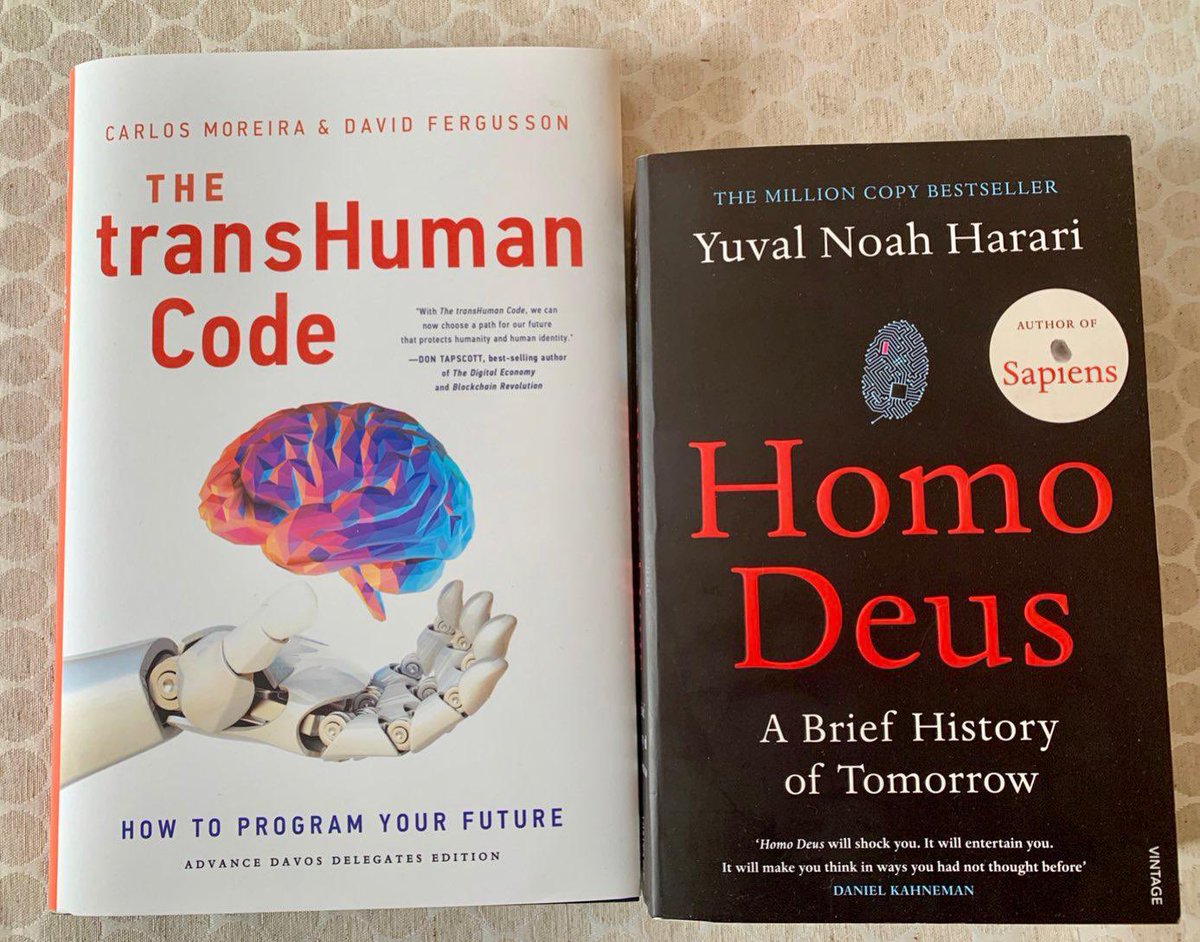
#transhumancode book corrects the #homodeus notion that Homo sapiens is a post-truth species, whose power depends on creating and believing fictions. We can read on #homodeus that ever since the stone age, self-reinforcing myths have served to unite human collectives.
Carlos Creus Moreira tweet media
Weiningen (ZH), Schweiz 🇨🇭 English
1
2
5
365