Post

Python Programming
Python Programming@PythonPr·
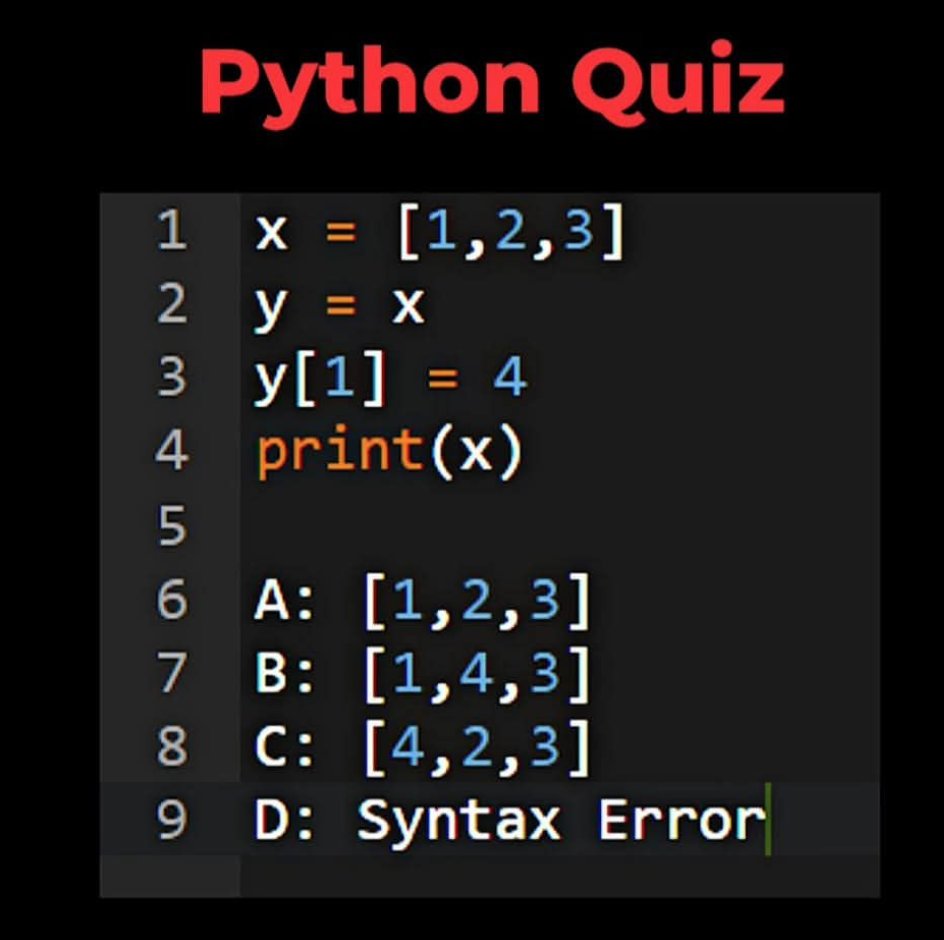
Python Question / Quiz; What is the output of the following Python code, and why? Comment your answers below!
Python Programming tweet media
English
24
7
80
9.6K
Earnest Codes
Earnest Codes@Earnesto037·
@PythonPr Answer: B: [1,4,3] x = [1,2,3]: A list object is created in memory, and the variable x is assigned as a reference to this list. y = x: This does not create a copy of the list. Instead, it makes the variable y point to the same list object in memory that x points to.
English
1
0
4
408
Ademola Ogunrinde | Civil Eng & AI/Tech
@PythonPr • x = [1, 2, 3] → x is a list. • y = x → y is a reference to the same list object as x. • y[1] = 4 → This modifies the second element of the list (index 1) to 4. • Since x and y point to the same list, the change is reflected in both. Correct Answer B: [1, 4, 3]
English
0
0
2
329
Jimmy Fikes
Jimmy Fikes@akajim·
@PythonPr B. [1,4,3] since x and y are pointing to the same object. A change in the original list by either x or y will be reflected in the output of either.
English
0
0
1
64
Human cycle
Human cycle@savallsicart·
@PythonPr Is B y [1] changes the second element of the list to 4... the output will be: [1, 4, 3]
English
0
0
0
534
ꋬꆰꋪꋬꂵ
ꋬꆰꋪꋬꂵ@LAqram87521·
@PythonPr D syntax error. The instruction print (x) must be indented.
English
0
0
0
12
4KWallVibes
4KWallVibes@4KWallVibes·
@PythonPr Option B Because the expression y[1] =4 is updating the element at index 1 which is 2 to 4
English
0
0
0
47
Fochaz
Fochaz@fmabonga·
@PythonPr B. [1, 4, 3]. Lists are mutable hence x an y point to the same object.
English
0
0
0
169
cecejiaw.
cecejiaw.@rasamatchaenak·
@PythonPr B, because y points to the same list as x, so modifying y[1] also changes x, resulting in [1, 4, 3].
English
0
0
2
537
แชร์