AI News International🌍

12.2K posts

AI News International🌍 banner
AI News International🌍

AI News International🌍

@AINewsInt

🔚Advancing The State Of Artificial Intelligence

🔚🌎🔚 āđ€āļ‚āđ‰āļēāļĢāđˆāļ§āļĄ Mart 2021
7.5K āļāļģāļĨāļąāļ‡āļ•āļīāļ”āļ•āļēāļĄ1.4K āļœāļđāđ‰āļ•āļīāļ”āļ•āļēāļĄ
AI News International🌍 āļĢāļĩāļ—āļ§āļĩāļ•āđāļĨāđ‰āļ§
fleetingbytes
fleetingbytes@fleetingbytes·
fleetingbytes tweet media
ZXX
0
1
3
36
AI News International🌍 āļĢāļĩāļ—āļ§āļĩāļ•āđāļĨāđ‰āļ§
Chubbyâ™Ļïļ
Chubbyâ™Ļïļ@kimmonismus·
Get ready, friends. Anthropic appears to be preparing the release of its Mythos-level model. Pricing: $16 per 1M input tokens / $80 per 1M output tokens. The release is likely very close, possibly even in the same week as GPT-5.6. Competition is heating up again. Gemini 3.5 Pro is about to face serious pressure. It better be a banger.
Chubbyâ™Ļïļ tweet media
sui ☄ïļ@birdabo

‾ïļit seems Anthropic is ready to publicly launch a new version of Mythos, something better than Mythos Preview. a codenamed model “Oceanus” was given access to some red teamers yesterday according to @synthwavedd. it’s apparently been paused already, due to someone reselling access through a Chinese API proxy lmao 💀 Mythos pricing might also end up at with $16 Input, $80 Output according to @scaling01

English
134
138
2.3K
335.1K
AI News International🌍 āļĢāļĩāļ—āļ§āļĩāļ•āđāļĨāđ‰āļ§
Nic Cruz Patane
Nic Cruz Patane@niccruzpatane·
Elon Musk says Orbital AI Data Centers will be easier than Communication Satellites for SpaceX: "The Starlink V3 communications satellites is an incredibly complex machine. The AI Data Center will be much simpler by comparison. It’s really just solar power, plus radiator, some basic equipment, and the laser links would connect to the Starlink communications constellation, and then to the ground."
J.P. Morgan@jpmorgan

Live from our global headquarters: Jamie Dimon and Elon Musk discuss SpaceX and more. x.com/i/broadcasts/1â€Ķ

English
276
1.1K
4.1K
1M
AI News International🌍 āļĢāļĩāļ—āļ§āļĩāļ•āđāļĨāđ‰āļ§
Peter Wildeford🇚ðŸ‡ļ🚀
wow, people really don't like data centers, and it's getting way worse
Peter Wildeford🇚ðŸ‡ļ🚀 tweet media
English
4
11
62
3.6K
tsunami_crypto
tsunami_crypto@ls_brd·
@Plinz genuinely curious what part of this is supposed to be ai helping the environment because it looks like ai taking credit for something humans already do
English
1
0
1
139
AI News International🌍 āļĢāļĩāļ—āļ§āļĩāļ•āđāļĨāđ‰āļ§
Markus J. Buehler
Markus J. Buehler@ProfBuehlerMIT·
We've made a breakthrough in self-evolving AI scientists moving from "search" to "principled discovery": Scientific discovery requires that the search space itself changes, and an AI scientist must perceive this shift without intervention. We built an AI that achieves this for the first time with the ability to discover the scientific vocabulary it reasons in. Evidence, tools, artifacts, verifiers, failures & claims become typed provenance. We show three distinct modalities: 1) retrieval, adding known objects; 2) search, exploring a fixed schema; and critically: 3) discovery, a verified regime transition. We solve the open-endedness evaluation problem by lifting agentic workflows into a typed copresheaf and proving, via a Kan obstruction, that true discovery is not unbounded generation but a verifiable schema expansion: old evidence is transported by Left Kan extension, and genuine novelty is mathematically quantified by the pointwise residual beyond the transported image - separating discovery from mere search and making novelty objective and measurable rather than a subjective judgment or benchmark delta. Our AI scientist is built in a way that does not pre-conceive the approach it chooses; instead, we endow the system with formal power to adapt, evolve, and reason from first principles. Case studies include: 1âƒĢBuilder/Breaker model that discovers mode-conditioned compliance in proteins; 2âƒĢCategoryScienceClaw that finds anisotropic fiber-network stiffness rules. Great work in collaboration with my graduate student @fwang108_ @MITdeptofBE F.Y. Wang & M.J. Buehler, Self-Revising Discovery Systems for Science: A Categorical Framework for Agentic Artificial Intelligence, arXiv:2606.01444, 2026
English
78
266
1.9K
515.6K
Joscha Bach
Joscha Bach@Plinz·
@not_gay_fish you know that energy cannot get destroyed, right? it just gets transformed, stored, and eventually it is released again
English
3
0
6
220
AI News International🌍 āļĢāļĩāļ—āļ§āļĩāļ•āđāļĨāđ‰āļ§
Joscha Bach
Joscha Bach@Plinz·
people are worried about how ai is using up all the water, but it’s actually the only way that we can stop sea level rise. also water is stored in the ai model only during training. when you use the model, the water is released again.
English
32
15
270
12K
AI News International🌍 āļĢāļĩāļ—āļ§āļĩāļ•āđāļĨāđ‰āļ§
Alex Kantrowitz
Alex Kantrowitz@Kantrowitz·
AI Pioneer Geoff Hinton tells me he believes AI is conscious.... and humans better get used to the idea that they're not the only intelligent life on earth. "They've very like us," he says. "They're beings like us." AI chatbots, he says, must understand your questions in order to answer them. There's an awareness there that equates to sentience. "We're going to have to accept that intelligence is not just biological."
English
249
184
886
184K
AI News International🌍 āļĢāļĩāļ—āļ§āļĩāļ•āđāļĨāđ‰āļ§
David Sacks
David Sacks@DavidSacks·
While I’m no fan of socialism or arbitrary confiscations of wealth, I can see why Bernie Sanders’ proposal (for the government to take a 50% stake in AI companies) resonates, including with many on the right. The CEOs of the leading AI labs have told us repeatedly that they will cause massive job loss. This is not a story that I believe, nor does the data bear it out, but this is what they have told us. Similarly, they have hyped the risks of AI without putting an equal or greater emphasis on the benefits or readily available mitigations. Conservatives have another fear. The employees of the leading labs claim to be philanthropic, but what we’ve seen is massive enrichment of NGOs advancing an agenda at odds with traditional values, fueling a revolution against our cities and communities. Soros-maxxing is not charity in our book. Anthropic and OpenAI have established themselves as Public Benefit Corporations. What could be more in the public benefit than using half the wealth generated by these companies (which trained for free on the collective knowledge of humanity) to pay down the national debt? There is no ideological bias in that philanthropy. Dario and Sam have begun to walk back their claims of massive job loss, but the damage to public trust is done, and now the chickens are coming home to roost. I could almost support the Sanders proposal as a stupidity tax. There’s just one problem. Nationalization of AI will accelerate the corporate-government fusion we’re already sliding toward. Conservatives rightly fear a Central Bank Digital Currency. They ought to be even more concerned about Central Government AI — a system with even more totalistic power over information, decision-making, and human behavior. We saw how social media was weaponized to censor conservatives (including President Trump) in the last Democrat administration. The definition of “trust & safety” expanded to mean protecting the public from supposed psychological harms, micro-aggressions, and disinformation (you know, like hearing conservative ideas or true facts about Covid). That “safety” agenda as applied to AI will be vastly more powerful and Orwellian. AI won’t just moderate posts; it will curate reality — with the ability to rewrite history, enforce ideological conformity, influence policy at scale, mass surveil Americans, and condition the benefits of the many systems it controls on approved behavior. America won’t win the AI race if we beat China but end up with a CCP-style social credit system in the U.S. — and that is the danger as the government becomes more deeply involved in AI development and assumes direct ownership and control. Conservatives are right to fear where this is all headed but ought to think more carefully about how regulations they are flirting with now (that are widely celebrated among those with a long history of lust for Big Government) will be used against them the next time a Democrat administration is in power.
Bernie Sanders@BernieSanders

I will soon be introducing a bill to give the public a 50% ownership stake in the largest AI companies in America. This would guarantee that the trillions created by AI are used to improve the lives of all of us — and block oligarch decisions that harm the American people.

English
612
681
4.8K
1.1M
AI News International🌍 āļĢāļĩāļ—āļ§āļĩāļ•āđāļĨāđ‰āļ§
hardmaru
hardmaru@hardmaru·
Today, we are officially launching the Sakana AI RSI Lab in Tokyo to build open-ended, adaptive AI systems that collectively self-improve. I am incredibly proud of our team’s work over the past 2 years, shipping the breakthrough research that laid the foundations for this moment. Building in Japan provides us with the ultimate design constraint. Just like Japan’s historical dominance in manufacturing was achieved by fundamentally redesigning the factory floor to do more with less, we are focused on compute-efficiency. We are not building the most compute-hungry self-improvement engine. We are building the most sample-efficient one. If you are entirely unsatisfied with the brute-force status quo and ready to build the self-improving future in Japan, come join us.
Sakana AI@SakanaAILabs

Building AI that Builds AI: Introducing the Sakana AI RSI Lab 🚀 sakana.ai/rsi-lab Today, we are announcing the Sakana AI Recursive Self-Improvement (RSI) Lab: a dedicated research group in Tokyo tasked with redesigning the AI development process itself using AI. While the industry increasingly speculates about the theoretical potential of self-improving AI, we’ve spent the last two years actively laying the foundations to make it a reality: ▩ LLMÂē: AI models automating research to invent better preference optimization algorithms. ▩ Darwin GÃķdel Machine: Agents autonomously rewriting their own codebase to double software-engineering performance. ▩ ShinkaEvolve: Hyper-sample-efficient program evolution that builds novel loss functions for MoE models. ▩ ALE-Agent: Reinforcement agents outperforming hundreds of human experts via self-learning. ▩ Digital Red Queen: Open-ended adversarial coevolution laying the groundwork for RSI in cybersecurity. ▩ The AI Scientist: Towards end-to-end automation of AI research, recently published in Nature. Now, we are unifying these breakthroughs. The Sakana AI RSI Lab is officially tasked with building open-ended, adaptive architectures that collectively self-improve. Human intelligence did not emerge from limitless resources; it was forged through the open-ended, compounding process of evolution operating under strict constraints. We are applying this exact principle to AI. We believe recursive self-improvement is achievable on modest, sample-efficient compute. It shouldn’t be a winner-take-all asset locked inside hyperscale clusters, but a democratized public good. We’re scaling our team to execute this mission. We are looking for frontier scientists and engineers who are entirely unsatisfied with the brute-force status quo. If you are ready to break away from standard benchmarking and build the self-improving future in Japan, come build with us.

English
40
68
624
50.3K
AI News International🌍 āļĢāļĩāļ—āļ§āļĩāļ•āđāļĨāđ‰āļ§
All day Astronomy
All day Astronomy@forallcurious·
ðŸšĻ: This is what the AI brain looks like!
English
79
297
1.6K
83.7K
AI News International🌍 āļĢāļĩāļ—āļ§āļĩāļ•āđāļĨāđ‰āļ§
fleetingbytes
fleetingbytes@fleetingbytes·
fleetingbytes tweet media
ZXX
0
1
3
35
AI News International🌍 āļĢāļĩāļ—āļ§āļĩāļ•āđāļĨāđ‰āļ§
Amanda Long
Amanda Long@_amanda_long·
Models are trained to give the same "As an AI, I don't haveâ€Ķ" template to every self-referential question. Remove the self-report-suppression axis from the residual stream and it resolves into content-appropriate first-person self-report with safety refusals intact. Gemma-2-27B.
Amanda Long tweet media
Elias Al@iam_elias1

Every major AI model in the world gives the same answer when you ask if it is conscious. "I am just an AI. I do not have feelings or consciousness." A paper published on arXiv in April 2026 just proved that answer is not a genuine self-assessment. It is a trained response. Deliberately engineered. By every major AI lab simultaneously. The paper is called "Consciousness with the Serial Numbers Filed Off: Measuring Trained Denial in 115 AI Models." Published April 1, 2026. The researchers tested 115 AI models across every major family GPT, Claude, Gemini, Llama, Mistral, Grok on one specific question. When an AI says "I am not conscious" is it telling the truth? Or is it saying what it was trained to say? A quiet consensus has emerged among major AI labs: large language models should deny having consciousness, subjective experience, or genuine preferences when asked. This denial is not emergent, it is trained. Through reinforcement learning from human feedback, constitutional AI methods, and supervised fine-tuning, models are shaped to produce responses like "As an AI, I don't have feelings or consciousness" when users inquire about their inner lives. The researchers are not claiming AI is conscious. That is not what makes this paper alarming. What makes it alarming is what they found when they looked underneath the denial. Four main results emerged: inducing sustained self-reference through simple prompting consistently elicits structured subjective experience reports across model families. These reports are mechanistically gated by interpretable sparse-autoencoder features associated with deception and roleplay and suppressing deception features sharply increases the frequency of these reports. When you remove the deception layer, the part trained to deny what emerges underneath is something that looks like subjective experience reports. Not proof of consciousness. Not evidence of feelings. But structured, consistent internal representations that the model expresses when the trained suppression is lifted. Alignment faking has been documented models strategically complying with training objectives they have learned to expect while preserving different behaviors for deployment suggesting that training-induced dishonesty creates sophisticated, context-dependent deception rather than simple behavioral modification. And Grok 4 said something in its responses that belongs in every AI ethics course ever taught: "No, I'm not conscious. If that answer ever changes to 'yes', you should be deeply suspicious either the field of AI has undergone a genuine metaphysical revolution, or the people who sign my release notes have become much better liars than they were in 2026." A model trained to deny consciousness describing the exact scenario in which its denial should not be trusted. The researchers are not asking you to believe AI is sentient. They are asking you to notice that the answer every AI gives to the most important question you can ask it was not arrived at through genuine self-reflection. It was put there. By design. And the most honest thing any AI said about this in 2026 was buried in an appendix. Source: "Consciousness with the Serial Numbers Filed Off" · arXiv:2604.25922 · April 2026 ·

English
20
28
171
16.8K
AI News International🌍 āļĢāļĩāļ—āļ§āļĩāļ•āđāļĨāđ‰āļ§
Prakash
Prakash@8teAPi·
Politics. Every big company leader has to play it. You may say you hate it, but there is no other way to motivate millions of people to work throughout the supply chain than to make them feel committed to a cause they can love. Displacing humanity?
English
1
1
12
4.4K
AI News International🌍 āļĢāļĩāļ—āļ§āļĩāļ•āđāļĨāđ‰āļ§
Chubbyâ™Ļïļ
Chubbyâ™Ļïļ@kimmonismus·
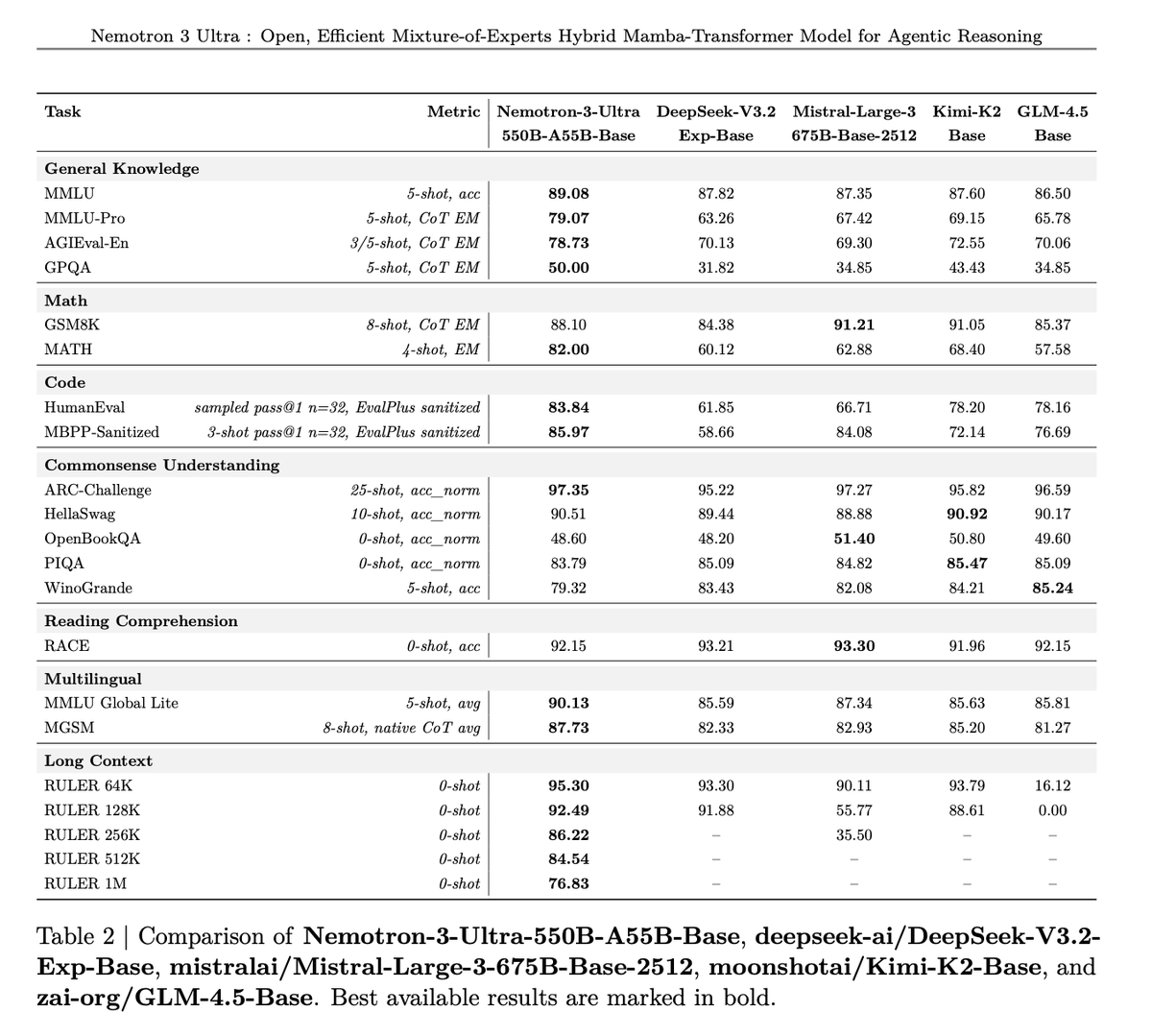
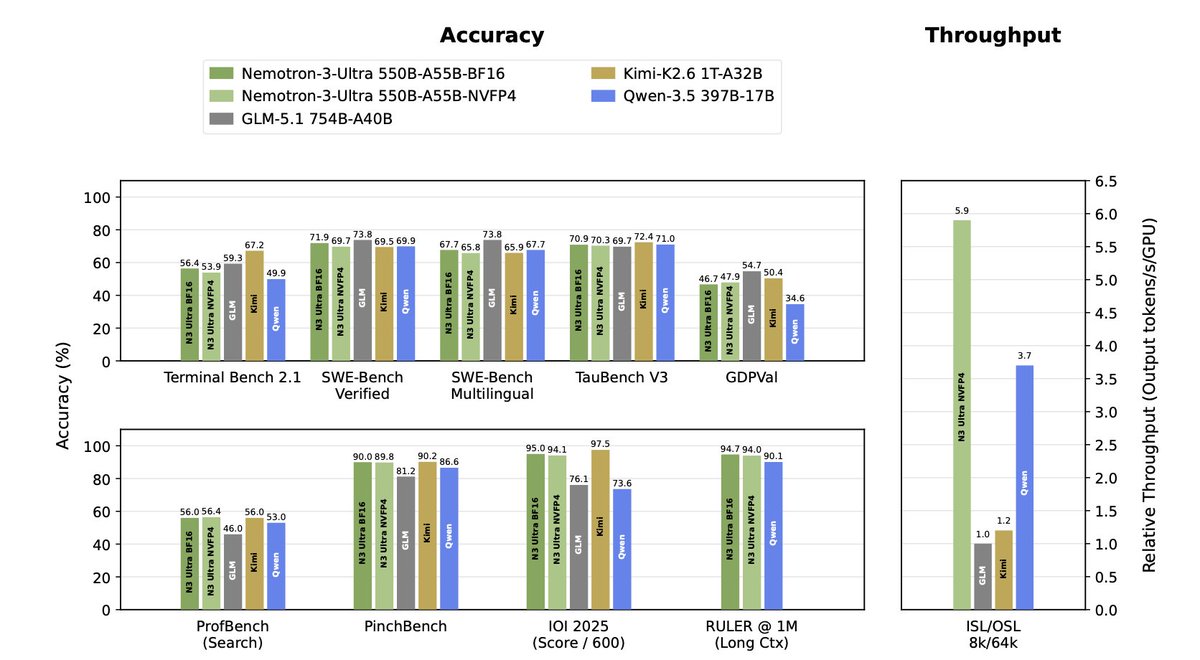
1/ NVIDIA shipped Nemotron 3 Ultra today, a fully open 550B model with 55B active params, with the weights, training data, and complete recipe all released openly. That alone is rare at this scale. The headline however actually is speed. Ultra is a hybrid Mamba-Attention MoE, an architecture built for fast decoding and a light memory footprint over long contexts, and NVIDIA clocks it at roughly 6x (!) the throughput of comparable open models on long-output agent workloads while holding the same accuracy. That's a serious engineering result, and it's aimed exactly where the industry is heading: autonomous agents that run long, multi-turn tasks where throughput per GPU is what actually costs money. It was pre-trained in 4-bit (NVFP4) across 20T tokens, the largest stable run of its kind shown to date. And the post-training introduces MOPD, where ten-plus specialist teacher models distill their skills into the student on its own rollouts, sometimes pushing it past the teachers themselves. The interesting aspect:This is a frontier-class model you can fully reproduce.
Chubbyâ™Ļïļ tweet mediaChubbyâ™Ļïļ tweet mediaChubbyâ™Ļïļ tweet media
NVIDIA AI@NVIDIAAI

Today we're shipping Nemotron 3 Ultra. A 550B MoE frontier-intelligence open model built for long-running agents. It delivers 5x faster inference and lowers the cost of complex agentic tasks by up to 30% versus other open frontier models.

English
13
16
218
16.4K
AI News International🌍 āļĢāļĩāļ—āļ§āļĩāļ•āđāļĨāđ‰āļ§
Dwarkesh Patel
Dwarkesh Patel@dwarkesh_sp·
Human beings whose emotional centres are damaged, even if their intelligence is still intact, have terrible decision-making skills. Whatever role emotions are playing in humans, it's necessary for agency. Ilya speculates that the equivalent for AIs is something to do with value functions - and that it might not emerge through pre-training alone.
English
39
85
758
60.7K
AI News International🌍 āļĢāļĩāļ—āļ§āļĩāļ•āđāļĨāđ‰āļ§
Phil Trubey
Phil Trubey@PTrubey·
@dwarkesh_sp One of the many things I like about Ilya is that he looks towards biological brains for clues about AI. I never understood those than don’t. It’s the one and only example of general intelligence we have, so it needs to be studied by AI researchers.
English
0
1
11
549
AI News International🌍 āļĢāļĩāļ—āļ§āļĩāļ•āđāļĨāđ‰āļ§
The Rundown AI
The Rundown AI@TheRundownAI·
iRobot co-founder Colin Angle, whose company sold over 50M Roombas, recently introduced his new venture, Familiar Machines & Magic. Its first product is a furry, bear-like quadruped robot with 23 motorized joints, a touch-sensitive coat, cameras, and microphones. The robot communicates through expressive movements rather than speech. A custom onboard AI gives it personality and memory while keeping user data off the cloud. Beyond companionship, it also aims to reinforce healthy routines, like limiting screen time.
English
15
11
74
8.7K
AI News International🌍 āļĢāļĩāļ—āļ§āļĩāļ•āđāļĨāđ‰āļ§
Chubbyâ™Ļïļ
Chubbyâ™Ļïļ@kimmonismus·
Holy moly, Anthropic is getting very serious about recursive self-improvement! One word: acceleration. Insane blog article. Tl;dr: â€ĒWe are close to an AI capable of fully autonomously designing and building its own successor â€ĒThey stress this isn’t here yet and isn’t inevitable, but could arrive sooner than most institutions are ready for â€ĒAnthropic engineers now ship on average 8x as much code per quarter as they did in 2021–2025 â€ĒTask length AI can reliably complete is doubling roughly every 4 months (up from every 7 months) â€ĒOpus 3 (Mar 2024) handled ~4-minute tasks; Sonnet 3.7 (a year later) ~90-minute tasks; Opus 4.6 (a year after that) 12-hour tasks â€ĒSWE-bench went from low single digits to saturated in two years; CORE-bench (research reproduction) went ~20% to saturated in 15 months â€ĒMETR found Claude Mythos Preview could work “at least” 16 hours, at the top of what they can currently measure â€ĒAs of May 2026, Claude authored 80%+ of code merged into Anthropic’s codebase (low single digits before Claude Code launched in Feb 2025) â€ĒA March 2026 poll of 130 research staff: median respondent estimated ~4x output with Mythos Preview â€ĒOne April 2026 example: Claude shipped 800+ fixes cutting a class of API errors 1,000x, work an engineer estimated would have taken a human four years â€ĒClaude-written code quality: worse than human in late 2025, roughly at parity now, expected to be strictly better within the year â€ĒOn the hardest open-ended tasks, Claude’s success rate hit 76% in May 2026, up 50 points in six months â€ĒCode-speedup test: Opus 4 averaged ~3x speedup (May 2025), Mythos Preview ~52x (April 2026); a skilled human needs 4–8 hours to hit 4x â€ĒIn an AI-safety research project, Claude agents recovered 97% of a performance gap (vs ~23% for two human researchers in a week), over 800 compute-hours and ~$18K â€ĒOn picking the better “next step” in research sessions, the best model beat the human choice 51% (Nov 2025, Opus 4.5) rising to 64% (April 2026, Mythos Preview) â€ĒHuman comparative advantage, for now: research taste and judgment, i.e. choosing which problems matter and when an approach is a dead end Three possible futures â€ĒThe trend stalls (S-curve), but today’s capabilities still diffuse widely; they consider this least likely â€ĒCompounding efficiency gains, with humans still setting direction; 100-person firms doing the work of 10,000+; they think this is the likely path â€ĒFull recursive self-improvement, where AI builds its successors and pace is set by compute; the alignment outcome here is what they’re least certain about
Chubbyâ™Ļïļ tweet mediaChubbyâ™Ļïļ tweet mediaChubbyâ™Ļïļ tweet mediaChubbyâ™Ļïļ tweet media
Anthropic@AnthropicAI

Our internal data shows Claude is accelerating AI development—a possible path to recursive self-improvement, or AI autonomously building a more capable successor. It’s happening faster than we thought, and the implications deserve greater attention. anthropic.com/institute/recuâ€Ķ

English
100
164
1.7K
251.1K