
AL STOCK TRADES

5.9K posts

AL STOCK TRADES banner
AL STOCK TRADES

AL STOCK TRADES

@ALSTOCKTRADES

Wall Street-Level Analytics. Retail Empowerment Through Data & Education. Not Financial Advice.

Headquarters: Tucson, Arizona เข้าร่วม Şubat 2022
1 กำลังติดตาม7.4K ผู้ติดตาม
ทวีตที่ปักหมุด
AL STOCK TRADES
AL STOCK TRADES@ALSTOCKTRADES·
I RAISE MY PRICE TARGET FOR CLOVER HEALTH $CLOV TO $7.25
English
9
6
93
108.4K
AL STOCK TRADES รีทวีตแล้ว
Albert Alan, MD
Albert Alan, MD@AlbertAlan·
$CLOV While everyone is watching software stocks get obliterated and arguing about whether AI saves or destroys SaaS, almost nobody is paying attention to what Clover Health is quietly building with Counterpart Health, and I think it might be one of the most asymmetric setups in the entire market right now. Counterpart is Clover’s subsidiary that takes their AI clinical decision support platform, the Clover Assistant, and licenses it to other Medicare Advantage insurers and providers who have nothing to do with Clover’s own health plan. The model is hybrid SaaS plus shared savings, meaning Counterpart doesn’t just collect a subscription fee, it gets paid when the AI actually reduces medical costs for its customers. That alignment is almost unheard of in software. Management has said their near term target is for Counterpart to cover as many lives as Clover’s own MA plan does, which would effectively double the company’s technology footprint without Clover having to take on a single dollar of additional insurance risk. This is a platform play hiding inside an insurance company and the market is either ignoring it or doesn’t understand it yet because Counterpart isn’t material revenue today. But that’s exactly the kind of thing you want to find before consensus catches up. What makes this setup structurally different from anything getting crushed in the IGV right now is how the AI economics actually work. In traditional SaaS, every AI feature you bolt on introduces variable compute costs that eat your margins alive. GitHub Copilot was costing Microsoft up to $80 per user while charging $10. That math is destroying software valuations across the board, the sector P/E collapsed from 51x to 27x in twelve months while earnings estimates barely moved. Goldman Sachs saw this coming and launched their HALO framework, Heavy Assets Low Obsolescence, telling clients to own businesses where AI can’t replicate the moat because the moat is physical execution, regulatory entrenchment, and human accountability. Clover and Counterpart sit squarely in that world. Their AI doesn’t add cost per interaction, it removes cost per interaction. When the Clover Assistant prompts a doctor to catch chronic kidney disease a year and a half earlier, that’s a patient who doesn’t end up on dialysis at $90,000 a year. When it gets doctors to start diabetes medications three years sooner, that’s fewer emergency hospitalizations, fewer amputations, fewer catastrophic claims. The AI is a margin expander, not a margin compressor. And the regulatory moat underneath it all is fortress-grade. You cannot spin up a competing Medicare Advantage plan the way you can fork a SaaS product overnight. CMS approvals, state licensing, star ratings, provider network contracts, years of clinical data flowing through the platform, 95% plus member retention, that is the definition of heavy assets and low obsolescence in a sector where 10,000 Americans age into Medicare every single day regardless of what the market does. Everyone is asking which software companies survive AI. The better question is which companies are using AI to dominate industries that require atoms, not just bits. Counterpart Health might be the answer nobody is talking about.
Albert Alan, MD@AlbertAlan

Chamath’s framing is clean but it’s missing a third door that nobody wants to talk about. The real story IGV is telling you isn’t just about whether AI replaces software or doesn’t. It’s about the death of the asset-light business model itself. For a decade the market rewarded companies that scaled on code and subscriptions with almost zero marginal cost per user. That entire thesis just got inverted. Every SaaS company bolting AI into their product is now eating 20 to 40 cents of variable compute cost on every dollar of revenue where they used to eat almost nothing. GitHub Copilot was literally losing Microsoft $20 to $80 per user per month at a $10 price point. That’s not a software margin profile, that’s a hardware margin profile wearing a software costume. So what you’re actually watching in that IGV chart isn’t just an AI disruption repricing, it’s the entire sector morphing from asset-light into something that looks a lot more like an industrial business, right at the exact moment the market is realizing it. Goldman figured this out in February and quietly launched their HALO framework, Heavy Assets Low Obsolescence, essentially telling clients that the companies who own atoms, not just bits, are the new defensible compounders. Their pair trade basket has outperformed the S&P software index by nearly 80 percentage points over the past year. But here’s what even Goldman isn’t saying out loud yet. If AI compresses the margin structure of subscription software permanently, and it forces every vendor into usage-based or outcome-based pricing just to survive, then the terminal value assumptions baked into every DCF on every name in that ETF are fundamentally broken. You’re not just looking at multiple compression. You’re looking at the end of the SaaS valuation framework as a category. The P/E on the software sector went from 51x a year ago to 27x today while earnings estimates barely moved. That tells you the market isn’t discounting a bad quarter, it’s discounting a permanent structural change in how these businesses make money. Meanwhile the companies that actually own scarce physical infrastructure, think data centers, power generation, copper, cooling systems, the cloud hyperscalers themselves on the capex side, those are the ones whose replacement cost goes up as AI scales, not down. The scarcity used to be code. Now it’s electricity and silicon. Everyone’s arguing about which software names survive the AI wave. The bigger question is whether “software company” even remains a distinct asset class when every one of them is forced to become a compute-intensive industrial operation just to keep the lights on.

English
0
1
2
51
AL STOCK TRADES รีทวีตแล้ว
Albert Alan, MD
Albert Alan, MD@AlbertAlan·
Chamath’s framing is clean but it’s missing a third door that nobody wants to talk about. The real story IGV is telling you isn’t just about whether AI replaces software or doesn’t. It’s about the death of the asset-light business model itself. For a decade the market rewarded companies that scaled on code and subscriptions with almost zero marginal cost per user. That entire thesis just got inverted. Every SaaS company bolting AI into their product is now eating 20 to 40 cents of variable compute cost on every dollar of revenue where they used to eat almost nothing. GitHub Copilot was literally losing Microsoft $20 to $80 per user per month at a $10 price point. That’s not a software margin profile, that’s a hardware margin profile wearing a software costume. So what you’re actually watching in that IGV chart isn’t just an AI disruption repricing, it’s the entire sector morphing from asset-light into something that looks a lot more like an industrial business, right at the exact moment the market is realizing it. Goldman figured this out in February and quietly launched their HALO framework, Heavy Assets Low Obsolescence, essentially telling clients that the companies who own atoms, not just bits, are the new defensible compounders. Their pair trade basket has outperformed the S&P software index by nearly 80 percentage points over the past year. But here’s what even Goldman isn’t saying out loud yet. If AI compresses the margin structure of subscription software permanently, and it forces every vendor into usage-based or outcome-based pricing just to survive, then the terminal value assumptions baked into every DCF on every name in that ETF are fundamentally broken. You’re not just looking at multiple compression. You’re looking at the end of the SaaS valuation framework as a category. The P/E on the software sector went from 51x a year ago to 27x today while earnings estimates barely moved. That tells you the market isn’t discounting a bad quarter, it’s discounting a permanent structural change in how these businesses make money. Meanwhile the companies that actually own scarce physical infrastructure, think data centers, power generation, copper, cooling systems, the cloud hyperscalers themselves on the capex side, those are the ones whose replacement cost goes up as AI scales, not down. The scarcity used to be code. Now it’s electricity and silicon. Everyone’s arguing about which software names survive the AI wave. The bigger question is whether “software company” even remains a distinct asset class when every one of them is forced to become a compute-intensive industrial operation just to keep the lights on.
Chamath Palihapitiya@chamath

You have two choices: 1. This is the beginning of the end of the AI replacement cycle. Everything up until now was false alarms and mis/disinformation. You can start to scale back into these companies because, once the noise subsides, these companies are durable and will be around roughly in the same or better position in 10 years. 2. This is the beginning of the beginning of the AI replacement cycle. Customer churn slowly ticks up. NDR slowly ticks down, RPO begins to be discounted - initially by a little, then by a lot. SBC gets minimized, FCF gets maximized. Valuations become exercised in seeing which assumptions are reliable and which are unreliable - all roads lead to more vol an a general downward trend on price and multiples. Good luck to all the players.

English
0
1
2
142
AL STOCK TRADES รีทวีตแล้ว
Albert Alan, MD
Albert Alan, MD@AlbertAlan·
$CLOV Another CMS Health Tech Ecosystem demonstration just dropped, and once again Clover Health and Counterpart Health are at the center of it. This time, Samsung Health, BeWell, and AthenaHealth showcased patient directed data sharing, and when it came time to pull claims data into the demo, where did they connect? Clover Health, through Counterpart Health's infrastructure via Commonwealth Health Alliance. That's now two separate CMS Health Tech Ecosystem demonstrations featuring two completely different technology stacks, both relying on Clover Health and Counterpart Health as a core data source. In the first demo, HealthEx connected to Clover Health through MedAllies and the TEFCA network powered by Kno2, feeding patient records into Anthropic's Claude for AI powered health insights. In this second demo, Samsung Health connected to Clover Health through BeWell and Commonwealth Health Alliance, pulling claims data alongside FHIR connections with Meditech and AthenaHealth. Here's what the demo showed. A user opens Samsung Health, verifies their identity through Clear, and connects to the CMS aligned network through BeWell. Records from Clover Health, Meditech, and AthenaHealth appear organized in moments. The user can review post visit summaries, interact with their data through an AI assistant, and see Samsung Watch wearable metrics displayed alongside clinical records. When they're ready, they select which records to share, generate a secure QR code, and their provider scans it at the point of care using AthenaOne and AthenaCapture. Clinical records and wearable data import directly into the provider's workflow. No faxes. No redundant intake. No delays. The user also has a full transparency log showing exactly where and when their data has been shared. What stands out to me is the positioning of Counterpart Health across this ecosystem. They are not building a single integration with a single partner. They are becoming foundational infrastructure that multiple platforms connect to. Kno2 connects to them. BeWell connects to them through Commonwealth Health Alliance. HealthEx connects to them through MedAllies. Every pathway leads back to Counterpart Health's interoperable gateway. Where I believe this is heading: Counterpart Health was originally built as Clover Assistant, a clinical decision support tool for physicians managing Medicare Advantage patients. It has since evolved into a standalone platform powering bidirectional data exchange at scale. What we are watching now is Counterpart Health transitioning from a physician enablement tool into a nationally recognized health data infrastructure layer. Consider the trajectory. Clover Health is the first payer live on a CMS Aligned Network. Counterpart Health's infrastructure already connects hundreds of data sources. Their platform is built on FHIR standards with USCDI v3 compliance, which is exactly what CMS is mandating across the industry. And they have publicly stated that their capabilities can be extended to other health plans seeking to participate in interoperability networks. That last point is critical. Counterpart Health is not just serving Clover Health's 153,000 Medicare Advantage members. They are positioning themselves as the infrastructure that any payer can plug into to meet federal interoperability requirements. As CMS continues to push TEFCA adoption and aligned network participation, every health plan in the country will need what Counterpart Health has already built and demonstrated in production. Now layer in the AI dimension. Anthropic's Claude, Samsung Health's AI assistant, and whatever comes next all need clean, structured, interoperable health data to function. Counterpart Health is producing exactly that. They are not competing with the AI layer. They are feeding it. If Clover Health is the first payer live on these networks today, and Counterpart Health is the infrastructure making it possible, the question is not whether other payers will follow. The question is how many of them will build their own infrastructure versus licensing it from Counterpart Health. I want to recognize Kevin Holub, Chief Product Officer at Counterpart Health, Therasa Bell, President and Founder of Kno2, and the teams at Samsung Health, BeWell, Commonwealth Health Alliance, AthenaHealth, Meditech, and Anthropic for their contributions to bringing this ecosystem to life. This is interoperability in production. And Clover Health and Counterpart Health are showing up in every demo.
English
4
4
34
1.3K
AL STOCK TRADES รีทวีตแล้ว
Albert Alan, MD
Albert Alan, MD@AlbertAlan·
$CLOV
healthex@HealthEx_io

HealthEx was proud to showcase several demos at the CMS Healthtech ecosystem gathering yesterday in DC. HealthEx supported demos for @AlteraHealth, @CloverHealth, @MEDITECH, @UnitedHealthGrp, and our own demo with @HeyEpic, @NetsmartTech, @CloverHealth, @MedAllies, @Kno2, @Clear, and @claudeai. HealthEx is also proud to be one of teams meeting MVP requirements for the KillTheClipboard category, and to be one of the first apps featured in the Medicare App Library. The important work we are doing to enable patients to access and share their health records, at the moments that matter, wouldn't be possible without the collaborators here that span the breadth of healthcare. Thank you also to @CMSGov for convening collaborators across the public and private sector, all working together to empower patients in their health journeys!

QCT
0
2
26
1.4K
AL STOCK TRADES รีทวีตแล้ว
Albert Alan, MD
Albert Alan, MD@AlbertAlan·
$CLOV The people calling this pointless are standing at the exact part of the curve where every exponential story begins.
Albert Alan, MD tweet media
English
0
3
38
1.3K
AL STOCK TRADES รีทวีตแล้ว
Albert Alan, MD
Albert Alan, MD@AlbertAlan·
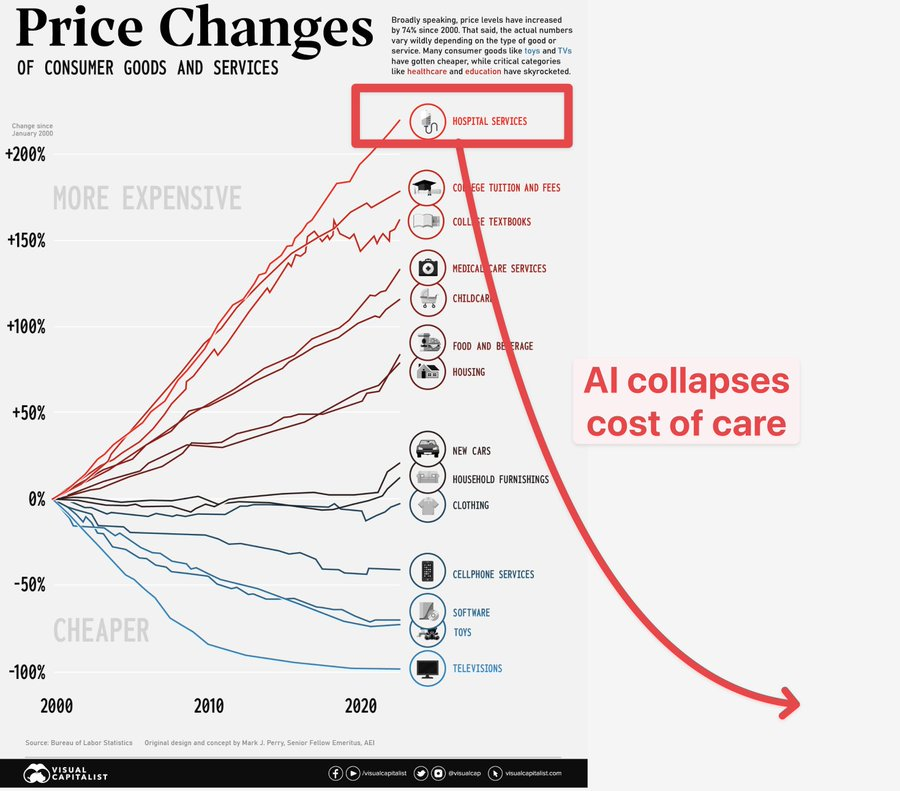
$CLOV The Trillion Dollar Question People always ask me what comes next. I told you the story of Andrew Toy. I told you about BlackBerry. I told you about how the people kill the incumbent, not the competitor. Today I'm going to show you the math. And when you see it, you're going to understand why this is not a million dollar question, not a billion dollar question, but potentially a trillion dollar question. Let me set the table. The Chart That Should Terrify Every American There is a chart that has been circulating for years showing the price changes of consumer goods and services since the year 2000. On the bottom of that chart, you see the things that technology touched. Televisions dropped over 100%. Software collapsed in price. Cell phone services fell by more than 50%. These are the industries where innovation was allowed to do its job, where competition drove prices down and quality up. The consumer won. Now look at the top of the chart. Hospital services have increased by over 200% since the year 2000. Medical care services are up over 100%. These are the industries where the system was designed not to get better but to get more expensive. The question every American should be asking is simple. Why did technology make everything else in my life cheaper except the one thing that can bankrupt me? The Numbers Are Staggering The United States spent $5.3 trillion on healthcare in 2024. That is not a typo. $5.3 trillion. That works out to roughly $15,474 per person in America, and it now accounts for 18% of the entire gross domestic product of the country. To put that in perspective, the United States spends more on healthcare than the entire GDP of every country on the planet except China. CMS projects that healthcare spending will reach $5.6 trillion in 2025 and is on pace to hit $8.6 trillion by 2033. The health share of the economy is expected to climb to over 20% of GDP within the next decade. Federal spending on healthcare programs alone hit $1.8 trillion in 2025. Medicare cost the federal government $988 billion. Medicaid and CHIP cost another $691 billion. And CBO projects that Medicare spending will nearly double to $2 trillion by 2036. These are numbers so large that they almost lose their meaning, so let me bring it down to earth. The gross national debt broke through $39 trillion in March of 2026. The federal government is currently running a projected deficit of $1.9 trillion for fiscal year 2026 alone. Interest payments on the national debt reached $270.3 billion in just the first three months of fiscal year 2026, which now exceeds what we spend on national defense. The Bipartisan Policy Center and the Congressional Budget Office have both stated plainly that under current law, the debt trajectory will rise from 100% of GDP today to 156% of GDP by 2055. And the largest driver of that trajectory is healthcare spending. This is the debt spiral. And healthcare is the engine powering it. ## The M2 Money Supply and Why Costs Will Not Fix Themselves Here is where the economic conversation needs to happen because most people do not connect these dots. The M2 money supply, which includes cash, checking deposits, savings accounts, and other liquid assets, hit a record $22.4 trillion as of January 2026. That represents a 4.5 to 4.8% year over year increase, and it is climbing after a brief period of contraction following the pandemic era explosion. Between 2020 and 2022, the Federal Reserve injected an unprecedented amount of liquidity into the economy. M2 went from roughly $15 trillion to over $21 trillion in less than two years. Here is what this means for healthcare. When you expand the money supply, you do not magically create more doctors, more hospital beds, or more MRI machines. You create more dollars chasing the same constrained supply of medical resources. This is textbook monetary inflation applied to a sector that already has structural pricing problems. Healthcare costs were rising before the money printing. The liquidity injection poured gasoline on a fire that was already burning. And the government is addicted to this cycle. Spend more, print more, borrow more, repeat. They cannot stop because the political incentives are designed to keep the spending going. The M2 money supply tells you that the era of easy money is not over. It paused. Now it is expanding again. And every dollar that gets created dilutes the purchasing power of the dollars you already have, which means the $5.3 trillion we spent on healthcare last year will be $5.6 trillion this year, and $6 trillion the year after that, and $8.6 trillion by 2033. The trajectory does not bend on its own. It requires something external to break the cycle. The Insurance Model Is Broken and the People Know It Let me ask you something. If you are paying $560 to $610 a month in premiums for an individual ACA plan before subsidies, and your deductible is $7,476 on a Bronze plan or $5,304 on a Silver plan, at what point are you actually insured? You are paying nearly $7,000 a year in premiums and then you are told that you need to spend another $5,000 to $7,500 out of pocket before your insurance even starts helping you. That means for a healthy individual, you could be spending $12,000 to $14,000 a year before your insurance company pays a single dollar toward your actual medical care. For employer sponsored plans, the average deductible in 2025 was $1,886 for a single employee, with small companies averaging $2,631. And if you are on a high deductible health plan, the average annual premiums are $8,620 for single coverage and $25,379 for a family. The maximum out of pocket for 2026 is $10,600 for an individual and $21,200 for a family. For 2027, those numbers jump to $12,000 and $24,000. CMS has even proposed allowing catastrophic plans to go as high as $15,600 for an individual and $31,200 for a family. At some point, a reasonable person has to ask: what am I paying for? Many Americans are now doing the math and realizing that for routine care, preventive visits, and even some procedures, it can be cheaper to pay out of pocket than to use their insurance. You are paying for the privilege of having a card in your wallet that does not start working until you have already spent thousands of dollars. Medical debt has become one of the leading causes of bankruptcy in the United States. People with insurance are going bankrupt from medical bills. That is not a functioning system. That is a system designed to extract money from consumers at every possible point of contact. And here is the part that should make your blood boil. Traditional insurance companies have zero structural incentive to lower costs. They operate on what is essentially a percentage of total medical spending. When costs go up, they raise premiums. Their revenue goes up. Their administrative cut gets bigger. They profit directly from the inflation of the very system they claim to manage. Why would they ever want costs to come down? The answer is they would not. And they have not. For decades. CMS Is Cracking Down and the Incumbents Are Bleeding But something has changed. The Centers for Medicare and Medicaid Services has started applying serious pressure. And the results are showing up in the stock prices of the largest health insurers in America. UnitedHealth Group, which for over a decade was considered one of the most reliable growth stocks on Wall Street, has lost roughly 54% of its value from its 52 week high of $606 to around $277 as of recent trading. The company's medical care ratio exploded from a stable 82% where it had sat for years to 88.9% in 2025, with some quarters hitting 89.9%. That is a 600 basis point increase eating directly into profits. Their adjusted EPS collapsed 40.9% year over year. Their operating margin fell from 5.2% in 2024 to 2.7% in 2025. Optum Health, their services arm, swung from $7.77 billion in operating income to a $278 million operating loss. The company is now projecting its first annual revenue decline in more than three decades, guiding to just over $439 billion for 2026, a 2% drop from last year and well below analyst expectations. The structural headwinds are real. CMS is eliminating diagnosis based reimbursement upcoding starting in 2027. The V28 coding transition represents a $6 billion headwind in 2026 alone. The proposed 2027 Medicare Advantage rate increase is essentially flat. UnitedHealth has the highest MA exposure in the industry at 30% of national enrollment, and they are planning to shed roughly 1 million members in 2026 to right size their book of business. They are getting smaller to try to survive. Humana is in even more trouble. Their star ratings on their largest contract dropped from 4.5 stars to 3.5 stars, and the percentage of members enrolled in plans with four or more stars plummeted from 94% to just 25%. That translates to a $3.5 billion net revenue headwind. Their 2026 earnings guidance came in at "at least $9.00" per share, which is a 47% decline from 2025 and well below analyst expectations of $12.00. For 2026, Humana has stated that individual Medicare Advantage margins are expected to be slightly below breakeven. The second largest MA insurer in the country is telling you they expect to make essentially nothing on their core product. This is not a temporary blip. This is a structural reset of the entire Medicare Advantage business model. The government is deliberately squeezing margins. CMS is demanding higher quality, better outcomes, and lower costs. They are removing the coding tricks that allowed insurers to inflate their reimbursements. They are raising the bar on star ratings. And the incumbents cannot handle it because their entire model was built on the assumption that costs would keep going up and they would keep getting paid more. AI Collapses the Cost of Care Now go back to that chart. Look at the bottom half. What do all of those industries that got cheaper have in common? Technology entered the equation and fundamentally changed the cost structure. Software made cell phone services cheaper. Automation made electronics cheaper. The internet made information free. Healthcare has been waiting for its technology moment. And the hypothesis on that chart is exactly right. AI collapses the cost of care. But let me be specific about how, because this is where most people get lost. The way AI collapses healthcare costs is not by replacing doctors. It is not some science fiction robot performing surgery. It is by giving doctors better information at the exact moment they are making clinical decisions. It is about catching a chronic condition in year one instead of year five. It is about diagnosing COPD when it is manageable with a $50 monthly prescription instead of when it requires a $200,000 hospitalization. It is about making thousands of better clinical decisions every day, at the point of care, across millions of patients. This is the difference between reactive medicine and proactive medicine. The current system waits until you are sick, then spends enormous amounts of money trying to make you less sick. A proactive system identifies the trajectory of your health early and intervenes when it is cheap, effective, and humane. Who Captures the Alpha So here is the trillion dollar question. If healthcare AI can decrease the cost of care, who collects the alpha? Who wins? Ultimately, the American taxpayer wins. If you can bend the cost curve on a $5.3 trillion annual expenditure, even by a few percentage points, you are talking about hundreds of billions of dollars in savings. For a country in a debt spiral where healthcare spending is the single largest driver of federal deficits, the ability to reduce costs is not just valuable, it is existential. The government literally cannot afford the current trajectory. The numbers do not work. Something has to give. But here is the critical insight. These costs are not going to decrease by magic. The government cannot simply legislate costs lower without destroying access to care. You cannot tell hospitals to charge less without hospitals closing. You cannot tell doctors to accept less without doctors leaving the profession. The money printing will continue. The M2 money supply will keep expanding. The government will keep spending because it is structurally incapable of doing otherwise. What has to happen is that a company needs to build the technology that makes it possible to deliver better care at lower cost. Not cheaper care. Better care that happens to cost less because it is proactive rather than reactive. The company that solves this problem does not just win a contract. That company becomes a critical piece of the national infrastructure. It becomes the technology layer that sits between the government, the providers, and the patients, and it earns a premium for every dollar of cost it removes from the system. On a $5.3 trillion annual spend that is heading toward $8.6 trillion, even capturing a fraction of the value created by bending that curve is a massive, generational business opportunity. Counterpart Health and the Case for Clover Counterpart Health, a subsidiary of Clover Health, is building exactly this. And the data is not theoretical. It is real, published, and compounding. In 2025, Counterpart Health released results showing that returning Clover Health members whose primary care physicians use Counterpart Assistant demonstrated an approximate 1,500 basis point MCR differential compared to those whose doctors do not use the platform. Let me say that again. 1,500 basis points. In an industry where UnitedHealth is in crisis because their MCR moved 600 basis points in the wrong direction, Clover's technology is demonstrating a 1,500 basis point advantage. Counterpart Assistant is not a back office analytics tool. It operates inside the clinical encounter, at the moment the doctor is making decisions with the patient. It provides real time, clinically intuitive insights about the patient's full medical history, chronic conditions, gaps in care, and recommended interventions. In 2025, new capabilities were added including integrated ambient scribing, natural language chat within a PHI safe environment, and proactive visit summaries. This is not a static product. It is evolving into a full clinical operating system for value based care. The outcomes speak for themselves. New members were 75% more likely to be diagnosed with COPD in their first year under a Counterpart Assistant physician. Outpatient pulmonology utilization increased 18%, meaning patients were being treated in lower cost settings instead of emergency rooms. All cause hospitalizations dropped 18% for congestive heart failure and 15% for COPD. Thirty day readmissions fell 25% for CHF and 18% for COPD. In high need, underserved neighborhoods measured by Area Deprivation Index, diagnosis rates were 70 to 89% higher across four major chronic diseases when Counterpart Assistant was in use. Clover Health's PPO Medicare Advantage plan achieved the number one HEDIS score nationwide for the second consecutive year. Not among small plans. Not among technology companies. Nationwide, across every PPO MA plan in the country. And they did this with a wide network of non employed physicians, without capitation, meaning the technology itself is driving the quality, not a closed system of owned doctor groups. From a financial perspective, Clover Health reported $1.924 billion in total revenues for 2025, a 40% increase year over year. Medicare Advantage membership grew 38% to 113,803. The company achieved adjusted EBITDA profitability of $21.7 million. For 2026, Clover is guiding to 154,000 to 158,000 average MA members, total revenues of $2.81 to $2.92 billion, consolidated gross profit of $470 to $510 million, adjusted EBITDA of $50 to $70 million, and is targeting its first ever full year GAAP net income profitability in a range of $0 to $20 million. Membership grew 53% for the 2026 plan year, with over 95% retention during the annual enrollment period and over 97% of members in their flagship PPO product. Counterpart Health is also scaling its third party business. Live third party customer clinicians grew over 450% year over year. The company has stated that it believes Counterpart can help external providers and payers improve their MCR by over 1,000 basis points, with a 700 basis point reduction by the second year and an additional 800 basis points by the third year. For context, if Humana, which has roughly 7 million Medicare Advantage members, could achieve even a fraction of this improvement, it would translate into billions of dollars in annual savings. The Defense of This Argument Let me address the counterarguments directly because I said I would build this case with no holes. "Clover's MCR data is self reported." The HEDIS score is not. HEDIS is an industry standard quality measurement maintained by the National Committee for Quality Assurance. Clover's PPO plan being ranked number one nationally is independently verified. The hospitalization reductions and readmission data are drawn from retrospective analyses of real patient encounters. And the company's overall financial MCR, while different from the differential metric, is reflected in their actual insurance results and CMS filings. "The incumbents could build this technology themselves." UnitedHealth has spent billions on Optum. Optum Health just swung to a $278 million operating loss. Humana's cost management strategy has resulted in a star rating collapse and near breakeven margins on their core product. The incumbents have had decades and tens of billions of dollars to solve this problem. They have not. Because their business model was never designed to lower costs. It was designed to process claims. "Clover is still a small company." Correct. With $1.9 billion in revenue growing at 40% year over year, approaching first time GAAP profitability, and a technology platform that is demonstrating clinical and financial results that the largest companies in the industry cannot match. Every company that eventually became a dominant platform was small once. The question is whether the technology works. The data says it does. "Medicare Advantage is under regulatory pressure." It is. And that pressure is exactly why this technology matters. CMS is demanding lower costs and better outcomes. The companies that cannot deliver are being crushed. The company that can deliver those outcomes through technology is not threatened by this pressure. It is the solution to it. When the government says it wants lower MCRs, better star ratings, and proactive care, they are describing what Counterpart Assistant already does. The Conclusion The United States spends $5.3 trillion a year on healthcare. That number is heading toward $8.6 trillion. The national debt is at $39 trillion. Interest payments alone now exceed defense spending. The M2 money supply is at a record $22.4 trillion and climbing. The system cannot sustain itself. Everyone from CBO to the Bipartisan Policy Center to the Federal Reserve has said so. The government is not going to stop spending. But it is going to start demanding that the money it spends produces better results. CMS is already doing this. The upcoding crackdowns, the flat rate proposals, the star rating pressure. This is the government telling the insurance industry: figure out how to do more with less, or we will take away your bonus payments and compress your margins until you either adapt or die. The incumbents are dying. UnitedHealth has lost half its market value. Humana is guiding to breakeven on its core product. The old model is collapsing in real time. Somewhere in the middle of this trillion dollar problem is a company that has built an AI platform that demonstrably reduces hospitalizations, catches chronic diseases earlier, produces the highest quality scores in the country, and creates a 1,500 basis point MCR advantage for the physicians who use it. That company is now licensing this technology to external providers and payers, growing its third party clinician base by over 450% year over year, and approaching its first full year of GAAP profitability. The chart says AI collapses the cost of care. The data says Counterpart Health is already doing it. Nobody is going to carry two phones forever. Nobody is going to accept going bankrupt for healthcare forever. The only question is who is already building for what comes next. Andrew Toy has done this before.
Albert Alan, MD tweet media
English
11
4
39
1.7K
America_First
America_First@Task_Master_17·
@ALSTOCKTRADES Hey Al can you unblock me? i mistakingly blocked you before and then noticed you blocked me. I follow you and am interested in 'The Terminal". Thanks Bud.
English
1
0
1
7
AL STOCK TRADES
AL STOCK TRADES@ALSTOCKTRADES·
I RAISE MY PRICE TARGET FOR CLOVER HEALTH $CLOV TO $7.25
English
9
6
93
108.4K
AL STOCK TRADES รีทวีตแล้ว
Albert Alan, MD
Albert Alan, MD@AlbertAlan·
$CLOV Warren Buffett said, "The stock market is a device for transferring money from the impatient to the patient." Healthcare is no different. Epic Systems took an entire decade to reach $1.5 million in revenue. 24 customers. A handful of employees. Started with 3 half time people in the basement of an apartment building, sharing space with the American Girl Doll Company. By most standards? A slow growing small business in Madison, Wisconsin. Today? $5.7 billion in revenue. 607 customers. Never lost a single one. Nearly 80% of Americans touch their system. And they raised a grand total of $70,000 in equity capital. Ever. People are so impatient in healthcare. They want disruption in 18 months. But this industry doesn't work that way. Peter Drucker called hospitals "the most complex form of human organization we have ever attempted to manage." You don't transform that overnight. Microsoft was founded just 4 years before Epic. Both started as tiny operations run by brilliant programmers. One became a trillion dollar company in a horizontal market. The other quietly became the central nervous system of American healthcare. Both took decades. Real healthcare transformation takes decades of compounding. Showing up. Listening to customers. Building trust one system at a time. That's exactly why I'm invested in Counterpart Health, a subsidiary of Clover Health. They're not chasing the quick flip. They're building something that lasts, the way the greatest companies in healthcare have always been built. The impatient want results tomorrow. I'm betting on the long game. I'm very excited for the future.
Albert Alan, MD tweet media
English
3
2
25
1.3K
AL STOCK TRADES รีทวีตแล้ว
Albert Alan, MD
Albert Alan, MD@AlbertAlan·
$CLOV Let me break this down for the people in the back who doubted it. Clover Health just showed up at a CMS Health Tech event and demonstrated something most of you said would never happen. So let me explain it simply. Here's what's actually happening now. A Medicare patient can log into Claude, that's Anthropic's AI, the one that's beating ChatGPT in enterprise adoption, and connect their health records through HealthEx. No new app. No new account. Just connect it. Claude then pulls in ALL of their medical data. Claims from Clover Health, hospital records from Epic, specialist records from NetSmart, you name it, all through the TEFCA network powered by Kno2 and Counterpart Health. The patient can ask Claude plain English questions like "what do my lab results mean?" or "what are my insurance benefits?" and get real answers based on THEIR actual health data. But here's the part that should blow your mind. The patient can then generate a QR code called a Smart Health Link that packages up whichever records they choose. They walk into ANY doctor's office, the doctor scans that QR code, and within SECONDS that doctor has the patient's full picture loaded right into their Epic or Cerner system. No faxes. No phone calls. No "can you send over those records." No waiting three weeks for a records transfer. That means a patient moving from Florida to Arizona with five chronic conditions can hand their new doctor EVERYTHING on day one with a single QR code scan. Clover Health is the FIRST payer live on a CMS Aligned Network doing this. Counterpart Health built the infrastructure. Kno2 routes the data as a federally designated QHIN. And Anthropic's Claude, the AI that enterprises trust MORE than ChatGPT for regulated industries like healthcare, is the brain that makes it all make sense to the patient. This isn't a concept. This isn't a press release about something coming "soon." This was demonstrated LIVE. But yeah, keep telling me CLOV is just a meme stock. 🤷‍♂️
English
12
10
78
4.6K
AL STOCK TRADES รีทวีตแล้ว
Albert Alan, MD
Albert Alan, MD@AlbertAlan·
Clover Health $CLOV Stock: CMS Just Announced a 2.48% Rate Increase $13 BILLION Bombshell
English
1
2
15
1.5K
AL STOCK TRADES รีทวีตแล้ว
Impervious
Impervious@Impervious38·
This is bigger than a demo! TEFCA + HealthEx turns data access into a commodity. The value shifts to whoever can turn that data into outcomes at the point of care. That’s exactly where Counterpart Assistant sits. Don't get left behind 😉 $CLOV
healthex@HealthEx_io

Honored to demo at the @CMSGov Health Tech Ecosystem: Live! First Wave Launch this Thursday. Two real patients. Two new capabilities: the first payer data via TEFCA IAS, and Smart Health Links for seamless record sharing. We signed the Kill the Clipboard and Conversational AI pledges - and we're backing them up. With @CloverHealth @counterparthlth @HeyEpic @Clear @Kno2 @NetsmartTech @AnthropicAI #HealthTech #TEFCA #CMS #DigitalHealth

English
0
3
21
1.4K
AL STOCK TRADES รีทวีตแล้ว
healthex
healthex@HealthEx_io·
Honored to demo at the @CMSGov Health Tech Ecosystem: Live! First Wave Launch this Thursday. Two real patients. Two new capabilities: the first payer data via TEFCA IAS, and Smart Health Links for seamless record sharing. We signed the Kill the Clipboard and Conversational AI pledges - and we're backing them up. With @CloverHealth @counterparthlth @HeyEpic @Clear @Kno2 @NetsmartTech @AnthropicAI #HealthTech #TEFCA #CMS #DigitalHealth
healthex tweet media
English
2
3
27
3.1K
AL STOCK TRADES รีทวีตแล้ว
Albert Alan, MD
Albert Alan, MD@AlbertAlan·
$CLOV What are you doing. VOTE NOW! Link Below!
Albert Alan, MD tweet media
English
3
3
14
1.4K
AL STOCK TRADES รีทวีตแล้ว
Albert Alan, MD
Albert Alan, MD@AlbertAlan·
$CLOV TEAM YOU KNOW WHAT TO DO!
Clover Health@CloverHealth

Healthcare AI just showed up at the Webbys. 🏆 The Clover Health Broker Assistant is a 2026 @TheWebbyAwards nominee in AI – Customer Experience or CRM. We built it to take the complexity out of Medicare Advantage for the brokers on the front lines helping people find the right plan for them. Voting is open through April 16, every vote counts and we'd appreciate your support. 👉 wbby.co/58831N
English
1
3
29
1.3K
AL STOCK TRADES รีทวีตแล้ว
Albert Alan, MD
Albert Alan, MD@AlbertAlan·
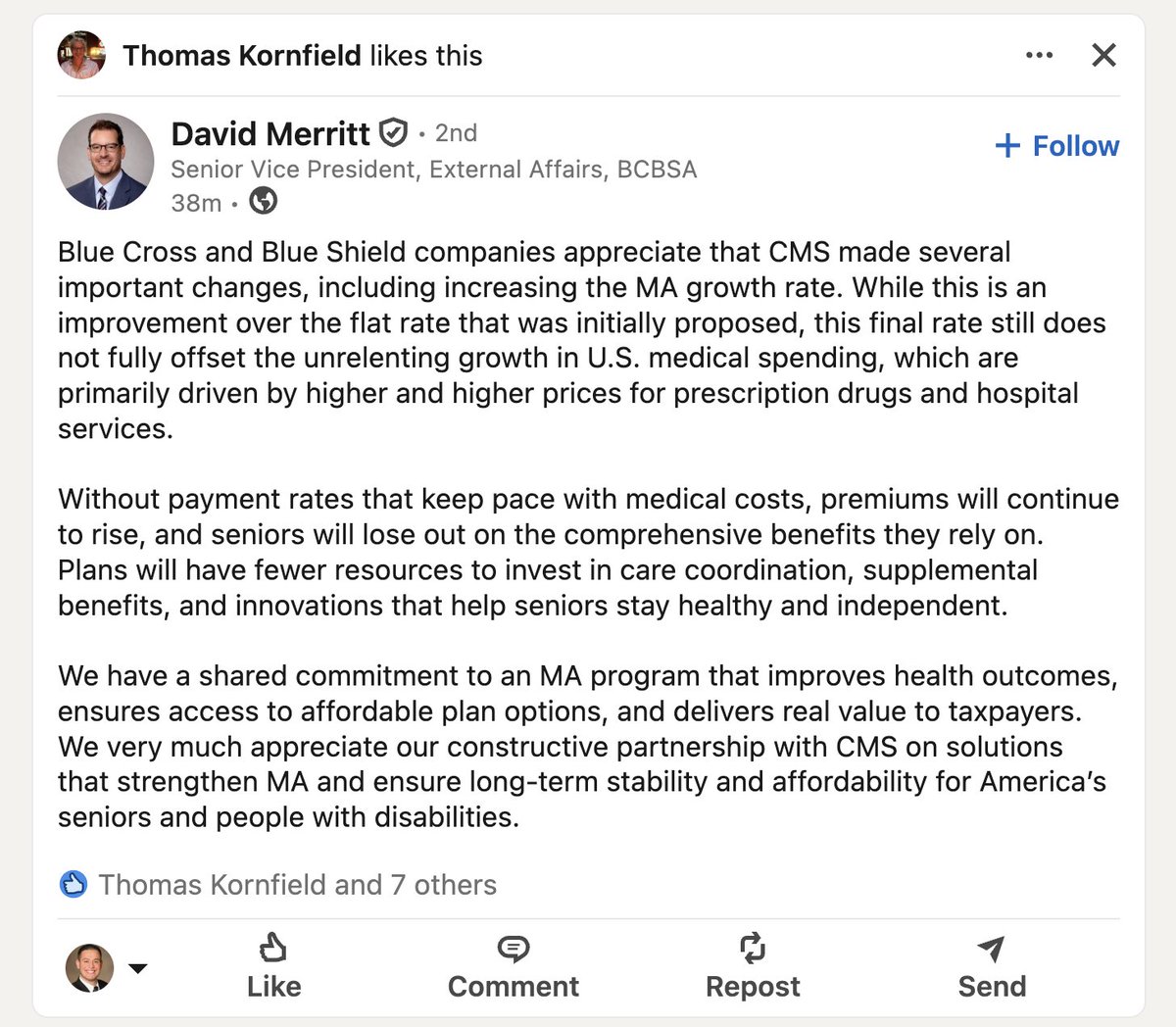
$CLOV $ALHC What did I say last night about Insurance companies having ZERO incentive to lower healthcare costs! Well here is Mr. Merritt (Senior Vice President of Blue Cross Blue Shield) literally telling CMS "this final rate still does not fully offset medical costs... premiums will continue to rise, and seniors will lose..." He thinks this is 2010, just like blackberry thought it was 1999. Mark this post by 2036. Dr. Albert Alan, MD
Albert Alan, MD tweet media
English
2
3
23
1.7K
AL STOCK TRADES รีทวีตแล้ว
Albert Alan, MD
Albert Alan, MD@AlbertAlan·
$CLOV I need to talk about what Clover Health just did because it hit me somewhere I was not expecting. When I was a third year medical student, we admitted an elderly patient through the emergency department. Advanced dementia. Nonverbal. No family at bedside. No identification beyond what the ambulance crew could provide. And no medical records. We had a human being in front of us and almost nothing to work with. We could do a physical exam. We could draw labs. But a physical exam does not tell you which of the four blood pressure medications someone was started on six months ago at a clinic across town. It does not tell you that a cardiologist already ruled out the arrhythmia you are about to spend twelve hours working up. It does not tell you that this patient had a severe allergic reaction to a contrast dye last year, and you are about to order a CT with contrast because no one documented it anywhere you can access. It does not tell you that the reason this patient is altered is because someone recently changed their seizure medication and nobody in this emergency room has any way of knowing that. We treated that patient the best we could. But I remember standing there thinking we are not practicing medicine right now. We are guessing. Educated guessing, yes. But guessing. For a patient who could not fill in a single gap for us. Who depended entirely on a system that had failed to keep their story in one place. I have carried that feeling with me into my career. Because that patient was not an outlier. That patient is someone’s mother or father in a memory care facility right now. That patient is the reason a family member calls every new doctor’s office and repeats the same history over and over, terrified that something critical will slip through the cracks. That is why what Vivek Garipalli and the Clover Health team just accomplished means so much to me. Clover became the first payer to go live on a CMS Aligned Network, delivering real time interoperability through their Counterpart Health platform. A patient’s clinical history and claims data can now follow them. Structured. Standardized. Accessible in the moments that matter most, not buried in a fax queue or locked inside a system that does not connect to anything. Picture what this means. Your parent with dementia is transported to an unfamiliar emergency room. And instead of starting from zero, the treating physician can pull up their medication list, their problem list, their recent encounters. They can see that the lisinopril was just increased. They can see the contrast allergy. They can make decisions rooted in knowledge instead of uncertainty. For a patient who cannot advocate for themselves, this technology becomes their voice. Vivek, thank you. You built CarePoint Health to serve communities that the system overlooked. You built Clover to change how Medicare works for seniors. And now you have moved the entire industry forward by proving that interoperability is not a regulatory box to check. It is how we protect the people who are least able to protect themselves. Everyone knows there is a way to invest and build wealth. That path is well worn. But what is rare, what is truly rare, is choosing to build something that makes a doctor more capable at a bedside. Something that wraps itself around the most vulnerable people in our society and says we see you, even when you cannot speak for yourself. That is not just a business. That is a contribution to humanity. I will be a better doctor because of what Clover Health is building. And I think about that patient from my third year often. I think about how different that night could have been. How many nights like that are happening right now in hospitals all over this country. And how what Clover just made real has the power to change every single one of them. Vivek, you and your team got this one right. And I am grateful.
Vivek Garipalli@VivekGaripalli

A really important additional reason for your parent or grandparent (or great grandparent) to consider Clover as their insurer

English
4
3
35
5.1K
AL STOCK TRADES รีทวีตแล้ว
Albert Alan, MD
Albert Alan, MD@AlbertAlan·
$CLOV People always ask me why I'm so bullish on Clover Health. I've laid it out more times than I can count. So today, I'm going to do the world a favor and break this down one final time at a level of thinking most people never operate at. Now let me be upfront. Even after reading this, some of you still won't get it. And I say that with zero disrespect. Some signals broadcast at a frequency that not every receiver is built to detect. Whether that's a product of environment or wiring, I can't tell you. But for those of you who are already tuned in, this is going to hit like a freight train. Consider this my public service announcement. Most people think you have to beat the incumbent. Andrew Toy knows you just have to wait for the people to do it for you. In 2008, if you wanted a secure work phone, you used a BlackBerry. Period. The "smart" people said: why would anyone build security for Android? BlackBerry already exists. Andrew Toy built it anyway. His company, Divide, bet on one simple insight: nobody is going to carry two phones forever. People didn't want a "work phone" and a "personal phone." They wanted ONE phone that did both. The experts laughed. BlackBerry had enterprise locked down. But Andrew wasn't trying to beat BlackBerry. He was building for the world that was coming. The one where consumers refused to accept an inconvenience just because "that's how it's always been done." By 2014, Google acquired Divide. His technology is now embedded in every Android device on the planet. He never fought BlackBerry. The people killed BlackBerry. He just built what they'd need next. Now think about healthcare. Right now, insurance companies tell you what doctors you can see. Systems like Epic and Cerner dictate how doctors practice. Insurance companies require "prior authorizations." Literally permission slips before your doctor can treat you. Sound familiar? "We know what's best for you." That's Verizon telling you what's good for the internet. That's BlackBerry telling you a corporate phone is all you need. Here's the part nobody talks about: Insurance companies have ZERO incentive to lower healthcare costs. They take a percentage of total spending. Costs go up? They just raise premiums. Their cut gets bigger. They profit from the very problem they claim to solve. So who's going to fix it? Not the incumbents. They're getting rich. The consumers will. People are going bankrupt from medical bills. They're starting to ask: why am I paying more every year for worse outcomes? Why does my doctor need permission from an insurance company to help me? Why is nobody catching my problems early when it's cheap instead of late when it costs $200K? Andrew Toy saw this coming the same way he saw the two phone problem. At Clover Health, he's building the infrastructure for proactive care. Catch conditions early. Help doctors act before it's expensive. Align incentives so the company wins when the PATIENT wins, not when costs rise. People right now are saying "the healthcare system is too big to change" the same way they said "you'll never compete with BlackBerry in enterprise." Both positions sound logical in the moment. Neither makes sense long term. Nobody is going to carry two phones forever. Nobody is going to accept going bankrupt for healthcare forever. The only question is: who's already building for what comes next? Andrew Toy has done this before. Until Next Time, Albert Alan, MD
Albert Alan, MD tweet media
English
2
6
59
2.8K