Klopikkon รีทวีตแล้ว
Klopikkon
1.2K posts


Klopikkon รีทวีตแล้ว

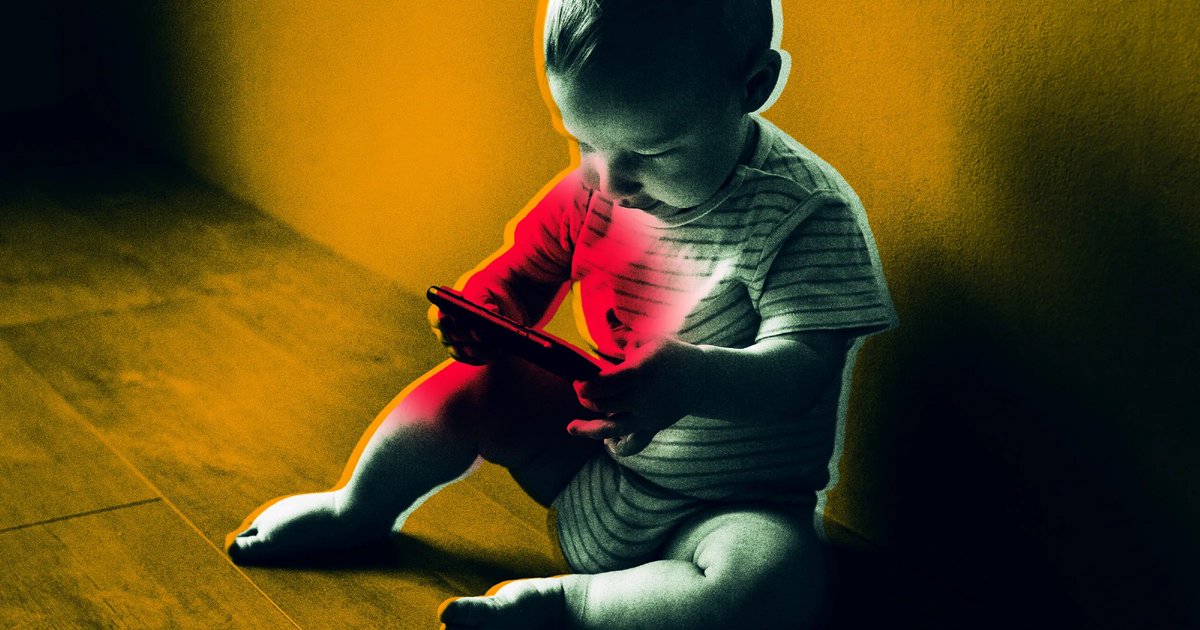
🚨🇺🇸 NEW STUDY REVEALS: THE SMARTPHONE CHILDHOOD EXPERIMENT IS OFFICIALLY BACKFIRING
A massive, NIH-backed study just dropped a quiet bomb on modern parenting:
Kids who get smartphones by age 12 face higher risks of depression, poor sleep, and obesity.
Not because of what they do on the phone - just owning one was enough.
Researchers followed 10,000+ adolescents nationwide. Median age of first phone? 11.
And the pattern was brutal: the younger the phone, the worse the health outcomes one year later.
We’re talking increased depressive symptoms, less sleep, higher obesity rates, chronic fatigue, ...
And this held true even when kids had other screens like tablets. The phone itself was the tipping point.
Lead author Dr. Ran Barzilay said the wild part is they weren’t tracking apps or doomscrolling.
They asked one question: does having your own smartphone this young affect your health?
Answer: yes - and not in a small way.
So what's going on?
Phones aren’t just screens - they’re 24/7 social comparison machines, excellent sleep wreckers, attention grabbers and stress amplifiers, ...
They are basically dopamine slot machines wrapped in Gorilla Glass.
You can lock down apps, but you can’t lock down adolescence.
Researchers now want to study kids who got phones even earlier - under age 10 - to see who’s most vulnerable and how to protect them.
Because let’s be real: 95% of teens already have smartphones.
This is no longer a question of if - it’s how do we keep them from cracking under the weight of constant connection?
This is far from a moral panic. It’s the data finally catching up to what every exhausted parent already suspected:
Childhood wasn’t built for push notifications.
Source: CBS, Futurism
English
Klopikkon รีทวีตแล้ว

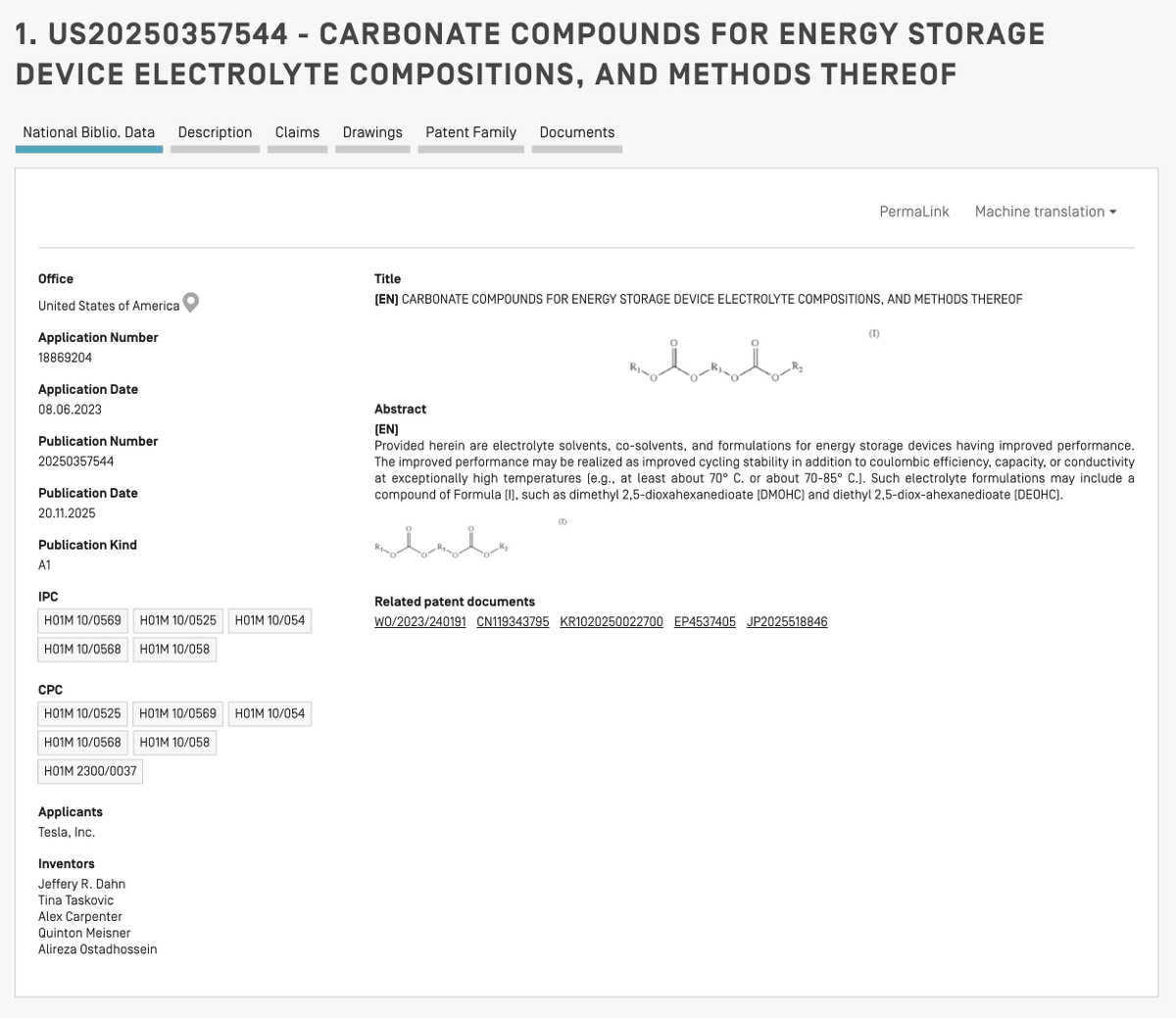
📄 The patent US20250357544, filed by Tesla with renowned battery researcher Jeff Dahn listed as a lead inventor, details a significant breakthrough in battery chemistry 🔋
🔬 The core innovation introduces a new type of liquid electrolyte designed to make Lithium-ion batteries last significantly longer, especially when pushed to their absolute limits.
❓ Key takeaways from this patent ❓
🌡️ Current batteries have a major weakness: they degrade rapidly under high voltage (e.g., 4.3V) or extreme heat (70°C–85°C). This stress causes the electrolyte to break down, leading to dangerous gas buildup, increased internal resistance, and a rapid loss of range. Tesla’s solution solves these specific failure points with a completely new chemical approach.
🧪 The secret lies in a new family of "dicarbonate" compounds defined by a unique molecular backbone: R1-O-C(=O)-O-R3-O-C(=O)-O-R2. The two primary versions highlighted are called DMOHC and DEOHC. These new solvents act as the liquid highway that allows ions to travel back and forth between the battery's positive and negative sides.
🤝 Crucially, these solvents don't work alone. The patent highlights that they perform best when paired with a specific salt called LiFSI, rather than the industry-standard LiPF6. The experiments show that LiFSI dissolves faster in these new solvents and creates a mixture that is incredibly resistant to heat.
💧 There is one catch: pure DMOHC is very thick (viscous), like honey, which can slow down ion movement. To fix this, the patent describes blending it with thinner, runnier solvents like Dimethyl Carbonate (DMC). Tesla found that specific blends (like 40% new solvent / 60% standard solvent) keep the fluid flowing efficiently while preserving the heat-resistant benefits.
🛠️ Making these new solvents is surprisingly straightforward. The manufacturing process begins with common, relatively inexpensive ingredients: a simple alcohol (ethylene glycol) and pyridine dissolved in dichloromethane. A chemical called methyl chloroformate is slowly added to this mixture to link the molecules together into the final carbonate structure.
💰 The cost outlook is promising. Because the starting ingredients are widely available industrial chemicals, the long-term cost to mass-produce this electrolyte could be very low—essential for keeping electric vehicle prices down. Current lab-scale tests reported a production yield of "up to 70%."
🚧 However, there is a manufacturing hurdle to clear. The current method uses "flash column chromatography" to purify the liquid, a slow technique meant for labs, not factories. For mass production at Tesla's scale, they would need to transition to continuous distillation, a feasible step given how simple the molecule is.
🔥 The performance data is remarkable. In standard industry testing, lithium-ion cells usually die quickly when exposed to high heat because the electrolyte cooks and degrades. The data in this patent flips that narrative completely.
🏆 In extreme stress tests, nickel-rich battery cells using the new DMOHC electrolyte retained greater than 99% of their original capacity after 3,500 hours of continuous cycling at a scorching 70°C.
🆚 To put that in perspective, standard "control" batteries typically lost about 10% to 15% of their capacity under similar conditions after just 2,000 hours. The degradation curve for Tesla's new electrolyte was essentially flat, indicating that the destructive reactions that usually kill batteries in hot climates effectively stopped.
🎈 Beyond lifespan, safety is a massive benefit. One of the most dangerous side effects of a dying battery is gas generation, which causes pouch cells to swell up like a balloon and potentially rupture.
🛡️ The results showed zero gas issues. While standard batteries operating at high voltages (3.8V and 3.9V) at 85°C eventually vented gas and failed, the cells containing the new DMOHC blends generated almost no measurable gas over hundreds of cycles.
🚕 This combination of durability and safety points to specific future uses. It supports the goal of a "Million Mile Battery" capable of powering Robotaxis or commercial trucks that run 24/7 and generate immense heat.
❄️ Finally, it could change how cars are built. If a battery can naturally withstand 85°C without failing, future vehicles could use simpler, lighter, and cheaper cooling systems. Theoretically, this innovation allows for a battery that is not only longer-lasting but also safer and more affordable to integrate into vehicles.
❓ What this means for Tesla's lineup ❓
🚀 For Tesla’s current lineup, this is an immediate performance unlock
Today, drivers of the Model 3, Model Y, and Cybertruck sometimes face "thermal throttling" at Superchargers—where charging speeds slow down because the battery gets too hot. By raising the safe operating temperature to 70°C+ (from the current limit of roughly 60°C), this new electrolyte would allow vehicles to maintain peak charging speeds for much longer, significantly cutting down wait times during road trips without requiring any new charging hardware.
☀️ It also solves a major geographic challenge
Electric vehicles currently degrade faster in scorching climates like Arizona, Texas, or the Middle East, requiring aggressive active cooling that drains the battery even when parked. With this new "heat-proof" chemistry, a Tesla parked in the desert sun would suffer virtually no degradation, matching the longevity of vehicles in milder climates and boosting resale value for owners in hot regions.
🤖 Looking to the future, this is the "missing link" for the Robotaxi
Tesla’s upcoming autonomous fleet is designed to run nearly 24/7, stopping only for rapid charging blasts. This intense duty cycle generates massive continuous heat that would destroy current batteries in less than a year. The patent’s data—showing stability over thousands of cycles at high temperatures—confirms that Tesla has cracked the durability code needed to make a million-mile autonomous taxi economically viable.
📉 Finally, this innovation could radically lower manufacturing costs
Current battery packs require complex, heavy liquid cooling loops (radiators, pumps, and coolant lines) to keep cells in a narrow "Goldilocks" temperature range. If the battery cells are naturally safe and stable at 85°C, future vehicles like the $25,000 "Model 2" could switch to simpler, cheaper air-cooling or passive cooling systems. This would shed weight, reduce parts, and simplify the assembly line, helping Tesla undercut competitors on price.
🏁 In conclusion
This patent represents a silent but monumental shift in EV technology. While headlines often focus on solid-state batteries or new anode materials, this electrolyte breakthrough proves that significant gains can still be unlocked within liquid Lithium-ion chemistry.
By solving the fundamental problem of heat-induced degradation, Tesla isn't just making a battery that lasts longer on paper; they are enabling a future where electric vehicles charge faster, survive in harsher climates, and cost less to build.
If these lab results translate to mass production, the "Million Mile Battery" moves from a theoretical goal to a manufacturing reality, securing Tesla's technological lead for the next generation of electric transport.
English
If we needed anymore proof the liberals are completely out of touch in Australia 🤣🤣🤣🤣. Firs nuclear now this 🤣 Australia biggest joke
The Chaser@chaser
The party denied completely abandoning everything net zero related, saying they are still on track for net zero election wins by 2050.
English
@RyanTorresTesla Powerwall switch owner process in Australia doesn't work. Had to manually find team and email them.
Need feedback section within app or query section instead of raising a request & having to book service appointment straight away
English

The whole dong has been swallowed.
Major milestone.
$TSLA
Sawyer Merritt@SawyerMerritt
NEWS: Tesla has just expanded its Robotaxi service area in Austin, Texas for the first time in two months.
English


@DirtyTesLa Counter point for those outside of US
No FSD 12
Years of waiting
No public comments before this
10k+ AUD investment
Elon not known for his correct timings
English

HW3 people: Come on Tesla just give us an update, say something!!
Tesla: V14 Lite in 9 months!
NO NOT THAT
English
Great to hear Tesla address hardware 3 customers. Recognizing that they are early adopters and updates coming to them is important.
Tesla is hoping to release version 14 lite in Q2 of 2026 for hardware 3
English
@SawyerMerritt Some do hw3 fsd for Aussies, as we can't vote from any of our platforms!
English

Tesla is now accepting questions for their Q3 earnings call next week. The earlier you submit your question, the more likely it will be upvoted and answered on the call, so submit quick!
Submit: app.saytechnologies.com/tesla-2025-q3
English
@Nedsir1 @wholemars Counterpoint, new unbox method makes normal 3 & Y cheaper to make therefore greater revenue on each of existing models alongside the new low cost variants? , I can't see them using this method only for low cost version?
English

@wholemars Not angry, but two years of "new low-cost models in development" seems unnecessary (in the extreme) for a couple of reduced trim variants.
English

The only reason to be angry about Tesla’s new base models is that you’re a moron
English
Klopikkon รีทวีตแล้ว
Tesla Full Self-Driving 14.1 First Drive!
As I demonstrate in this video, your Tesla can now automatically park itself when arriving at your destination.
English
Klopikkon รีทวีตแล้ว
BREAKING: Tesla delivered 497,099 vehicles in Q3, +7.3% YoY and their best quarter ever. Wall Street was expecting 443k. Total Q3 production was 447,450
Tesla also announced they deployed an all-time high 12.5GWh of energy storage in the quarter.

English
Klopikkon รีทวีตแล้ว

New episode tomorrow on the path to fully autonomous robots with @svlevine
One question I had for him: why won't robotics be like self driving cars?
Google started their self driving project in 2009.
And for over a decade and half, we’ve had the kinds of cool demos we sometimes now see for robotics, without any commercially viable and widely deployed machines.
Sergey thinks we're in a different regime with robotics today, for 2 reasons:
1. Mistakes are way less costly (killing someone versus breaking a dish), so you can deploy much earlier and actually learn from those mistakes in deployement.
2. LLMs give robots a level of common sense which significantly boosts their generality. "You can say, 'Hey, there's a sign that says slippery floor. What's going to happen when I walk over that?' No autonomous car in 2009 would have been able to answer that question."
Full episode out tomorrow!
English
@mrMDofficial @Tesla I do agree it with ur statement, but I'd rather the testers be aware there may be trouble rather than not know!
English
@mrMDofficial @Tesla Quoting the article here "But the Victorian government told 7.30: "The Department of Transport and Planning has not approved any testing of fully autonomous vehicles in Melbourne's CBD and it will continue to engage with Tesla."
Victorias government seems to disagree,
English
For those on the FSD in Australia, might be worth a read! abc.net.au/news/2025-09-0…
Might need permits in Victoria! Don't agree with the other stuff in the article but hope the FSD testers don't get punished for not having a permit! @tesla
English
@CARN0N carsales.com.au/editorial/deta…
showed some interesting areas where it might need improvement, but pretty promising to say the least! the question is when will hw3 get it though haha
English

Klopikkon รีทวีตแล้ว