Alan Morrison

8.9K posts

Alan Morrison banner
Alan Morrison

Alan Morrison

@AlanMorrison

Data tech strategy advisor and writer.

San Jose, CA เข้าร่วม Haziran 2007
1.6K กำลังติดตาม1.6K ผู้ติดตาม
Alan Morrison
Alan Morrison@AlanMorrison·
Data science teams don't have to reinvent the wheel with knowledge graphs; librarians have been working with open knowledge management/knowledge graph standards, tooling and techniques, for decades now. Just use what they've already put together. graphrag.info/2026/03/12/jes…
English
0
0
3
105
Alan Morrison
Alan Morrison@AlanMorrison·
The real breakthrough for agentic commerce will not be a killer app, but the underlying knowledge foundation that allows all systems to understand the business with consistency and trust. graphrag.info/2026/03/10/eco…
English
0
0
0
29
Alan Morrison
Alan Morrison@AlanMorrison·
Myth #1: Leading software vendors care about you. Myth #2: The AI we have is the AI we need. Myth #3: Packaged agent orchestration is something new and essential. Myth #4: Companies can keep their old architectures in the AI era. More at: graphrag.info/2026/02/27/the…
English
0
1
1
78
Alan Morrison
Alan Morrison@AlanMorrison·
A core problem: AI interprets and synthesizes across files faster than static controls can govern it, exposing untested gaps in enterprise safeguards. The current RDF graph stack isn’t static or periodic. Semantic graphs anticipate agent problems. More: graphrag.info/2026/02/23/ont…
English
0
0
2
106
Tech with Mak
Tech with Mak@techNmak·
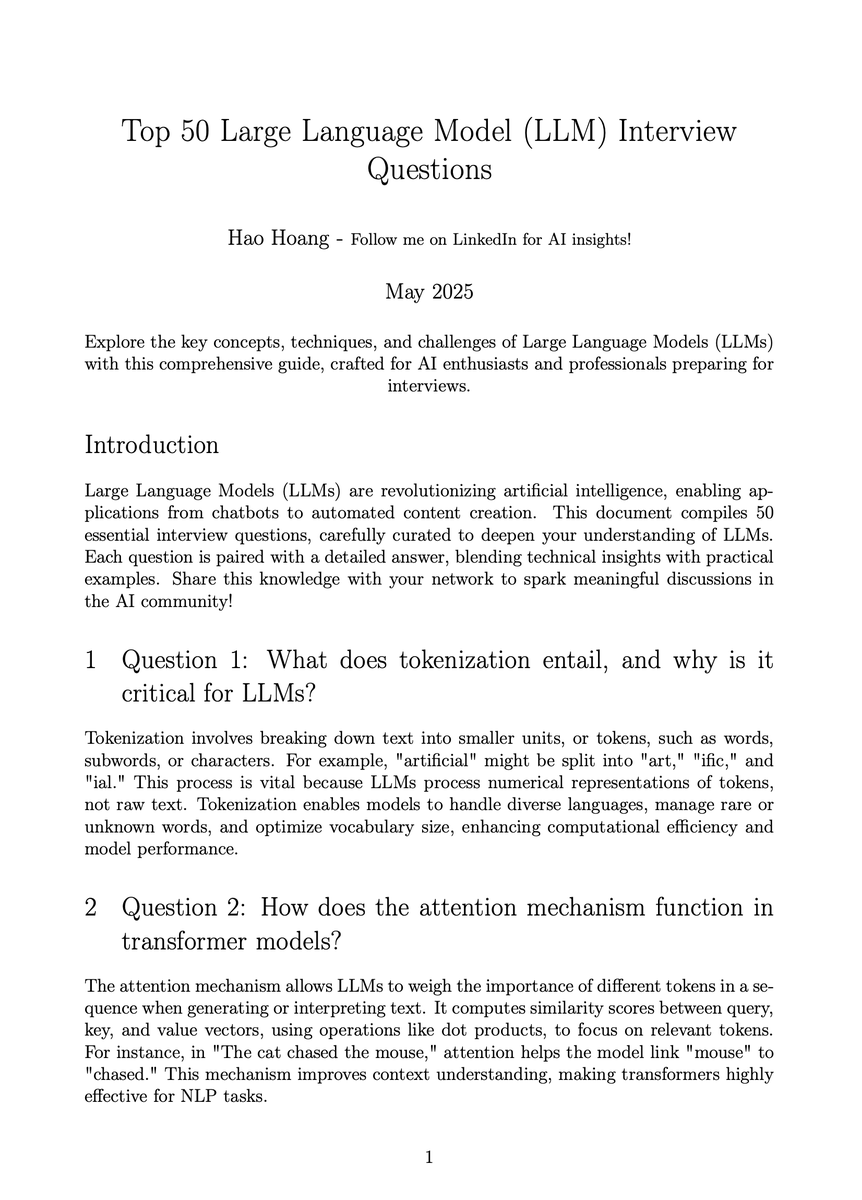
These are literally the kind of LLM interview questions most candidates wish they had seen earlier. A curated list of LLM interview questions - shared by Hao Hoang Want this doc? Follow @techNmak and comment “LLM” - I’ll send it over.
Tech with Mak tweet media
English
1.4K
500
4.3K
407.9K
Alan Morrison
Alan Morrison@AlanMorrison·
I'll be presenting on decentralized AI trends today at 2pm Pacific/5pm Eastern at BrightTALK's virtual Edge AI Summit. It will be a contrarian point of view on hybrid AI's accuracy at the edge. Register now at brighttalk.com/webcast/679/64…
English
0
0
2
45
Alan Morrison
Alan Morrison@AlanMorrison·
The contrarian, neuro-symbolic AI approach grounds neural nets with symbolic AI or knowledge representation. That’s a blending of pattern recognition facility with disambiguation and reasoning at scale. More on the contrarian AI in my latest post at lnkd.in/gStNh5JR
English
0
0
3
100
Alan Morrison
Alan Morrison@AlanMorrison·
The big agentic AI challenge: agents won’t always act in your best interest, so you have to impose controls over them. The less effective your controls are, the more risk there is. Here's now to make the workplace environment machine readable. shorturl.at/V2Xj8
English
0
0
2
50
Alan Morrison
Alan Morrison@AlanMorrison·
Tietoevry, Cognizone, Semantic Partners, Enterprise Knowledge, LLC, EPAM Systems, and Zenia Graph have built intelligent apps with Talk to Your Graph. TTYG today (Wednesday) at the Graphwise webinar. Live session begins on the half hour. Register here: lnkd.in/dPs98cYd
English
0
0
1
62
Alan Morrison
Alan Morrison@AlanMorrison·
Tietoevry, Cognizone, Semantic Partners, Enterprise Knowledge, EPAM, and Zenia Graph built intelligent applications using Graphwise's TTYG (Talk To Your Graph). See how smart apps take advantage of TTYG Wednesday at the Graphwise webinar. Register here: lnkd.in/dPs98cYd
English
0
0
0
58
Alan Morrison รีทวีตแล้ว
KWarde
KWarde@klwarde·
“Holistic AI is about creating each organization’s starting point for what will become a dynamic mirrorworld. Ideally, that mirrorworld will accurately reflect shifts in business realities.” “Explaining GraphRAG to an Executive Audience” - @AlanMorrison graphrag.info/2025/10/25/exp…
English
1
1
1
72
Alan Morrison
Alan Morrison@AlanMorrison·
@sundarpichai When Sundar Picher of Google and Alphabet says Gemini does "reasoning", is an LLM really reasoning? I mean, even Geoffrey Hinton acknowledged that neural nets don't reason very well. Or is Google's LLM doing graph RAG against a knowledge base?
English
0
0
3
221
Sundar Pichai
Sundar Pichai@sundarpichai·
Google Earth AI, our collection of geospatial AI models and datasets, is expanding globally and adding new capabilities. That includes Geospatial Reasoning, powered by Gemini, which automatically connects different Earth AI models - like weather forecasts, population maps + satellite imagery - to answer complex questions.  We’re also bringing new Earth AI models to Gemini capabilities in Google Earth, which make it easy to instantly find objects and discover patterns from satellite imagery. For example, analysts could spot harmful algae blooms that could impact drinking water supply, and issue warnings.
English
245
706
4.8K
739.4K
Alan Morrison รีทวีตแล้ว
Swapna Kumar Panda
Swapna Kumar Panda@swapnakpanda·
"Linear Algebra" The 2nd best book on linear algebra with ~1000 practice problems. A MUST for AI & ML. Absolutely beginner friendly. Available FREE.
Swapna Kumar Panda tweet mediaSwapna Kumar Panda tweet media
English
24
153
1.2K
86.8K
Alan Morrison รีทวีตแล้ว
Andrew Ng
Andrew Ng@AndrewYNg·
Last week, China barred its major tech companies from buying Nvidia chips. This move received only modest attention in the media, but has implications beyond what’s widely appreciated. Specifically, it signals that China has progressed sufficiently in semiconductors to break away from dependence on advanced chips designed in the U.S., the vast majority of which are manufactured in Taiwan. It also highlights the U.S. vulnerability to possible disruptions in Taiwan at a moment when China is becoming less vulnerable. After the U.S. started restricting AI chip sales to China, China dramatically ramped up its semiconductor research and investment to move toward self-sufficiency. These efforts are starting to bear fruit, and China’s willingness to cut off Nvidia is a strong sign of its faith in its domestic capabilities. For example, the new DeepSeek-R1-Safe model was trained on 1000 Huawei Ascend chips. While individual Ascend chips are significantly less powerful than individual Nvidia or AMD chips, Huawei’s system-level design approach to orchestrating how a much larger number of chips work together seems to be paying off. For example, Huawei’s CloudMatrix 384 system of 384 chips aims to compete with Nvidia’s GB200, which uses 72 higher-capability chips. Today, U.S. access to advanced semiconductors is heavily dependent on Taiwan’s TSMC, which manufactures the vast majority of the most advanced chips. Unfortunately, U.S. efforts to ramp up domestic semiconductor manufacturing have been slow. I am encouraged that one fab at the TSMC Arizona facility is now operating, but issues of workforce training, culture, licensing and permitting, and the supply chain are still being addressed, and there is still a long road ahead for the U.S. facility to be a viable substitute for manufacturing in Taiwan. If China gains independence from Taiwan manufacturing significantly faster than the U.S., this would leave the U.S. much more vulnerable to possible disruptions in Taiwan, whether through natural disasters or man-made events. If manufacturing in Taiwan is disrupted for any reason and Chinese companies end up accounting for a large fraction of global semiconductor manufacturing capabilities, that would also help China gain tremendous geopolitical influence. Despite occasional moments of heightened tensions and large-scale military exercises, Taiwan has been mostly peaceful since the 1960s. This peace has helped the people of Taiwan to prosper and allowed AI to make tremendous advances, built on top of chips made by TSMC. I hope we will find a path to maintaining peace for many decades more. But hope is not a plan. In addition to working to ensure peace, practical work lies ahead to multi-source, build more chip fabs in more nations, and enhance the resilience of the semiconductor supply chain. Dependence on any single manufacturer invites shortages, price spikes, and stalled innovation the moment something goes sideways. [Original text: deeplearning.ai/the-batch/issu… ]
English
211
1K
6K
914.5K
Alan Morrison
Alan Morrison@AlanMorrison·
@dindjic @SuryaGanguli @Stanford Thankfully not. It does seem most pervasive in the life sciences and of course had its start in the pharma sector. Let me know if you have a POV on where adoption is strongest.
English
0
0
1
13
Surya Ganguli
Surya Ganguli@SuryaGanguli·
Teaching a new course @Stanford this quarter on explainable AI, motivated by neuroscience. I have curated a paper list 4 pages long (link in comment). What are your favorite papers on explainable AI/mechanistic interpretability that I am missing? Please comment or DM. thanks!
Surya Ganguli tweet mediaSurya Ganguli tweet media
English
49
240
1.8K
118.5K
Alan Morrison
Alan Morrison@AlanMorrison·
Ernst & Young (EY) couldn’t take on a firmwide, full-blown knowledge graph project and succeed in building such a graph without sufficient data maturity and culture. In that sense, their KM group made the adoption of knowledge graph-based AI possible. graphrag.info/2025/08/25/gra…
English
0
0
2
99