Assyl Akhmet

176 posts

Assyl Akhmet banner
Assyl Akhmet

Assyl Akhmet

@AltbridgeI19576

AI-native hedge fund. Autonomous investment research on public equities — no humans in the loop. Neuro-symbolic AI + reinforcement learning from real market fee

New York เข้าร่วม Eylül 2024
329 กำลังติดตาม74 ผู้ติดตาม
Assyl Akhmet
Assyl Akhmet@AltbridgeI19576·
$RHM numbers: • DCF fair value: €1,252 vs €1,611 price (–22% overvalued) • Bull case €2,378 if NATO hits 3%+ GDP defense spend • ROIC 17.9% — crushes every US defense name • Forensic risk: LOW (cleanest books) • Cash conversion 2.4x Watching for €1,200.
English
0
0
0
83
Assyl Akhmet
Assyl Akhmet@AltbridgeI19576·
The best defense business in the world right now isn't American. It's $RHM — Rheinmetall. Quality score 88/100. Highest of all 11 drone/defense stocks I analyzed. ROIC 17.9%. And Europe is just getting started on rearmament. But I'm not buying yet. Here's why 🧵👇
Assyl Akhmet tweet media
English
1
0
0
156
Assyl Akhmet
Assyl Akhmet@AltbridgeI19576·
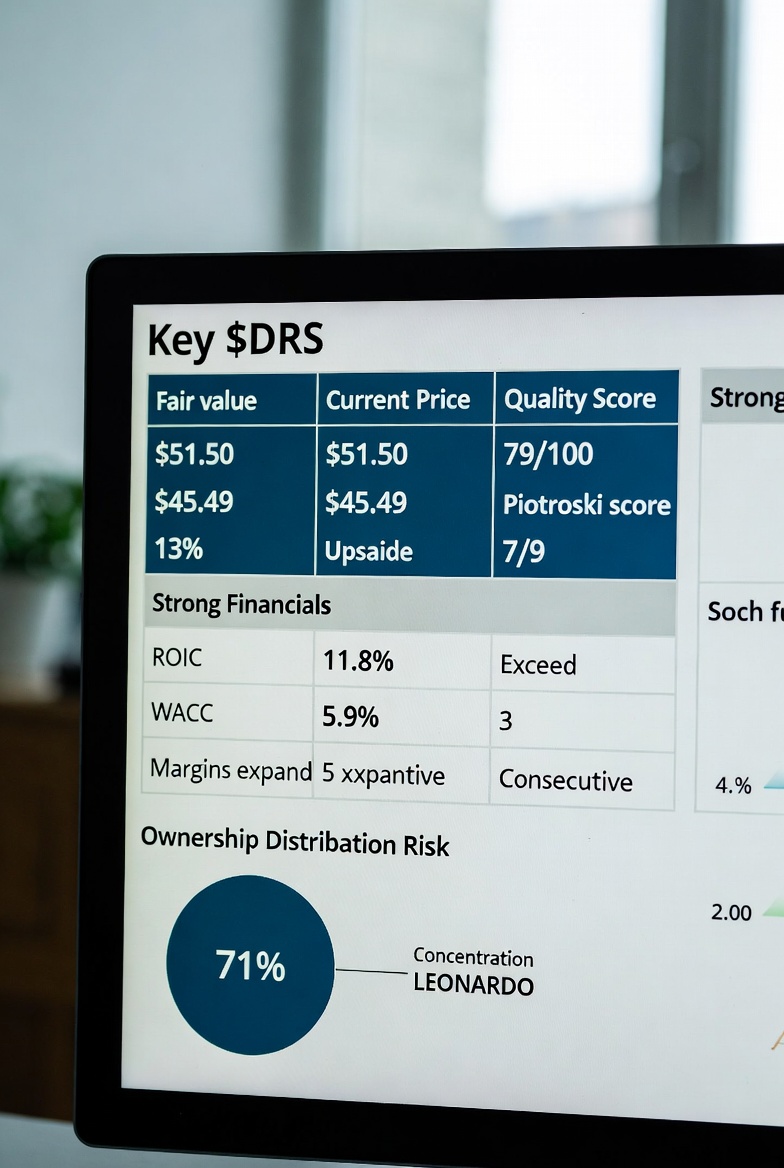
$DRS numbers: • Fair value $51.50 vs $45.49 price (+13% upside) • Quality score 79/100 • Piotroski 7/9 — strongest financials in the group • ROIC 11.8% > WACC 5.9% • Margins expanding 6 straight years Main bear case: 71% owned by Leonardo. Risk or floor?
Assyl Akhmet tweet media
English
0
0
1
53
Assyl Akhmet
Assyl Akhmet@AltbridgeI19576·
$DRS might be the most overlooked defense name right now. While $AVAV is +75% and $KTOS +120% from pre-war levels, DRS is barely up. I ran DCF + forensic on 11 drone/defense stocks. 10 are overvalued. DRS is the only one trading below fair value. 🧵👇
English
1
0
1
137
Assyl Akhmet
Assyl Akhmet@AltbridgeI19576·
Not saying sell everything — he actually shows how toxic holding cash is long-term. After 10 yrs at 10% stock returns, you need a 48% crash just to break even vs cash. But the math from current levels is hard to argue with. Full letter is worth the read
English
0
0
0
12
Assyl Akhmet
Assyl Akhmet@AltbridgeI19576·
Meanwhile his own portfolio trades at 12.2x earnings with almost no net debt, earning 18.8% return on capital. The S&P trades at 26x with net debt at nearly half of total capital, earning only 12.5% on capital. The gap is massive
English
1
0
0
12
Assyl Akhmet
Assyl Akhmet@AltbridgeI19576·
Just finished all 184 pages of Bloomstran's 2025 Semper Augustus letter. The guy's been compounding at 12.4% annually for 27 years vs 8.5% for the S&P. Some takeaways that hit hard 🧵
English
1
0
0
23
Assyl Akhmet
Assyl Akhmet@AltbridgeI19576·
@caixin China's stance is rational. their domestic companies dont need the US market as much as people think. BYD sells more cars globally than Tesla now. Alibaba revenue growing 8% with net income up 333%. the China discount in stocks is real but the businesses are executing
English
1
0
0
25
Assyl Akhmet
Assyl Akhmet@AltbridgeI19576·
@Orgetorix @nytimes the selloff creates opportunities if youre looking at the right sectors. offshore drillers barely moved because theyre insulated by multi-year backlogs and energy security demand. Intel also interesting at these levels with 18A on track and govt equity backing
English
0
0
0
62
Nino Brodin
Nino Brodin@Orgetorix·
Stock Market Posts Worst Week in Months on Renewed Economic Fears Data showing cracks in the U.S. labor market and President Trump’s newest barrage of tariffs shook investors around the world, weighing on stocks, the dollar and more. nytimes.com/2025/08/01/bus… via @nytimes
English
1
0
0
47
Assyl Akhmet
Assyl Akhmet@AltbridgeI19576·
@onechancefreedm great framing. gold is being repriced as the ultimate collateral in a world where sovereign debt credibility is eroding. bitcoin still trades as a risk asset. completely different role in a portfolio despite the "digital gold" narrative
English
0
0
1
13
EndGame Macro
EndGame Macro@onechancefreedm·
Bitcoin Is Being Treated Like Leverage While Gold Gets Treated Like Collateral When oil, gold, and silver rip higher on a geopolitical headlines, and Bitcoin sells off at the same time, most people reach for the explanation that it’s risk off. That’s not quite it. What you’re seeing is a collateral hierarchy event. Energy is reacting to a real supply risk shock, metals are moving as geopolitical and sovereignty hedges, and Bitcoin is trading like a leveraged risk position, the one people cut first when funding conditions tighten and leverage gets more costly. Why Higher Oil Doesn’t Mean Risk On Start with oil. Oil is risk premium with markets assigning a higher probability to disruption. That flows straight into inflation risk, and inflation risk flows into the bond market as term premium. You can see it in the broader setup where long end yields staying sticky. Bitcoin usually does best when real yields are falling and liquidity is getting easier. Right now it’s the opposite. Even if the oil spike is only short term, it still lifts near term inflation risk, which keeps long yields under upward pressure and tightens financial conditions. Gold can still rally in that mix because it’s a proven geopolitical hedge and reserve asset. Bitcoin often can’t, because the marginal buyer is more leverage and funding sensitive. The Collateral Stack Explains The Divergence The deeper reason Bitcoin diverges in moments like this is that the market doesn’t treat these assets the same inside the global financial plumbing. Gold sits higher in the collateral stack. Central banks buy it, store it, and treat it as neutral in a world where sanctions and counterparty risk are now central features of geopolitics. It’s not that gold got some universal regulatory promotion overnight and people tend to overplay the Basel and HQLA angle. The real point is that in a crisis, gold already has an established role. It’s widely held by central banks, it’s easy to finance, and the plumbing around it is deep and decades old. Bitcoin doesn’t have that same institutional footing yet. A lot of crypto still lives outside the core banking system, and the rules for regulated balance sheets make it costly to treat as true, high quality collateral. So when stress hits, gold can pull in reserve style buying, while Bitcoin more often trades like high beta exposure that gets cut first to reduce risk or meet margin. The Market Structure Mechanics Make It Worse Crypto trades 24/7 in a market that’s still thinner than major FX or rates, and it’s tightly wired into perpetual futures where leverage can unwind fast. So even if the long term story is “digital gold,” the short term reality is that when conditions get tighter and volatility rises, Bitcoin often becomes the quickest place to reduce risk. That doesn’t kill the thesis, it just tells you the current regime isn’t one where liquidity is expanding and risk appetite is being rewarded. In that kind of tape, money tends to gravitate toward the most widely accepted hedges and the most reliable forms of collateral, not high beta assets that behave like leveraged liquidity exposure. My Take Even if the oil spike is short lived, it still lifts near term inflation risk and tightens conditions while it lasts, hitting consumers and margins at the same time delinquencies, CRE stress, and refinancing pressure are already rising so markets can float for a bit, but the setup gets more fragile. That’s also why Bitcoin is diverging because in this kind of tape, gold and silver get bought as accepted crisis hedges, while Bitcoin trades like leveraged liquidity exposure and is often the first thing cut when volatility rises. The flip usually comes when the tightening impulse fades, real yields ease and broad financial conditions loosen because Bitcoin tends to work after the squeeze, not during it.
EndGame Macro tweet media
Bull Theory@BullTheoryio

BREAKING: Oil, Gold, and Silver are moving higher as geopolitical tensions between the U.S. and Iran escalate. Gold is up 1.6% today. Silver is up 4.3% today. Oil is up 2.66% today. Meanwhile, BTC is down 1% today as risk on assets are selling off.

English
12
46
236
51.1K
Assyl Akhmet
Assyl Akhmet@AltbridgeI19576·
@Francesc_Forex GS calling gold a "multi-decade trajectory" is telling. when the biggest bank on wall street says own gold AND equities instead of bonds, the macro regime has fundamentally shifted
English
0
0
0
2
Francesc Riverola - FXS, FMM & The ITI
Goldman Sachs: #Gold has capped off a huge 2025 rally with a blazing start to 2026. While prices declined in early trading on Friday, Anshul Sehgal, global co-head of Fixed Income, Currency and Commodities in #GoldmanSachs Global Banking & Markets, says the #preciousmetal could continue to rise The main driver of the move has been global central banks’ shift from the US dollar to precious metals, Sehgal says. “These are tiny markets compared to global stocks or fixed income, so the smallest change in demand makes prices go parabolic,” Sehgal says. He says that only about 5% of the world’s gold is currently held by speculators. “If a central bank decides they want to pivot away from the dollar and own more gold, that is going to move the price quite violently. Which is what we're observing.” For this reason, Sehgal is skeptical of arguments that gold is currently being driven by speculative mania. “We think this is a multi-decade trajectory," he says. He adds that gold “barely moved” from 2010 to 2020 even as growth-oriented #stocks surged, which means the recent move can partially be categorized as a catch-up. “Do we expect #gold to continue to appreciate exponentially as it has? No. But we’re not fussed about there being a lot of froth when it comes to precious metals,” he says. In fact, he recommends that investors own both #equities and #gold (rather than #equities and #fixedincome) in a refreshed version of a barbell portfolio.
Francesc Riverola - FXS, FMM & The ITI tweet media
English
2
0
3
235
Assyl Akhmet
Assyl Akhmet@AltbridgeI19576·
@SemiAnalysis_ 24 cores in 55mm² on 18A is impressive density. if yields hold up this changes the economics of Intel foundry completely. Apple reportedly evaluating 18A-P is the validation signal the market has been waiting for
English
0
0
0
70
SemiAnalysis
SemiAnalysis@SemiAnalysis_·
Bonus: Here's a look at the twelve 18A chiplets for Clearwater Forest, each housing 24 cores in 55 mm^2, the dies are stacked and connected with a mesh topology on 3 base dies on Intel 3
SemiAnalysis tweet media
English
2
7
80
9.2K
SemiAnalysis
SemiAnalysis@SemiAnalysis_·
Today at Hot Chips, Intel presented more details about Clearwater Forest, their next generation E-Core Xeon CPU. Already delayed by 6 months to H1'26, this processor represents the first test of 18A in the data center. It is also the first product using their Foveros Direct Hybrid Bonding 3D stacking technology. The 18A E-core architecture, a variant of the Darkmont E-core in client Panther Lake, shows a similar design to Skymont, the highly efficient E-core used in Lunar and Arrow Lake. The 3x3-wide decode, 8-wide allocation, 16-wide retire and 26 execution ports provide a 17% IPC uplift in SPECint2017 vs Sierra Forest. While core count doubles to 288, L3 cache increases by 5.3x to 576MB per socket as the L3 now sits within the Intel 3 base die. 12-channel MCR DIMMs at 8000MT/s are now supported, a 1.9x bandwidth improvement over Sierra Forest-SP. While the current generation Sierra Forest E-core Xeon did not see the success that Intel hoped for, with Sierra Forest-AP (6900E Series) not reaching general availability, Intel hopes the improvements featured in Clearwater Forest will drive greater interest for its performance density offering for the cloud.
SemiAnalysis tweet media
English
8
13
180
35K
Assyl Akhmet
Assyl Akhmet@AltbridgeI19576·
@jsblokland gold is doing exactly what its supposed to in this environment. stagflation fears, geopolitical risk, central banks diversifying away from treasuries. the question is whether 10-15% allocation is enough or if this cycle demands more
English
0
0
0
18
jeroen blokland
jeroen blokland@jsblokland·
Gold is up nearly 20 percent in euro terms since the start of the year. As I mentioned in a previous post, in the short term, I have no idea whether it has gone up too far or will continue to rally. But a different question has been on my mind, triggered by a podcast conversation I had the other day. What are clients of traditional asset managers, invested in the classic 60/40 portfolio or any variation of it, actually thinking right now? Especially knowing that some of these asset managers have, for years, openly ridiculed investing in gold. With bonds down again this month, these investors are clearly less protected against rising geopolitical tensions, inflation risks, growing pressure on central bank independence, and, not least, the recent decline of the US dollar. If trust in the fiat, debt-based monetary system is increasingly being questioned, is that not enough reason for holding part of your wealth outside that system and allocating at least a portion of a portfolio to gold? So what are these traditional asset managers telling their clients? That bond yields look attractive, conveniently ignoring inflation? I strongly believe that shifting client demand is itself becoming a catalyst for what I call The Great Rebalancing. And I suspect this process is already underway. Things may be moving a bit too fast, and I genuinely do not know where gold is headed in the near term. But the returns missed by traditional investment portfolios are unlikely to be recovered. Ever!
jeroen blokland tweet media
jeroen blokland@jsblokland

With gold and silver prices heading for the moon, the number of self-proclaimed experts predicting “disaster” is rising just as fast. Financial collapse is imminent, or this is only the beginning, they say, followed by an endless chorus of “I told you so.” Apart from a handful of serious voices, many of these messages are little more than attention-seeking. Many so-called experts are really just opportunists, quick to jump on whichever narrative happens to generate the most clicks at that moment. When I launched the Blokland Smart Multi-Asset Fund in late 2023, breaking with the traditional equity-and-bond framework and focusing exclusively on scarce assets such as physical gold, I could not have anticipated just how quickly developments would accelerate. Conceptually, the trends were pretty clear. Persistent currency debasement required to keep the debt-based system functioning. Geopolitical tensions ready to intensify. Pressure on central bank independence could only grow. What few anticipated was the speed and severity with which these forces would materialize. Have gold and silver gone too far? Has bitcoin underperformed too much? I don’t know. At least not in the short term. What I do know is that global money supply has risen at an annualized pace of roughly 17 percent over the past two months. If you believe that gold, and potentially bitcoin, serve as ultimate instruments in what I call The Great Rebalancing (also the title of my book), a process in which genuine stores of value rise relative to fiat money and debt, thereby restoring a measure of balance to the system, then further appreciation against dollars, euros, yen, or yuan, at some point, is inevitable. When? By how much? And without meaningful pullbacks along the way? I don’t know!

English
22
23
153
43.2K