Bill Alexander

19.6K posts

Bill Alexander banner
Bill Alexander

Bill Alexander

@BillAlexander4

Construction Attorney, Sportjumping promoter, interested in horses, musician.
Glasgow เข้าร่วม Ekim 2011
2.5K กำลังติดตาม971 ผู้ติดตาม
Bill Alexander
Bill Alexander@BillAlexander4·
@Sheracing @jamesaknight But he would be conscious of needing to ride for a finish. The pressure on jockeys to be seen to be trying is considerable.
English
1
0
0
19
Helen Sheracing
Helen Sheracing@Sheracing·
@jamesaknight The problem is reconciling how it looked and what Paul Townend actually felt. I'm wanting to think if Townend felt something amiss, he would have pulled up.
English
1
0
1
737
Bill Alexander
Bill Alexander@BillAlexander4·
@heraldscotland If GP’s are private contractors ( I understand that most of them are) then is not up to them to employ more staff ?
English
0
0
0
11
The Herald
The Herald@heraldscotland·
Over 70% of Scotland’s GPs warn patient safety is being compromised as workload pressures mount and staffing concerns grow. 👇
The Herald tweet media
English
2
3
1
414
James 🏴󠁧󠁢󠁳󠁣󠁴󠁿 🇺🇦
Me, ma dug (non-binary) and my girl. And Sibelius 6, which I am a bit obsessed with right now. I wasn’t sure if I’d have another birthday with her, but I have. And hopefully many more. It’s been a strange year…
English
7
0
103
6.1K
Bill Alexander
Bill Alexander@BillAlexander4·
@EasyPeasy_3 Identity parades are quite informal these days. “ He was carrying a green bag and had a retro camera”
English
1
0
1
83
Bill Alexander รีทวีตแล้ว
Imtiaz Mahmood
Imtiaz Mahmood@ImtiazMadmood·
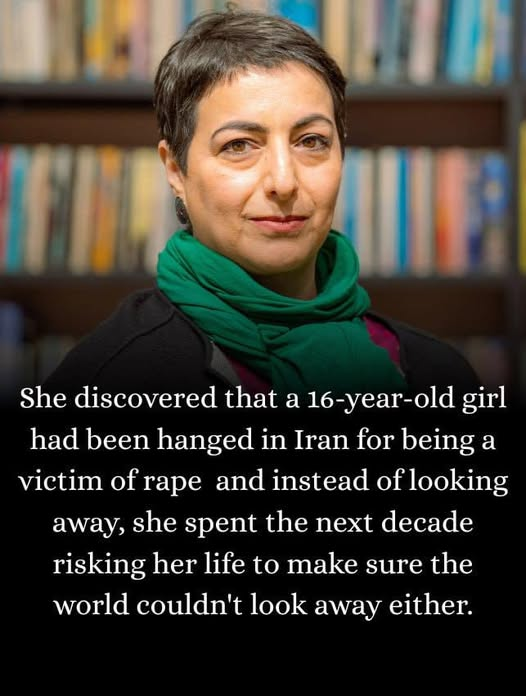
n 2004, a journalist named Asieh Amini came across a story from a small town in northern Iran. A 16-year-old girl named Atefeh Sahaaleh had been publicly hanged. The official charge: "acts incompatible with chastity." The reality, which Amini uncovered through careful, dangerous investigation: Atefeh had been repeatedly raped by a neighbor and other men beginning when she was nine years old. She had been neglected by her family and paid to keep silent — money she used simply to survive. At 13, Iran's morality police arrested her. A judge sentenced her to one hundred lashes. Under Iranian law, a woman could be sentenced to lashings three times — the fourth offense carried the death penalty. She was 16 when they hanged her. Amini wrote the story. Her newspaper refused to publish it. Another paper refused as well. A women's publication finally agreed to run an edited version. She kept going. Born in 1973 in the Mazandaran province of northern Iran — one of four sisters who spent their childhood painting, reading, and playing outdoors — Amini had built her career as a journalist through the brief flowering of press freedom following President Khatami's election in 1997, editing a women's affairs newspaper called Zan until hardline clerics shut it down in 1999. She had known the Iranian state's capacity for silencing voices. She had not yet known the full depth of what it was capable of doing to girls. After Atefeh, she knew. Case after case began reaching her. Leyla — a 19-year-old with diminished mental capacity, herself a victim of child rape, facing execution. The judge in her case told Amini plainly that Leyla was a threat to family life because of her "sexual availability." Amini enlisted human rights lawyer Shadi Sadr, published Leyla's story, drew international attention, and helped get her out of prison and into the care of a women's organization in Tehran. One life at a time. One story at a time. Against a legal system that had no interest in being exposed. In 2006, Amini discovered that despite a government moratorium on stoning — a directive issued in 2002 that carried no binding legal force — a man and woman had been stoned to death in Mashhad for adultery. The judge claimed he answered only to Sharia law. The Ministry of Justice denied the stoning had happened. State media attacked Amini's credibility. That October, Amini and Sadr co-founded the Stop Stoning Forever (SSF) campaign — systematically documenting stonings occurring across Iran and sharing their findings through colleagues abroad who could publish without fear of arrest. The state took notice. In March 2007, Amini was among 33 women arrested during a silent sit-in at a Tehran courthouse. During interrogation she realized — with the specific clarity of someone who had been investigating surveillance — that the police had been investigating her for some time. She was released after five days. Her phones, she was certain, were tapped. Her movements tracked. She kept reporting. The sustained pressure of the work eventually took its physical toll — stress-induced symptoms that included headaches, vision problems, and muscle paralysis forced her to step back briefly while her partners reorganized the campaign from outside Iran. She recovered. She continued. In 2009, following the disputed reelection of Mahmoud Ahmadinejad, Amini was among the demonstrators beaten in the protests that swept Iran. She continued reporting — under pseudonyms, in the chaos. Then came the warning: police were questioning prisoners about her. She needed to leave. She had been invited to a poetry festival in Sweden. She took her daughter Ava and she went. They did not come back. Amini settled eventually in Norway, supported by the International Cities of Refuge Network — a program that protects writers facing state persecution. From exile, she continued her advocacy, published two books of Norwegian-language poetry, and kept doing what she had always done: making sure that the stories of girls and women the Iranian state wanted silenced were heard by the world instead. She was awarded the Human Rights Watch Hellmann/Hammett Award in 2009 — the same year she fled. The Oxfam Novib/PEN Award in 2012. The Ord i Grenseland prize in 2014. Asieh Amini picked up a pen in a country that punished women for existing outside the law's narrow definitions — and she used it, at enormous personal cost, to push against every wall that pen could reach. The girl from Mazandaran who dreamed of becoming a painter and writer became something rarer and harder: A witness who refused to look away. And a voice that — no matter how many times the state tried to silence it — kept finding new ways to be heard.
Imtiaz Mahmood tweet media
English
72
2.4K
6.1K
165.9K
James 🏴󠁧󠁢󠁳󠁣󠁴󠁿 🇺🇦
‘We’ve identified cases early’. 🤦🏼‍♂️ There is no evidence these men are any less likely to die now than if they had been diagnosed after experiencing *symptoms*. However, there is a lot of evidence that many of them will have been *over-diagnosed* and…
Sir Tom Hunter@SirTomHunter

We’re testing 25,000 men across Scotland free of charge, just a simple blood test. In the first week alone, over 1,400 men came forward, and we’ve already identified cases early. That’s lives changed and potentially lives saved. Visit scottishprostate.com to get involved, it could make all the difference.

English
5
6
13
7.8K
Bill Alexander
Bill Alexander@BillAlexander4·
@EasyPeasy_3 Oncologists use PSA monitoring, so whilst it is not perfect it has some value. The side effects of the treatment can be difficult in some instances , but not always. There is no research on this aspect though. Looks like you have confirmed my insanity then.
English
1
0
1
46
James 🏴󠁧󠁢󠁳󠁣󠁴󠁿 🇺🇦
@BillAlexander4 I refer you to my previous point, and the position of the NSC and Cancer Research UK. PSA screening of asymptomatic males causes more harm than good. As soon as the test can be improved, or the screening cohort sensibly narrowed, no sane person should support it.
English
1
0
1
43
James 🏴󠁧󠁢󠁳󠁣󠁴󠁿 🇺🇦
@BillAlexander4 Why? They’re not actually doing anything ‘wrong’. Men can request a PSA from their GP. It’s a free country, and people are free to encourage and/or do stupid things. I am also free to tell them they’re being stupid. 😂
English
1
0
0
25
James 🏴󠁧󠁢󠁳󠁣󠁴󠁿 🇺🇦
@BillAlexander4 I wouldn’t suggest they are not well meaning, but it’s a ‘not for profit company’. It’s not even a charity. Running trials is a very complicated business. This smacks of well-meaning amateurs trying to do their best and sadly probably causing more harm than good.
English
1
0
0
42
Bill Alexander
Bill Alexander@BillAlexander4·
@EasyPeasy_3 II understand that it is a legitimate organisation. Why not ask them ?
English
1
0
0
45
Bill Alexander
Bill Alexander@BillAlexander4·
@EasyPeasy_3 The evidence used by the national screening committee was from the NHS in England. There was no Scottish data whatsoever. Men in Scotland are three times more likely to have advanced prostate cancer ( metastasis ) If nothing else, the screening is gathering Scottish data
English
2
0
0
403
Bill Alexander
Bill Alexander@BillAlexander4·
@EasyPeasy_3 Possibly because there are significantly higher levels of advance prostate cancer in Scotland. It is primarily an English committee. Health is a devolved matter and we should have a Scottish evaluation, in my opinion.
English
1
0
0
180
James 🏴󠁧󠁢󠁳󠁣󠁴󠁿 🇺🇦
@BillAlexander4 The question is why a dataset of a bit of an island with a population of 50m can’t be applied to the bit with a population of 5m. The committee will have crunched the numbers that they had - and it’s a UK wide committee.
English
1
0
0
183
Bill Alexander
Bill Alexander@BillAlexander4·
@EasyPeasy_3 I sent an FOi to the screening committee after I read the research they relied on. They confirmed that there was no Scottish data. I have no medical qualifications but I know how to test the evidential basis for a decision.
English
1
0
1
200
The Ferret
The Ferret@FerretScot·
A Scottish golf course is trying to prove the sport can work with nature — not against it. We visited Machrihanish Dunes, where there’s no irrigation or chemicals, and sheep help manage the land theferret.scot/natural-golf-c…
English
1
5
10
587
alexmassie
alexmassie@alexmassie·
It’s ‘juice’, you fools.
Jubal Hardin@Jubal_Hardin

@haruki839 Here are maps that show what it is called and where. And yes, in the Deep South many still call everything Coke (Coca-Cola), even when it isn’t. 😂

English
34
4
70
10.1K