Paul Slobodian

1.5K posts

Paul Slobodian

Paul Slobodian

@Chenango21

Son of Ukrainian imgrt ,Ex Boston cab driver, former Teamster + SEIU, Retired Clinical/ Org. Psychologist (MA and CA). MIT/Sloan. Board mbrStateThink tank.

เข้าร่วม Mart 2012
351 กำลังติดตาม154 ผู้ติดตาม
Paul Slobodian
Paul Slobodian@Chenango21·
@aakashgupta I once debated in favor of lotteries as “voluntary taxation”. But, it is highly addictive and has huge social costs. At least ban tv ads for all gambling.
English
0
0
2
107
Aakash Gupta
Aakash Gupta@aakashgupta·
Warren Buffett, in his first sit-down since stepping down as Berkshire CEO, gave the cleanest indictment of legalized gambling in a decade. He called it a tax cut for the wealthy. The math proves him exactly right. Americans wagered $165 billion at legal sportsbooks in 2025. They lost $16 billion of that. FanDuel pulled $6 billion of the losses. DraftKings pulled $5.3 billion. Every state with legal mobile sports betting collected a tax on the bettor side. New York alone took in over $1.2 billion in 2025 sports betting tax revenue. Layer the lottery on top. State lotteries generate over $90 billion a year. The bottom half of income earners account for roughly 70% of total spend. The average lottery player makes $38,000. A household earning $20,000 spends three times more on tickets than one earning $30,000. The implicit tax rate, meaning whatever the state keeps after prizes, runs 30 to 50% depending on the game. No other revenue source in America has that base and that rate. The structural design is the engine. A single straight sports bet carries a hold of 4 to 5%. A four-leg parlay carries a hold above 30%. FanDuel and DraftKings spent five years rebuilding their apps to make parlays the default product. FanDuel's blended hold rate hit 11.4% in 2025, up from roughly 7% in 2022. The product got worse for the customer and the customer wagered more anyway. Now look at the substitution. Nine US states have no state income tax. Seven of those nine run state lotteries. Seven of those nine have legalized sports betting. The states most committed to never taxing wealth are the same states running the largest extraction machines on people who cannot afford to lose. Read it as policy. Here is what Buffett is actually pointing at. The state needs revenue. It can raise income tax on the top decile, or it can run a lottery plus a sports betting tax. The second option raises the money from the people who can least afford it. The first option becomes politically optional. New York's $1.2 billion in 2025 sports betting tax is $1.2 billion the state did not have to ask of someone earning $5 million. DraftKings and FanDuel sell a privatized collection mechanism for a regressive tax that the state never has to defend at the ballot box again. Voters approve legalization once. Collection runs forever. The state takes a cut. The wealthy get a quieter top bracket. The bettor's cut shrinks every quarter as the parlay menu gets pushed harder. The function of a government, Buffett said, is not to play its people for suckers. Thirty-nine state governments now do.
English
228
1.3K
5.3K
924.7K
Paul Slobodian รีทวีตแล้ว
Tim Young
Tim Young@TimRunsHisMouth·
John Stossel warned us about the SPLC years ago.
English
113
2.6K
9.2K
159.1K
Paul Slobodian รีทวีตแล้ว
Dutch Rojas
Dutch Rojas@DutchRojas·
The ACA banned new physician-owned hospitals in 2010. Patient outcomes at POHs are better. Costs are lower. Satisfaction is higher. Now you know why they were banned.
English
10
66
383
8K
jkruegere2jw
jkruegere2jw@jkruegere2jw·
@Chenango21 Which language? For English I use NET, NLT and NIV. Whichever language you need, I reccomend multiple translations if possible - a word for word, a thought for thought, and one in between.
English
1
0
0
46
Manifest History
Manifest History@ManifestHistory·
I’ve finally decided to read the entire bible. So far, I’ve read Genesis and Exodus. I’m obviously really interested in reading the Gospels and New Testament. I’m debating skipping ahead to the Gospels. What do you recommend I do: Read the bible from front to back or skip ahead and read the Gospels (or entire New Testament) and then go back to the Old Testament.
English
4.1K
83
2.8K
376.7K
Mollie
Mollie@MZHemingway·
@ManifestHistory STRONGLY RECOMMEND going through each book in order. I got so much out of it — though it took me more than a year.
English
51
15
578
32.7K
Paul Slobodian
Paul Slobodian@Chenango21·
@DutchRojas Credit Rojas: Three simple steps to fix health care: 1. End Certificate of Need. 2. Enforce price transparency (see how Oklahoma Surgercy Center does it). 3. End facility fees. Hospitals buy practices and immediately boost prices. This will create a surge in private practice!
English
1
3
10
414
Dutch Rojas
Dutch Rojas@DutchRojas·
15% of physicians remain in unaffiliated private practice. In 2010 that number was 75%. The physicians still standing are the ones who held out the longest. They don’t need employment. They need an economic structure that makes independence durable. That is a very large and very underserved market.
English
27
86
578
118.2K
Paul Slobodian
Paul Slobodian@Chenango21·
@barronsonline Three simple steps to fix heathe care: 1. End Certificate of Need. 2. Enforce price transparency (see how Oklahoma Surgercy Center does it). 3. End facility fees. Hospitals buy doctor owned practices and immediately boost prices. This will create a surge in private practice!
English
0
0
0
16
Barron's
Barron's@barronsonline·
Thank You, Seniors. Healthcare Spending Is Pumping Up Economic and Job Growth. trib.al/ndaSIQ6
English
1
2
2
3K
Brandon Fuller
Brandon Fuller@fuller_brandon·
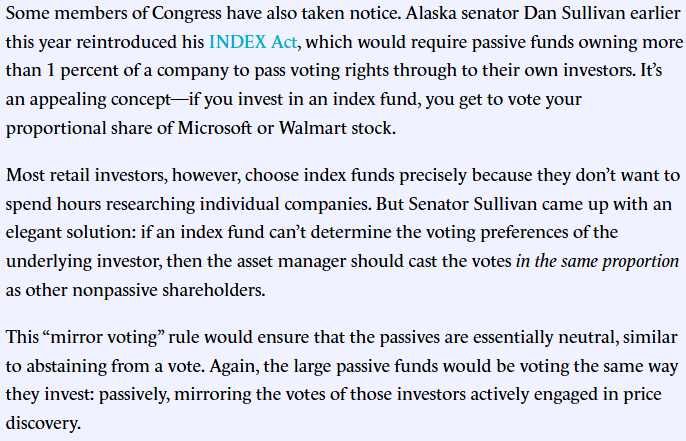
From 2018–21, BlackRock voted to embed CCP committees into Chinese companies' governance structures 74% of the time — while Vanguard did so 1.5% of the time and State Street just 0.04%. Why the inordinate deference to the CCP? Interestingly, in August 2020 "BlackRock became the first global asset manager to obtain a wholly foreign-owned mutual fund license in China." With the license in hand, BlackRock support for CCP embedding dropped to (still relatively high) 55% by 2022. "An event study reveals that the adoption of party-building provisions is associated with negative abnormal returns." Fascinating analysis from Professor Lauren Yu-Hsin Lin. blogs.law.ox.ac.uk/oblb/blog-post…
English
1
1
3
148
Vinnie Tortorich
Vinnie Tortorich@VinnieTortorich·
A doctor drank a petri dish of bacteria to prove every expert wrong. He won the Nobel Prize. In 1982, every doctor on earth knew stomach ulcers were caused by stress and spicy food. Patients were put on antacids for life. Zantac alone was a billion-dollar drug. Nobody questioned it. Then Barry Marshall and Robin Warren found a spiral bacterium called H. pylori living in the stomachs of ulcer patients. They said bacteria caused ulcers. The medical establishment laughed. Bacteria can't survive in stomach acid. Papers rejected. Mocked at conferences. So in 1984, Marshall drank a broth of H. pylori. Within days he was vomiting with severe gastritis. He biopsied his own stomach and proved the bacteria were there, destroying the lining. Then he cured himself with a two-week course of antibiotics. A two-week course of pills replaced a lifetime of antacids. The cure was cheaper than the disease. And that was the problem. The antacid industry was worth billions. A cheap cure was bad for business. It took a decade for the medical establishment to accept what Marshall had already proven with his own body. In 2005, Marshall and Warren won the Nobel Prize in Medicine. Millions of ulcer patients are now cured with antibiotics instead of managed with pills for life. He poisoned himself to save millions. They called him crazy. Follow the money. Question everything. #NSNG #NoSugarNoGrains #QuestionEverything #FollowTheMoney #BigPharma
English
90
1.2K
4.2K
243.5K
Jessica Adams
Jessica Adams@RxRegA·
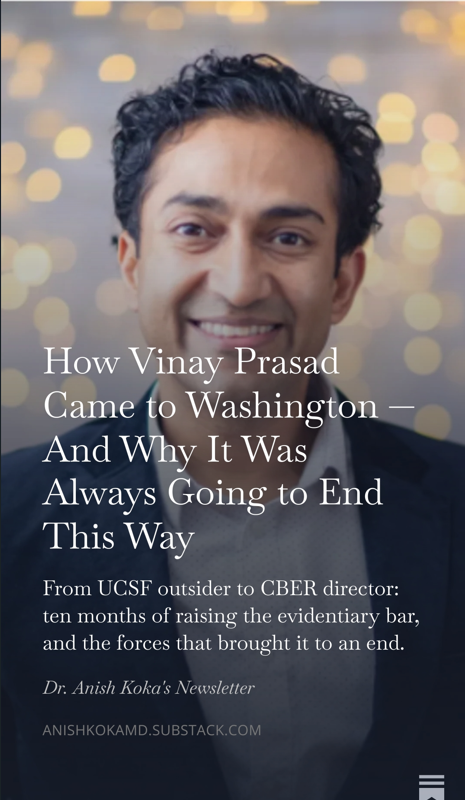
If you’ve been wondering why I can’t let go of the ousting of Vinay Prasad from the FDA, here it is, plain and unvarnished. He was a once in a lifetime hire. Prasad was one of the strongest appointments the agency has ever made, and the FDA should have fought like hell to keep him. That doesn’t mean I agreed with every call. For example, I support advisory committees. But it’s worth noting that advisory committees were already in decline prior to his appointment. Besides, disagreement with one aspect does not negate the whole. The failure to retain Prasad was a consequential mistake; it signals exactly how the agency, the media, and the investor class handle serious challenges to the status quo. And the backdrop makes it worse. Prasad walked into the CBER director’s office after a truly rough stretch in FDA history: overly broad use of COVID vaccines, with related resignations of two top vaccine officials, Paxlovid cheerleading, Elevidys and Aduhelm debacles, and misguided misinformation-policing, among others. This stretch had eroded public trust. He inherited a scarred institution, and the expectation was that he would challenge the status quo and repair the perception of the FDA as acting merely as a rubber stamp. What’s been maddening to watch is the yawning gap between what everyone claims to want, like higher evidence standards, fewer weak approvals, more appropriate use of accelerated approval, and how violently the system recoils the moment someone tries to deliver it. Modest, data driven moves were treated like heresy. The loudest critics rarely engaged the substance; they only amplified an outrage coming squarely from the perspective of pharma and investor interests. A clearer accounting of what actually changed and what didn’t during the time Vinay Prasad was at the FDA is still worth laying out. Accomplishments included the COVID vaccine framework, the Elevidys label narrowing, and proposing to strengthen CBER research and vaccine standards more generally. The Moderna flu vaccine refuse to file decision was an example of using an unconventional approach. It was resolved quickly in a manner that will result in better evidence generation, but with much media fanfare. And worth noting: not all of his accomplishments were around tightening standards. He co-authored significant approaches to introduce regulatory flexibility and support true innovation: formal guidance documents for the new plausible mechanism pathway and Bayesian methodology. Both of these are being praised, but no one is bothered that a key architect on these projects is leaving the FDA? Not to mention the single trial paper. Instead, the public narrative chose to fixate on three leadership overrides, endlessly framed as “chaos” or a break from sacred norms. Conveniently omitted: every single override aligned decisions with the new COVID vaccine framework that Prasad had developed to navigate uncertainty without rubber stamping. Approval volume stayed roughly in line with historical norms. Rare disease decisions weren’t some override spree; they were part of long running debates over accelerated approval pathways that predate Prasad by years. Reasonable people can quarrel over individual calls. What’s indefensible is pretending the record was defined by recklessness rather than a short, intense effort to tighten standards in an agency long accused of being too cozy with industry. ...
English
22
30
207
25K
Paul Slobodian
Paul Slobodian@Chenango21·
@BrentAWilliams2 My friend in Med. Adv. thinks he has autism and would like to find a program that kicks back money to him monthly for enrolling just like Medicare Advantage does. (He doesn’t live in Minneapolis).
English
0
0
0
39
Brent A. Williams, MD
Brent A. Williams, MD@BrentAWilliams2·
Get rid of Medicare Advantage, MACRA, MIPS, CMMI, etc., and stop privileging huge hospital systems over independent physicians.
Secretary Kennedy@SecKennedy

At HHS, we reject the idea that our health system is too broken to fix. Today, @DrOzCMS and I are announcing a new Healthcare Advisory Committee—top experts from across the country coming together to provide insight on how to cut costs, reduce red tape, and put patients first. Real reform starts now.

English
13
35
177
11.4K
Paul Slobodian รีทวีตแล้ว
Sama Hoole
Sama Hoole@SamaHoole·
In 1953, Ancel Keys published a paper showing a relationship between dietary fat consumption and heart disease mortality across six countries. The relationship was striking. The graph was compelling. The problem: Keys had data from twenty-two countries. He selected six. The six that supported his hypothesis. If you plot all twenty-two countries, the relationship disappears. This was pointed out at the time, by Yerushalmy and Hilleboe in 1957, in the American Journal of Public Health. Keys was aggressive in dismissing the criticism. He was influential enough to make it stick. He later chaired the committee that wrote the American Heart Association dietary guidelines. The guidelines blamed fat. The guidelines became government policy. The government policy became the food pyramid. The food pyramid became what your grandmother was told to eat. It began with a man who had twenty-two data points and published six. Everything downstream: the statins, the low-fat products, the LDL obsession, the dietary guidelines your doctor is still referencing, traces back to that selection. Cherry-picking doesn't usually have this kind of legacy. This one did.
Sama Hoole tweet media
English
29
266
839
24.3K
Paul Slobodian
Paul Slobodian@Chenango21·
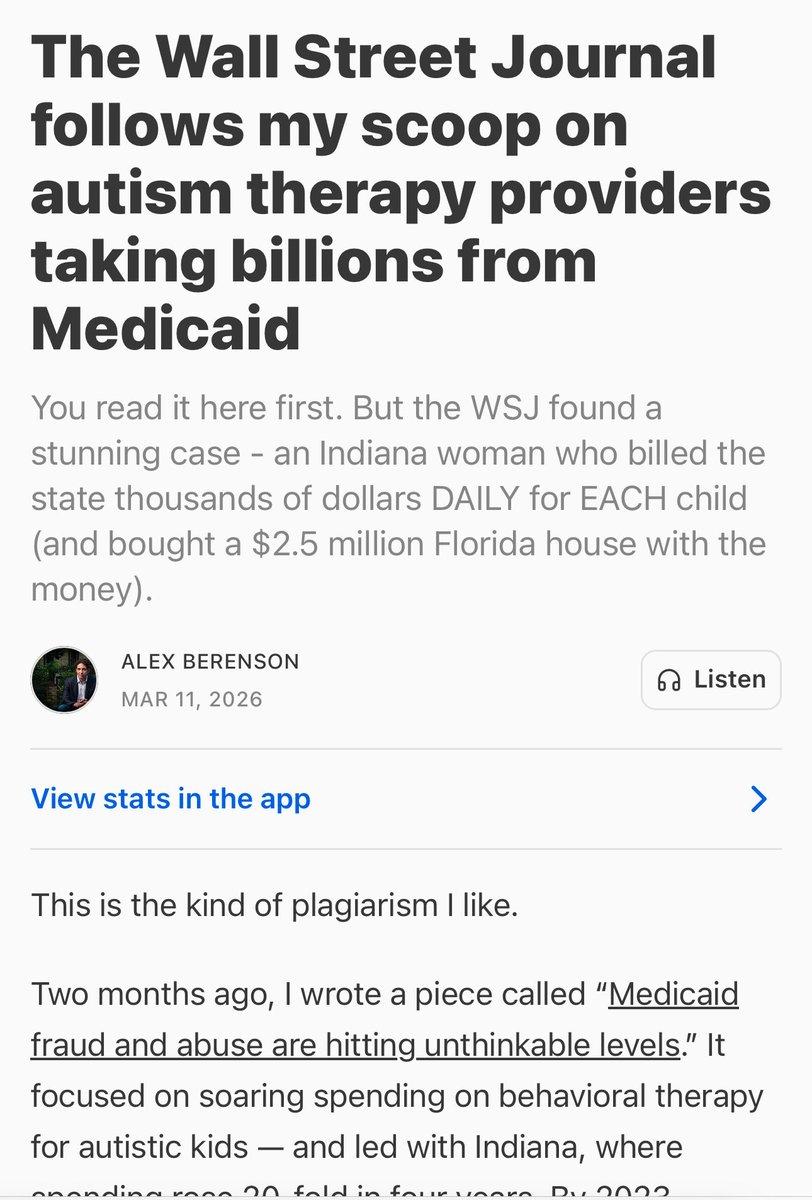
@AlexBerenson @WSJ It should be a standard practice for journalists to cite/credit journalists who did consequential work prior to their own piece.
English
0
0
1
60
Alex Berenson
Alex Berenson@AlexBerenson·
New Unreported Truths: @WSJ follows me with a great piece about abuse in Medicaid autism programs
Alex Berenson tweet media
English
6
19
130
15.3K
Anish Koka, MD
Anish Koka, MD@anish_koka·
Better things to do than spend Saturday morning writing this, but important since there aren't enough actual journalists who can do their job. (link in reply)
Anish Koka, MD tweet media
English
30
49
309
29.1K
Paul Slobodian
Paul Slobodian@Chenango21·
@drjohnm @anish_koka Koka and Mandrola are my cardiologists, though I have never seen a cardiologist. When my primary care doctor said I should see one I declined as I have no symptoms, but if I ever have symptoms I said I’d try to see Koka or Mandrola!
English
1
0
5
606
Paul Slobodian รีทวีตแล้ว
Dutch Rojas
Dutch Rojas@DutchRojas·
If the WSJ understood healthcare economics… Mr. Tucker is right on the diagnosis. And the cure is simpler than lawmakers and government appointed experts want to admit. Republicans could collapse healthcare premiums today if they chose competition over protectionism. Here’s how: 1.Let physicians compete. End the moratorium on the 200-plus physician-owned hospitals that were frozen by statute, not market failure. 2.Kill Certificate of Need laws in the remaining 35 states and Washington, D.C. They exist to block entrants, not protect patients. Looking directly at you Minnesota, Kentucky, North Carolina, New York, and Washington D.C. 3.Enforce price transparency. Not guidance. Not pilots. Enforcement. Capital markets and tech can wrap this up in 12 months. 4.Eliminate site-of-service arbitrage. Same care, same price, regardless of whether it’s delivered inside or outside a health system. 5.Revoke nonprofit status from the 212 health systems that take more in subsidies than they return in actual community benefit. 6.Stop the $275 billion annual taxpayer transfer to health systems while independent physicians and clinicians get crowded out. 7.Lift the residency cap from the 1997 Balanced Budget Act and allow independent practices to train residents, not just consolidated systems. Once this is done then go on offense. The United States of America could be the greatest nation for global healthcare. Pay off all our debt and give our children hope and economic freedom.
Jeffrey A Tucker@jeffreytucker

Republicans could FIX this today, and immediately, by 1) allowing insurers to offer REAL catastrophic plans, not fake ones with preventive mandates, 2) permitting universal unlimited HSAs, and 3) allowing premiums to adjust downward for reduced individual risk. wsj.com/health/healthc…

English
30
191
768
48.2K
Andy froemel
Andy froemel@FroemelAndy·
@EricLDaugh @nickshirleyy We all owe Nick Shirley a debt of gratitude. He exposed rampant fraud that went undetected for years. This will inspire other citizen journalists to do the same.
English
1
0
1
152
Eric Daugherty
Eric Daugherty@EricLDaugh·
🚨 JUST IN: Minneapolis man THANKS Nick Shirley for exposing the fraud in Minnesota "This is crazy! I'm glad you are bringing light to it. It is a CRAZY situation!" AMERICANS support locking up the people stealing from Americans. @nickshirleyy
English
38
282
1.5K
34.1K