Darryl Grauman
2.6K posts

Darryl Grauman
@DarrylGMan
Strategist, Mentor, Investor, Tech Geek, AI Nerd,MMA Coach, Kettlebell Fanatic, Blockchain Enthusiast, Dad, Big Kid.

Auckland, New Zealand เข้าร่วม Mayıs 2010
969 กำลังติดตาม654 ผู้ติดตาม

@traskjd Tried yesterday. Hallucinated the completion of work. Went back to Gemma.
English

If you’ve got more than 20GB of VRAM handy, you *gotta* try this model.
Spotting tokens about twice the speed of Claude/GPT, and smarts seems comparable.
Throw it into LMStuido, it’s great.
Doug Rathbone 🦘🇦🇺👨💻@dougrathbone
Its becoming clearer that future computer work will be achievable with the help of local AI models. Playing with Qwen 3.6 on a local 4090 and i'm getting 110tok/s. Answers seem indistinguishable from Claude.
English

@winstonpeters Maybe someone should read the room and look at the petrol price (vs cost of crude oil).

English

NZFirst Campaign Policy Announcement: NZFirst Will Break Up the Supermarket Duopoly, Bring Food Prices Down for Kiwis
New Zealand First is today announcing an election policy to end the supermarket duopoly - breaking their stranglehold, backing kiwi suppliers, and delivering fairer prices at the checkout for kiwi families.
For too long, New Zealanders have faced rising grocery bills while Woolworths and Foodstuffs control more than 80 percent of the grocery market. The Commerce Commission has previously found those supermarket giants earning around $1 million a day in excess profits.
Meanwhile kiwi families are choosing between heating and eating.
The massive imbalance is being felt across the supply chain - recently a grower received just 60c per kg of peas, while those same peas retail for as much as $5.79.
The current system sees job losses and uncertainty hit food producers such as McCain Foods and Heinz Wattie's - it means less for producers, less for workers, and more pressure on families.
New Zealand First will introduce legislation to reform the system and break up Foodstuffs into two nationwide cooperatives based on brand: one for New World and Four Square, and another for Pak’nSave - putting both in direct competition with Woolworths New Zealand.
Real competition means real pressure to lower prices, improve value, and treat suppliers fairly.
Our policy will include tougher penalties, faster investigations, and real enforcement powers for the Commerce Commission - penalties for serious breaches will be lifted to match Australia, including fines of up to $10 million, three times the gain, or 10 percent of turnover.
The role of the current toothless Groceries Commissioner, belatedly established by Labour in 2023, will also be reformed giving the position the proper powers to investigate, make binding decisions, and impose penalties directly - not just sit on the sidelines and give warnings.
We will also address the supermarket giants’ stranglehold over who gets access to the shelf and who doesn’t.
When they control the pathway from farm to shelf, they control the price.
A new framework for industry rules will be introduced under the Commerce Act 1986, allowing targeted action to fix competition problems more quickly without waiting for lengthy legislative change – it will ensure kiwi producers are no longer pushed out or squeezed off the shelf by a system that favours the biggest players.
The days of easy profits and zero accountability for the supermarket giants need to end.
Hardworking kiwis need real action to tackle the price of food at the supermarket.
English

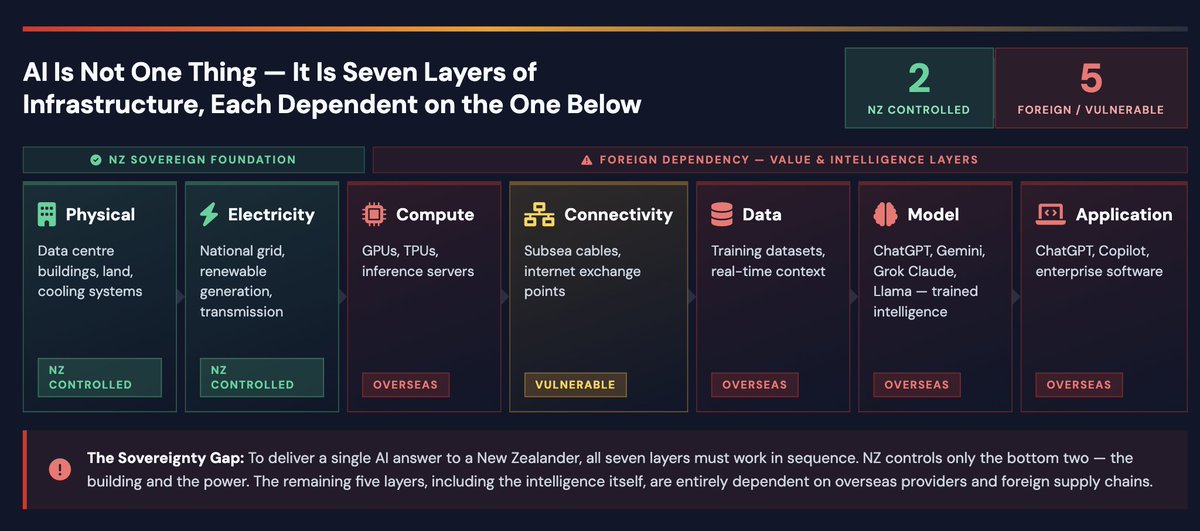
Here's the reality check on NZ's AI infrastructure position.
🏗️ WE CONTROL: Layers 1-2 (Physical buildings + Electricity grid)
✈️ WE FLY BLIND ON: Layers 3-7 (Chips, Cables, Data, Models, Applications)
Every input to ChatGPT, Claude, Gemini, or Grok - whether direct or via MS Copilot - gets sent overseas for processing.
This isn't theoretical - it's our current reality.
The slide visualises why we need to think beyond just 'building more data centres' and think about sovereignty across the entire AI stack.
If this doesn't become a 2026 election issue, then we have our heads in the sand. Let me know if you want to see some more of the deck or if its too boring.
#AINZ #AIInfrastructure #DataSovereignty #TechPolicy #NZTech

English
Darryl Grauman รีทวีตแล้ว

I just finished a slide deck for a talk I’m giving on Monday
For NZ, AI is one insight that should shift how we think about the 2026 election:
We don’t just lack AI infrastructure—we fly blind on 5 of the 7 layers of the AI stack. NZ controls only the physical buildings and electricity grid. We don’t control the chips, cables, data, models, or applications.
Kinda like discovering we’ve outsourced 100% of our fuel refining and have zero reserve.
This isn’t hypothetical, every input to ChatGPT or Anthropic (direct or via MS Copilot), Gemini or Grok is sent overseas.
Full breakdown (7-layer model, and cost of inaction) coming Monday once I’ve read it through a few more times with fresh eyes.
English

@haydenbreese @Peter_J_Beck Lol. Advanced AI features like trading, human-like voice conversations etc will still have latency issues - but Elon will find a way in a few years.
English

@DarrylGMan Yes indeed. Land based energy bottleneck is a problem. Shall we talk to @Peter_J_Beck and see if he will deploy some NZ Ai chips into orbit? Wait we need a Fab…
English
Darryl Grauman รีทวีตแล้ว

Yes but our power infrastructure presently can’t support it. If Datagrid was running at full capacity there would be a deficit between generation and consumption. And because the electricity markets regulate on what is called marginal pricing.
Generators submit offers into the market each half-hour, stating how much electricity they can supply and at what price. The system operator (Transpower) stacks these offers from cheapest to most expensive. The price is then set by the last (most expensive) generator needed to meet demand at that moment. Every generator dispatched in that half-hour receives that same clearing price, regardless of their own offer price 🤦🏼♂️.
So if Datagrid is running at 1GW then every single home and business is going to have to bear a massive electricity cost increase due to the volume of fossil fuel imports as well as probable power cuts.
So it doesn’t stop at the DC level. It’s a larger issue.
English

New Zealand has an opportunity to play a role in the Ai era. Foundation models need big capital. Open source models arguably can be made for less for example, eg. China. We need infrastructure and entrepreneurs. We need more of datagrid.nz. The sentiment is on point. We are a small country and benefit from innovations from around the world. Sometimes the world benefits from us too… rocketlabcorp.com We all need to be more capable at home because we cannot always rely on a disrupted world.
English

@brnnnmcdnld It’s going to get worse. Sorry to say.
x.com/darrylgman/sta…
Darryl Grauman@DarrylGMan
English

@JosephMooneyMP It’s not going to get any better.
And the big issue is that short term election cycles will just push the can down the road.
Darryl Grauman@DarrylGMan
English

It’s been interesting hearing Opposition Leader Chris Hipkins saying that the closure of the Marsden Point refinery was a “private business decision.”
While strictly correct, it omits significant government policies and decisions which made that “private decision” the only realistic one. I haven’t seen any media commentary on this.
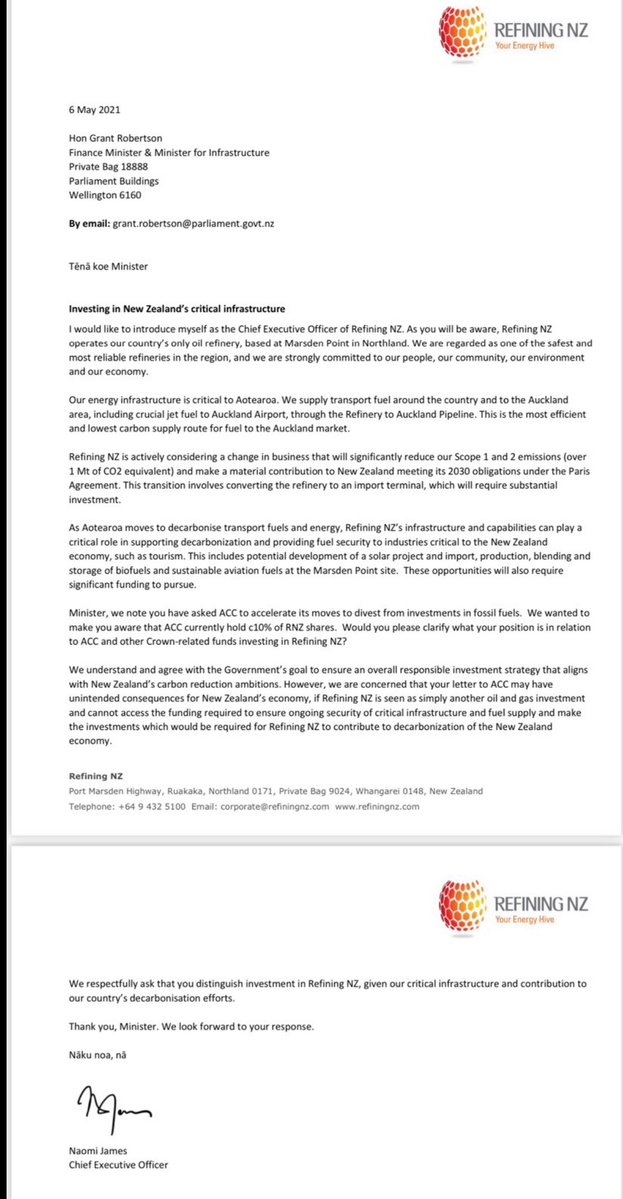
A May 2021 letter from the Refinery’s CEO to the then Minister of Finance described Marsden Point as one of “the safest and most reliable refineries in the region.”
Notwithstanding that, the letter said it was considering a major change to its business to significantly reduce its Scope 1 and Scope 2 emissions, and become an import only terminal. It noted that the Minister had directed ACC to accelerate moves to divest from fossil fuels. The letter noted that ACC held around 10% of Refining NZ’s shares, and as significant investments would be required to change it into an import only terminal, it asked the Minister to distinguish investment in Refining NZ from other fossil fuel investments given its critical infrastructure role.
But why was Refining NZ looking at shutting down its refinery despite being one of the “safest and most reliable in the region”?
A 2019 Ministry for the Environment Regulatory Impact Statement lays it out plainly.
Refining NZ’s Negotiated Greenhouse Agreement - protecting it from full ETS exposure since 2003 - expired 31 December 2022. Under government policy settings it would then receive zero industrial allocation and face the full cost of its emissions. The ministry’s own analysis said this would “nearly halve the profitability of the refining business” - at 2019 prices of just $18 per NZU, it would produce an annual ETS bill of ~$20 million.
The RIS recorded Refining NZ’s profits over five years:
∙2012: $31M
∙2013: -$5M (a loss)
∙2014: $10M
∙2015: $151M
∙2016: $47M
Average that out and you get roughly $47M per year (with an exceptional 2015 year).
The ministry itself said full ETS exposure would nearly halve profitability even at $18/unit.
NZU prices didn’t stay at $18 which was readily foreseeable.
The NZU price hit a record high of $88.50/unit in late 2022.
Applied to the Refinery’s Scope 1 emissions of 1 to 1.3 million tonnes per year, that’s an annual ETS liability of $88.5M to $115M, and that’s before Scope 2 costs on purchased electricity and gas.
On a business losing money in bad years, a potential $100M+ annual carbon bill isn’t a headwind. It’s a death sentence.
The ministry knew this in 2019, and suggested options the government could take in terms of emissions liabilities to keep the refinery in operation, warning:
“The closure of Refining NZ, which employs approximately 300 people, would have a
significant negative impact on the Northland economy and would leave New Zealand
dependent on the supply of refined petroleum products sourced from overseas refineries that may choose to prioritise supply to other nations ahead of New Zealand at times of shortages.”
Read the Ministry’s RIS for yourself (that specific comment is at paragraph 25) 👇
environment.govt.nz/assets/Publica…

English


Fact:
Marsden Point was the only place in NZ that turned crude oil into usable fuel.
Labour closed it & it’s a storage now.
They sacrificed NZ for globalist control agenda of “climate change”
Disaster really, NZ’s interest should always come first.
New Zealand First@nzfirst
Winston Peters: New Zealand First believes in energy security. It underpins everything.
English

@kaiviti_cam If they could all look past their noses to how the future may play out.
Darryl Grauman@DarrylGMan
English

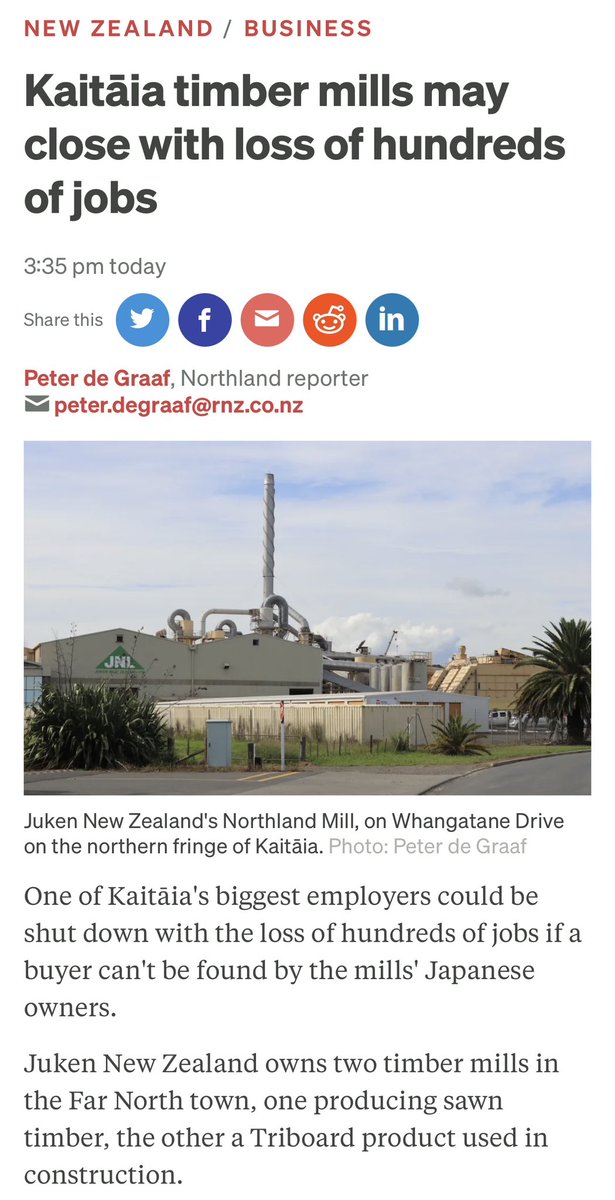
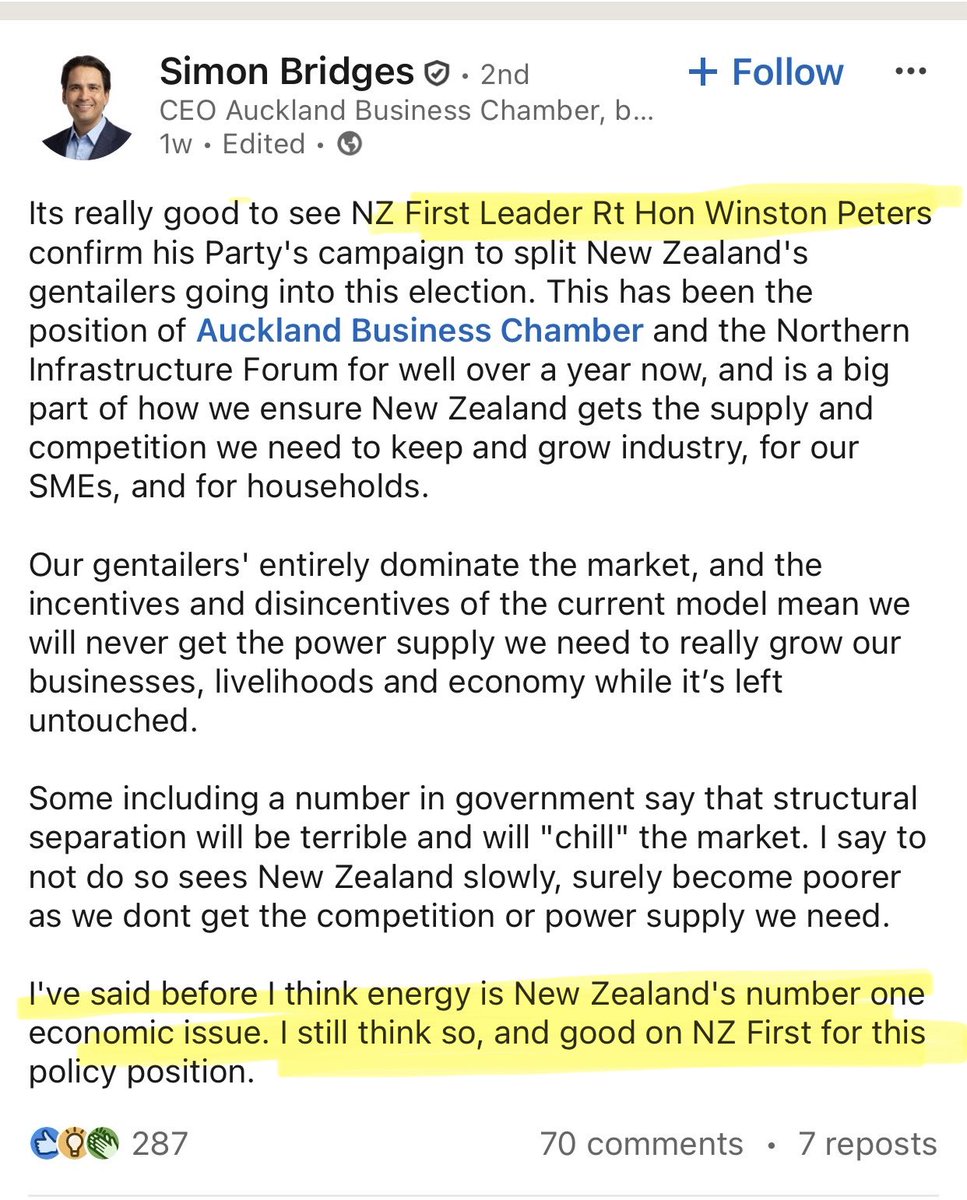
One of Kaitaia’s largest employers, set to close with the loss of hundreds of jobs. Why? - the usual story : HIGH ELECTRICITY PRICES.
This is exactly why the gentailers need to be busted up as per NZ Firsts’ policy.
Luxon and Seymour are dead set against the reform and Seymour wants to sell off the remaining govt ownership in the power companies.
This is why Simon Bridges is supporting WP, NZ is quickly de-industrialising, Luxon thinks Robbie Williams concerts will build an economy.
NZ has a massive energy problem. We are run by ideological muppets.


English

@GadSaad This is the result of a country engulfed in Suicidal Empathy:
x.com/DarrylGMan/sta…
Darryl Grauman@DarrylGMan
English

New Zealand! I see you.
discover.aucklandlibraries.govt.nz/search/card?id…
English

So sitting with a broken foot this weekend, I ran out of Claude and Codex tokens; so I decided to write, AI assisted of course.
Have a look at my first X article which contrasts the current fuel crisis to some crystal ball gazing and NZ's hopelessly insufficient AI strategy.
#nzpol
Darryl Grauman@DarrylGMan
English