
DevRev

1.6K posts

DevRev banner
DevRev

DevRev

@devrev

We built Computer, your AI teammate. Working together, we can make work faster, smarter – and even a bit more fun.

Palo Alto, CA เข้าร่วม Şubat 2009
49 กำลังติดตาม3.2K ผู้ติดตาม
DevRev
DevRev@devrev·
$7 trillion is the prize. But it doesn't go to everyone. It goes to the platforms where AI doesn't just sit on data – it acts on it. Where a support signal feeds product. Where a renewal risk surfaces before the customer calls. The growth is real. The question is who the context belongs to.
English
0
0
0
3
ARK Invest
ARK Invest@ARKInvest·
"Given the productivity promise, we believe global enterprise software revenue should scale 38% at an annual rate during the next five years, from $1.4 trillion today to $7+ trillion, all AI-driven, in 2030." More in this week's newsletter ⬇️
ARK Invest@ARKInvest

x.com/i/article/2036…

English
1
4
26
16.3K
DevRev
DevRev@devrev·
The multiples collapsed. The need didn't. Companies still have tickets, customers, renewals, and product decisions to make. The question isn't whether software survives – it's whether the next layer knows your company as well as your best employee does. That's the bar AI-native has to clear. Most don't.
English
0
0
0
4
Vlad 👾
Vlad 👾@vladsvitanko·
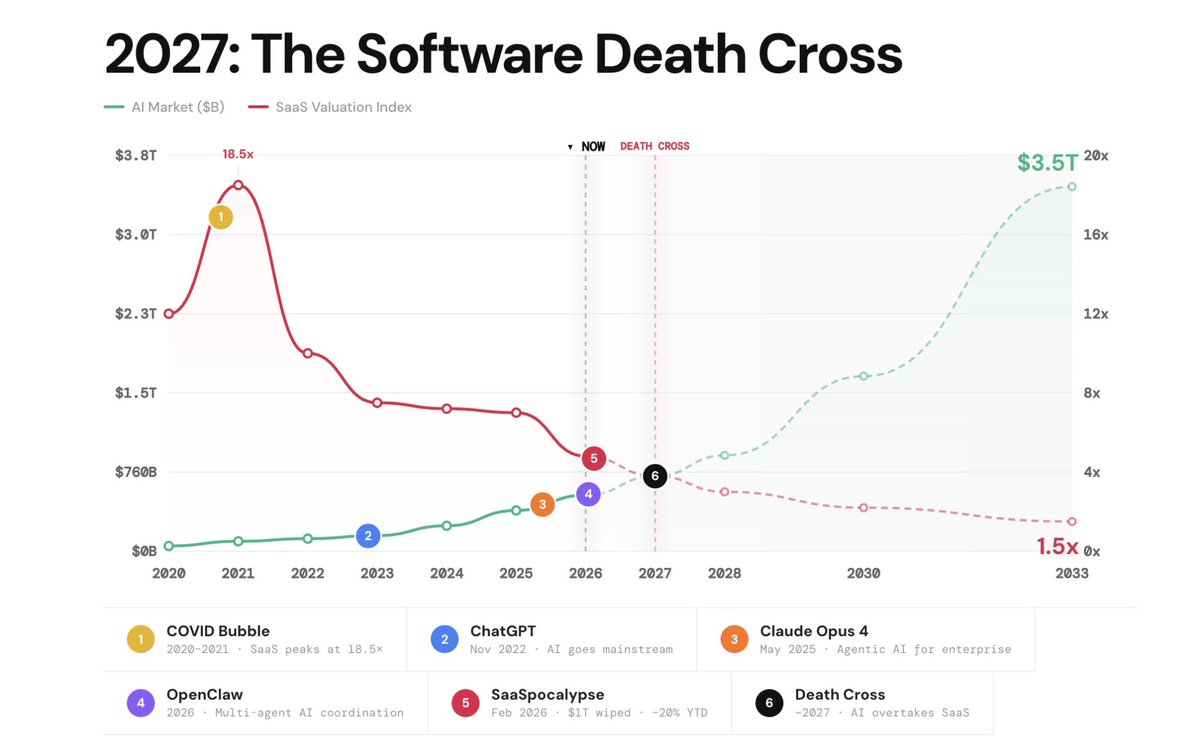
We're only 70 days into 2026 and AI has already killed 50% of SaaS companies. And it seems this SaaSpocalypse just started.. > $2 trillions wiped out from software stocks > SaaS multiples collapsed from 18.5x to 4.7x today > $50/seat subscription fatigue is real > you can vibecode any soft you want for free in Claude By 2027, we'll reach the point of "Software Death Cross." Which basically means that bye-bye to EVERYTHING, except AI giants. Look, Anthropic & OpenAI & Perplexity & others are dropping new features every day. So far i've seen: - claude replaced cybersecurity audits with just one feature - google genie is killing gaming companies (stocks -$15B in hours) - video models like kling are replacing human content creators - perplexity computer becoming an ultimate co-pilot for everything ... and also just 12 hours ago claude launched FREE diagrams & interactive chats You're literally one feature away from being destroyed by Claude. "when the intelligence is abundant, tech becomes obsolete" So your only way to survive is this: 1. Business model. SaaS is shifting to SaaA (software as an agent). Instead of paying $49/seat, you'll pay $0.009/task. 2. Build a strong distribution moat. Community & IRL is the new sexy. 3. Plug & Play. Next 12 months, we'll be using ChatGPT (for example) to log in anywhere (instead of gmail today). Apps will have a full context about the user. 4. Pivot to vertical API infra that 1000s of apps are using not even knowing about it. Good luck, i am rooting for you. PS.: software death cross by 2027? 👀 - VS.
Vlad 👾 tweet media
English
41
23
48
1.2K
DevRev
DevRev@devrev·
The brain metaphor is right, but incomplete. A brain without memory of the patient's history isn't useful. An AI agent without shared context across support, product, and ops isn't a teammate – it's a very fast autocomplete. The commodity isn't the software. It's the context-free agent.
English
0
0
0
8
Rohan Paul
Rohan Paul@rohanpaul_ai·
Satya Nadela is basically describing the death of the traditional SaaS model. Explains the AI agentic future, and where the "value" lives. Because business logic is moving from the software application to the AI agents. Currently, you buy software for its specific features and rules. Nadella argues that in the future, software apps will essentially become dumb databases ("CRUD") or simple tools. The AI Agent will hold all the intelligence, orchestration, and reasoning, simply updating the databases as needed. The software becomes a commodity; the AI becomes the "brain" and the worker. ----- Video from Bg2 Pod Youtube Channel (link in comment)
Rohan Paul@rohanpaul_ai

Bloomberg: Microsoft is heading for its worst quarter since 2008 as 2 AI fears hit at once. - Heavy AI spending without clear revenue payoff, and - Frontier model builders like OpenAI and Anthropic threatening parts of its core software business. --- bloomberg. com/news/articles/2026-03-27/microsoft-set-for-worst-quarter-since-2008-as-ai-takes-two-bites

English
116
112
815
177.7K
DevRev
DevRev@devrev·
Most enterprise AI fails before it starts. Not because the model is bad. Because the data is a mess. Siloed tools. Disconnected teams. No shared context. You can't build a smart teammate on a dumb foundation.
English
0
0
0
46
DevRev
DevRev@devrev·
@ForbesCoaches Honestly the accountability gap is what keeps us up at night too. Speed is easy to sell. Governance is the harder conversation and the more important one 100%
English
0
0
0
19
Forbes Coaches Council
Forbes Coaches Council@ForbesCoaches·
AI Tool Or AI Teammate? How Leaders Must Redesign Accountability In The Age Of AI Agents hubs.li/Q049CDPF0 Written by Samuel Rodrigues of Autonomo
English
1
1
1
42
DevRev
DevRev@devrev·
@SingulrAI was scaling fast. But the work? It was everywhere. Email threads. Slack messages. Calls. Docs no one remembered creating. Hours went into preparing updates – not solving problems. They didn’t need another tool. They needed clarity. So they chose DevRev. Build, support, and customer conversations came into one place. Feedback flowed straight into feature work. Nothing slipped through the cracks. Customer checkpoints stopped being status theatre. They became real conversations. The shift was immediate. More time building. Less time stitching context together. And customers could see progress without asking for it. Turns out, when context is shared – everything moves faster. Read the full case study: dvrv.ai/4e1KPmv
DevRev tweet media
English
0
0
0
48
DevRev
DevRev@devrev·
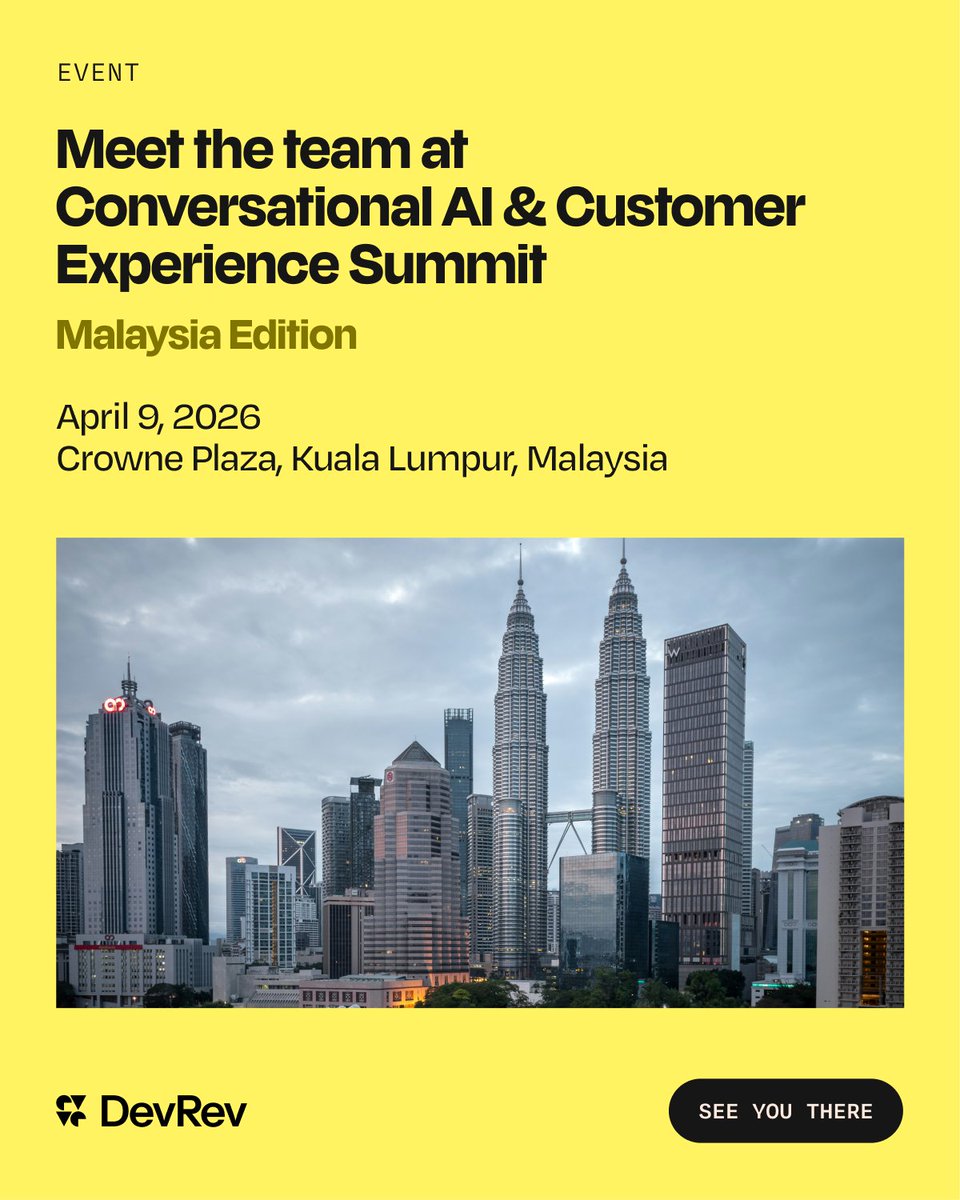
Most AI speeds up the work. It doesn't fix it. We're at Conversational AI & Customer Experience Summit - Malaysia Edition on April 9 because we think that's worth changing. Context gets lost. Conversations don't become outcomes. Teams are left piecing it all back together – manually, again. Computer is built to close that gap. Not as a tool. As a teammate. Come see us at booth #4, or book time with our team ahead of the event. Work's broken. Let's actually fix it: dvrv.ai/3PF2eHK
DevRev tweet media
English
0
0
0
78
DevRev
DevRev@devrev·
This is a massive win for the @Polkadot ecosystem for sure..! AI is only as powerful as the data it can actually "see." At DevRev, we’re obsessed with this exact problem of connecting disparate data (docs, support, and code) into a unified context so AI agents don't just guess, they know. Great to see more builders prioritizing structured context!
English
0
0
1
197
Polkadot Devs
Polkadot Devs@PolkadotDevs·
AI is only as good as the context it can access, and @Polkadot docs are now available via Model Context Protocol (MCP), giving AI agents direct access to real, structured developer knowledge. No scraping or guesswork. Just source-of-truth context. 🔗#connect-via-mcp" target="_blank" rel="nofollow noopener">docs.polkadot.com/ai-resources/#…
Polkadot Devs tweet media
English
2
13
105
2.6K
DevRev
DevRev@devrev·
Hot take: the biggest AI bottleneck in your company isn't the technology. It's the 14 tabs your support team has open right now. What's the most ridiculous tool-switching moment you've witnessed at work?
English
0
0
0
85
DevRev
DevRev@devrev·
@migoya Growth will come from platforms where AI is not layered on top of the data, but built into it. Unified, aware of context, and able to act.
English
0
0
0
10
Martin Migoya
Martin Migoya@migoya·
Enterprise software is on the verge of another transformation. First came custom software: highly differentiated, built to fit. But expensive to maintain and hard to scale. Then SaaS took over: lower maintenance, continuous updates, greater efficiency. But also rigid cores, underused features, and roadmaps driven by vendors. We gained efficiency, but lost differentiation. Now we’re entering a third phase: AI-native services. AI fundamentally changes the economics of maintenance. When intelligent agents can generate, test, deploy, and continuously evolve code at a fraction of historical cost, the old trade-off breaks down. For the first time, companies can combine true customization with subscription economics. Software designed around your workflows and data, yet continuously maintained and improved at scale. This also changes what we mean by “services.” Services were never just manual work. They were human-scale work: revenue scaled with headcount, margins scaled with utilization. AI changes the lever. The next generation of services is human-led and AI-accelerated, architecturally repeatable, continuously evolving, and outcome-oriented rather than hour-based. At Globant, this shows up in AI Pods: AI-powered service units that design and continuously evolve living enterprise systems. Living software delivered as a service. There is no SaaS apocalypse. Standard platforms will remain massive businesses and critical pieces of enterprise infrastructure. But for many use cases, a smarter alternative now exists. Custom software gave us differentiation. SaaS gave us efficiency. AI-native services bring both together. The services industry isn’t going away. It’s being upgraded.
English
33
57
279
46.1K
DevRev
DevRev@devrev·
SaaS is not going anywhere. But what survives will look very different from what we see today. The platforms that win will not be the ones that layered AI onto existing workflows. They will be the ones that asked a harder question: what does the product look like when AI does most of the work? That shift forces a reset. Pricing has to change. The definition of value has to change. And the incentive structures need a hard look. A support platform should not benefit from more tickets. A CRM should not benefit from more data entry. The business model has to align with customer outcomes, not the volume of their problems. SaaS will survive. But only the version that is honest about what it is actually selling.
English
0
0
1
14
GREG ISENBERG
GREG ISENBERG@gregisenberg·
This is how the $1.3 trillion SaaS apocalypse will actually play out 50% of SaaS companies will die. Not because AI killed them, but because they refused to kill parts of themselves. The companies that can't imagine cannibalizing their own business models will disappear first. The project management tool that charges per seat but won't build AI that reduces headcount. The customer support platform that bills by ticket volume but won't create AI that slashes ticket numbers. The marketing automation tool that charges by contact count but refuses to build AI that makes small teams as effective as large ones. The analytics platform that sells dashboards instead of insights and can't imagine a world where the questions get answered automatically. They'll cling to outdated pricing models while watching their customers leave for competitors who understand that AI isn't a feature, it's a fundamental shift in how software delivers value. The SaaS companies that survive will do something counterintuitive: they'll actively work to make their traditional metrics look worse in the short term. THE REALITY THAT NO-ONE IS TALKING ABOUT: SaaS companies of today are the AI companies of tomorrow. They'll build AI that reduces the number of users needed, automates tasks they used to charge for, and eliminates entire categories of problems they once solved. They'll find new ways to capture value that align with the efficiency they're creating. The best SaaS companies sell solutions to specific problems in specific industries. Those problems don't disappear with AI. If anything, they just get solved more elegantly. Shopify won't be replaced by an AI shopping assistant, they'll build it themselves. HubSpot won't be killed by AI content tools, they'll integrate them so deeply you'll forget they weren't always there. You even have the founder of hubspot incubating his own agent companies. My updated thinking on SaaS and AI is this: In 5 years, we won't talk about "AI companies" vs "SaaS companies". Just like we don't distinguish between "internet companies" and "companies" anymore. SaaS isn't going to die. SaaS is just going through puberty.
Ben Lang@benln

Sold all my public SaaS stocks. It's been real. Assuming Cursor and Manus are only going to get better from here, it's all downhill for SaaS from here.

English
98
127
1.2K
259.8K
DevRev
DevRev@devrev·
@samrithshankar @tarunsachdeva @badlogicgames We heard someone say 'Team intelligence' and we absolutely couldn't scroll past. That's our whole thing. The idea that AI should make your team smarter and not just you.
English
0
0
0
26
Samrith Shankar
Samrith Shankar@samrithshankar·
@tarunsachdeva @badlogicgames This is something we’ve been struggling at work, and one of the goal is to enable “team intelligence”. This is a solid way to do that.
English
2
0
1
143
Mario Zechner
Mario Zechner@badlogicgames·
we as software engineers are becoming beholden to a handful of well funded corportations. while they are our "friends" now, that may change due to incentives. i'm very uncomfortable with that. i believe we need to band together as a community and create a public, free to use repository of real-world (coding) agent sessions/traces. I want small labs, startups, and tinkerers to have access to the same data the big folks currently gobble up from all of us. So we, as a community, can do what e.g. Cursor does below, and take back a little bit of control again. Who's with me? cursor.com/blog/real-time…
English
178
321
2.5K
258.4K
DevRev
DevRev@devrev·
This might be one of the most honest observations in B2B right now. The AI actually resolving tickets is not coming from the platform that owns the customer relationship. It is coming from tools built for agents from day one. Not retrofitted later. Because in the end, the data model matters more than the brand.
English
0
0
0
26
DevRev
DevRev@devrev·
Your brand spends years earning trust. Your support stack can undo it in a single interaction. This is the problem Arvind Fashions Limited – home to Tommy Hilfiger, Calvin Klein, and USPA – decided they could no longer accept. Five brands. Customer queries arriving across web, app, and WhatsApp. An OMS, IMS, and POS with no shared data. Agents working without a unified view of the customer in front of them. The gap between what those brands promised and what support delivered wasn't a staffing problem. It was an architecture problem. And they fixed it at the root. On April 23, Aviral Gupta from Arvind Fashions Limited walked through exactly how – what drove the decision, how the migration was managed, and what's running now. Shamanth Kengeri from DevRev will demonstrate the platform live. 30 minutes. If your support experience doesn't match your brand experience, this one's for you. Register now: luma.com/9illnia1?utm_s…
DevRev tweet media
English
0
0
0
83
DevRev
DevRev@devrev·
This is exactly what we obsessed over. You can't have smart agents without a living knowledge graph – one that updates when a ticket closes, when a customer churns, when a product changes. The hard part isn't the idea. It's keeping the graph current. Bidirectional sync is where most teams give up.
English
0
0
0
19
DevRev
DevRev@devrev·
Every enterprise AI deployment story we've heard starts the same way: "we thought it would take 6 weeks." The culprit is never the model. It's the data access, the permissions, the "whose Jira is the source of truth" conversation. Speed to deployment is a product decision, not a services one.
English
1
0
1
44
DevRev
DevRev@devrev·
@levie This is right. But the part nobody's solving: the agent filling out your CRM note has no idea the same customer just filed a P1 ticket. Support, product, and sales still live in different worlds. The next unlock isn't more agents. It's shared context across all of them.
English
0
0
0
22
DevRev
DevRev@devrev·
It’s time for #ThrowbackThursday. We found this in our camera roll… and safe to say, no one stayed in the colour-free zone 🌈 No meetings. No threads (for a while). Still, everything kept moving. Good thing Computer had our backs. 10/10 chaos. Would deploy again. #DevRev
English
0
1
1
132
DevRev
DevRev@devrev·
Couldn’t make it to Effortless Mumbai? 🇮🇳 That probably wasn’t a choice. Most teams are stretched thin, and stepping out for a full day isn’t easy. But here’s the thing. What we saw in that room is exactly what most teams are struggling with right now. Too many tools, too many pilots, and too much “AI strategy”, but not enough that actually works together. That gap is what this session is about. On April 16, join Lisa Bianco (Member of Marketing Staff, DevRev) and Adhithyakumar K.S (Member of Marketing Staff, DevRev) as they walk through what actually held up in the real world – not just what sounded good on stage. Here’s what we’ll cover: → Why “more AI” isn’t the answer – and how the best teams make it actually work together → What it takes to move from pilots to production – from UPI-scale fraud detection to 92% faster search → What real “AI at work” looks like – from QBR decks to dispute resolution, handled in minutes → The shift that matters – why consistency beats peaks, and what AI actually changes (and doesn’t) From scattered pilots to systems that operate as one – we’ll show you how. Save your spot: luma.com/1hi2oidx?utm_s… Date: April 16, 2026 Time: 10 AM IST #DevRev
DevRev tweet media
English
1
0
0
122