
Study shows that going net zero with clean energy would bring down energy bills at least five times further than maximising oil and gas production.
uk.finance.yahoo.com/news/sheer-fan…
English
Geoffrey Lean
24.4K posts

@GeoffreyLean
World's longest-serving (55 yrs) environment journo. On Y Post, Observer, Indep, Telegraph. Also in Mail, i, Sun, Guardian, BBC, E Standard, Open Democracy etc.

Germany has unveiled a revolutionary salt-air battery that could transform global energy storage. Instead of relying on lithium — a costly, finite, and environmentally challenging resource — this technology uses salt, air, and carbon to create a long-lasting, stable battery with a lifespan measured in decades, not years. The battery works by converting chemical energy into electricity using a reaction between salt and oxygen. Unlike lithium-ion systems, it doesn’t overheat, doesn’t require rare-earth elements, and is nearly 100% recyclable. It also stores energy at a lower cost, making it ideal for large-scale renewable grids. If deployed globally, salt-air batteries could make solar and wind power more reliable by storing energy even during long cloudy winters or calm wind periods. It’s a reminder that nature’s simplest materials — salt and air — may hold the key to humanity’s clean-energy future.

Absolutely bang on from George Monbiot here 🎯 theguardian.com/commentisfree/…



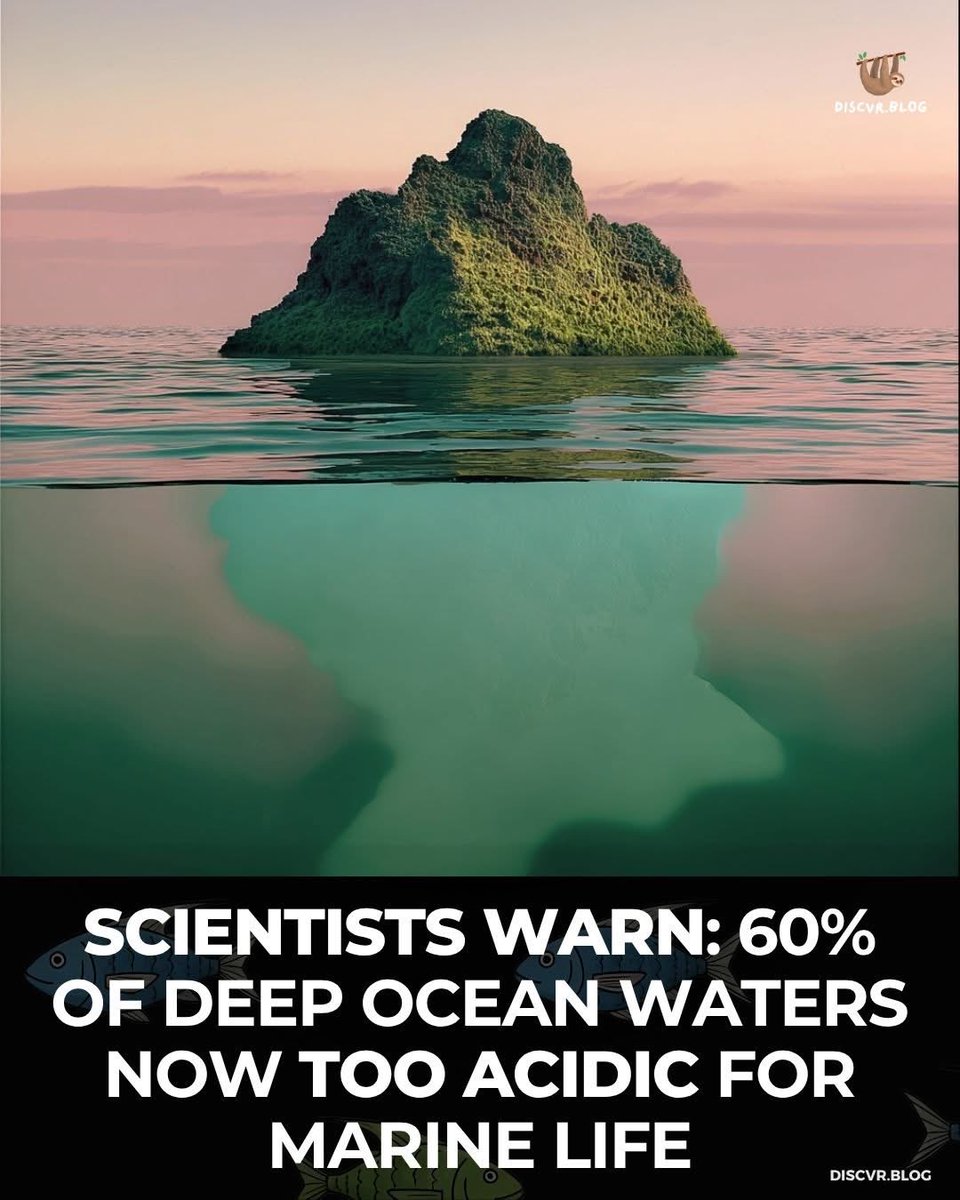
Ocean acidification has been identified in the Planetary Boundary Framework as a planetary process approaching a boundary that could lead to unacceptable environmental change. Using revised estimates of pre-industrial aragonite saturation state, state-of-the-art data-model products, including uncertainties and assessing impact on ecological indicators, we improve upon the ocean acidification planetary boundary assessment and demonstrate that by 2020, the average global ocean conditions had already crossed into the uncertainty range of the ocean acidification boundary. This analysis was further extended to the subsurface ocean, revealing that up to 60% of the global subsurface ocean (down to 200 m) had crossed that boundary, compared to over 40% of the global surface ocean. These changes result in significant declines in suitable habitats for important calcifying species, including 43% reduction in habitat for tropical and subtropical coral reefs, up to 61% for polar pteropods, and 13% for coastal bivalves. By including these additional considerations, we suggest a revised boundary of 10% reduction from pre-industrial conditions more adequately prevents risk to marine ecosystems and their services; a benchmark which was surpassed by year 2000 across the entire surface ocean. onlinelibrary.wiley.com/doi/10.1111/gc…
I will always tell the American people the truth. Pesticides and herbicides are toxic by design, engineered to kill living organisms. When we apply them across millions of acres and allow them into our food system, we put Americans at risk. Chemical manufacturers have paid tens of billions of dollars to settle cancer claims linked to their products, and many agricultural communities report elevated cancer rates and chronic disease. Unfortunately, our agricultural system depends heavily on these chemicals. The U.S. represents 4% of the world’s population, yet we use roughly 25% of its pesticides. If these inputs disappeared overnight, crop yields would fall, food prices would surge, and America would experience a massive loss of farms even beyond what we are witnessing today. The consequences would be disastrous. I support President Trump’s Executive Order to bring agricultural chemical production back to the United States and end our near-total reliance on adversarial nations. His EO protects two pillars of national strength: our defense readiness and our food supply. When hostile actors control critical inputs, they directly threaten the security of the American people. The Trump administration will secure these supply chains to eliminate that vulnerability. President Trump did not build our current system — he inherited it. For decades, Washington designed modern agriculture. Policymakers wrote farm policy, directed research dollars, structured subsidies and crop insurance, and shaped commodity markets to reward monocultures and maximum yield. Those deliberate choices locked farmers into chemical dependence and prioritized short-term output over long-term soil vitality and human health. We are now changing course — without destabilizing the food supply. Alongside @USDA @SecRollins, we are accelerating the transition to regenerative agriculture by expanding farming systems that rebuild soil, increase biodiversity, improve water retention, and reduce reliance on synthetic chemicals, including pre-harvest desiccation. We are also driving the rapid adoption of next-generation technologies, including laser-guided weed control, electrothermal and electrical systems, robotics, precision mechanical cultivation, and biological controls that replace blanket spraying with precision intervention. These solutions are not theoretical. Farmers are already putting them to work. Markets are scaling them. Now the federal government will act with urgency to expand their reach and accelerate adoption nationwide. I have met with hundreds of farmers and agricultural leaders across the country. They understand the pressures firsthand. Chemical inputs cut into margins. Chemical-resistant pests are spreading. Soil health is declining. Foreign markets are shutting out American produce. Farmers want workable alternatives, and they want policies that support transition without threatening their livelihoods. At HHS, I am leading a coordinated effort grounded in gold standard science. I am working with Secretary Rollins and @EPALeeZeldin to expedite a better future where a thriving agricultural system is less dependent on harmful chemicals. We are sharing data, coordinating strategy, and supporting farmers through a practical transition. The Make America Healthy Again agenda forces us to challenge long-standing assumptions about how we grow food, structure markets, and measure success in this country. Reform at this scale will test entrenched interests, and it will not move in a straight line. President Trump has opened the door to this debate and backed meaningful change — not only in policy, but in the national conversation about health and agriculture. American farmers stand at the center of this movement. They deserve policies rooted in rigorous science and economic reality. Our children deserve a food system that protects and strengthens their health. With President Trump’s leadership, we are securing critical supply chains, confronting the health risks embedded in our current system, and deploying every available tool to build a stronger, safer, more resilient American food supply.

TRUMP MAKES AMERICA TOXIC AGAIN - NOW MERCURY POLLUTION To burn more coal Trump has erased the 2012 mercury rules. Mercury is one of the very worst toxins. It is highly persistent and bio-accumulative. A neurotoxin, it impairs brain development of small children and the elderly by Alzheimer's. It's toxic to all body systems. The order also erases a rule on particulate air pollution. Another Trump evil order for the fossil industry. And these are unsurvivable evil fossil fuel greenhouse gas polluting orders. The most evil-doing people. (NRECA 20 Feb. 2026) electric.coop/epa-repeals-me…. #airpollution #climatechange #globalwarming