சந்தியா@j_sandhiya
IT growth is not just about building tech parks… it’s about building people who can actually work in them. That’s where Kalaignar M. Karunanidhi made a historic impact.
He didn’t just create jobs through TIDEL Park and the state’s IT policy he created the people who could take up those jobs.
He made people efficient to work in IT by bringing computer education into government schools, opening the first door to the IT world for rural and poor students. He introduced Computer Science in Class 11 & 12 in 1998–99, and later expanded it to Classes VI–X through the Samacheer Kalvi (Uniform School Education System) around 2010.
Under his government, the Single Window System for engineering admissions was introduced in 1997 through Anna University, allowing students from all backgrounds to transparently choose popular branches like CSE and IT.
Tamil-medium engineering was introduced in 2010 to help rural students access high-tech education without language barriers.
Expansion of engineering education, especially in IT and CSE during the late 1990s and 2000s, created a large number of first-generation graduates.
He also made IT accessible to all through social justice. Reservation policies (31% BC, 18% SC, 1% ST) ensured students from BC, MBC, SC, and ST communities could enter higher education. The First Graduate scheme (late 2000s) gave priority to students who were the first in their families to get a degree, creating a direct path from village backgrounds to IT careers.
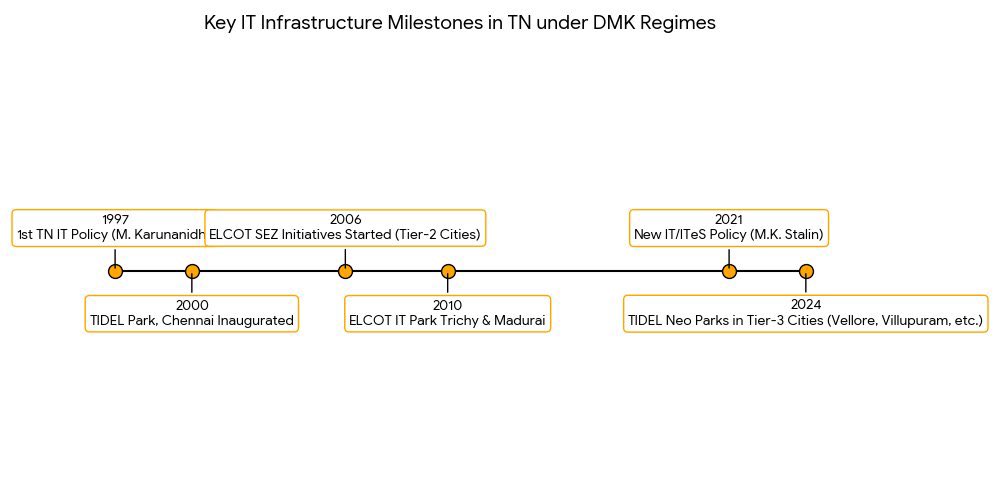
Through IT Parks like TIDEL Park (2000), and expansions in cities like Madurai, Coimbatore, and Tirunelveli, job opportunities were decentralised. The IT policy attracted companies across Tamil Nadu, not just Chennai.
So it was not just about creating IT jobs it was about creating the social foundation needed to qualify for those jobs.
IT growth is not just constructing buildings; the real growth is the first-generation graduates working inside those buildings that is Kalaignar’s success.
Meanwhile, major IT expansion happened in Bangalore under Indian National Congress rule both at the Central and State level (1997 to 2004), including the 1997 Karnataka IT Policy and early startup-focused initiatives.
In contrast, All India Anna Dravida Munnetra Kazhagam did not introduce a strong startup-focused IT policy during that phase, which led to many startups moving to Karnataka. Still, Tamil Nadu remains a top IT state because development was not limited to Chennai.
One more reason was power outage issues. Industrial and IT growth was accelerating around 2004, but power planning lagged in AIADMK period Tamil Nadu became more dependent on wind energy (which is seasonal) and power purchase from other states. No new thermal capacity was sanctioned early enough. Though later projects were initiated by DMK , delays meant the issue continued, leading to power shortages between 2006 and 2011 this is also played one of the factor .
Despite that, IT growth was spread across second-tier cities like Madurai, Coimbatore, and Tirunelveli. And in 2021, Neo TIDEL Parks were developed across Tamil Nadu, continuing the vision of decentralised IT growth.
Final point: Kalaignar didn’t just build IT infrastructure he built an entire generation ready to use it. That is the real success you can't just ignore his effort