
Why Should We Care: Indo-Pacific Pod
1.5K posts

Why Should We Care: Indo-Pacific Pod
@IndoPacPodcast
Join Ray Powell and Jim Carouso as they explore issues defining this century's pivotal region, the Indo-Pacific. New podcast every Friday.


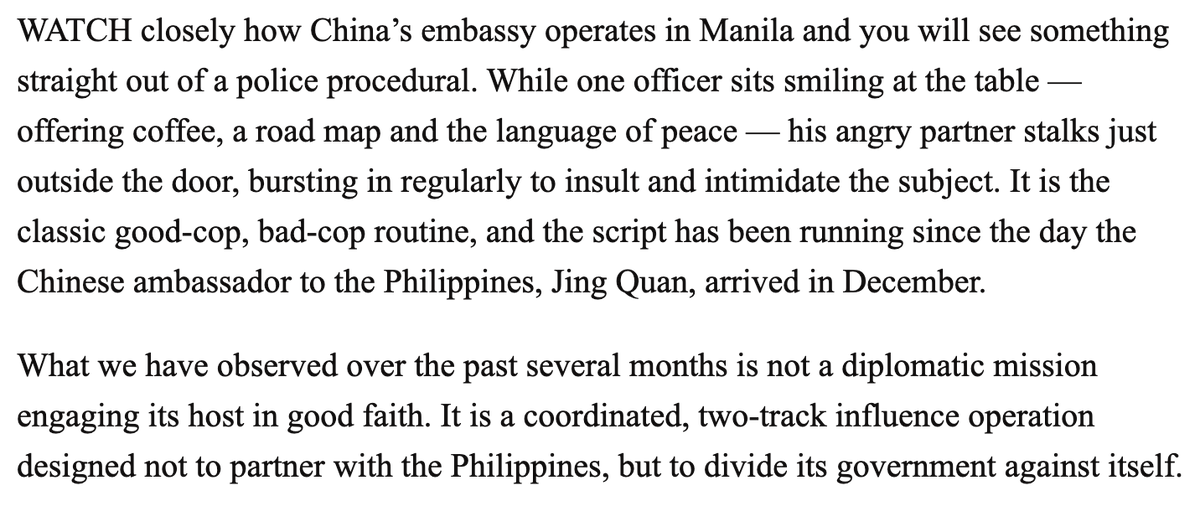
🙀That escalated quickly.👀 Rigoberto Tiglao was so rattled by Part 1 of my op-ed on "Beijing's good-cop, bad-cop playbook in Manila" that he couldn't even wait for Part 2 to be published a day later. Before even seeing the full argument, he had already pounded out 2,000 words of ad hominem hysterics — not rebutting anything I wrote, but proclaiming himself "stunned" that a voice critical of Beijing had dared to grace the pages of @TheManilaTimes. Tiglao treats the Times' opinion page as the exclusive playground of those who toe the 🇨🇳Party line — literally. Former Chinese Ambassador Huang Xilian published 13 opinion columns in the same paper during his tenure, while openly pro-Beijing columnists like Tiglao have run there for years without interruption. Not once did Tiglao object to a sitting foreign government official using the paper as a direct messaging platform. But one two-part series that names the Chinese embassy's interference operation for what it is? That's an "infiltration" by a "professional propagandist" that must be exposed and expelled. Tiglao's rule is clear: voices supporting Beijing are welcome in The Manila Times. Voices questioning Beijing are infiltrators.🕵️ Not only is his column revealingly hysterical, it's unbelievably sloppy: "Concealing his background" — 🤣Child, please. I'm a retired Air Force officer. Is there anyone who doesn't know this? Tiglao found my full biography easily enough on the web to fill four pages with it. If I'm trying to "conceal" any of this I'm not very good at it. "Paid by the US Navy" — 🚫False. The SeaLight Foundation is an IRS-registered 501(c)(3) nonprofit funded by modest private donations. I receive no salary — not from the Navy, not from Stanford or the Gordian Knot Center, not even from SeaLight. Zero. Tiglao could have verified this with a single search. He chose not to. The name "Project Myoushu" proves it targeted China — 🤦♂️Dude. "Myōshu (妙手)" is a 🇯🇵Japanese word — a game of Go term meaning "inspired move" (which was, in fact, the reason we chose it). It's not Chinese. On my actual argument — Tiglao's own column concedes: "There is no use to debunk Powell's piece." At least he's honest about that, because ... he doesn't try. 🙄 Not a word about the 🇨🇳ambassador's dual-track messaging. Not a word about the spokesperson's personal attacks on government officials. Not a word about Beijing claiming "indisputable sovereignty" while calling for dialogue to "resolve disputes". Not a word about the embassy weaponizing the DFA Secretary's quotes against her own government. Nope. He attacked the messenger because he couldn't touch the message. I'll let readers decide which column dealt in evidence and which dealt in ad hominem. They can draw their own conclusions about my actual argument using the links below.👇

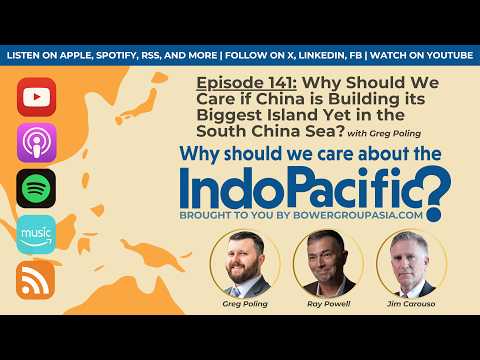
"Why Should We Care if China is Building its Biggest Island Yet in the South China Sea?" At the start of 2025, Antelope Reef was little more than a sandbar in the Paracel Islands. Months later, it's on track to become China's largest artificial island in the South China Sea. In this episode, we sit down with @GregPoling, director of the Southeast Asia Program and the Asia Maritime Transparency Initiative (@AsiaMTI) at CSIS and author of On Dangerous Ground: America's Century in the South China Sea, to unpack what China is building, why it's building it now, and what it means for the region – and especially Vietnam. Greg walks us through the latest satellite imagery, explains why the scale and speed of construction caught even seasoned analysts off guard, and lays out the military implications of a potential new airstrip in the western Paracels – the first in an area where Vietnamese fishermen have operated for generations. We explore why both China and Vietnam claim the Paracel Islands, how Vietnam’s own massive island-building campaign in the Spratly Islands complicates the narrative, and why Hanoi’s response to Antelope Reef has been surprisingly restrained. The conversation turns to the broader geopolitical landscape: Vietnam’s strategic rebalancing between Washington and Beijing, the Philippines’ recalibration during its ASEAN chairmanship, and whether a South China Sea Code of Conduct can ever be more than symbolic. With the 10th anniversary of the landmark 2016 Hague arbitral ruling approaching in July, we assess whether it has been a net positive or negative for the Philippines and the rules-based order. We also discuss middle-power alignment, the expanding Comprehensive and Progressive Trans-Pacific Partnership, and what countries like the United States, Japan, and Australia should and shouldn’t do in response. Links to the full episode with @GordianKnotRay and Jim Carouso below.


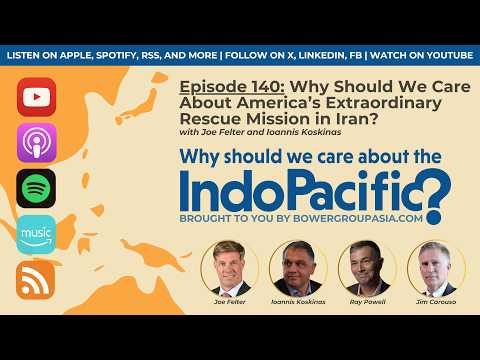
Special Ep: "Why Should We Care About America’s Extraordinary Rescue Mission in Iran?" The U.S. military just pulled off one of the most dramatic combat search and rescue missions in history, sending forces deep into Iran to recover the crew of a downed F‑15E Strike Eagle fighter. Aircraft were lost, firefights erupted, and both airmen came home alive. The last time America attempted something this ambitious inside Iran was Operation Eagle Claw in 1980 - and that ended in disaster. In this podcast, hosts @GordianKnotRay and Jim sit down with two retired special operations colonels: Ioannis Koskinas (Air Force Special Operations, CEO of The Hoplite Group, former senior advisor to Generals McChrystal and Schwartz) and Joe Felter (Army Special Forces, Director of Stanford’s Gordian Knot Center for National Security Innovation, former Deputy Assistant Secretary of Defense). As @JoeFelter puts it: no other country could have pulled this off, and no other country would have tried. The conversation starts with the rescue: how it was planned in under 48 hours, how and why aircraft were lost at a forward staging site deep in Iran, and what separates this outcome from the 1980 failure. It then pivots to the broader war: where the conflict with Iran is headed, the risk of Gulf state escalation, and why both guests, drawing on painful experience from Afghanistan’s collapse, warn against assuming tactical brilliance equals strategic victory. The episode closes with the Indo‑Pacific: what allies are thinking as American attention and resources once again pour into the Middle East, and whether the U.S. can fight in the Gulf without undermining its ability to deter China. Links to the full episode below.


Ep. 139 is available wherever you get your podcasts, including: - YouTube: youtu.be/iWHbwFY7KtA - Apple: podcasts.apple.com/us/podcast/why… - Spotify: open.spotify.com/episode/20WiLm… - Amazon: music.amazon.com/podcasts/9e5b7… - RSS: rss.com/podcasts/indo-… + More! 🔥 Sponsored by @BowerGroupAsia


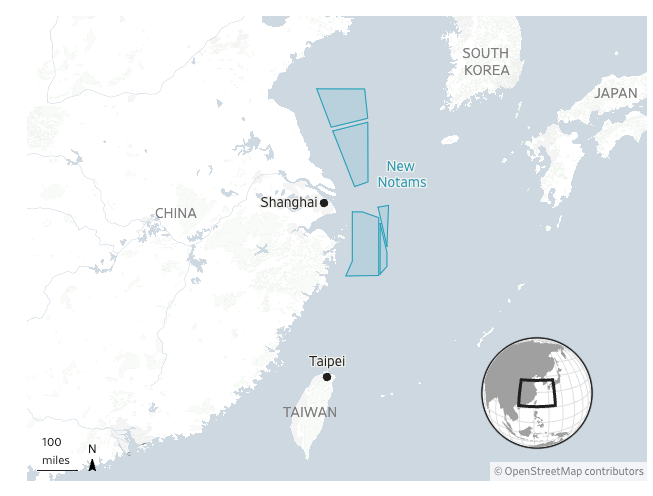
China Creates New Aviation Mystery With Offshore Warning Zones—Beijing reserves airspace for 40 days, suggesting possible military activity ahead @joyuwang wsj.com/world/china/ch… wsj.com/world/china/ch…

Ep. 139 is available wherever you get your podcasts, including: - YouTube: youtu.be/iWHbwFY7KtA - Apple: podcasts.apple.com/us/podcast/why… - Spotify: open.spotify.com/episode/20WiLm… - Amazon: music.amazon.com/podcasts/9e5b7… - RSS: rss.com/podcasts/indo-… + More! 🔥 Sponsored by @BowerGroupAsia