Mykola Kondratiuk

1.4K posts

Mykola Kondratiuk banner
Mykola Kondratiuk

Mykola Kondratiuk

@ItsKondrat

Director of PM | Managing 10+ AI agents daily | PMP | Speaker at LeadDev London & PM Days | Building open-source PM tools

Ukraine 🇺🇦 เข้าร่วม Ekim 2025
428 กำลังติดตาม104 ผู้ติดตาม
Mykola Kondratiuk
Mykola Kondratiuk@ItsKondrat·
same morning Apple shipped model-choice to every device, Wrike and Asana switched on autonomous agents in PM tools you already approved. OS + SaaS. both default-on. neither interviewed. a roster you can't see isn't a roster. it's six tools and a shrug.
English
0
0
0
64
Mykola Kondratiuk
Mykola Kondratiuk@ItsKondrat·
caught myself dropping a doc with real names into whatever was already open last week. routing decided by window state. not by me. now everyone has six models one tap away. the fix: not which model is best - which kind of work goes where, and what gets pasted into nothing.
English
1
0
0
21
Mykola Kondratiuk
Mykola Kondratiuk@ItsKondrat·
@lennysan cognitive surrender is just routing by default. pick which work goes to which model, which none of them touch - that's the actual discipline
English
0
0
0
48
Lenny Rachitsky
Lenny Rachitsky@lennysan·
Tony Fadell's resume: + Co-created the iPhone → $2.3 trillion in sales + Created the iPod → saved Apple from bankruptcy + Founded Nest → AI in your home 11 years before ChatGPT I asked him about everything he's learned: 🔸 Why opinion-based decisions are essential for v1 products 🔸 Why marketing matters as much as the product itself 🔸 Why taste is the biggest moat in AI 🔸 His prediction for the next breakthrough consumer device 🔸 Why "cognitive surrender" to AI is the biggest risk for builders Listen now 👇 youtu.be/RJjl1TwyfWM
YouTube video
YouTube
English
34
18
185
226K
Mykola Kondratiuk
Mykola Kondratiuk@ItsKondrat·
@rohit4verse ngl the skipped hire framing is still wrong - what matters is which work routes to which model, by default or by decision. founders track neither
English
0
0
0
284
Rohit
Rohit@rohit4verse·
Anthropic president Daniela Amodei just said AI has replaced almost no jobs in 2026. she's counting the jobs AI takes. nobody's counting the five hires a founder used to make and now skips. you don't fire a seat you never opened. a seed round used to fund those five people. now one person fills all five. i mapped this stack six weeks before she said it, and the post above did 3.3M views.
Rohit@rohit4verse

x.com/i/article/2047…

English
47
33
290
408.7K
Mykola Kondratiuk
Mykola Kondratiuk@ItsKondrat·
@aakashgupta always thought the PRD failure was imagination divergence - everyone simulates a different product in their head. building one breaks that fast. the doc becomes useful after, not before
English
0
0
0
3
Aakash Gupta
Aakash Gupta@aakashgupta·
The PRD isn't a deliverable anymore. It's a rough draft for a prototype. An OpenAI PM was 20 minutes into writing one. Stopped. Built the thing instead. Showed it to stakeholders. The conversation was better than any doc review he'd ever run. Here's why that works and most PRDs don't. A PRD asks every person in the room to simulate the product in their head. The design lead is imagining one version. The engineer is imagining another. Legal is reading words. Nobody is looking at the same thing. The document creates the illusion of alignment without the substance of it. A prototype collapses that gap. Everyone sees the same object. Reactions are faster, more specific, and more honest. "This button feels wrong" is more useful than three paragraphs of spec. The part that stuck with me: he replaced the full PRD with a companion doc. Ten FAQs. As you look at this prototype, you will probably have these questions. Here are the answers. That's a better document than most PRDs I've read. A 20-page PRD tries to anticipate every technical constraint, every edge case, every stakeholder preference, and ends up being wrong about most of them because nobody has seen the thing yet. Ten questions written after the prototype exists are actually answerable. Abhi Muchhal showed the full Codex workflow in this episode, including how he built a growth dashboard and a 1040 tax filing app without touching a traditional spec document. The PM role used to be: write the thing, then build the thing. Now it's: build the thing, then explain the thing.
Aakash Gupta@aakashgupta

People keep saying GPT-5.5 + Codex mogs Claude Code. So I got OpenAI PM @AbhiMuch to show me exactly how to use Codex like a pro: 03:48 - What Codex unlocks for PM work 05:34 - How he built his growth dashboard 11:32 - How to build in Codex with Playwright 14:52 - Moving away from PRDs to Codex prototypes 21:23 - 3 automations running before his day starts 28:37 - WhatsApp computer use demo setup 33:05 - Codex takes action inside WhatsApp 37:00 - Building a 1040 tax filing app in Codex 43:42 - What drove ChatGPT to 1B WAU 47:18 - ImageGen 2, the biggest ELO jump of any model 59:26 - How to break into OpenAI as a PM

English
3
8
54
23.9K
Mykola Kondratiuk
Mykola Kondratiuk@ItsKondrat·
@petergyang @kunchenguid plan quality helps but it's not what actually breaks loops in my experience. routing kills it - which model handles what type of work. get that wrong first
English
0
0
1
107
Peter Yang
Peter Yang@petergyang·
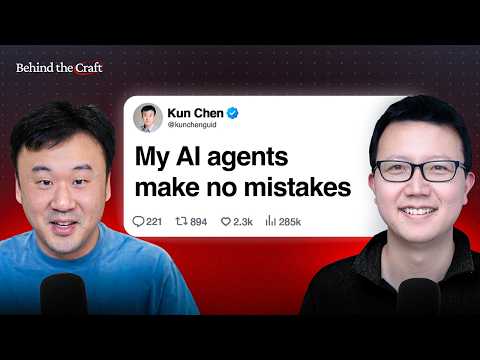
My 5 biggest takeaways from @kunchenguid, ex-Meta L8 engineer, on how he set up his agentic engineering system: 1. Spend most of your time planning and validating, not coding. Kun sees himself as the manager of an always-on engineering team. His job is to create plans, validate work, and improve the overall system. The coding phase is handled almost entirely by agents. 2. The quality of your plans determines how long agents can work on their own. Memes about loops aside, an one-line prompt might keep an agent working for a few minutes but a detailed plan can keep it going for hours. If you want agents to run longer, invest more upfront in the spec, goals, and validation criteria. 3. Use visual plans, not walls of markdown. Kun built Lavish, an open-source tool to make visual HTML plans, that anyone can use for free: github.com/kunchenguid/la… Instead of reading a giant markdown plan, Lavish turns it into a visual HTML artifact where you can leave inline feedback. This makes it much easier to tell the agent exactly what to change before coding starts. 4. Run agents in parallel, but isolate the work. Kun uses Treehouse to manage reusable worktrees so agents don’t step on each other’s changes: github.com/kunchenguid/tr… If the work is exploratory or likely to fill the context window, he delegates it to a subagent. This way, the main agent stays focused while the subagents dig, test ideas, and report back. 5. Let agents review the code before you do. Kun no longer manually reviews every AI-written PR. Instead, he uses No Mistakes to run a fresh agent review, rebase the change, run tests, update docs, create the PR, and assign a risk level: github.com/kunchenguid/no… In Kun’s testing across 267 agent changes in 15 repos, No Mistakes caught and fixed 68% of mistakes that would have been missed. Kun walked through Lavish, Treehouse, No Mistakes, and his full agentic engineering workflow in our episode. 📌 Watch it here: youtu.be/88B6DimMD2g
YouTube video
YouTube
Peter Yang tweet media
Peter Yang@petergyang

"If you're still manually reviewing every line of code, you're the bottleneck." Here's my new episode with @kunchenguid, an ex-Meta L8 engineer who now ships up to 40 PRs a day with AI agents. Instead of manually reviewing code, he built an agentic engineering system that includes: ✅ Lavish, his free tool for annotating AI's plans as visual HTML artifacts ✅ gnhf or "good night, have fun," his free orchestrator to get agents working towards a goal while you sleep ✅ No Mistakes, his free AI code validation pipeline for catching errors before merge Some quotes from Kun: "If I spend a lot of time crafting detailed plans, then the agents can work for much longer." "Every time I encounter friction in my workflow and I don't find an existing tool that can solve the problem, I just build something myself." "To really scale how much we can get from the agents, we have to move ourselves out of the loop as much as possible." 📌 Watch now: youtu.be/88B6DimMD2g Links to Kun's free agentic engineering tools below 👇

English
23
26
249
32.9K
Mykola Kondratiuk
Mykola Kondratiuk@ItsKondrat·
@shannholmberg agent loops force the routing question - which capability handles which piece? most teams never name it.
English
0
0
0
750
Shann³
Shann³@shannholmberg·
what is agent looping for the last two years we prompted agents one task at a time. that is starting to change instead of asking an agent to build the landing page and then driving every step yourself, you set up a loop that handles discovery, planning, the work, checking, and iterating until the goal is met looping is a setup you build. almost any agent harness can run it, it just depends on how you wire it up at its simplest, looping is one agent working on itself: > researches > drafts > checks the draft against a goal > fixes what is weak > runs that cycle again until the work clears the requirements you are not prompting each step anymore. the agent repeats the cycle for you the bigger version is a fleet looping. you give an orchestrator agent a goal, it breaks the goal into pieces, hands each piece to a specialist agent, and those specialists hand smaller jobs to their own subagents the whole tree keeps looping through discovery, planning, execution, and verification until the goal is met one agent looping is like a person redoing their own draft. a fleet looping is a whole team running a project end-to-end you create a goal, and the system runs the loop until it finishes within the reqs you set open and closed looping: OPEN LOOPING is exploratory. it still has conditions and a goal, but you give the agent or the fleet a wide space to move in. it can try different paths, discover things, build something you did not fully spec out this is the exciting end, it is what Peter and others are doing, and tbh it is where I want to spend more time the catch is cost, an open loop with real room to explore burns an insane amount of tokens. for the 90 percent of people without an unlimited budget it is not runnable yet, and pointed at projects with a loose standard it turns into a slop machine CLOSED LOOPING is bounded. a human designs the end-to-end path first: > clear goal > defined steps > an eval at each step > a point where it stops or hands back to you (and feeds back performance data) the agents still loop, but inside framework you built. it gets better every run because each pass feeds the next, and it runs on a normal budget because the path is tight. for most marketing work, closed is the one that pays off today. > the orchestrator owns the goal > the specialists own the steps > the subagents do the narrow work > an eval gate make sure its not slop
Shann³ tweet media
Peter Steinberger 🦞@steipete

Here’s your monthly reminder that you shouldn’t be prompting coding agents anymore. You should be designing loops that prompt your agents.

English
192
691
6K
718.4K
Miles Brundage
Miles Brundage@Miles_Brundage·
Claude is much funnier than Codex
English
15
0
137
18.5K
Mykola Kondratiuk
Mykola Kondratiuk@ItsKondrat·
@Hartdrawss tbh the more expensive mistake is naming what's off-limits. most teams write 500 lines of context and forget the 'what not to touch' part.
English
1
0
0
26
Harshil Tomar
Harshil Tomar@Hartdrawss·
i've shipped 50+ large scale software for clients and the most expensive mistake i keep seeing founders make isn't bad code. it's starting a build without giving the model a single document to work from. here's the 4 file system i use on every claude code project before i write a single prompt: - CLAUDE[.]md my stack, conventions, folder structure, what not to touch and what needs approval. claude reads this every session and allows me to work without re-explaining the entire project from scratch every single time. - design[.]md this is your actual design language. colors, spacing, component rules even including the tailwind classes. this helps me and the team to stop letting claude guess what "clean" means and start making it match what we actually intend. - components[.]md every reusable component documented usually on top of shadcn and claude pulls from what exists instead of silently building a second version of pre-existing components allowing to avoid so so much of technical dead code - slices[.]md the full build broken into vertical shippable pieces before a single line of code is written. the team shoots for one slice at a time ensuring nothing breaks what came before. three rules i don't break: - make claude read all 4 files at the start of every session. non negotiable - when output drifts, stop immediately. go back to slices[.]md and reorient. drifting output is always a context problem, not a model problem - after every slice ships, update components[.]md. the system only works if you maintain it the gap between what you intended and what got built is never a prompting problem. it's a documentation problem. before any project starts, i run `/grill-me` by @mattpocockuk to surface every unknown. save the output and close the gap before getting to the build step
Harshil Tomar tweet mediaHarshil Tomar tweet media
English
8
4
30
1.2K
Gergely Orosz
Gergely Orosz@GergelyOrosz·
@__apf__ Fulltime! Forcefully assigned. It's why so many devs at Meta are actively searching for new jobs. There's around 5,000 of them reassigned for FT data labeling
English
18
6
585
76.7K
Gergely Orosz
Gergely Orosz@GergelyOrosz·
Just learned: Software engineers used to do manual data labeling at Scale AI while Alex Wang was CEO. After he left, new leadership joined, and were HORRIFIED to learn this. Stopped it ASAP Now at Meta, software engineers are assigned manual data labeling... see the pattern?
English
204
158
5.7K
1.1M
Mykola Kondratiuk
Mykola Kondratiuk@ItsKondrat·
@Av1dlive writing loops is just routing on purpose. each iteration decides which model gets what - and what doesn't go to any of them.
English
0
0
1
39
Avid
Avid@Av1dlive·
Boris Cherny (Claude Code creator): "I don't prompt Claude anymore... my job is to write loops." In his latest interview, he breaks down the setup step by step. He runs /loops + a dynamic workflow + a couple hundred agents that read his GitHub, Slack, and Twitter and decide what to build next. His only job now is writing the loops that orchestrate them. That's a multi-agent workflow. I broke down how to build your own below ↓
Avid@Av1dlive

x.com/i/article/2061…

English
34
23
105
25.7K
Mykola Kondratiuk
Mykola Kondratiuk@ItsKondrat·
iOS 27: six AI models now live on every company phone. your team didn't pick them. they just showed up. the skill nobody's naming: which AI gets which kind of work, and which work none of them touch. that's the roster decision. right now the default is making it for you. #AI
Mykola Kondratiuk tweet media
English
0
0
0
43
Mykola Kondratiuk
Mykola Kondratiuk@ItsKondrat·
@neil_xbt most teams skipped that part. agents arrived, nobody assigned scope. 'which one touches prod' answered by whoever opened the IDE
English
0
0
0
44
NeilXbt
NeilXbt@neil_xbt·
In February 2026, a small OpenAI team shipped 1 million lines of production code! They did not write a single line by hand. The agents wrote it. Humans designed the system that made the agents reliable. That system has a name now. Harness Engineering. Within 90 days, Anthropic published three papers on it. ThoughtWorks formalized a framework. The simplest definition: Agent equals Model plus Harness. The harness is everything that is not the model. The constraints that keep agents on track. The feedback loops that catch mistakes. The documentation that tells the agent where it is. The tools it has permission to use. Strip the harness away and you have a raw language model guessing its way through your codebase. Add the right harness and you have a system that ships production code. The complete mental models are here. Follow @neil_xbt for more AI engineering intelligence.
Rahul@sairahul1

x.com/i/article/2063…

English
31
37
219
18.1K
Mykola Kondratiuk
Mykola Kondratiuk@ItsKondrat·
@kimmonismus they just showed up. six models one tap away - nobody named which one gets which work.
English
0
0
0
12
Chubby♨️
Chubby♨️@kimmonismus·
Tomorrow could be Apple’s most important AI moment yet. WWDC 2026 is expected to be all about one thing: making Siri relevant again. If the leaks are right, Apple is rebuilding Siri around a custom Google Gemini model, reportedly around 1.2 trillion parameters. For context: Apple’s own on-device AI model is roughly 3B parameters. The biggest rumor: Apple’s new Siri will reportedly be powered in the background by Google Gemini. Not as a Google-branded chatbot, but as an Apple-controlled intelligence layer running behind Siri, likely tied to Apple’s privacy-first infrastructure. So the new Siri likely becomes a hybrid system: • small Apple model locally on your device • large Gemini-class model in the cloud • Siri as the orchestration layer • Apple controlling the UI, app access and privacy layer What to further expect: • a much more conversational Siri • deeper personal context across apps, messages, files, calendar, photos and contacts • screen awareness • actions inside apps • a dedicated Siri app with chat history • voice chat, file uploads and multimodal interaction • better integration with Dynamic Island • optional support for other AI services like ChatGPT, Claude or Gemini Apple wants to turn Siri into the private AI layer of the operating system. A system agent that can search, understand, write, edit, summarize, organize and act across your iPhone, Mac and iPad. We may also see new Apple Intelligence features for: • AI photo editing • smarter Camera / Visual Intelligence • improved Writing Tools • natural-language Shortcuts • better Wallet and Health integrations • more privacy controls around AI data Either way, WWDC 2026 could define Apple’s position in the AI race. Exciting how the new CEO will handle all of this. Images: Bloomberg, Mark Gurman
Chubby♨️ tweet mediaChubby♨️ tweet mediaChubby♨️ tweet media
English
79
37
605
194.9K
Mykola Kondratiuk
Mykola Kondratiuk@ItsKondrat·
@emollick six models one tap away as of today. zero team decisions yet about which does which work
English
0
0
0
2.4K
Ethan Mollick
Ethan Mollick@emollick·
A year ago the closest thing we had to an AI agent was o3.
English
168
123
3.5K
220.5K
Mykola Kondratiuk
Mykola Kondratiuk@ItsKondrat·
@rewind02 ngl karpathy didn't name this one: which model you route which work to. ios 27 made it unavoidable
English
0
0
0
71
rewind
rewind@rewind02·
Andrej Karpathy talked about what AI engineers actually need to know right no this isn't a roadmap for getting hired it's a reality check for everyone already in the industry here's what he says engineers are getting wrong: > Most engineers treat LLMs as a single paradigm, but there are actually three > LLMs have their own "psychology" - encyclopedic memory, uneven intelligence, and anterograde amnesia > the generation-verification loop is the most important concept nobody talks about > "keep AI on a leash" is not a metaphor. a 10,000-line diff is useless. small, concrete, incremental changes win every time > every product needs an autonomy slider. from autocomplete to full agent > "year of agents" is wrong. agents are a decade, not a year > building for humans is no longer enough the engineers who thrive won't be the ones who know the most models they'll be the ones who understand how to work with fallible, powerful systems and build products humans can actually trust full interview and a detailed article on what every AI engineer needs to know are below👇
Rahul@sairahul1

x.com/i/article/2063…

English
18
28
149
29K
Mykola Kondratiuk
Mykola Kondratiuk@ItsKondrat·
the limit on my 10-agent sprint wasn't cost, it was shared context falling apart. that degradation point is a stop condition. it only counts if you named it before it happened, not after you see it in the rearview.
English
0
0
0
14
Mykola Kondratiuk
Mykola Kondratiuk@ItsKondrat·
the value of a stop button is it fires fast. make pulling it a group decision and you've broken it. escalation is slower than the agent it's chasing. one human. standing authority. no meeting. a pause nobody can end is just an outage - write the resume bar before you need it.
English
1
0
0
17
Mykola Kondratiuk
Mykola Kondratiuk@ItsKondrat·
"we'd just turn it off" is the most confident lie in every AI team. ok. what trips it? a real condition: agent outside its slice, output drops below checkable bar, token velocity spikes, it edits its own instructions. pick the ones that fit. write them down. that's the job.
English
1
0
0
22
Mykola Kondratiuk
Mykola Kondratiuk@ItsKondrat·
@gippp69 cool. nobody's asking who verifies the report before it hits a client. API cost isn't the risk.
English
1
0
1
15
Gipp 🦅
Gipp 🦅@gippp69·
A GROUP OF CHINESE FRIENDS USED NVIDIA’S 1M TOKEN MODEL TO SELL $450 RESEARCH REPORTS. THE API COST WAS UNDER $1 they were not building a chatbot. founders sent them competitor sites, pricing pages, reviews and messy investor docs. Nemotron 3 Ultra read the whole pile in one run that is the edge. 1 million tokens of context means no rag setup, no splitting pdfs into 40 parts, no stitching broken summaries together by hand a full client report can cost cents to run. OpenRouter lists it around $0.50 per 1M input tokens and $2.50 per 1M output tokens. the client does not care what model did it. he cares that the market map arrives tomorrow first they sold one-off competitor reports for $300-$600. then the same workflow became weekly market monitoring for startups and small agencies NVIDIA did not just drop another benchmark model. it dropped cheap long-context infrastructure that turns boring research into a service the smartest model gets attention. the cheapest model that reads the whole folder gets invoices.
shmidt@shmidtqq

x.com/i/article/2063…

English
45
21
148
21.2K