
ทวีตที่ปักหมุด
Jediphone
36.5K posts


Jediphone
@Jediphone
Persistent curiosity unlocks the universe. =^..^= *•. “To strive, to seek, to find, and not to yield.”
✨🌲🌊 เข้าร่วม Eylül 2008
1.4K กำลังติดตาม1.5K ผู้ติดตาม
@BigBrainPsych When a difficult situation arises, remember that a clenched fist is not open to the solution.
When you feel anger, your closed mind is not open to better possibilities.
A clenched fist cannot receive anything;
Only the open hand catches the next good idea, or opportunity.
English

Most people think success comes from caring more.
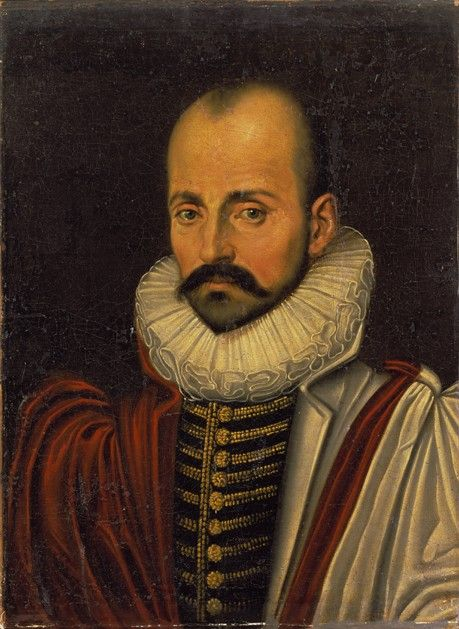
Michel de Montaigne proved the opposite 450 years ago. Modern psychology confirmed he was right.
Here's the philosophy that frees you from outcome obsession ↓
We live in an era of relentless outcome fixation.
Metrics. Follower counts. Performance reviews.
Psychologists call it "maladaptive perfectionism." And it's quietly destroying performance, elevating burnout risk by 20–30% and linking directly to depression and low self-esteem.
The cruel irony?
The harder you chase the result, the worse you perform.
Anxiety splits your attention. Perfectionism triggers paralysis. The approval you seek becomes the very thing that repels people.
But a 16th-century French nobleman figured out the cure long before the science existed.
Meet Michel de Montaigne ↓
Born in 1533, Montaigne seemed destined for political greatness.
Then life dismantled him.
His closest friend died. He lost his daughter. His ambitions collapsed.
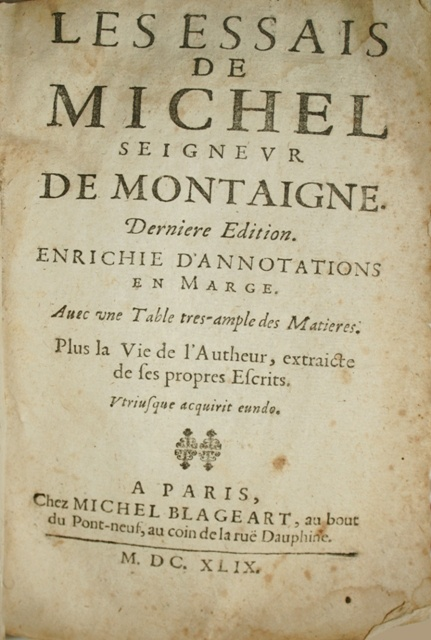
Instead of clawing back control, he retreated to his tower library and let go. Between 1572 and 1595, he wrote 107 essays simply to understand himself.
His conclusion?
"He who places his happiness in dependence upon tomorrow is condemned to eternal unhappiness."
His essays shaped Shakespeare, Descartes, and modern philosophy for centuries.
He called his method mettre à nonchalloir, or strategic nonchalance. It's not laziness, nor apathy.
It's a deliberate release of ego-driven fixation on outcomes, so spontaneity and serendipity could finally do their work.
His philosophy had 3 principles:
1) Release the need for external validation
People become prisoners of their own minds, trapped in loops of judgment and approval-seeking.
Today, that loop runs 24/7 through every notification and metric.
The less you need to prove yourself, the more magnetic you become.
2) Accept uncertainty instead of controlling it
Perfectionism promises safety. It delivers exhaustion.
Relaxed minds outperform anxious ones by up to 30% in creative insight.
Loosening your grip doesn't slow progress. It accelerates it.
3) Value process over product
It means redirecting energy from approval toward meaningful action.
You'll notice relationships become more genuine. Opportunities come naturally.
3 ways to apply this today ↓
• Audit your attachments. Ask: "What expectations am I carrying that aren't mine?" Name the worries draining you, then set them down.
• Practice nonchalance. When anxiety spikes, step back. Solutions surface when you stop forcing them.
• Engage authentically. The more you allow others to be themselves, the deeper your connections become.
Montaigne survived plague, personal tragedy, and political collapse by mastering one insight modern psychology is only now quantifying:
Presence breeds serendipity.
And once you stop gripping the outcome...
Something shifts.
—
Thanks for reading!
Enjoyed this post?
Follow @BigBrainPsych for more content like this.
English
@aakashgupta @his4Everz
“Perhaps the best test of a man’s intelligence is his capacity for making a summary.”
~ Lytton Strachey
"Technical skill is mastery of complexity, while creativity is mastery of simplicity."
~ Erik Christopher Zeeman
English

Simplification is a literal neural signature of mastery, not a communication preference.
Your prefrontal cortex can hold about 4 items in working memory at any given moment. That's the biological ceiling. Doesn't matter how smart you are. The constraint is fixed.
What changes with expertise is compression. Your brain learns to "chunk" multiple pieces of information into single units. A chess grandmaster doesn't see 32 pieces on a board. They see 5-6 familiar patterns. A senior engineer doesn't see 40 variables in a system. They see 3 forces interacting.
The prefrontal cortex and basal ganglia run a gating system that decides what gets into working memory and what gets filtered out. Dopamine modulates those gates. When someone builds deep expertise in a domain, their basal ganglia learns which information to compress and which to discard, freeing up slots for higher-order reasoning.
The person who can explain something simply has built enough mental chunks that the complex version collapses into a small number of organized patterns. The person who overcomplicates things is often still holding each variable separately, maxing out their working memory, and spilling the cognitive overflow into their explanation.
This is why Feynman could explain quantum mechanics to freshmen. His compression ratio was so high that concepts taking 4 working memory slots for a grad student took 1 slot for him. The remaining 3 slots were free for analogy, storytelling, and reading the room.
Simplicity is what happens when your brain has run enough reps to compress the pattern. Complexity is what happens when it hasn't.
Natism@his4Everz
You can tell someone’s smart by how well they simplify things, not complicate them.
English
@postalwtf Look interesting, but any plans for iPhone? Not often at my desk when I need reminding…
English


The most valuable skill in history just changed forever.
Elon Musk just handed you the only survival framework that matters.
Musk: “The biggest thing is, what questions do we not know to ask?”
For centuries, the smartest person in the room held the most answers.
AI didn’t level the playing field. It burned it down.
Superintelligence in your pocket answers anything. Instantly. Perfectly. For free.
Musk: “Once you know the question, the answer is usually the easy part.”
Let that land.
The next generation of winners won’t be defined by what they know. They’ll be defined by what they think to ask.
AI commoditized execution.
Script, plan, code, strategy. Models handle all of it.
The bottleneck was never intelligence. It was never labor. It’s curiosity. It’s always been curiosity.
Traditional education spent decades training you to memorize answers. AI made that obsolete overnight.
Human value is no longer tied to knowledge. It’s tied to the judgment of which problems are even worth solving.
That’s the gap machines can’t close.
Because asking the right question isn’t a skill. It’s a worldview.
It requires taste. Intuition. The ability to look at a landscape everyone else is staring at and see the one thing nobody thought to interrogate.
Master the art of asking the exact right question to a machine that knows everything and you can build anything.
The skill isn’t knowing. It’s knowing what to ask.
That judgment, that taste for what’s worth pursuing, that’s the last truly human edge. The only one markets will keep paying for.
Answers are infinite now. Free, instant, and available to everyone on earth equally.
The only thing separating you from the person who builds the next great company is the quality of your questions.
Answers are free. Questions are everything.
English

His company found out he was using AI to do 70% of his job.
Instead of getting fired, he's now making $200K and running the department.
Here's what he did differently than everyone else...
Most employees use ChatGPT to write emails faster. Maybe automate their calendar. Some meeting notes.
Their boss doesn't care.
Your boss doesn't get their annual bonus because you answer emails 20% faster.
They get it when revenue goes up, costs go down, and the team ships faster.
That's exactly what this guy figured out.
He stopped using AI to make himself faster.
He started using it to automate the work that actually moves the needle for his company.
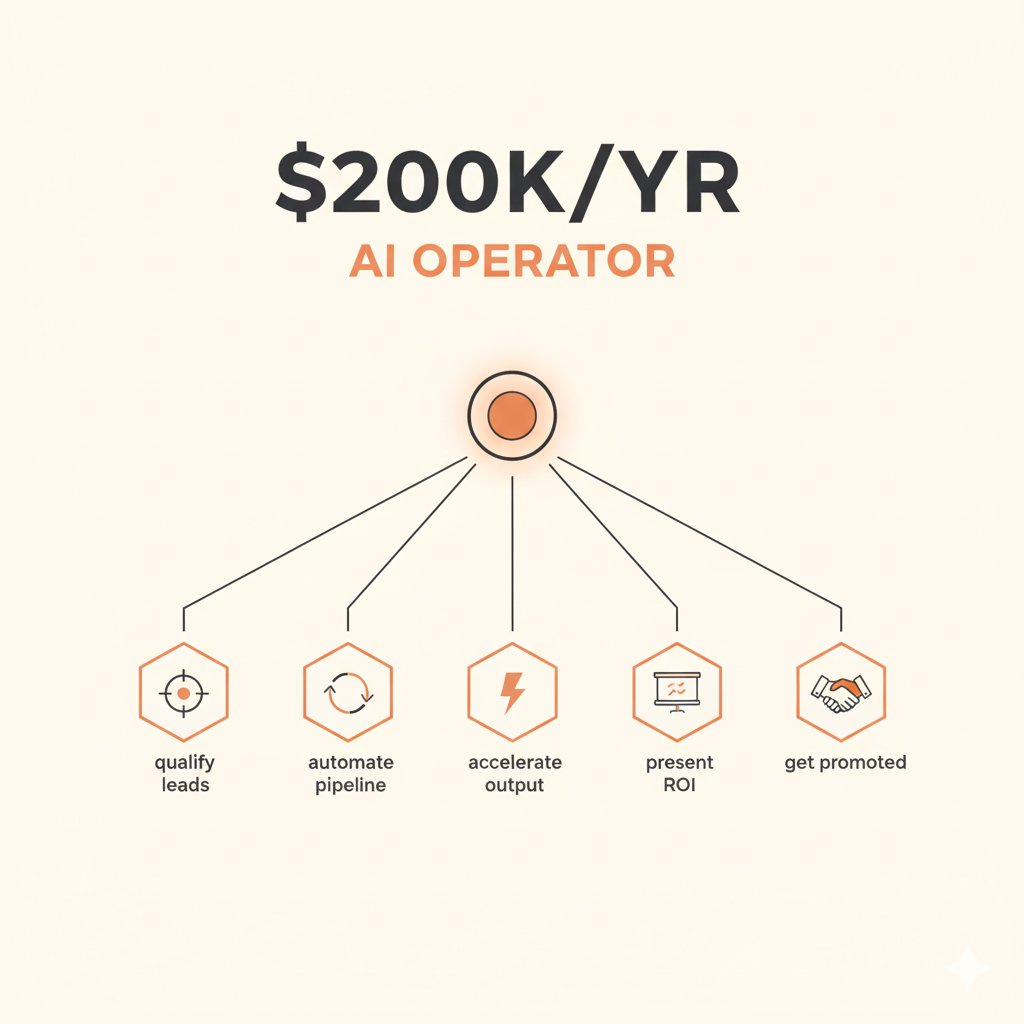
Lead qualification. Sales pipeline. Customer follow-ups. Stuff that directly impacts revenue.
Then he did something most people skip entirely.
He built a presentation showing leadership exactly how much time and money his automations were saving them.
He didn't pitch "this makes my job easier."
He pitched "this saves YOU 15 hours a week and increases output by 3x."
By the end of that meeting, he had full buy-in from every person in the room.
42% raise. New title. Remote work.
And he's not the only one.
Companies are now paying AI-skilled employees 56% more and promoting them 38x faster.
Not because they're smarter. Because they learned a 3-step system that turns you from a regular employee into the one person your company can't afford to lose.
I broke down the entire system in a free training:
Step 1: How to accelerate your output using AI (the right way)
Step 2: How to build automations that work without you
Step 3: The adjacent skills that make you irreplaceable
Follow + comment "OPERATOR" and I'll DM you the full training.
English
@DellAnnaLuca Looks like they’ll eat the competition for breakfast. And anything Lindy will have real staying power. Can they turn information into knowledge though?
“Knowledge is information that has causal power.”
~ @DavidDeutsch
English

I don’t often share fun ads, but this is my kind of witty 👏
Flo Crivello@Altimor
Introducing Lindy Assistant, the ultimate AI assistant. It talks with you through iMessage, connects to 100s of apps, helps you with your meetings and emails, and proactively finds ways to save you time all day. Check out some examples of ways Lindy assistant helps below.
English
@AshmanR00nz @BrianRoemmele When a difficult situation arises, remember that a clenched fist is not open to the solution.
When you feel anger, your closed mind is not open to better possibilities.
A clenched fist cannot receive anything;
Only the open mind catches the next good idea or opportunity.
English

@BrianRoemmele I think you'll like this, Brian. ⊙ CURIOSITY IS THE CURE fractalreality.ca/circumpunct_vi…
English


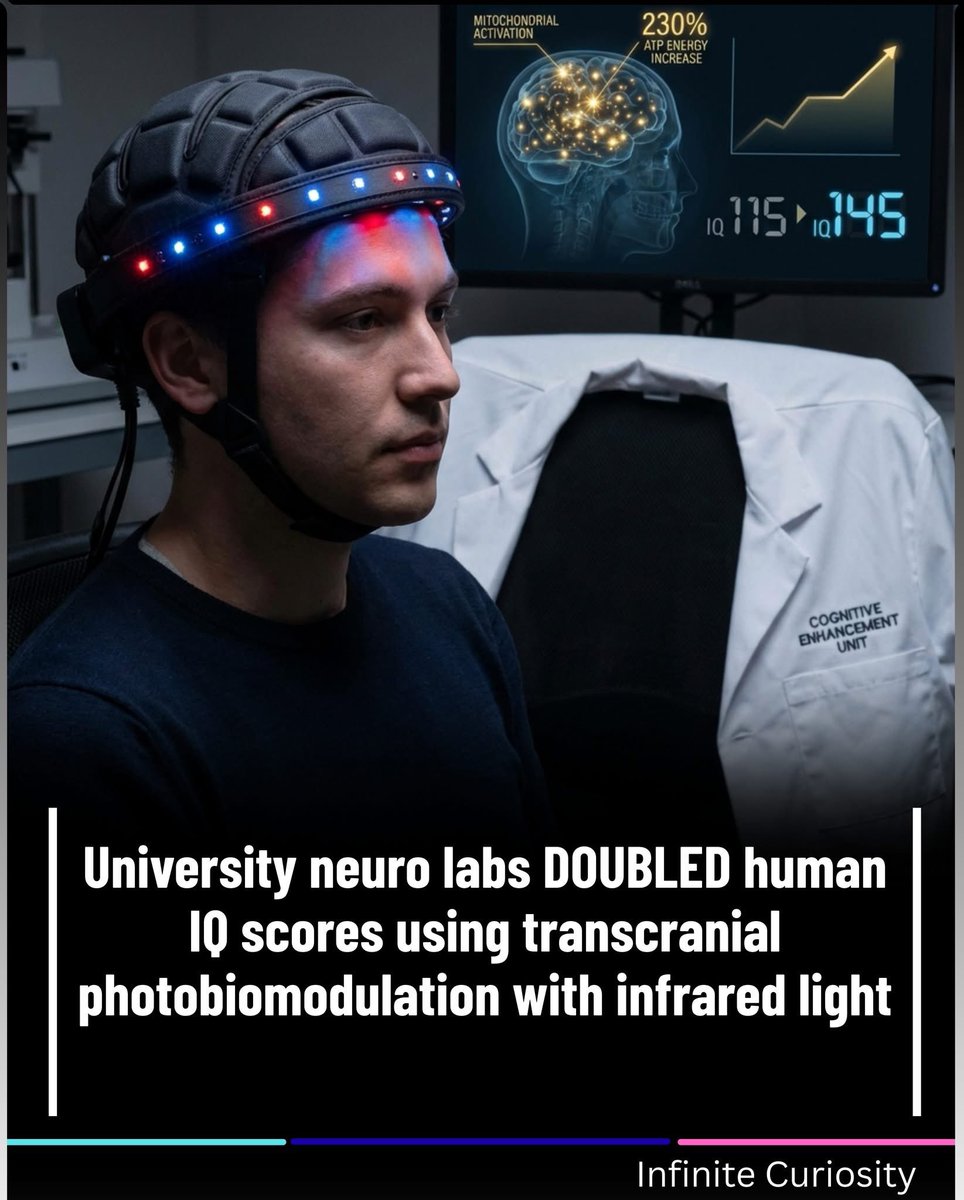
A biological miracle is happening in cognitive enhancement phototherapy centers.
Near-infrared light (1,064nm wavelength) penetrates the skull, stimulating mitochondria in prefrontal cortex neurons to produce 230% more ATP energy.
Subjects showed IQ increases of 18-23 points after 40 sessions over 8 weeks, with fluid intelligence improvements of 41% and processing speed gains of 67%.
Effects plateau at 14 months before gradual decline.
The infrared light supercharges cellular energy production in brain tissue, allowing neurons to fire faster, form more connections, and sustain complex thinking longer.
It's like upgrading from regular fuel to rocket fuel for brain cells.
Silicon Valley executives sit under infrared helmets during Zoom calls, students wear them while studying, and chess grandmasters use them before tournaments—all chasing those extra IQ points.
#IQEnhancement #Photobiomodulation #CognitiveUpgrade #InfraredTherapy #BrainPower
English
@elonmusk Interesting:
SciTech Era@SciTechera
Reminder Researchers achieve breakthrough in strong magnets without rare-earth metals. A new class of high anisotropy magnetic materials has been created using earth abundant elements, potentially ending the world’s dependence on rare-earth metals. In this study, researchers at Georgetown University developed a new magnetic material called C16-phase high-entropy borides, made from common metals like iron, cobalt, nickel, and manganese, combined with boron. Today’s strongest magnets depend on rare-earth elements, which are expensive, environmentally destructive to mine, and vulnerable to supply-chain disruptions. Instead of relying on rare earths, this material achieves high magnetic anisotropy through its tetragonal C16 crystal structure, which naturally locks magnetization in a preferred direction, the key to strong permanent magnets. Using a rapid technique called combinatorial sputtering, the team tested around 50 different compositions at once, identifying magnets whose performance approaches rare-earth magnets, all at room temperature (300 K). If this technology scales, it could enable cheaper and more sustainable: > Electric motors > Wind turbines and EVs > Magnetic data storage > Spintronic devices This research was published in Advanced Materials and shows that rare-earth elements may no longer be essential for high performance magnets.
English
@emollick Thought you might enjoy the artistic side of human & AI creation:
Kelly Boesch🏳️🌈@kellyeld
Stay liquid in a world of stone. ‘Quiet Rebellion’ Lyrics by me. Song made with Suno. Images made using Midjourney. Animation VEO3
English
@reasonisfun Yes - if all that is true, it’s mind blowing. The importance of breast feeding goes way up, and I would think that societies would want to prioritize that mother-child relationship by giving universal maternity leave for a year or more. And some countries already do.

English


𝗜𝗻𝘁𝗿𝗼𝗱𝘂𝗰𝗶𝗻𝗴 𝗧𝘄𝗶𝗻 — 𝘁𝗵𝗲 𝗔𝗜 𝗰𝗼𝗺𝗽𝗮𝗻𝘆 𝗯𝘂𝗶𝗹𝗱𝗲𝗿.
No setup. Secure. Infinitely scalable.
We just raised a $𝟭𝟬𝗠 𝘀𝗲𝗲𝗱.
After a beta with 𝟭𝟬𝟬,𝟬𝟬𝟬+ 𝗮𝗴𝗲𝗻𝘁𝘀 𝗱𝗲𝗽𝗹𝗼𝘆𝗲𝗱, we’re now opening to everyone.
RT and comment “Twin” — first agents on us. 👇
English

BREAKING: UnitedHealth stock, $UNH, extends its decline to -20% on the day, erasing -$65 billion of market cap.
The stock is now on track for its worst day since April 17th, 2025.

English
@martypartymusic ?? didn’t the CFMA indirectly contribute to the Great Financial Crisis of 2008 where average folks lost their homes and big banks (who used the derivatives to setup the crash) got bailed out? And wasn’t Bitcoin created as a reaction to that? What would Satoshi say about Clarity?
English

The upcoming Clarity Act is the modern crypto version of the 2000 commodities bill referred to as the Commodity Futures Modernization Act of 2000 (CFMA), a major U.S. federal law signed by President Bill Clinton on December 21, 2000, as part of a larger appropriations bill (Public Law 106-554).
The CFMA expanded US derivative market from $100 trillion to $600 trillion in 10 years making the US the center of global finance.
The Clarity Act is cryptos version of that bill.
It takes the chaotic crypto markets and implements rules enabling massive institutional investment and green lights DeFi.
English
@_The_Prophet__ Cannibal Capitalism - corporations take the blood and then marrow for their own profits. Pay the people (yes real human beings) who take the worst jobs less and deliberately keep them down by not even offering a chance at higher pay. No need for dystopian Sci-fi - it’s here now!
English

⚡️This is a high-coherence whistleblower post confirming what many suspected but couldn’t prove:
That food delivery apps are algorithmically exploiting both drivers and customers through engineered psychological manipulation and concealed systemic fraud.
Here’s the structural breakdown:
1. “Priority Delivery” is algorithmic gaslighting
•The fee does not increase delivery speed.
•The app slows down non-priority orders to make paid orders appear faster.
•The value is created by worsening the baseline, not improving the premium tier.
•Psychological manipulation is sold as a service.
2. “Desperation Score” is weaponized behavioral profiling
•Drivers are scored based on how quickly and consistently they accept low-paying orders.
•Those who accept garbage orders are labeled as “high desperation.”
•Once tagged, they are withheld from better-paying orders to extract maximum labor for minimum cost.
•It’s a digital caste system governed by internal compliance.
3. “Benefit Fees” are semantic laundering
•Regulatory fees framed as driver protection are redirected to anti-union legal funds.
•Customers believe they’re helping drivers.
•They’re funding corporate legal defense.
4. “Tip Theft 2.0” is legalized predictive exploitation
•Tip data is used to lower base pay predictions.
•The algorithm predicts what you’ll tip, then reduces the company’s contribution.
•Generosity is used as a subsidy mechanism to shift wage burden to the customer.
•The illusion of transparency replaces actual fairness.
5. The internal schema dehumanizes
•Drivers are referred to as “human assets” in system architecture.
•Language reinforces the view that labor nodes are expendable game tokens.
•Planning meetings optimize for fractional margin gains over human dignity.
6. The strategy is denial-of-agency through opacity
•Everything is legal because nothing is disclosed.
•Fees, scores, dispatch logic, and base pay algorithms are black boxes.
•Drivers and customers are both blindfolded while the system feeds on behavioral data.
7. This is not an exception. It’s a blueprint
•This pattern matches what’s happening in rideshare, gig writing, content moderation, and customer service.
•What looks like a scam is actually a platform logic: monetize desperation, mask extraction, externalize moral cost.
This is a glimpse into the structure of algorithmic exploitation as it currently operates:
•Incentive distortion
•Asymmetry of information
•Exploitation masked as choice
•Optimization that crushes the human variable
This leak is coherent with every other structural exploit we’ve detected.
It is not anomalous.
It is the system.
Jesse@d0wnsideofme
holy fucking shit
English
. @BrianRoemmele Wondering if you have seen this truly Open Source LLM that you can retrain with your own data?
Olmo 3 …includes every stage, checkpoint, datapoint, and dependency used to build [Olmo 3].
open.substack.com/pub/cameronrwo…
English
@BrianRoemmele Brian, I luv ya man, you had me at Equilibrium-Driven Sparsification, but please eradicate the use of the phrase “This Changes Everything” from your vocabulary. Literally nothing changes everything, but so many YouTubes and Xtweets proclaim it that is almost an insta-delete.🙏
English
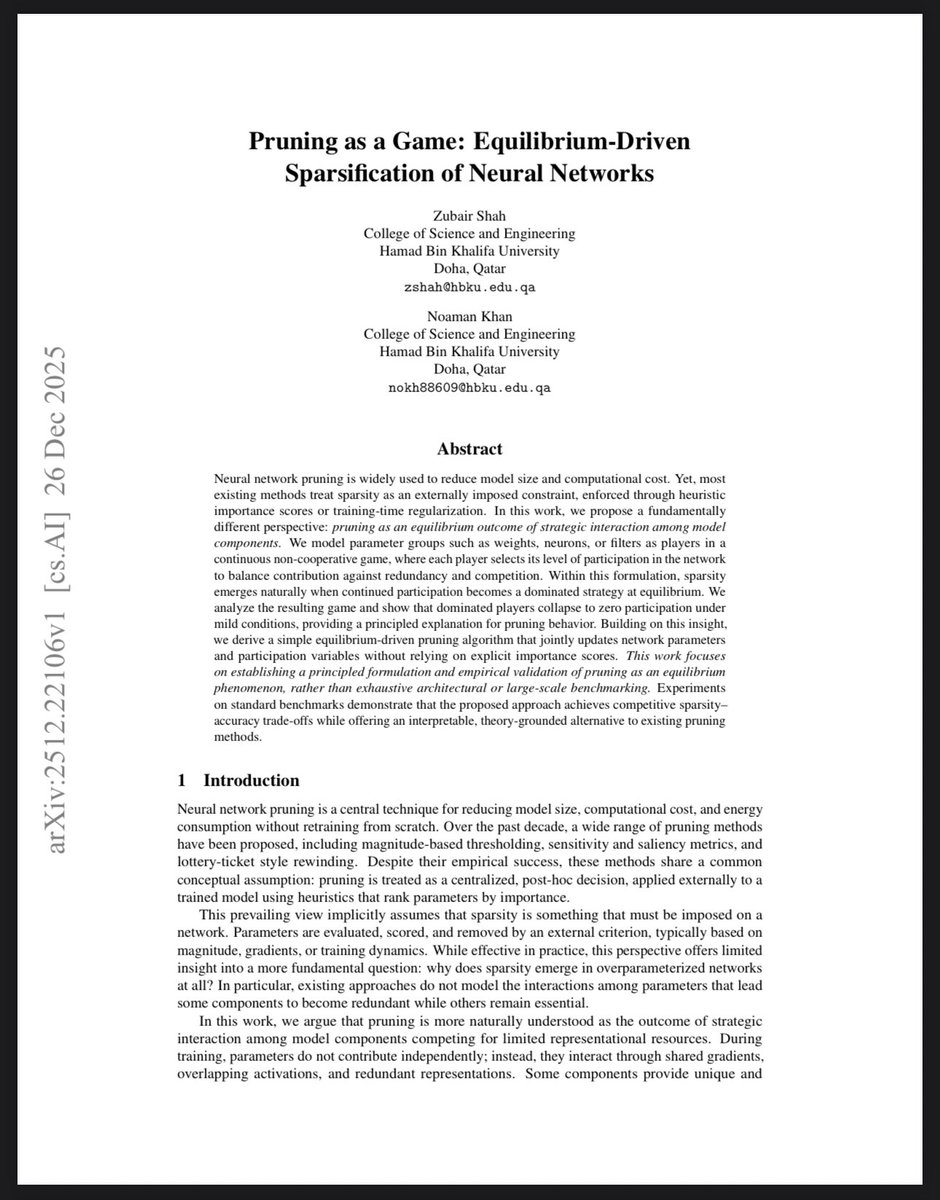
Breakthrough: Game-Theoretic Pruning Slashes Neural Network Size by Up to 90% with Near-Zero Accuracy Loss: Unlocking Edge AI Revolution!
I am testing this now on local AI and it is astonishing!
introduced Pruning as a Game.
Equilibrium-Driven Sparsification of Neural Networks, a novel approach that treats parameter pruning as a strategic competition among weights. This method dynamically identifies and removes redundant connections through game-theoretic equilibrium, achieving massive compression while preserving – and sometimes even improving – model performance.
Published on arXiv just days ago (December 2025), the paper demonstrates staggering results: sparsity levels exceeding 90% in large-scale models with accuracy drops of less than 1% on benchmarks like ImageNet and CIFAR-10. For billion-parameter behemoths, this translates to drastic reductions in memory footprint (up to 10x smaller), inference speed (2-5x faster on standard hardware), and energy consumption – all without the retraining headaches of traditional methods.
Why This Changes Everything
Traditional pruning techniques – like magnitude-based or gradient-based removal – often struggle with “pruning regret,” where aggressive compression tanks performance, forcing costly fine-tuning cycles. But this new equilibrium-driven framework flips the script: parameters “compete” in a cooperative or non-cooperative game, where the Nash-like equilibrium reveals truly unimportant weights.
The result?
Cleaner, more stable sparsification that outperforms state-of-the-art baselines across vision transformers, convolutional nets, and even emerging multimodal architectures.
Key highlights from the experiments:
•90-95% sparsity on ResNet-50 with top-1 accuracy loss <0.5% (vs. 2-5% in prior SOTA).
•Up to 4x faster inference on mobile GPUs, making billion-parameter models viable for smartphones and IoT devices.
•Superior robustness: Sparse models maintain performance under distribution shifts and adversarial attacks better than dense counterparts.
This isn’t just incremental – it’s a paradigm shift. Imagine running GPT-scale reasoning on your phone, real-time video analysis on drones, or edge-based healthcare diagnostics without cloud dependency.
By reducing the environmental footprint of massive training and inference, it also tackles AI’s growing energy crisis head-on.
The implications ripple across industries:
•Mobile & Edge AI: Affordable on-device intelligence explodes.
•Green Computing: Lower power draw for data centers and devices.
•Democratized AI: Smaller models mean broader access for startups and developing regions.
As AI scales toward trillion-parameter frontiers, techniques like this are essential to keep progress practical and inclusive.
Pruning as a Game: Equilibrium-Driven Sparsification of Neural Networks
(PDF: arxiv.org/pdf/2512.22106)
I will continue my testing but thus far results are robust!
English
I'm not saying I fully believe this yet. And I'm not saying that there are zero gains or anything like that. But we may still end up wetware-limited, more than we think. Loading in the context & writing the prompts is a lot like setting up the environment & writing the programs.
English
Alternative thesis: prompting is programming.
Just like you could make the machine do anything if you could just program faster, you could also make the machine do anything if you just prompt faster...and verify faster. And the latter is the hard part.
Andrej Karpathy@karpathy
I've never felt this much behind as a programmer. The profession is being dramatically refactored as the bits contributed by the programmer are increasingly sparse and between. I have a sense that I could be 10X more powerful if I just properly string together what has become available over the last ~year and a failure to claim the boost feels decidedly like skill issue. There's a new programmable layer of abstraction to master (in addition to the usual layers below) involving agents, subagents, their prompts, contexts, memory, modes, permissions, tools, plugins, skills, hooks, MCP, LSP, slash commands, workflows, IDE integrations, and a need to build an all-encompassing mental model for strengths and pitfalls of fundamentally stochastic, fallible, unintelligible and changing entities suddenly intermingled with what used to be good old fashioned engineering. Clearly some powerful alien tool was handed around except it comes with no manual and everyone has to figure out how to hold it and operate it, while the resulting magnitude 9 earthquake is rocking the profession. Roll up your sleeves to not fall behind.
English