Jon Luo

32 posts

Jon Luo

Jon Luo

@JonZLuo

Bioinformatics Analyst at @GeisingerRsrch. MS @CMUCompBio. Tweets are my own views. Might have peaked in high school.

เข้าร่วม Şubat 2023
304 กำลังติดตาม469 ผู้ติดตาม
ทวีตที่ปักหมุด
Jon Luo
Jon Luo@JonZLuo·
Want to implement chain-of-thought reasoning in your text-to-SQL tool to help guide the SQL query generation? One way is to provide few-shot examples demonstrating CoT. @langchain makes this a piece of cake. (1/4)
Jon Luo tweet media
English
16
43
336
55.4K
Krithik Ramesh
Krithik Ramesh@KrithikTweets·
@EziraYimerWolle should have tweeted it out at the same time, my bad, jupyter notebook to run everything and codebase going up ASAP :)
English
4
1
12
751
Krithik Ramesh
Krithik Ramesh@KrithikTweets·
🧬 Meet Lyra, a new paradigm for accessible, powerful modeling of biological sequences. Lyra is a lightweight SSM achieving SOTA performance across DNA, RNA, and protein tasks—yet up to 120,000x smaller than foundation models (ESM, Evo). Bonus: you can train it on your Mac. read our paper here: arxiv.org/abs/2503.16351
Krithik Ramesh tweet media
English
18
145
730
120K
Asher Trockman
Asher Trockman@ashertrockman·
State space models have struggled to learn to do things like copying and associative recall 🟢 -- things that self-attention learns easily 🟠... But it turns out we just needed to change SSM initialization a bit 🔵. Our init helps a lot, and even makes state space layers *look* more like self-attention layers. Maybe SSMs have been underestimated? Read more: arxiv.org/abs/2410.11135 w/ @harhrayr, @zicokolter, Sanjiv Kumar, Srinadh Bhojanapalli
Asher Trockman tweet media
English
6
56
355
41.5K
Jon Luo
Jon Luo@JonZLuo·
@ashertrockman @Grad62304977 Thanks for sharing the gist, excited to play around with it. In lines 82-83, 2*d_inner is 2*d, right?
English
1
0
2
125
Asher Trockman
Asher Trockman@ashertrockman·
Thanks! Here you go: gist.github.com/ashertrockman/… Doing something similar via regularization instead of initialization probably also works, but I haven't tried. Making the learnable mask close to all-1s indeed seems to be the most important component, especially for Mamba 1. But for Mamba 2, other things are quite important too, especially making B and C correlated. I point these things out in the code above too. The correlated weights phenomenon was important in my previous work on mimetic initialization (arxiv.org/abs/2305.09828) and IIRC encouraging this with regularization was not helpful like initialization.
English
1
0
4
698
Jon Luo
Jon Luo@JonZLuo·
Need help finding something! It's a cartoon drawing of a monster (representing LLMs) and I think a lasso or maybe a window that the monster was being squeezed through (representing prompt engineering). I'm pretty sure I saw it on Twitter a few weeks ago? Anyone remember this?
English
1
0
1
439
LangChain
LangChain@LangChain·
🧙‍♂️The SQL Wizard @JonZLuo strikes again🧙‍♂️ One of the biggest pain points we've noticed with our SQL chain is that differences in dialects (mssql, sqlite, etc) made it hard to make a generic prompt How did @JonZLuo fix this? Dialect specific prompts! 🧵
English
4
32
205
75.3K
Jon Luo
Jon Luo@JonZLuo·
With this, each prompt can be individually adjusted as needed for each SQL dialect without affecting the others. PR’s and suggestions very welcome from everyone!
LangChain@LangChain

@JonZLuo added specific prompts for MSSQL, MYSQL, MariaDB, Oracle, Postgres, and SQLite PR: github.com/hwchase17/lang… Huge shout out to @JonZLuo - he's already done a ton to push the capabilities of the SQL chains, and this just continues that 💪💪💪

English
0
7
44
20.3K
Jon Luo รีทวีตแล้ว
Mayo Oshin
Mayo Oshin@mayowaoshin·
Announcing the third batch of AI chatbot experts sharing insights during the upcoming "Build a ChatGPT Chatbot For Your Data" program AI SQL experts: NLP Practitioner, @fpingham Bioinformatics Analyst, @JonZLuo Semantic search expert: @transitive_bs Learn more below...
Mayo Oshin@mayowaoshin

Announcing the second batch of AI chatbot experts sharing insights during the upcoming "Build a ChatGPT Chatbot For Your Data" program Co-founder at LangChainAI, @hwchase17 Co-founder at Chroma, @atroyn Learn more about the program below...


English
3
8
68
109K
Jon Luo
Jon Luo@JonZLuo·
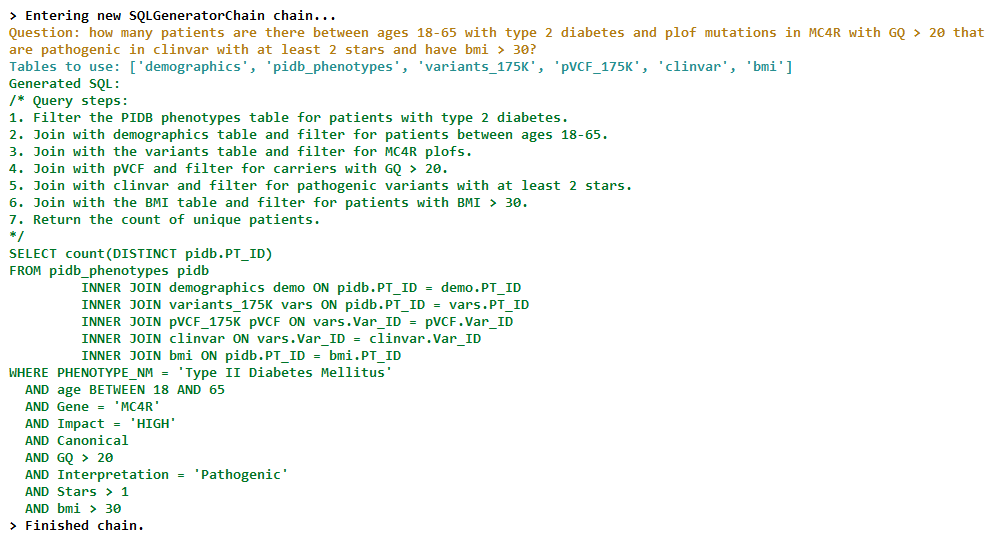
Want to implement chain-of-thought reasoning in your text-to-SQL tool to help guide the SQL query generation? One way is to provide few-shot examples demonstrating CoT. @langchain makes this a piece of cake. (1/4)
Jon Luo tweet media
English
16
43
336
55.4K
Jon Luo
Jon Luo@JonZLuo·
@jxnlco @langchain Sorry for the late reply - not that I know of for CoT. Also thinking about the best way to go about it. I think we need to be deliberate in selecting the subset of questions/queries from spider for benchmarking.
English
1
0
0
97
jason liu
jason liu@jxnlco·
@JonZLuo @langchain Are there evals on spider to see if it actually performs better than baseline? Or at least how different models perform. Not a critique. I’ve been thinking about this for a while and never had time to run evals. Saw that llama index has some.
English
1
0
0
140
Jon Luo
Jon Luo@JonZLuo·
@monitus @langchain Sorry for the late reply! SQLGeneratorChain is just a chain I made that generates SQL code but does not execute it. The SQLDatabaseChain in LangChain executes the query after generating it.
English
0
0
1
121
Jon Luo
Jon Luo@JonZLuo·
@socialtippers @langchain I think they're complementary. What they've demoed so far is very cool but you need to upload or connect your data, which may be undesirable. Generally with your own tools, you can make more bespoke solutions and also work without ever sending your data to a third party.
English
0
0
1
714
Social Tippers
Social Tippers@socialtippers·
@JonZLuo @langchain Second, will the new release of integrations by Open AI replace any of the work which you have done with querying numerical and categorical data, or make it easier? I have a need for very similar queries to what you are doing in that demo.
English
1
0
0
924
Jon Luo
Jon Luo@JonZLuo·
@socialtippers @langchain Hey, thanks for the kind words and sorry for the late reply. I think a lot of the heavy lifting in understanding complex joins comes from providing the few-shot examples. Zero-shot doesn't work as well - however, I was using Codex which doesn't do great zero-shot txt2SQL anyway
English
1
0
1
181
Social Tippers
Social Tippers@socialtippers·
@JonZLuo @langchain I really enjoyed your presentation in the webinar, and I was disappointed that your attempt to actually provide a DEMO of something was curtailed. Second, have you achieved what that code does out of the box with Langchain, or did you have to do customization for those joins?
English
1
0
0
202
Jon Luo
Jon Luo@JonZLuo·
While it may underperform in zero-shot tasks (as seen in @ekzhu's cool Spider evals), I found it to be excellent in the few-shot setting for text-to-sql, although I don't have a formal eval. I'm needing to wrestle a lot more with the other models for my app. RIP Codex😢(2/2)
English
0
0
1
380
Jon Luo
Jon Luo@JonZLuo·
An underappreciated thing about Codex imo was its context length. With 8k context len, you could provide many more few-shot examples than other models. In addition to being able to feed it more examples, it had stronger in-context learning ability: twitter.com/goodside/statu… (1/2)
Riley Goodside@goodside

Farewell to OpenAI Codex. Codex's code‑davinci‑002 was the best performing model in the GPT-3/3.5 line for many tasks. Despite its name, it excelled in both code and natural language. It will be missed. Left: OpenAI email. Right: From Yao Fu 2022 yaofu.notion.site/How-does-GPT-O…
English
1
0
2
1.2K
Jon Luo
Jon Luo@JonZLuo·
@mayowaoshin @langchain sky's the limit! If appropriate for your data, you could have the chain/agent execute the query to interpret the results or to decide on the next action, use a tool to generate a plot, etc
English
0
0
1
34
Mayo Oshin
Mayo Oshin@mayowaoshin·
@JonZLuo @langchain So what’s the next recommended step after the sql query has been generated?
English
1
0
0
51
Jon Luo
Jon Luo@JonZLuo·
@mayowaoshin @langchain Sorry - examples are injected into the prompt which isn’t shown in the output here. Green is the generated SQL for the input question (orange). Blue is from a chain that selects only the tables needed to answer an input question so we don’t clog the prompt w/ unneeded table DDL
English
1
0
1
153
Mayo Oshin
Mayo Oshin@mayowaoshin·
@JonZLuo @langchain Awesome. A bit confused by the output though. So your few shot example is in green? And blue is hard coded?
English
1
0
0
155
Jon Luo
Jon Luo@JonZLuo·
...and that's all there is to it. This can help the LLM navigate unruly queries and is more interpretable for the reader. There is also ongoing work to implement zero-shot CoT for SQL in @langchain. Exciting times! (4/4)
Jon Luo tweet media
English
5
0
7
2.5K
Jon Luo
Jon Luo@JonZLuo·
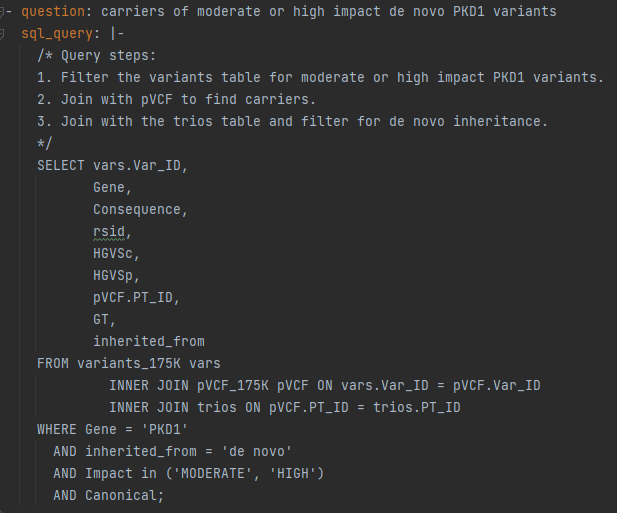
Annotate your examples with CoT, demonstrated here in a block comment as mentioned in the prompt. I manage my examples in a YAML file. Provide these examples to the prompt as described in the docs: langchain.readthedocs.io/en/latest/modu… (3/4)
Jon Luo tweet media
English
3
0
8
3K