Karin Maria Hodges

7.3K posts

Karin Maria Hodges banner
Karin Maria Hodges

Karin Maria Hodges

@KarinMariaPsyD

Parent; Dyslexic; UCLA Bruin; Co-Developer & Co-Instructor, MIT Course; Co-Producer, Mental Health Mirage; Founder Raising Moxie, LLC Concord, Ma

เข้าร่วม Mayıs 2017
686 กำลังติดตาม998 ผู้ติดตาม
ทวีตที่ปักหมุด
Karin Maria Hodges
Karin Maria Hodges@KarinMariaPsyD·
What’s super interesting is what you see when you work in one of the wealthiest towns in one of the wealthiest states in the country. Parents are resourced and highly educated. And I am a highly motivated Psychologist. So we definitely get things done. We’re able to partner and look at all the variables and address all of the variables. It basically looks like multiple case studies, each with an N of 1. And…Guess what? The kids that I’ve seen in treatment do not read well until given structured literacy approaches privately (private literacy specialists). This is the reality. I have also worked in low resourced districts alongside classroom teachers and understand the impossible circumstances these teachers face. It also does not change the primary source of the literacy crisis. The lack of high quality literacy instruction in most schools. But education will soon be reformed, thank goodness. Beyond literacy reform, we must get the distractions out of the school. The pop psychology that many educators are absolutely done with at this point. Bottom line: Support teachers to skillfully teach. Get them the proper professional development and materials. De-implement pseudoscience. It’s a distraction and waste of time. And it is confusing people.
Eleanor434@Eleanordog434

@NiaEducational @educator4ever36 @Dbirdfatty If you give us kids that aren’t chronically absent, don’t switch schools four times in five years, don’t sit in video games for hours on end when they get home, and parents that help them, then teachers can be blamed.

English

2
8
61
9.6K
Karin Maria Hodges
Karin Maria Hodges@KarinMariaPsyD·
@reseacher2022 @CarolynGorman_ This is a valid concern. If someone only ever lives and thinks through a lens of illness, they may not know how to be in, and think about, wellness and thriving. & These screeners show weak predictive validity, and many are built on psychologically unsophisticated assumptions.
English
0
0
1
9
K-12 School Shootings stats
K-12 School Shootings stats@reseacher2022·
@CarolynGorman_ I wonder who will screen the 'mental health professionals' who will be in charge of screening children? Who gets to decide who is and who isn't mentally well? The Columbine shooters were in court-ordered anger management therapy the whole time they plotted their massacre...
English
1
0
2
59
Carolyn D. Gorman
Carolyn D. Gorman@CarolynGorman_·
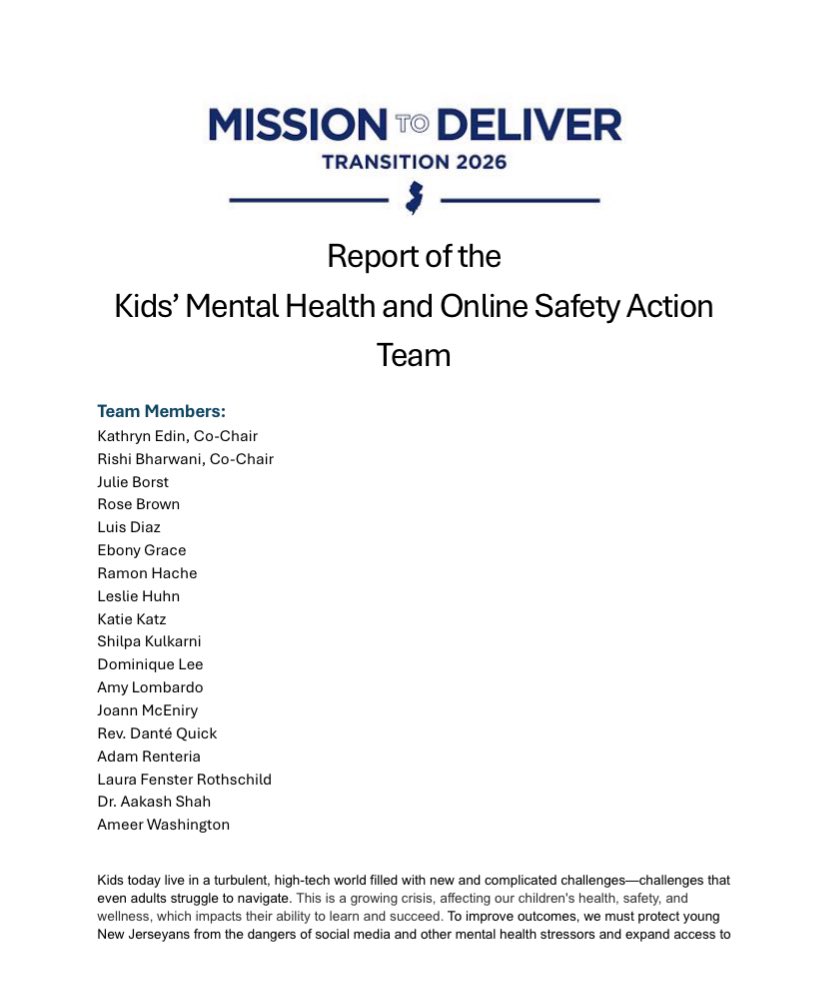
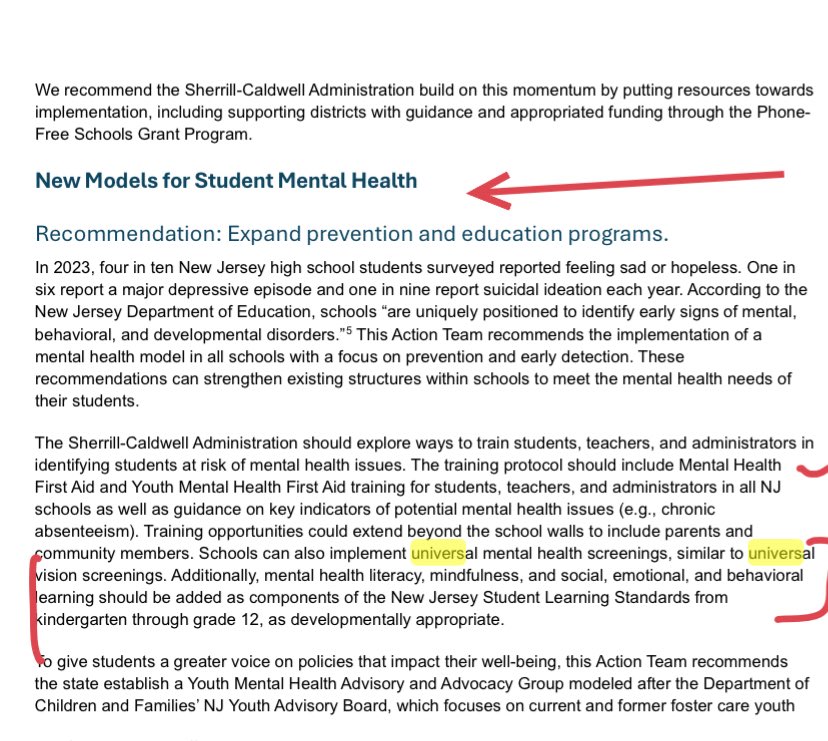
States that do not mandate universal school mental health screening are not in the clear. At least one-third of districts nationwide are already doing this. States must PROHIBIT universal school mental health screening.
Carolyn D. Gorman@CarolynGorman_

Virginia is quietly setting up to mandate all 6-12th graders be screened for mental conditions annually—will push HUGE numbers of kids toward to mis- and overdiagnosis. @ALegalProcess —who spots more scary details in legalese than anyone else—writes how bad it is. @CityJournal

English
16
39
165
21.5K
Karin Maria Hodges
Karin Maria Hodges@KarinMariaPsyD·
@ALegalProcess @CarolynGorman_ Why in the world, when we know the preconditions for thriving versus suffering, would we be asking the kids to dictate policy and reform? It is developmentally and ethically inappropriate to exploit the kids in this way. Teach educators to foster growth promoting environments.
English
0
0
2
12
Karin Maria Hodges รีทวีตแล้ว
Nicolas Badre
Nicolas Badre@BadreNicolas·
Dinner with psychiatrists last night: “When you see a young patient with new-onset psychosis after a prodromal course, you say to yourself, ‘I know what this is: it’s schizophrenia.’ And that allows you to deftly maintain a state of denial that is easily exposed when you consider that (1) you don’t know what causes the illness, (2) you don’t know if it’s an illness at all or a collection of different illnesses, (3) you don’t know how to treat it, although you have medications to ameliorate some symptoms, (4) you don’t know if it will get better, get worse, or even go away, (5) you don’t know how long to continue the medications or at what dose, (6) but you can do doctoring stuff like get yet another brain MRI that will demonstrate the same thing that bedeviled 19th-century psychiatrists: How can someone be so sick and have what appears to be a perfectly normal brain?”
English
43
46
235
45.8K
Karin Maria Hodges
Karin Maria Hodges@KarinMariaPsyD·
@RplusDyslexia @KJWinEducation @BenisonMrs We are saying the same thing using different language. In the field of psychology we talk about “practice” as in “the practice of psychology” and “psychological intervention” and “psychological practice” interchangeably. The nature of cross disciplinary dialogue ☺️.
English
1
0
2
45
Kareem J. Weaver
Kareem J. Weaver@KJWinEducation·
Adopting "High Quality Instructional Materials" that teachers dont have time to fully implement, is not a flex. Its virtue-signaling masquerading as social justice.
English
10
13
92
4.7K
Karin Maria Hodges รีทวีตแล้ว
Karin Maria Hodges
Karin Maria Hodges@KarinMariaPsyD·
@KJWinEducation @BenisonMrs I expect many of the programs out there never teach the cognitive developmental framework with which skills are based. Without an understanding by all teachers of underlying theory and science to practice, implementation seems destined to fail.
English
2
1
10
224
Karin Maria Hodges
Karin Maria Hodges@KarinMariaPsyD·
School and class composition matter. Behavioral contagion is very real.
English
2
3
23
2.1K
Karin Maria Hodges
Karin Maria Hodges@KarinMariaPsyD·
@SteveLawrence_ @DonKAriel Montessori schools have a great deal of synergy with Surf’sUP Method®️ through Raising Moxie®️. That is because the frameworks, applied well, are consistent with developmental psychology. A solid school climate is a solid school climate. So, yes - in the right setting.
English
0
0
1
34
Steve Lawrence
Steve Lawrence@SteveLawrence_·
@KarinMariaPsyD @DonKAriel Ergo, pedagogically purposeful mixed-age classrooms. Establish equilibrium, maintain equilibrium from one year to the next. The single-age paradigm is the problem. It’s fundamentally unnatural & exists for administrative convenience not children’s developmental needs.
English
2
0
3
88
Liz Stepan
Liz Stepan@LizStepan·
@KarinMariaPsyD @DonKAriel In the first trimester of a class of struggling hs readers, we had a few students that engaged in discussion and created a sense of positive momentum. They graduated out and the next trimester devolved into disengagement and misbehaviors.
English
2
0
1
99
Karin Maria Hodges
Karin Maria Hodges@KarinMariaPsyD·
My team at @RaisingMoxie is planning to organize a panel of experts someday soon, and we will be so honored if @BadreNicolas would consider sitting on that panel!! He is easily one of my favorite thinkers!!
Nicolas Badre@BadreNicolas

Some of my physician colleagues dismiss calls for more emphasis on nutrition and exercise in medicine. They point out that in some studies that is a substitute for treatment-as-usual and ineffective. However, I think those calls are pointing at something deeper than what some of the data captures. I think that those calls envision a more utopian style of medicine: a physician who truly knows their patients, has built real rapport and trust over time. Consider a patient walking in and saying, “Ugh, Doc, I’m going through a divorce, sleep has been terrible, and I just feel awful.” In that moment, some of us (1) write a prescription for an SSRI, and (2) offer a quick throwaway comment about exercise, nutrition, and sleep hygiene before moving on. I suspect what the critics are actually longing for is something more connected and humanistic: (3) a provider who looks them in the eye and says, without flinching, “I know you feel like crap right now, but the way you’re living right now: your exercise, nutrition, and sleep habits are setting you up for disaster.” They want a doctor who isn’t rushed, isn’t staring at a computer screen, who gives practical advice and doesn’t schedule the next visit three months out. I worry both perspectives are making important points that deserve to be heard right now. They’re describing different visions important to healthcare. One team is pointing out the true evidence. Another is pointing out the human connection that makes treatment more effective.

English
0
0
1
102
Karin Maria Hodges
Karin Maria Hodges@KarinMariaPsyD·
School and class composition matter. Behavioral contagion is very real.
English
0
0
2
117
Karin Maria Hodges
Karin Maria Hodges@KarinMariaPsyD·
School and class composition matter. Behavioral contagion is very real.
English
0
2
5
334
Karin Maria Hodges
Karin Maria Hodges@KarinMariaPsyD·
And this is why we need @RaisingMoxie
Jaynit@jaynitx

Jordan Peterson: "People don't have mental illnesses, they have lives too complicated to manage" "I actually think complexity is the fundamental problem. The terror management theorists think that death is the fundamental problem, and that's a good argument, because it is definitely a fundamental problem. But I think death is a subset of the complexity problem." Peterson explains why: "Sometimes people's lives become so complex that they'd rather be dead. The reason they seek death through suicide is to make the complexity go away. Because complexity causes suffering if it's uncontrolled. Things just get beyond your control." He describes how this happens: "You get hit by three or four catastrophes at the same time. Maybe the political system collapses. There's hyperinflation. You lose your job. Someone you love dies, or two people die. Maybe you get cancer. These things happen to people. And they just think: there's no getting out of this. It's just too much." Peterson shares what he learned as a psychologist: "One of the things that's very interesting about being a psychologist is what you learn: people come to you with mental illnesses, and that's almost never true. People come to you because their lives are so damn complicated they cannot stay on top of them in any way that doesn't make it look like they're just going to get more complicated. And then that causes symptoms." He uses a metaphor for genetic susceptibility: "Take a balloon and blow it up until it's beyond its tolerance. It's going to blow out at the weakest point. That's sort of what genetic susceptibility is. If I just keep adding complexity on top of you, at some point you'll blow out at your weakest point. Maybe you'll get physiologically ill. Maybe you'll start drinking. Maybe you'll develop an anxiety disorder. Maybe you'll get OCD. Maybe you'll get depressed. Whatever, there'll be something about you that's the weakest point. If I just push, that's where you blow out." Peterson reframes what we call "mental illness": "Those things almost never just happen. Sometimes, but not very often. Usually, people have just been hammered two or three different ways, and then they collapse in the direction of their biological weakness. Then maybe you put them back together. But it's almost always a complexity-related phenomenon rather than a mental illness-related phenomenon. Not always, but almost always."

English
0
0
0
146
Kareem J. Weaver
Kareem J. Weaver@KJWinEducation·
Still editing footage from our Georgia Road trip, seeing schools and systems that are helping kids learn to read. Almost done. But this weekend will share podcast episode with two people who helped lead system turnarounds. Specific, clear, challenging.
English
2
2
21
901