Lars Borm

351 posts

Lars Borm banner
Lars Borm

Lars Borm

@LarsBorm

Postdoc at Stein Aerts lab, smFISH of the non-swimming kind. Building and tinkering.

Leuven, Belgium เข้าร่วม Ekim 2017
224 กำลังติดตาม564 ผู้ติดตาม
Lars Borm รีทวีตแล้ว
evo-devo
evo-devo@Xiaojie_Qiu·
We’re thrilled to share that our MERFISH+ preprint is now live on bioRxiv!👉biorxiv.org/content/10.110… In this work, the Bintu and Zhu labs (UCSD) developed MERFISH+, a next-generation spatial genomics platform that combines genome-wide RNA and epigenetic imaging over a large field of view. By introducing acrydite-modified probes covalently anchored to hydrogels, MERFISH+ achieves remarkable imaging stability and enables >1,800-gene, multi-modal, and multi-month experiments. With this platform, they, together with the Chi lab at UCSD, profiled a whole developing human heart at 12 post-conception week with merely two slides, resulting in a total of 53 slides, 3.1 million single cells and more than 30 cell types. Building upon our previous 3D reconstruction and modeling framework, Spateo (github.com/aristoteleo/sp…), we reconstruct the 3D human heart that nicely captures the anatomical structure of the heart, including the intricate vasculature network. Sophisticated analyses provide a holistic view of an entire organ and enable systematic characterization of 3D cellular neighborhoods and transcriptional gradients of substructures such as the descending arteries. Furthermore, using a generative integration framework for spatial multimodal data (Spateo-VI), we harmonized these MERFISH+ transcriptomic and chromatin data to reconstruct a 3D spatially-resolved multi-omics atlas of the developing human heart, shared at zhu.merfisheyes.com and viewer.spateo.aristoteleo.com. MERFISH+ thus sets a new standard for large-format, multi-omic spatial profiling, enabling holistic, 3D characterization of organs at subcellular resolution. Huge congratulations to first authors Colin Kern, @qingquanZhang2, @YifanLu2024 , and Jacqueline Eschbach, and to all collaborators from the Bintu, Zhu, Chi, and Qiu labs for this amazing team effort. Thanks for your diligence, creativity, and hard work on this project. We’re grateful for support from @arcinstitute and our generous donors. Our lab is expanding—if you’re excited about building the next generation of single-cell and spatial genomics techniques and predictive single cell and spatial foundation models, we’re hiring! If you are interested, please reach out to me via direct message or email at xiaojie@stanford.edu. We are excited for any potential collaborations along this line of research in Stanford, UCSF and Berkeley and other labs as well.
English
8
62
270
41.8K
Lars Borm รีทวีตแล้ว
Fabian Theis
Fabian Theis@fabian_theis·
🚀 Excited to share scPortrait! Led by Sophia Mädler & Niklas Schmacke w/ the Mann lab — a new @scverse tool for standardized single-cell image data. Enables ML-ready extraction, >1B cell processing, cross-omics, & cancer macrophage insights. 🔗 biorxiv.org/content/10.110…
Fabian Theis tweet media
English
2
60
324
22.7K
Lars Borm รีทวีตแล้ว
Science Magazine
Science Magazine@ScienceMagazine·
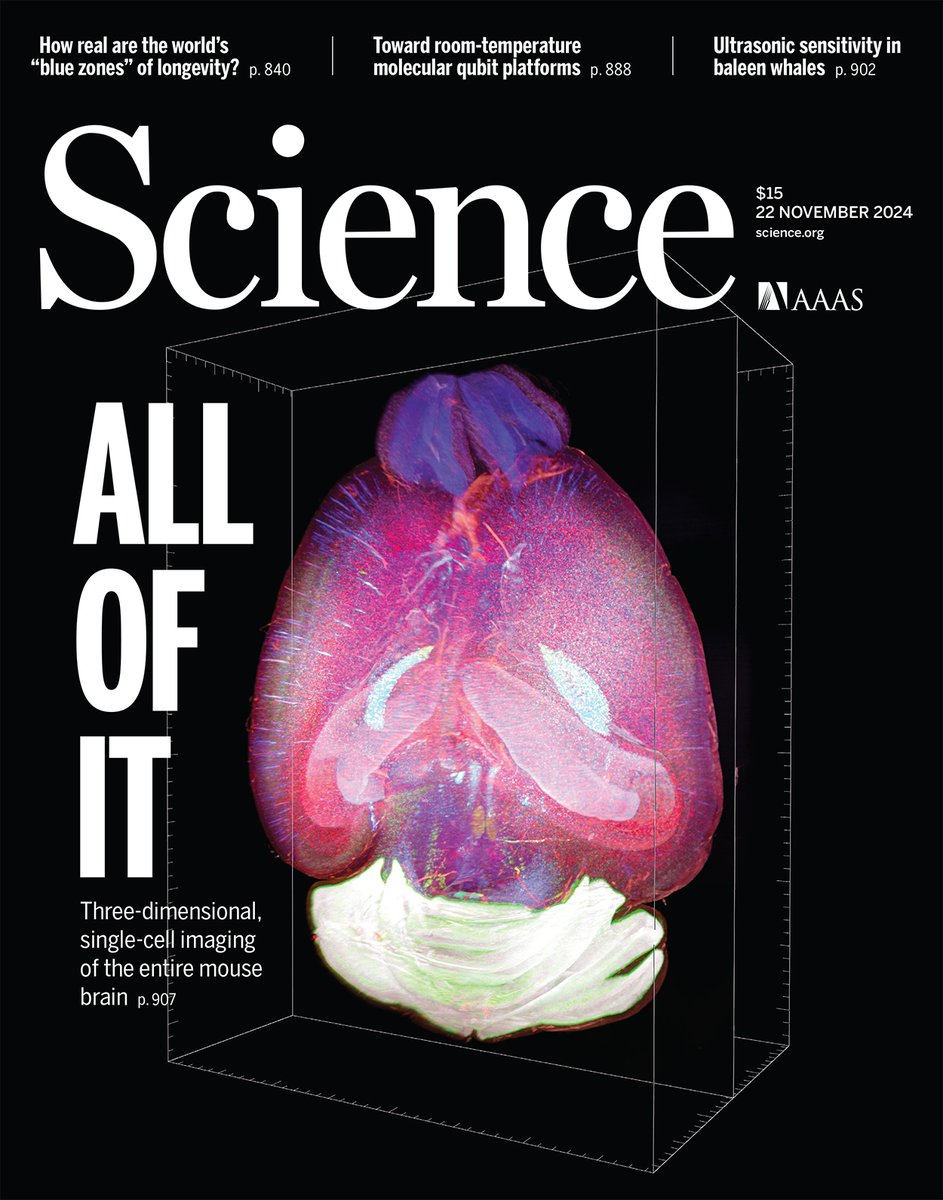
This light-sheet microscopy three-dimensional rendering shows a first-of-its-kind mouse whole-brain mRNA analysis at single-cell resolution. Learn more in this week’s issue: bit.ly/3CCapy5
Science Magazine tweet media
English
15
169
616
342K
Lars Borm รีทวีตแล้ว
evo-devo
evo-devo@Xiaojie_Qiu·
We are thrilled to share that our first paper from my new lab, Spateo (github.com/aristoteleo/sp…) for spatiotemporal modeling of molecular holograms, is now online in Cell: cell.com/cell/fulltext/…. Spateo is a comprehensive analytical framework for 3D whole-embryo spatiotemporal modeling. Its advanced features include: • 3D alignment and reconstruction at the whole-mouse-embryo scale (see the animation). • 3D spatial domain digitization and cell-cell communication analysis to understand spatial gene expression gradients and both inter- and intracellular communication. • 3D morphometric and volumetric analyses along with 3D morphogenesis vector field modeling to quantify dynamics such as surface area, volume, and cell density across organs, and to dissect the interplay between morphogenesis factors and cell migration. • A “Google Earth”-like browser, Spateo-viewer (viewer.spateo.aristoteleo.com and github.com/aristoteleo/sp…), for interactive and intuitive exploration of 3D spatial data. • Additional features, such as RNA signal-based single-cell segmentation. We are also honored that Nature “News and Views” has highlighted this work as well: nature.com/articles/d4158…. This is really an amazing outcome after two years' heroic revision process that rewrite the entire paper using a new data (doi.org/10.1101/2024.0…) for whole mouse embryos.
English
23
125
480
57.9K
Lars Borm
Lars Borm@LarsBorm·
Do you want to learn more about Spatial Omics data analysis? Please join our course 21-24Jan in Lausanne! Link below.
English
0
3
16
861
Lars Borm รีทวีตแล้ว
Rong Fan
Rong Fan@RongFan8·
Thrilled to report Patho-DBiT, just published in Cell 😊. It allows us to directly “see” all kinds of RNA species on the same clinical FFPE tissue slide, including mRNA, miRNA, snRNA, snoRNA, tRNA, etc, and splicing isoforms, genetic alterations (SNV, CNV, etc). Really a fun, cool, and powerful tool to explore human biology 🤩🤩 @CellCellPress cell.com/cell/fulltext/…
Rong Fan tweet media
English
36
274
1.1K
123.5K
Lars Borm รีทวีตแล้ว
zack chiang
zack chiang@z_chiang·
7 years ago, I met a junior fellow named @JD_Buenrostro who blew me away with a vision of futuristic genomic technologies Today, we (@ajaylabade31, @carolinecomenho) are excited to share our first steps into that future: Expansion in situ genome sequencing 1/
GIF
English
11
225
865
153K
Lars Borm รีทวีตแล้ว
Yinan Wan
Yinan Wan@yinan_wan·
Our paper ‘Whole-embryo Spatial Transcriptomics at Subcellular Resolution from Gastrulation to Organogenesis’ is now on biorxiv! We introduce weMERFISH, a platform for profiling gene expression in entire embryos at subcellular resolution. Here is🧵biorxiv.org/content/10.110… (1/12)
English
7
43
136
19.5K
Lars Borm รีทวีตแล้ว
𝓟𝓮𝓷𝓰 𝓗𝓮 何鵬
🚨𝐇𝐞 𝐋𝐚𝐛 job opportunity @UCSF 🚨: I'm hiring TWO postdocs - an experimentalist and a computational biologist. Join us to use cutting-edge single-cell and spatial technologies to unravel the mysteries of human tissues. opportunities.ucsf.edu/content/open-p…
𝓟𝓮𝓷𝓰 𝓗𝓮 何鵬 tweet media
English
1
91
195
32.3K
Lars Borm รีทวีตแล้ว
MatsNilssonLab
MatsNilssonLab@MatsNilssonLab·
🎉 Exciting news! Our latest work is now published in @Dev_journal! The open-source solution for RNA-targeted in situ sequencing provides an accessible and efficient method for spatially resolved gene expression analysis and spatial multi-omics. 🔗 doi.org/10.1242/dev.20…
English
0
8
15
2K
Lars Borm รีทวีตแล้ว
Bo Wang
Bo Wang@BoWang87·
🚀 The Segment Anything Model (SAM) has been upgraded to SAM2, featuring an efficient image encoder for segmenting images and videos. But does SAM2 outperform SAM1 in medical image and video segmentation? We're thrilled to present our paper "Segment Anything in Medical Images and Videos: Benchmark and Deployment"! We comprehensively benchmark SAM2 across 11 medical image modalities and videos. 📄 Paper: arxiv.org/abs/2408.03322 💻 Code: github.com/bowang-lab/Med… **Highlights:** 1. SAM2 doesn’t always outperform SAM1 in 2D medical images, but excels in video segmentation, making it more accurate and efficient for 3D images, such as CT and MR scans. 2. MedSAM still outperforms SAM2 on most 2D modalities, but SAM2 surpasses MedSAM for 3D image segmentation in a slice-by-slice approach. 3. Segmentation performance varies with model size; sometimes the smallest model outperforms larger ones. 4. Fine-tuning SAM2 significantly boosts its performance for medical image segmentation. While SAM2 may struggle with challenging objects that have unclear boundaries or low contrast, it excels in generating good initial segmentation masks for common medical images and videos. However, the official interface doesn’t support medical data formats and has limitations on video length. To address this, we've developed a 3D Slicer Plugin and Gradio API for efficient 3D medical image and video segmentation. We invite you to try them out and provide feedback! 🔧 Deployment: - 3D Slicer Plugin: github.com/bowang-lab/Med… - Gradio API: 5564949e4fbde69f0a.gradio.live (Note: Due to GPU limitations, the online API is available for only 12 hours and may be slow. We highly recommend deploying the Gradio API with your own computing resources: github.com/bowang-lab/Med… A big shoutout to Jun Ma (@JunMa_11) who recently joined our UHN AI hub (@UHNAIHUB) as Machine Learning Lead, and kudos to all co-authors: Sumin Kim, Feifei Li, Mohammed Baharoon (@BaharoonMS), Reza Asakereh, and Hongwei Lyu! This is true teamwork! Looking forward to collaborating with the community to advance 3D medical image and video segmentation foundation models! @UHN @UofTCompSci @UofT_LMP @UofT_TCAIREM @VectorInst #MedTech #AIinHealthcare #DeepLearning #MedicalImaging #SAM2 #MedSAM #AIResearch
English
19
168
757
178.2K
Lars Borm รีทวีตแล้ว
Suresh Poovathingal
Suresh Poovathingal@S_Poovathingal·
Happy to see our work, Nova-ST, a new open-source platform for high-resolution spatial transcriptomics published in @CellCellPress @CellRepMethods cell.com/cell-reports-m… 👇
VIB-KU Leuven Center for Brain & Disease Research@CBD_VIB

🗺 Introducing Nova-ST, a new open-source platform for high-resolution spatial transcriptomics! ⚡ Developed in the @steinaerts lab, Nova-ST will make large-scale, high-resolution spatial tissue analysis more accessible and affordable. Find out more ➡️ cbd.sites.vib.be/en/news#/news/…

English
6
12
52
8.4K