
ManchesterUX รีทวีตแล้ว

Learn how to use Cognitive Biases in UX to Boost Your Next Design Project 🙌
FREE Downloadable Cheatsheet 🔖
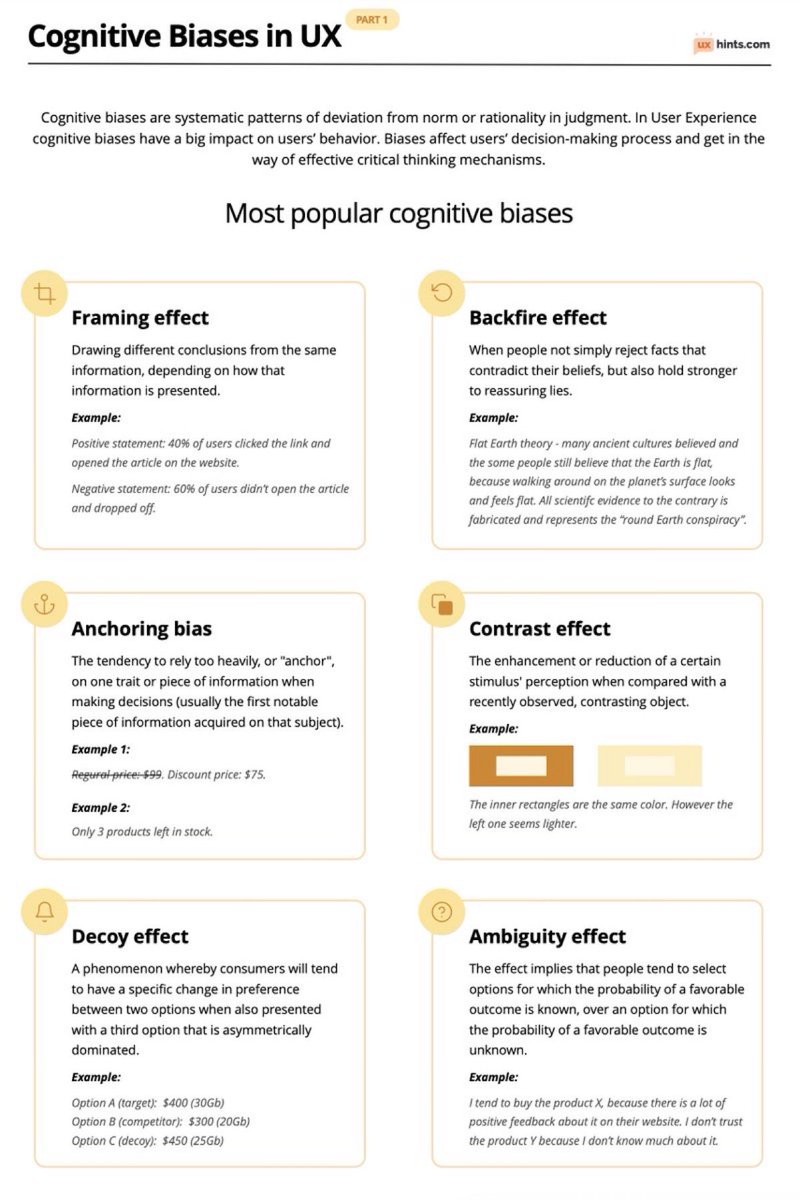
Cognitive biases are systematic patterns of deviation from norm or rationality in judgment. In User Experience cognitive biases have a big impact on users’ behaviour. Biases effect users’ decision-making process and get in the way of effective critical thinking mechanisms.
Most popular cognitive biases
Framing effect
Drawing different conclusions from the same information, depending on how that information is presented.
Example:
Positive statement: 40% of users clicked the link and opened the article on the website.
Negative statement: 60% of users didn’t open the article and dropped off.
Backfire effect
When people don’t simply reject facts that contradict their beliefs, but also hold stronger to reassuring lies.
Example:
Flat Earth theory - many ancient cultures believed and the some people still believe that the Earth is flat,
because walking around on the planet’s surface looks and feels flat. All scientific evidence to the contrary is fabricated and represents the “round Earth conspiracy”.
Anchoring bias
The tendency to rely too heavily, or "anchor", on one trait or piece of information when making decisions (usually the first notable piece of information acquired on that subject).
Example 1:
Regular price: $99. Discount price: $75.
Example 2:
Only 3 products left in stock.
Contrast effect
The enhancement or reduction of a certain stimulus' perception when compared with a recently observed, contrasting object.
Example:
The inner rectangles are the same colour. However the left one seems lighter.
Decoy effect
A phenomenon whereby consumers will tend to have a specific change in preference between two options when also presented with a third option that is asymmetrically dominated.
Example:
Option A (target): $400 (30Gb)
Option B (competitor): $300 (20Gb)
Option C (decoy): $450 (25Gb)
Ambiguity effect
The effect implies that people tend to select options for which the probability of a favourable outcome is known, over an option for which
the probability of a favourable outcome is unknown.
Example:
I tend to buy the product X, because there is a lot of positive feedback about it on their website. I don’t trust the product Y because I don’t know much about it.
#UX #UI #UXDesign #UIDesign #ProductDesign
English