Vivek Anantharaman

51 posts

Vivek Anantharaman

Vivek Anantharaman

@ProteinVerse

Computational Biology. Protein Evolution, Sequence, Structure, Function.

เข้าร่วม Kasım 2010
104 กำลังติดตาม46 ผู้ติดตาม
Vivek Anantharaman รีทวีตแล้ว
Aravind group
Aravind group@jivarahasya·
Extracellular Calcineurin-like phosphoesterases foster and signal altruistic behavior in bacteria This new work with @RamamurthiLab @ProteinVerse and colleagues uncovers a new role for extracellular calcineurin-like phosphoesterases in bacteria. The calcineurin-like superfamily that originated in some of the earliest reconstructible replicons preceding the last universal common ancestor includes members acting as diverse phosphoesterases: e.g., Calcineurin acts as a protein serine/threonine phosphatase, NadN acts as a NAD + pyrophosphatase; Icc is a cAMP phosphodiesterase; SMPDL3a-like proteins hydrolyze nucleotides such as cytidine 5’-diphosphocholine, cytidine diphosphate ethanolamine and ADP-ribose; the 2’,5’- phosphodiester debranching enzyme is a RNA phosphodiesterase; RNA cyclic 2’-3’ terminus phosphodiesterase acts in RNA repair; SbcD/Mre11 are DNA-recombination exoDNases, while the archaeo-eukaryotic DNA polymerase calcineurin-like subunits are DNA phosphodiesterases acting during replication; yet others were recently predicted by us to act as nucleotide-degrading enzymes in bacterial immunity. However, more mysterious were a large clade of Calcineurin-like enzymes that we describe here: they are extracellular and typically fused to a host of “adhesion” domains like Immunoglobulins, FN3 and the like. The current work establishes that one such enzyme, ShfP (YvnB) from Bacillus subtilis, generates glycerol, most likely by cleaving it off cell-surface lipoteichoic acids. This glycerol acts both as a signaling molecule and as a nutrient delivered by cells entering sporulation to their nonsporulating kin. The signal is likely received by the histidine kinase KinD via its MCP-N and Cache sensor domains – two domains that we discovered over two decades ago. The work presents evidence that this is a mechanism that fosters phenotypic heterogeneity, resulting in a diverse population that can hedge its bets between a starvation response and a sudden influx of nutrients. Although kin-recognition via conflict systems such as polymorphic toxins are prevalent among microbes, these findings show that genetically encoded modules for cooperative behavior in unicellular organisms can evidently also boost inclusive fitness. science.org/doi/epdf/10.11…
Aravind group tweet media
English
0
10
26
3K
Vivek Anantharaman รีทวีตแล้ว
Aravind group
Aravind group@jivarahasya·
From anti-invader immunity to the cytoskeleton: the tale of McrB proteins This work with @RamamurthiLab @ProteinVerse shows how a protein involved in bacterial immunity gave rise to a novel lineage-specific cytoskeletal protein. The McrB proteins are AAA+ ATPases that typically operate as NTP-dependent DNA translocating enzymes together with a restriction endonuclease or (more infrequently) other effectors to target invasive DNA from selfish elements like viruses. The AAA+ domain of McrB proteins is often fused to one or more N-terminal domains that serve as dedicated “readers” of modified nucleobases in DNA or effector or effector-recruiting adaptors. We discover several of the first of these classes of domains for the first time in this work. The interesting twist here is that Staphylococci possess a highly divergent McrB protein typified by PcdA, which has lost its associated restriction enzyme or effector partner but retains two modified DNA-binding EVE domains. Notably, it uses these EVE domains to bind FtsZ, which behaves as a DNA mimic. This ultimately leads to the recruitment of FtsZ to alternating orthogonal division planes, generating the characteristic grape-like pattern of S. aureus cell clusters. The emergence of this pattern might protect it against its animal host’s defenses. Thus, it shows how a lineage-specific cytoskeletal protein emerged from a protein originally involved in bacterial immunity. Remarkably, this is not the only time a McrB ATPase was recruited for a cytoskeletal role. A McrB ATPase from a bacterial immune system was transferred to the ancestral animal, where it founded the CTTNBP2/Nav2/Unc-53 lineage of proteins that comparably interact with F-actin or microtubules (eukaryotic cognates of FtsZ rings). Interestingly, like PcdA, CTTNBP2 shows a parallel degeneration of the AAA+ domain and stabilizes microtubules during dendritic spine formation. This suggests that the association between McrB and cytoskeletal components was perhaps an ancient function that allowed the McrB-based restriction systems to intercept invaders during cell division, potentially as a mechanism to block pseudolysogeny and related segregation into sister cells. nature.com/articles/s4156…
Aravind group tweet media
English
0
20
56
5.3K
Vivek Anantharaman รีทวีตแล้ว
Kumaran Ramamurthi
Kumaran Ramamurthi@RamamurthiLab·
@felixrl_ took on a ~50-yr-old mystery in #Staph aureus cell biology and came out on top! Check out his paper on how #Staphylococcus aureus chooses its cell division plane, how it forms clusters, and why all this matters during infection... #MOESM2" target="_blank" rel="nofollow noopener">nature.com/articles/s4156…
English
2
28
69
7.9K
Vivek Anantharaman รีทวีตแล้ว
Kumaran Ramamurthi
Kumaran Ramamurthi@RamamurthiLab·
Phenotypic heterogeneity may be ACTIVELY generated (not just passively by stochastic gene expression) in a population of sporulating #Bacillus subtilis, says Updegrove et al. A new sporulation pathway with 2 proteins of previously unknown function... science.org/doi/epdf/10.11…
English
3
18
41
5K
Vivek Anantharaman รีทวีตแล้ว
Kumaran Ramamurthi
Kumaran Ramamurthi@RamamurthiLab·
The cytoplasm is not necessarily chemically uniform, says Delerue, Updegrove, & @Sylvia_Char. Surface of the developing spore inside the #Bacillus subtilis mother cell is acidic & needs a chaperone to activate MurG (lipid II synthase) pnas.org/doi/epub/10.10…
English
1
9
38
4.6K
Vivek Anantharaman รีทวีตแล้ว
Aravind group
Aravind group@jivarahasya·
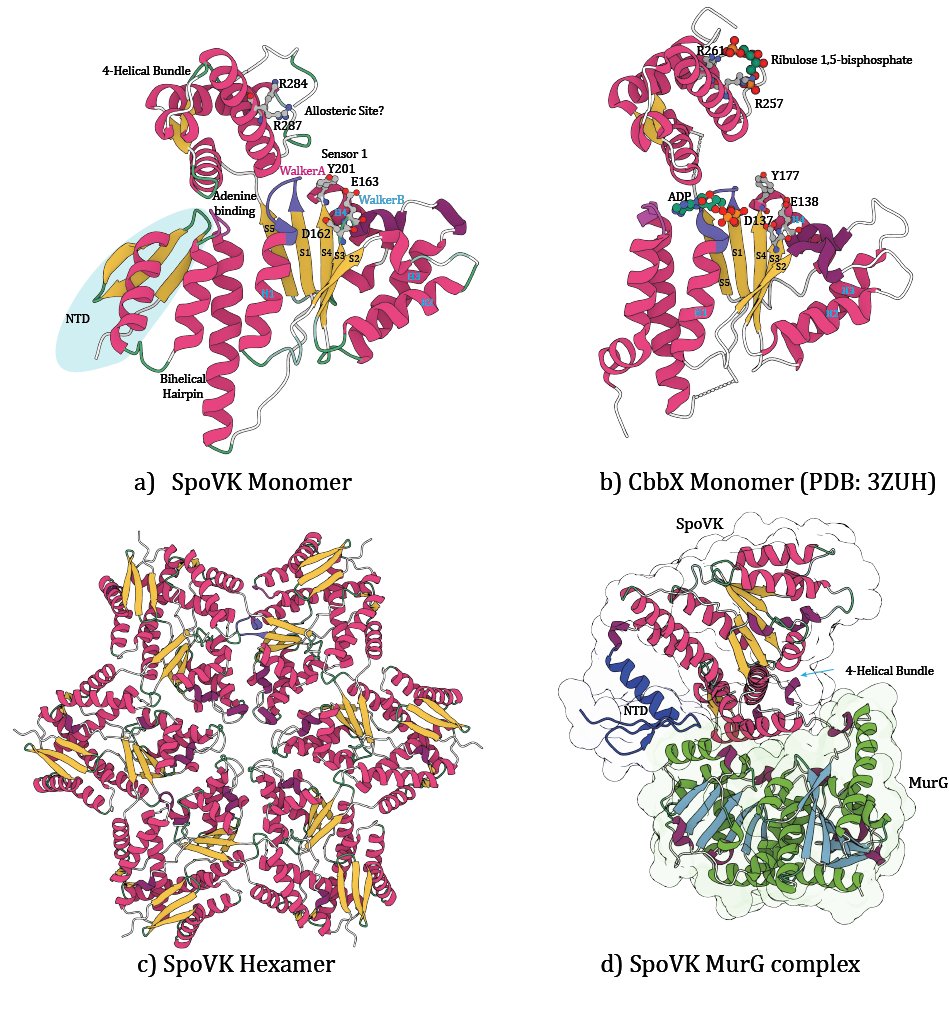
A chaperone assists peptidoglycan synthesis during sporulation Our new paper with the @RamamurthiLab @ProteinVerse on a cellular nano-environment-specific chaperone that defines a novel clade of AAA+ ATPases is out. While SpoVK was recognized as an AAA+ ATPase in our earliest work on these enzymes, its biochemical function remained unknown. The current work demonstrates that it is a specific chaperone for the peptidoglycan glycosyltransferase MurG that potentially aids its folding under low pH during sporulation. We show that SpoVK defines a specific higher-order clade of AAA+ domains that are sister group to the FtsH-like clade. In addition to SpoVK, this clade includes (i) CbbX the RuBisCO chaperone; (ii) the T7SS EccA-like chaperones; (iii) a subclade of eukaryotic exemplars predicted to be chaperones for RNA-processing complexes. (iv) a group of Bacillotan proteins with a variable number of AAA+ domains potentially involved in biological conflicts. All these appear to represent a radiation of classical AAA+ domains as specialized chaperones for distinct sub-cellular complexes activities. Interestingly, apart from being T7SS chaperones, some EccA proteins like Mycobacterium EccA1 also seem to regulate mycolic acid production, suggesting that members of this clade are specialized chaperones regulating the production of various cell-surface molecules. pnas.org/doi/10.1073/pn…
Aravind group tweet media
English
0
6
18
1.7K
Vivek Anantharaman รีทวีตแล้ว
Aravind group
Aravind group@jivarahasya·
AF model of HAAS domain-PadR system we published recently: shows HAAS domain, capturing the DNA-recognition helix+wing of the PadR wHTH. HAAS domains are fused to diverse sensor modules that facilitate its dissociation from PadR wHTH on receiving a signal doi.org/10.1128/msyste…
Aravind group tweet mediaAravind group tweet media
English
0
2
12
1.2K
Vivek Anantharaman รีทวีตแล้ว
Aravind group
Aravind group@jivarahasya·
the-scientist.com/multicellular-… Among other things, talks about Reverse transcriptase-based diversifying FGS domain systems that we first identified as key players in bacterial antiviral defense with analogies to animal mutagenesis of antigen receptors.
English
1
8
12
2.4K
Vivek Anantharaman รีทวีตแล้ว
Aravind group
Aravind group@jivarahasya·
Finally our Psp system paper is out: journals.asm.org/doi/epdf/10.11… Apart from uncovering manifold ramifications of the Psp system in membrane dynamics going back to the LUCA, it presents some new signaling paradigms: 1. the HAAS-PadR systems as an analogue of 2-component signaling
English
1
4
4
1.3K
Vivek Anantharaman รีทวีตแล้ว
Kumaran Ramamurthi
Kumaran Ramamurthi@RamamurthiLab·
Phenotypic heterogeneity is generated by passive mechanisms like noise in gene expression, right? Not always! Check out an ACTIVE mechanism for generating diversity in a clonal bacterial population: biorxiv.org/cgi/content/sh…
English
3
28
75
11.1K
Vivek Anantharaman รีทวีตแล้ว
Aravind group
Aravind group@jivarahasya·
A popular article in the Quanta magazine mentioning our work on the bacterial roots of eukaryotic apoptosis and immunity. quantamagazine.org/cellular-self-…
English
0
2
6
688
Vivek Anantharaman รีทวีตแล้ว
Aravind group
Aravind group@jivarahasya·
Are post-secretion signal peptides mere flotsam on the cell membrane? Our just-published work in collaboration with Laurie Waters lab at UWOsh shows that 1 such SP has remarkably reinvented itself as a small protein regulating Manganese transport via MntP onlinelibrary.wiley.com/doi/10.1111/mm…
English
1
10
54
5.8K
Vivek Anantharaman รีทวีตแล้ว
Aravind group
Aravind group@jivarahasya·
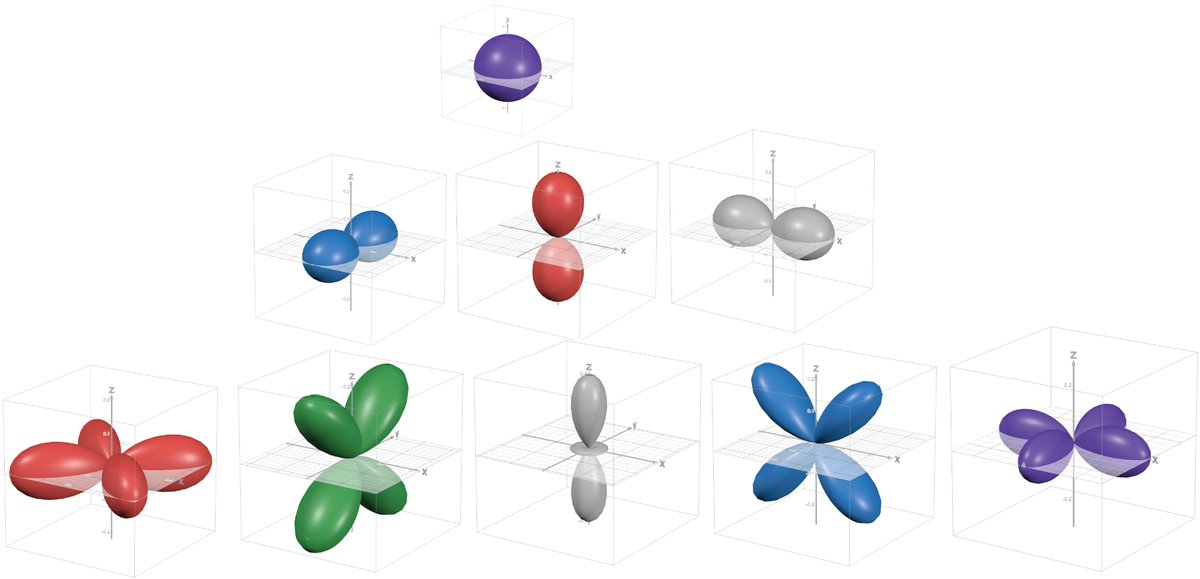
Coming: A strange case of signal peptides, neo-functional proteins and Mn. If you're wondering why this picture, Mn is the first d-block element that is widely used in biology; V is less so & Cr remains obscure. These are plots of 3 orbital equations specifying the blocks.
Aravind group tweet media
English
0
3
7
1.1K
Vivek Anantharaman
Vivek Anantharaman@ProteinVerse·
This study with Waters lab, Oshkosh, demonstrates that MntS small protein binds and inhibits the MntP Mn exporter and that it evolved from the signal peptide region of the Mn importer, SitA. biorxiv.org/content/10.110…
English
0
0
2
210
Vivek Anantharaman รีทวีตแล้ว
Kumaran Ramamurthi
Kumaran Ramamurthi@RamamurthiLab·
Think the cytoplasm is uniform in its physiochemical properties? "Nuh-uh!" say T. Delerue and @Sylvia_Char. Their preprint reports a chaperone required for cell wall assembly in #Bacillus due to decreased pH near the periphery of the developing spore. biorxiv.org/cgi/content/sh…
English
1
12
45
5.6K