Amany M.

36 posts

Amany M.

Amany M.

@Amany_MI

Chicago, IL Katılım Temmuz 2022
58 Takip Edilen23 Takipçiler
Amany M.
Amany M.@Amany_MI·
It’s my pleasure to share our most recent chapter published in the Handbook of Hydrocarbon and Lipid Microbiology. It was an enjoyable experience writing this chapter together with Dominique Missiakas. Please have a read: link.springer.com/rwe/10.1007/97…
English

0
0
0
14
Mohini B
Mohini B@MohiniB1·
Beyond thrilled to finally see my postdoctoral work with @Horswill_Lab published in @NatureComms. Here we report how the absence of the surface associated collagen binding adhesin causes visibly worsened skin infection. Bacterial deception at its best! nature.com/articles/s4146…
English
1
3
17
1.5K
Amany M. retweetledi
Amany M.
Amany M.@Amany_MI·
The colors of this butterfly 🦋 is truly amazing, lucky to have been able to get this quick shot ♥️
English
0
0
5
81
Amany M.
Amany M.@Amany_MI·
The glycolipid anchor Glc2DAG not only displaces the growing LTA polymer from the active site of LtaS as previously reported, but it also regulates the processing of LtaS enzyme by SpsB providing an elegant mechanism to regulate and control LTA synthesis in Staphylococcal cells.
English
0
0
0
66
Bobrovskyy Lab
Bobrovskyy Lab@Bobrovskyy_Lab·
First day at the new job! I am extremely excited to start my faculty position at #USouthFlorida. Go Bulls!!!
English
6
3
22
1.8K
Amany M. retweetledi
Andrew Akbashev
Andrew Akbashev@Andrew_Akbashev·
PhD is largely about leadership development. Advisors play a major role in it. Especially their management & mentorship styles. Research topics are secondary. ▫️ Below are the key points for establishing a great #research group. They will help your students excel. ▫️ 1. Inspire students to lead their projects. They should feel ownership of their work. 2. Discourage them from seeing failures at work as global disasters. Explain that learning requires failures. 3. Train them how to see the “big picture” (instead of always focusing on the details of their work). 4. Discourage excessive perfectionism. Teach them how to be efficient. 5. Inspire them to become a better version of their advisor. Not a copy!!! 6. Urge them to give as many talks as possible. At seminars, conferences and any local events. Well-developed communication skills are paramount for their future. 7. Help students develop networking skills. Introduce them to your colleagues and collaborators. 8. Let them to lead the collaborations that you initiated for their project. If there’s none, consider introducing collaborations into your student’s project. 9. At seminars, encourage them to ask questions & discuss their own topics with speakers whenever possible. 10. Ask for feedback on your approaches and group environment. Show them that getting feedback is normal and helpful for a group leader. Your #studentswill become greater team builders in the future. 11. Ensure that students ask each other for help and advice. They shouldn’t get used to solving problems solely on their own. It won’t make them great leaders. 12. Ensure their projects don't imply overworking. Help them make new collaborations if the project is too complex and time-consuming. 13. Discuss “senior” academic stuff (grants, budgets, tenure, etc). Help students understand how academia works. Encourage asking questions and have a group-wide discussion! 14. Diversify their skills and knowledge by giving access to experimental facilities and connecting them with experts. 15. Force them to prioritize lab safety over anything else. 16. Emphasize the importance of programming languages for data processing and analysis (Python, Julia, Matlab). It can significantly broaden their career opportunities. 17. Finally, don’t make them feel uncomfortable about having their personal lives. Let them manage their time! When to come and leave the lab, when to take vacation and how long it should be. Trust their judgement! There are many more points. But even if you follow these points, it will make a big difference for your students. ▫️ PhD graduates can become great leaders in various industry. And advisors can become a catalyst of their big adventures. ▫️ #AcademicTwitter #phdvoice #AcademicChatter
English
24
296
1.3K
219.4K
Amany M. retweetledi
Andrew Akbashev
Andrew Akbashev@Andrew_Akbashev·
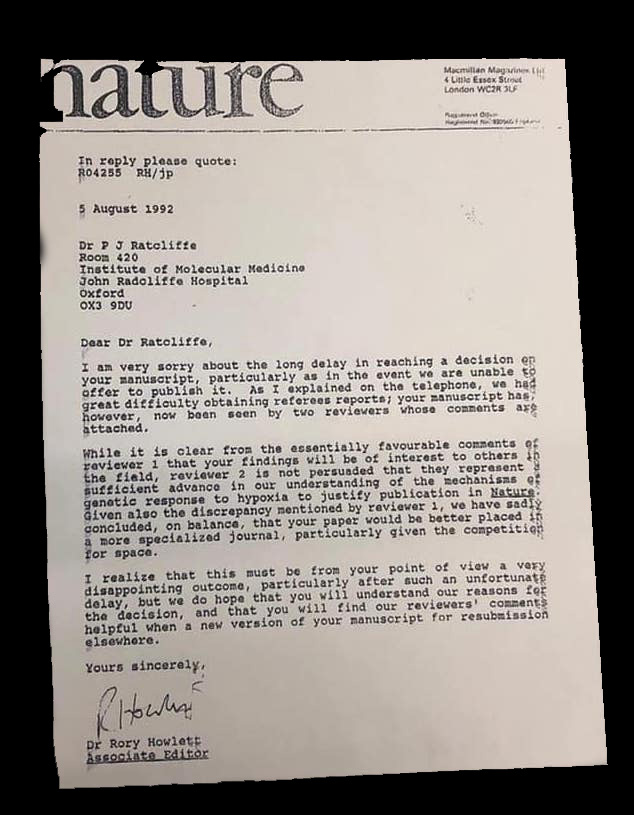
Rejection of your paper or grant has NO relevance to the opinion of #research community. It is nothing but the opinion of one person. Several examples: 1. The first paper on graphene was rejected from Nature because “it did not constitute a sufficient scientific advance”. Later, it was awarded a Nobel prize. 2. The first manuscript showing the microbiome-brain connection was published after 7 submissions that took 3 years. Today, this field has exploded. I expect it will get a Nobel prize in the future. 3. Theodore Maiman tried to publish a paper describing the first operating laser in Physical Review Letters and… got a rejection! 4. Peter Ratcliffe, who worked on cells’ response to changes in oxygen levels, got his key paper rejected from Nature (see photo). Later, he was awarded a Nobel Prize for this work. And there are many other examples… . And yet I see so many young scientists stressing about rejections. For some reason, they seem to genuinely expect that the editors should know which study is truly worth it. As a result, many rejections are met with surprise and disbelief:  “How could they reject it? They publish so much trash, and yet they think our detailed 3-year-long study is not interesting to the community! WHY?” . Well, the reality is: - Most editors have very little time to delve into your study. They can easily FAIL to recognize the potential impact of your study. Proper communication in the cover letter and clear writing style can help (although only to a limited degree). - Many reviewers have little idea about the science in your paper. But they can have a big ego. So, if they have a bad day or were rejected recently, it’s easy for them to find 1000 technical reasons to reject your paper as well. - Most scientists genuinely don’t know if your discovery can make any impact. If we could predict the course of science, we would be living very differently! My message is simple: Forget about objectivity. Academia is a very subjective world. Fight for objectivity but don’t take it for granted. A great study will be found, cited and recognized. Disregard of where it’s published. A bad study requires a high-impact journal to be found and cited. But the long-time recognition might be a problem. High-IF journals are simply billboards. Their rejections do NOT represent the opinion of a scientific community. You can get rejected but don’t reject yourself! Believe in your results. #AcademicTwitter #AcademicChatter
Andrew Akbashev tweet media
English
60
1.2K
3.7K
538.7K
Missiakas Lab
Missiakas Lab@MissiakasLab·
Mark your calendars 📆 @tancope presents @UChicagoCOM Research Forum this week!! Come, grab a free lunch, and learn about the interesting organisms Yunys has been growing this Friday at 12:30pm 🧫 you don’t want to miss it!
Missiakas Lab tweet media
English
1
1
7
1K