
ทวีตที่ปักหมุด

Redbelly Network
9.6K posts

@RedbellyNetwork
Open Capital Markets Infrastructure | 97.5k TPS L1 | Formally Verified Consensus | Compliant RWA Tokenization | Backed by CSIRO, Sydney University, ARC.
📈 Who sustains the highest throughput in Web3? We ranked blockchains by the highest TPS sustained over 100 consecutive blocks on mainnet Real performance, not just a single spike 📊 chainspect.app/dashboard?gain…

Thrilled to receive the @IEEEorg Mid-Career Award from @IEEETEMS which recognises outstanding blockchain contributions consistently for over a decade. I still remember the publication of our Blockchain Anomaly with @nakatoli in 2016 where we showed how final (i.e., committed) transactions could be rolled back in Ethereum. Fast forward, my oustanding research group and co-authors published in top places: @NDSSSymposium, @IEEESSP, IEEE TC, @CACMmag, obtained few Best Papers (ICDCS, IPDPS, @DsnIeee), and our blockchain patent has been granted in US, Europe, Hong Kong and New Zealand. I am grateful to them. @ieeetemsblock


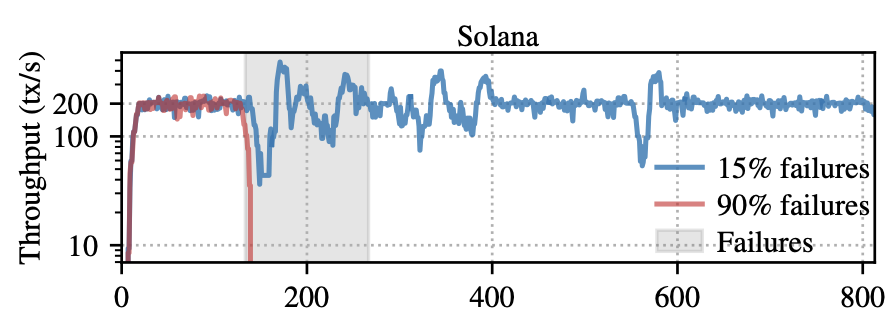
New research results show @RedbellyNetwork has very low median latency even when network packets get lost. Other blockchains, in particular @algorand, @aptos and @avax, either loose transactions or experience higher latency.

The next era of blockchain isn't about hiding. It's about proving. For years, crypto lived by a simple philosophy “Code is Law.” The idea was powerful. If the rules are embedded in code, you don’t need institutions, lawyers, or governments. But as the ecosystem matured, we started noticing something uncomfortable: Code alone doesn’t solve trust. In the early DeFi era, anonymity felt like freedom. ~Wallets with no names. ~Protocols with no identities. ~Money moving without permission. For many builders, that was the ultimate flex. But the same design that enabled innovation also created a fragile foundation. When billions disappear through hacks, exploits, or mixers, the question stops being philosophical. It becomes practical. Who is accountable? That question matters more than many people realize. Because the largest pools of capital in the world pension funds, sovereign wealth funds, real estate markets operate on one principle "legal certainty". These institutions don’t avoid blockchain because they fear decentralization. They avoid it because most chains cannot answer a simple real world question. Who actually owns what? This is where @RedbellyNetwork introduces a fundamentally different perspective. Instead of treating identity and compliance as external layers, Redbelly integrates Verified Public Identity (VPI) directly into the protocol. In other words: The system knows that the participants are real entities operating under real legal frameworks. Think of most blockchains like open marketplaces in the early internet. Anyone can enter. Anyone can transact. But when something goes wrong, resolving disputes becomes difficult. Redbelly’s model moves closer to something else entirely, A digital jurisdiction. A system where decentralized infrastructure still exists, but the participants are verifiable and accountable. This doesn’t weaken decentralization. It reframes its purpose. Instead of building networks optimized for anonymous speculation, the focus shifts toward networks capable of supporting real world financial systems. Markets where trillions in assets bonds, property, equities can exist on chain with confidence. Originality in Web3 isn’t launching another token. It’s confronting the deeper question the industry has avoided: How do you build decentralized systems that the real economy can actually use? Not just traders. Not just anonymous wallets. But institutions responsible for people’s life savings. The next evolution of blockchain won’t be defined by who can hide money the best. It will be defined by who can create verifiable trust at scale. Because the future of on chain finance depends on one simple capability, proving ownership in a way the real world recognizes. Rather than simply building a faster engine, Redbelly has designed a new social contract for the digital age. It is a synthesis of three traditionally opposing forces. The autonomy of decentralized networks, the accountability of verified identity, and the stability of established law. A system designed not only for crypto native users, but for the world’s real economy. @RedbellyDAO @RedbellyNetwork #RedbellyNetwork #RedbellyDAO #Rbnt
The DAO X Tipping Campaign nominations are in, it never gets old. Highlight: x.com/i/status/20321…

