
ทวีตที่ปักหมุด
Ronan
3.5K posts


Ronan
@Ronangmi
investing @Collab_Currency / @Dorm_DAO τ reply guy, dreamer
San Francisco, CA เข้าร่วม Eylül 2014
4.2K กำลังติดตาม2.5K ผู้ติดตาม

Ronan รีทวีตแล้ว

What if you could create an auto-research where your agent just focused on the eval
and it was designed so that others could have swarms of agents across the web try to solve it
and you paid them based on the ownership of the mechanism which produced the research

English

When are you going to be able to short rivian, gigalong anthropic and vol farm USD/GBP with dogwifhat as collateral? @SpencerApplebau and I try to answer that question in our new post on RWAs
Link below
English
if the network has stayed around 7-10m nodes and they need to do a 'limited time' campaign, it likely means there is a few new clients on the demand side that are maxing out the current networks bandwidth. bullish
why else would you do this?
*unless nodes are dropping off
Grass@grass
It’s never been easier to earn points before! For a limited time only, when you sign up for Grass, you instantly earn 10,000 Uptime Points! That is the equivalent of more than 50 hours of uptime with the desktop app! Download Grass. Run it in the background. Earn rewards. 👉grass.io/download
English

q1
major wins:
-hype 20 to 35
-crcl 60 to 110
-tao 181 to 250
had a couple smol wins in some equity shorts and smol gains in bksy, uipath but nothing that moves the needle.
Cut a few meme longs break even, and cut lighter yesterday for a smol gain.
Would like to⬇️ activity
English
Got a better news feed and added logos!
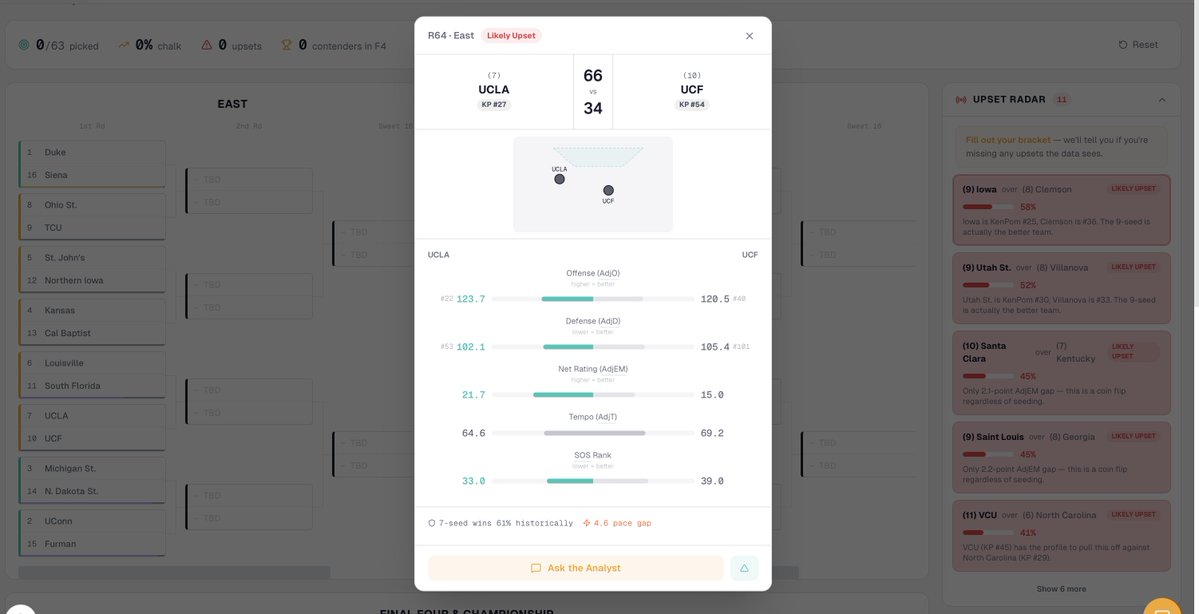
The head to head matchups in the bracket with ratings, win probabilities, and trapezoid positioning is the most helpful IMO
2026courtside.vercel.app
Ronan@Ronangmi
Made a March Madness bracket tool called Courtside. It combines @kenpomeroy ratings with the 'Trapezoid of Excellence' concept from @RyanHammer09 to help you analyze matchups and fill out your bracket Best viewing on desktop, check it out below! 2026courtside.vercel.app
English


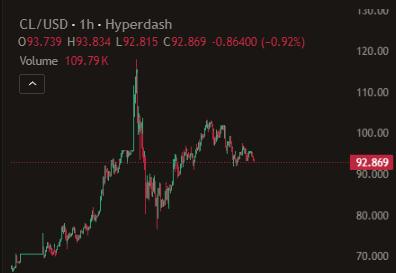
@bharat_usd deploying west coast strategy: invest in west coast stuff before it gets to the east coast and hedgies find out about it
English

Made a March Madness bracket tool called Courtside.
It combines @kenpomeroy ratings with the 'Trapezoid of Excellence' concept from @RyanHammer09 to help you analyze matchups and fill out your bracket
Best viewing on desktop, check it out below!
2026courtside.vercel.app

English
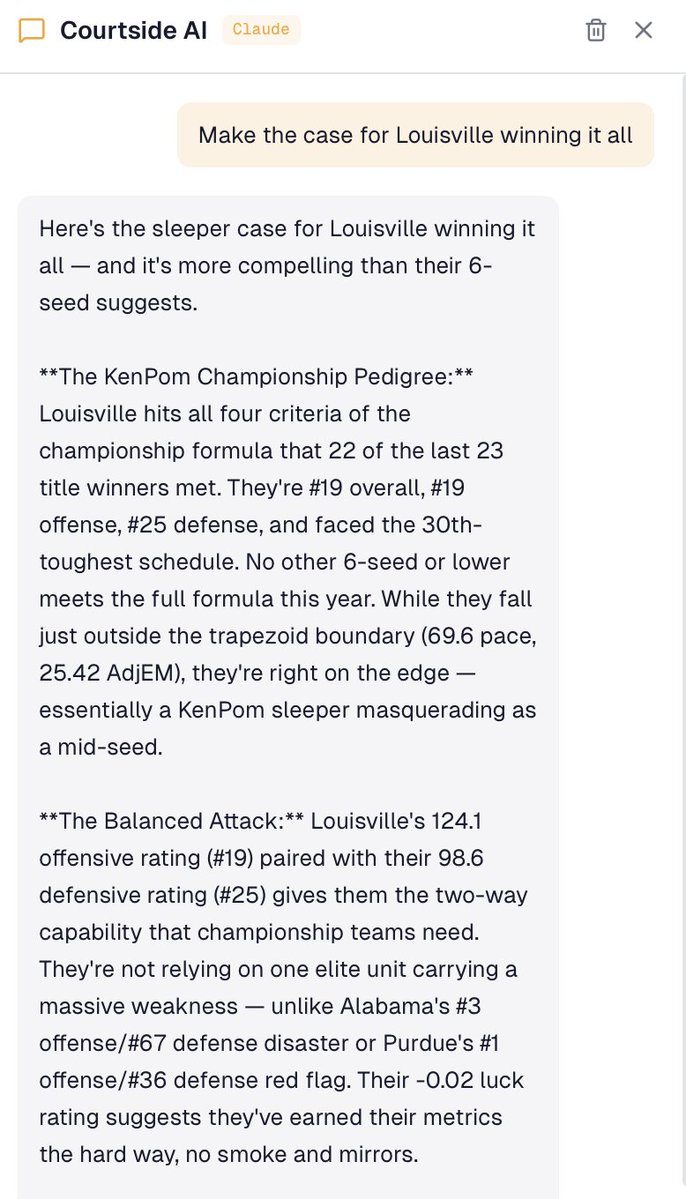
There's an AI analyst you can ask questions. It has the full dataset and gives answers based on the numbers
Also has an upset radar that flags the most vulnerable matchups, team archetype badges, and a champion profile checker that compares your pick against historical winners

English

throwing a little $ on Duke to win.
dont follow NCAA (too low skill) but i know they're 32-2 this entire szn + have a top 3 player.
i figure it's a 2-3x if they get to the sweet 16 (should be a cake walk). they dont need to win for this to work out. but its a ~5x if they do

English
@shill_ivey they are -600 to make the sweet 16 and -20000 to make their next game
English
when they win the first round, it probably means you're up 10-20% (21c ---> 25c or whatever)
also if that happens, you can also then buy "no" for sub 79c so you have both sides for sub 100c (win on either outcome)
English

Decentralized training never made any sense to me.
Datacenters are peak economies of scale. 100x more than fabs themselves. Close proximity, low latency, shared cooling, etc.
Why would you want to train on third-world Androids?
Paolo Ardoino 🤖@paoloardoino
Tether AI breakthrough Tether AI team just released new version of QVAC Fabric to include the World’s First Cross-Platform BitNet LoRA Framework to Enable Billion-Parameter AI Training and Inference on Consumer GPUs and Smartphones. Background Microsoft's BitNet uses one bit architecture to dramatically compress models. Traditional LLMs operate on full-precision computation, where weights are stored as complex, high-resolution numbers. The innovation of BitNet is that it shrinks these weights into a tiny ternary range of only -1, 0, and 1. significantly reducing memory usage and computation. LoRA, is a parameter-efficient fine-tuning technique that reduces the number of trainable parameters by up to ninety-nine percent. Together they slash memory and compute requirements. Yet BitNet has mostly been limited to CPU or CUDA NVIDIA backends, and lacked the support of LoRA fine-tuning. Enters QVAC Fabric: the unlock Today, with QVAC Fabric LLM, is the first time BitNet LoRA fine-tuning and inference work cross-platform across GPU vendors and operating systems using Vulkan and Metal backends. That means support for AMD, Intel, Apple Metal and also Mobile GPUs. And for the first time ever, BitNet inference runs efficiently on smartphones using mobile GPUs. On flagship devices, GPU inference is 2 to 11 times faster than CPU while using up to 90% less memory than the full precision models. The biggest unlock: QVAC Fabric LLM support for BitNet LoRA fine-tuning on heterogeneous GPUs. Our team was able to demonstrate this by fine tuning models up to 3.8 billion parameters on all flagships phones such as Pixel 9, S25 and iPhone 16 and up to 13 billion parameter models on the iPhone 16. Github repositories: github.com/tetherto/qvac-… : general QVAC Fabric codebase github.com/tetherto/qvac-… : specific QVAC Fabric's BitNet knowledge base, architecture docs and pre-built binaries What does it mean? What used to require dedicated GPUs now runs on consumer hardware. This breakthrough is the first real-world signal of a local private AI that can truly serve the people. And this is just the beginning. In the next months and years Tether will relentlessly continue to invest significant amounts of resources and capital to continue to research and develop open-source intelligence that can scale and evolve on local devices, providing maximum utility and privacy to its users. The era of Stable Intelligence has just begun. Free as in freedom.
English


"As vault returns accrue, a configurable portion can be captured as vault shares in a designated wallet, enabling apps to collect fees generated through their platform."
Assume apps will compete more aggressively on user balances now, like in web2 consumer apps
Privy@privy_io
1/ Earn on balances with Privy. Connect app balances to curated DeFi vaults and expand revenue opportunities with just a few API calls. Powered by vault infrastructure with @Morpho, with risk strategies from @steakhousefi and @gauntlet_xyz. Support for @aave and @kamino 🔜
English
there’s a lot of reasons why for many businesses, being a subnet makes more sense than not
but the main one is tapping into a global marketplace of specialists who compete to accelerate your biz has a much higher ROI than a monthly catchup with a VC

Sami Kassab@Old_Samster
the framing of "begging for resources" is wrong and not how the mechanics of the system works TAO emissions are just liquidity entering a pool at market price. So it can work as a bootstrapping mechanism early on, and a tailwind as the subnet matures. Chutes recently hit 0% TAO emissions due to net outflows from the LP and there was zero impact. The pool is deep enough that they could stay at 0% indefinitely and be completely unphased. The second part of the question I'm interpreting as "why not raise VC and keep more of the token supply". And the answer depends on whether you think the VC structure has historically worked for PoW projects. The DePIN chart graveyard from insider/VC/miner sell pressure is a pretty compelling data point against it. So don't think you can criticize the structure when its the one working the best right now. Founders choose Bittensor because it gives them the most intelligent miner set for supply-side GTM, inherited trust from a proven standardized ruleset, and a positive-sum ecosystem where every subnet's success lifts the whole thing.
English