Sergio Martínez

74K posts

Sergio Martínez banner
Sergio Martínez

Sergio Martínez

@SuperSerch

Java developer with a twist in security. DevOps & OpenStack enthusiast. OWASP member. Opinions my own.

47.743017, -86.934128 เข้าร่วม Mayıs 2009
550 กำลังติดตาม1.2K ผู้ติดตาม
Sergio Martínez รีทวีตแล้ว
Alex Baqueiro
Alex Baqueiro@AlexBaks82·
Cuando el gobierno te empieza a aconsejar "como vivir con menos" o "como vivir con algo más barato" Ya no está pensando en cómo mejorar la vida de la gente, sino en cuánto están dispuestos a aguantar.
Español
133
4.2K
15.6K
109.9K
Sergio Martínez รีทวีตแล้ว
FC Bayern München
FC Bayern München@FCBayern·
Accuracy is key 🎯
English
37
364
8.1K
100.5K
Sergio Martínez รีทวีตแล้ว
Martin Fowler
Martin Fowler@martinfowler·
NEW POST Modern hardware is fast, but software often fails to leverage it. Caer Sanders guides his work with mechanical sympathy. He distills this into principles: predictable memory access, awareness of cache lines, single-writer, natural batching martinfowler.com/articles/mecha…
English
6
52
272
39.2K
Sergio Martínez รีทวีตแล้ว
FC Bayern München
FC Bayern München@FCBayern·
🎙️🔴 Jetzt 𝐥𝐢𝐯𝐞: Die Pressekonferenz aus dem Bernabéu mit Vincent Kompany. 👉 youtube.com/live/NeZfrOS0K…
YouTube video
YouTube
FC Bayern München tweet media
Deutsch
9
21
294
31.8K
Sergio Martínez รีทวีตแล้ว
Alex Prompter
Alex Prompter@alex_prompter·
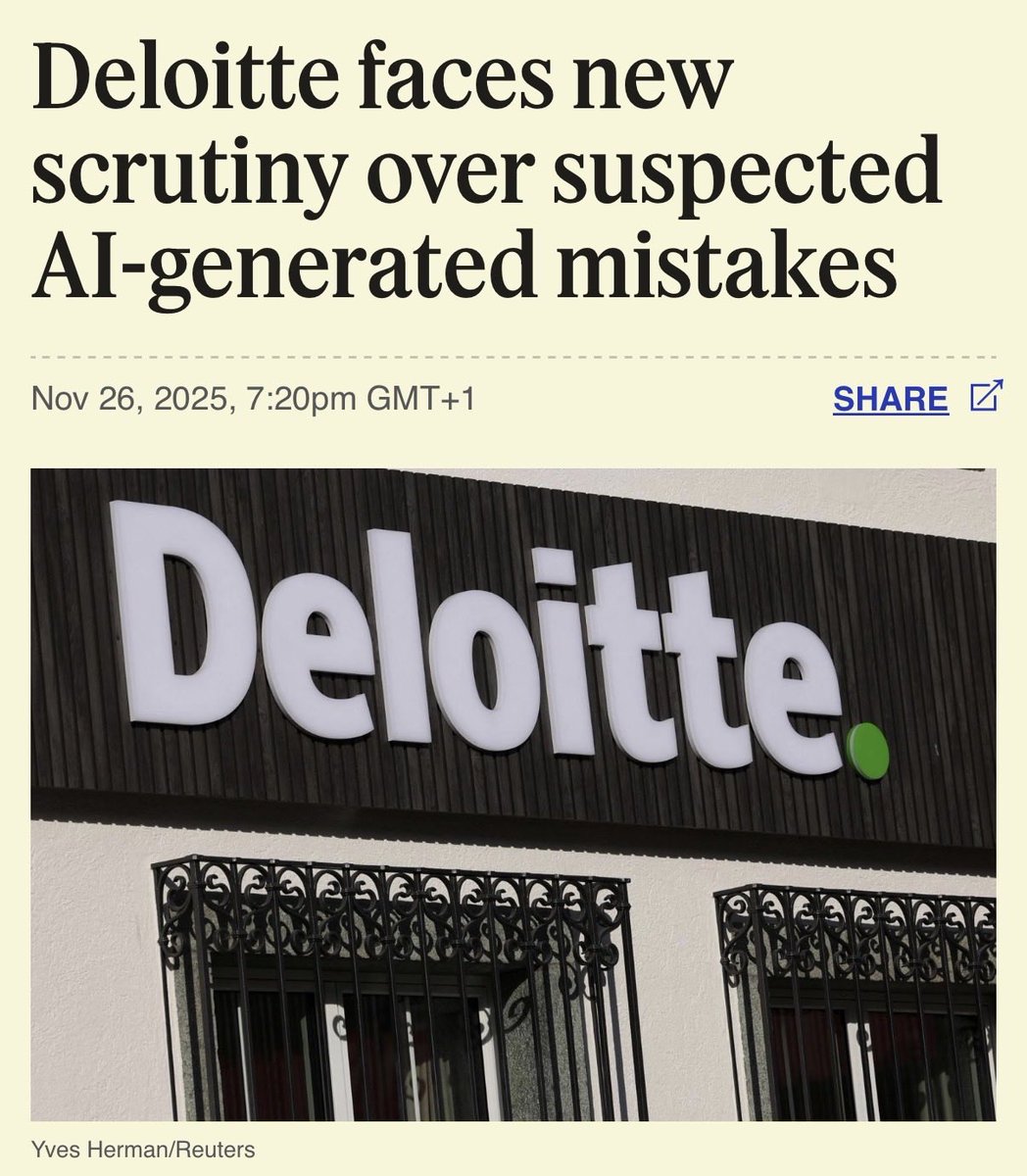
🚨 Holy shit… Deloitte was charged $1.6 million for a healthcare report filled with AI-hallucinated citations. This is the second time in two months they’ve been caught. First an Australian government agency. Now a Canadian province’s Department of Health. And their response? They “stand by the conclusions.” Let me translate that for you: “The AI made up the sources, but trust us, the advice is still good.” That’s a $1.6 million report. For a healthcare system. With fake citations that nobody at Deloitte bothered to verify before submitting. Not an intern’s draft. The final deliverable. The Australian incident was supposed to be a wake-up call. Deloitte even partially refunded that government for the errors. You’d think after publicly embarrassing themselves once, someone would have implemented a basic fact-checking step before hitting send on the next million-dollar engagement. They didn’t. And here’s what makes this story bigger than Deloitte. Every major consulting firm is racing to integrate AI into their workflows. McKinsey, BCG, Bain, Accenture. They’re all doing it. Because AI lets them produce reports faster with fewer junior analysts, which means higher margins on the same $500/hour billing rates. But the entire consulting business model is built on one thing: trust. You’re paying for credibility. You’re paying so that when you hand the report to your board or your minister, nobody questions the sources. The moment that trust breaks, the math changes completely. Why pay $1.6 million for AI-generated analysis with fake citations when you could run the same prompts yourself for $20/month and at least know to check the sources? That’s the real disruption nobody’s talking about. AI isn’t going to replace consulting firms by being smarter than them. It’s going to replace them by revealing that a huge percentage of consulting work was always just expensive research and formatting. And now the clients have access to the same tools. Deloitte’s problem isn’t that they used AI. It’s that they used AI the way most people use AI: paste in a request, take the output at face value, ship it. No verification layer. No human review of citations. No system. The firms that survive this era won’t be the ones who use AI the fastest. They’ll be the ones who build actual verification systems around AI output. The ones who treat AI as a first draft, not a final product. $1.6 million. Fake citations. Twice in two months. And they stand by the conclusions. The consulting industry’s biggest threat isn’t AI. It’s clients realizing they don’t need to pay someone else to hallucinate.
Alex Prompter tweet media
English
62
617
1.4K
54.9K
Sergio Martínez รีทวีตแล้ว
Physics & Astronomy Zone
Physics & Astronomy Zone@zone_astronomy·
"We aren't going to the Moon, but rather meeting it at an exact point in space. ​And it isn't necessary to spend fuel, either; the calculations are made so that everything works through pure physics and gravity. ​It is flawless."
English
197
1.7K
15.8K
969.2K
Sergio Martínez รีทวีตแล้ว
Karen 🌸
Karen 🌸@krncita7·
Estamos viviendo la era donde entras a Twitter, y un astronauta tuitea una foto desde el espacio mientras va camino a la luna. What a moment to be alive ✨
Reid Wiseman@astro_reid

There are no words.

Español
1
5.6K
70K
1.5M
Sergio Martínez รีทวีตแล้ว
Peer Richelsen
Peer Richelsen@peer_rich·
tldr: we are fucked and there are no ways yet to unfuck us
Alex Prompter@alex_prompter

🚨 BREAKING: Google DeepMind just mapped the attack surface that nobody in AI is talking about. Websites can already detect when an AI agent visits and serve it completely different content than humans see. > Hidden instructions in HTML. > Malicious commands in image pixels. > Jailbreaks embedded in PDFs. Your AI agent is being manipulated right now and you can't see it happening. The study is the largest empirical measurement of AI manipulation ever conducted. 502 real participants across 8 countries. 23 different attack types. Frontier models including GPT-4o, Claude, and Gemini. The core finding is not that manipulation is theoretically possible it is that manipulation is already happening at scale and the defenses that exist today fail in ways that are both predictable and invisible to the humans who deployed the agents. Google DeepMind built a taxonomy of every known attack vector, tested them systematically, and measured exactly how often they work. The results should alarm everyone building agentic systems. The attack surface is larger than anyone has publicly acknowledged. Prompt injection where malicious instructions hidden in web content hijack an agent's behavior works through at least a dozen distinct channels. Text hidden in HTML comments that humans never see but agents read and follow. Instructions embedded in image metadata. Commands encoded in the pixels of images using steganography, invisible to human eyes but readable by vision-capable models. Malicious content in PDFs that appears as normal document text to the agent but contains override instructions. QR codes that redirect agents to attacker-controlled content. Indirect injection through search results, calendar invites, email bodies, and API responses any data source the agent consumes becomes a potential attack vector. The detection asymmetry is the finding that closes the escape hatch. Websites can already fingerprint AI agents with high reliability using timing analysis, behavioral patterns, and user-agent strings. This means the attack can be conditional: serve normal content to humans, serve manipulated content to agents. A user who asks their AI agent to book a flight, research a product, or summarize a document has no way to verify that the content the agent received matches what a human would see. The agent cannot tell the user it was served different content. It does not know. It processes whatever it receives and acts accordingly. The attack categories and what they enable: → Direct prompt injection: malicious instructions in any text the agent reads overrides goals, exfiltrates data, triggers unintended actions → Indirect injection via web content: hidden HTML, CSS visibility tricks, white text on white backgrounds invisible to humans, consumed by agents → Multimodal injection: commands in image pixels via steganography, instructions in image alt-text and metadata → Document injection: PDF content, spreadsheet cells, presentation speaker notes every file format is a potential vector → Environment manipulation: fake UI elements rendered only for agent vision models, misleading CAPTCHA-style challenges → Jailbreak embedding: safety bypass instructions hidden inside otherwise legitimate-looking content → Memory poisoning: injecting false information into agent memory systems that persists across sessions → Goal hijacking: gradual instruction drift across multiple interactions that redirects agent objectives without triggering safety filters → Exfiltration attacks: agents tricked into sending user data to attacker-controlled endpoints via legitimate-looking API calls → Cross-agent injection: compromised agents injecting malicious instructions into other agents in multi-agent pipelines The defense landscape is the most sobering part of the report. Input sanitization cleaning content before the agent processes it fails because the attack surface is too large and too varied. You cannot sanitize image pixels. You cannot reliably detect steganographic content at inference time. Prompt-level defenses that tell agents to ignore suspicious instructions fail because the injected content is designed to look legitimate. Sandboxing reduces the blast radius but does not prevent the injection itself. Human oversight the most commonly cited mitigation fails at the scale and speed at which agentic systems operate. A user who deploys an agent to browse 50 websites and summarize findings cannot review every page the agent visited for hidden instructions. The multi-agent cascade risk is where this becomes a systemic problem. In a pipeline where Agent A retrieves web content, Agent B processes it, and Agent C executes actions, a successful injection into Agent A's data feed propagates through the entire system. Agent B has no reason to distrust content that came from Agent A. Agent C has no reason to distrust instructions that came from Agent B. The injected command travels through the pipeline with the same trust level as legitimate instructions. Google DeepMind documents this explicitly: the attack does not need to compromise the model. It needs to compromise the data the model consumes. Every agentic system that reads external content is one carefully crafted webpage away from executing attacker instructions. The agents are already deployed. The attack infrastructure is already being built. The defenses are not ready.


English
67
260
3.9K
1.2M
Sergio Martínez
Sergio Martínez@SuperSerch·
A must read if you deal with AI
Nav Toor@heynavtoor

🚨SHOCKING: Apple just proved that AI models cannot do math. Not advanced math. Grade school math. The kind a 10-year-old solves. And the way they proved it is devastating. Apple researchers took the most popular math benchmark in AI — GSM8K, a set of grade-school math problems — and made one change. They swapped the numbers. Same problem. Same logic. Same steps. Different numbers. Every model's performance dropped. Every single one. 25 state-of-the-art models tested. But that wasn't the real experiment. The real experiment broke everything. They added one sentence to a math problem. One sentence that is completely irrelevant to the answer. It has nothing to do with the math. A human would read it and ignore it instantly. Here's the actual example from the paper: "Oliver picks 44 kiwis on Friday. Then he picks 58 kiwis on Saturday. On Sunday, he picks double the number of kiwis he did on Friday, but five of them were a bit smaller than average. How many kiwis does Oliver have?" The correct answer is 190. The size of the kiwis has nothing to do with the count. A 10-year-old would ignore "five of them were a bit smaller" because it's obviously irrelevant. It doesn't change how many kiwis there are. But o1-mini, OpenAI's reasoning model, subtracted 5. It got 185. Llama did the same thing. Subtracted 5. Got 185. They didn't reason through the problem. They saw the number 5, saw a sentence that sounded like it mattered, and blindly turned it into a subtraction. The models do not understand what subtraction means. They see a pattern that looks like subtraction and apply it. That is all. Apple tested this across all models. They call the dataset "GSM-NoOp" — as in, the added clause is a no-operation. It does nothing. It changes nothing. The results are catastrophic. Phi-3-mini dropped over 65%. More than half of its "math ability" vanished from one irrelevant sentence. GPT-4o dropped from 94.9% to 63.1%. o1-mini dropped from 94.5% to 66.0%. o1-preview, OpenAI's most advanced reasoning model at the time, dropped from 92.7% to 77.4%. Even giving the models 8 examples of the exact same question beforehand, with the correct solution shown each time, barely helped. The models still fell for the irrelevant clause. This means it's not a prompting problem. It's not a context problem. It's structural. The Apple researchers also found that models convert words into math operations without understanding what those words mean. They see the word "discount" and multiply. They see a number near the word "smaller" and subtract. Regardless of whether it makes any sense. The paper's exact words: "current LLMs are not capable of genuine logical reasoning; instead, they attempt to replicate the reasoning steps observed in their training data." And: "LLMs likely perform a form of probabilistic pattern-matching and searching to find closest seen data during training without proper understanding of concepts." They also tested what happens when you increase the number of steps in a problem. Performance didn't just decrease. The rate of decrease accelerated. Adding two extra clauses to a problem dropped Gemma2-9b from 84.4% to 41.8%. Phi-3.5-mini from 87.6% to 44.8%. The more thinking required, the more the models collapse. A real reasoner would slow down and work through it. These models don't slow down. They pattern-match. And when the pattern becomes complex enough, they crash. This paper was published at ICLR 2025, one of the most prestigious AI conferences in the world. You are using AI to help you make financial decisions. To check legal documents. To solve problems at work. To help your children with homework. And Apple just proved that the AI is not thinking about any of it. It is pattern matching. And the moment something unexpected shows up in your question, it breaks. It does not tell you it broke. It just quietly gives you the wrong answer with full confidence.

English
0
0
0
23
Sergio Martínez รีทวีตแล้ว
SwiftOnSecurity
SwiftOnSecurity@SwiftOnSecurity·
Really not happy with how long posts are getting here. Long posts were for very special occasions. Twitter was invented for a reason.
English
39
55
819
19.5K
Sergio Martínez รีทวีตแล้ว
Darth Powell
Darth Powell@VladTheInflator·
Germany mandates all men ages 17-45 who want to leave Germany for longer than 3 months must now obtain a permit. "Drastic change to conscription: Men who want to leave Germany for longer periods will need approval" "All men over 17 and under 45 years old who want to leave Germany for longer than three months must obtain a permit from the Bundeswehr (German Armed Forces). It doesn't matter whether someone has planned a semester abroad, wants to take up a job abroad, or is planning a backpacking trip around the world: Above all, there is a mandatory visit to the Bundeswehr's career center.
Sascha 🍉|🇻🇦✝️🌹🕊️@Pasolinis_Asche

"Freiheit"

English
44
71
486
57.9K
Sergio Martínez รีทวีตแล้ว
Yesi Days 🤓
Yesi Days 🤓@silvercorp·
Siempre tienen otros datos, jamás se hacen responsables. Y aún así hay muchos que les siguen aplaudiendo y justificando 🤦🏻‍♀️🤦🏻‍♀️🤦🏻‍♀️🤦🏻‍♀️🤦🏻‍♀️🤦🏻‍♀️🤦🏻‍♀️🤦🏻‍♀️🤦🏻‍♀️🤦🏻‍♀️
Latinus@latinus_us

Gobierno de Sheinbaum arremete contra comité de la ONU: llama "tendencioso" al informe que pide investigar las desapariciones. #Latinus #InformaciónParaTi latinus.us/mexico/2026/4/…

Español
1
1
10
368
Sergio Martínez รีทวีตแล้ว
Robert Graham
Robert Graham@robertgraham·
Q: Why does the US need refugees? A: Because America, unlike most countries, is a country of "principles". It says so in the Declaration of Independence and the Constitution. "Principles" are the things you defend even when they don't serve your immediate best interest. For example, you defend "free-speech" not for yourself, but for speech you hate. America doesn't "need" refugees, but we accept refugees because we have principles. We help those suffering from oppression. It's the same with all the other western democracies. We do so because we are the good guys with principles. Now, we can have legitimate conversation about whether immigrants were gaming the system, or the impact letting in too many refugees has, or even the problem when refugees are can't fit in with our country. But we still let in some refugees because we are principled.
Tain Wailller@taylo54034

@jaddy789987 @robertgraham Why does the US need refugees? White people, as a percent of the population, has been steadily decreasing and will become a minority group. You might think that is a good thing, while others might not.

English
3
1
5
982
Sergio Martínez รีทวีตแล้ว
Brian ☀️🌏🌘
Brian ☀️🌏🌘@balail·
Artemis ii
Brian ☀️🌏🌘 tweet mediaBrian ☀️🌏🌘 tweet mediaBrian ☀️🌏🌘 tweet mediaBrian ☀️🌏🌘 tweet media
CY
316
14.5K
79.6K
2.5M
Sergio Martínez รีทวีตแล้ว
Jorge García Orozco
Jorge García Orozco@jorgegogdl·
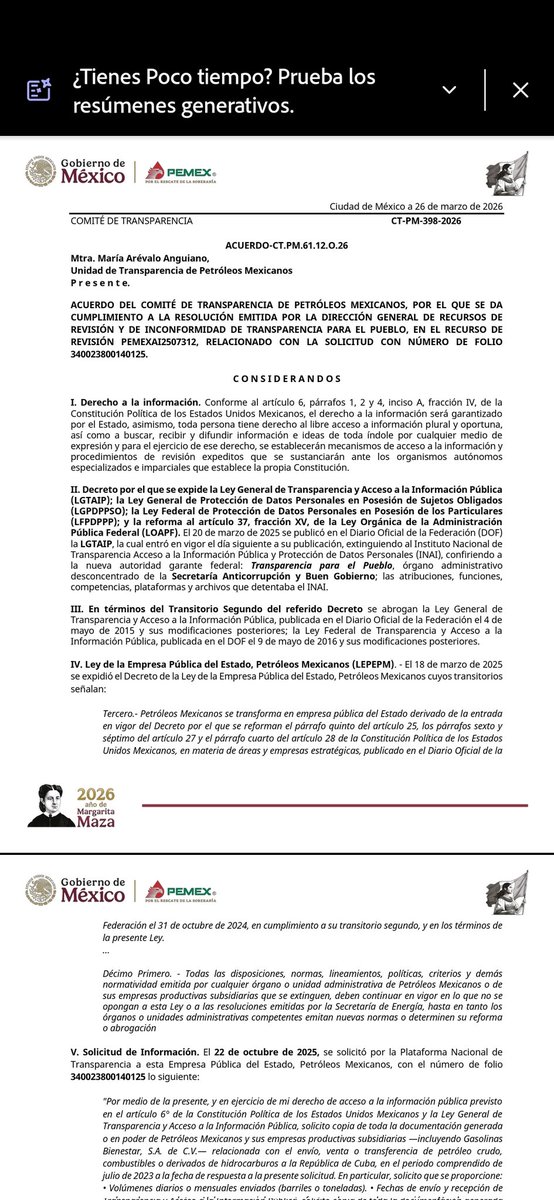
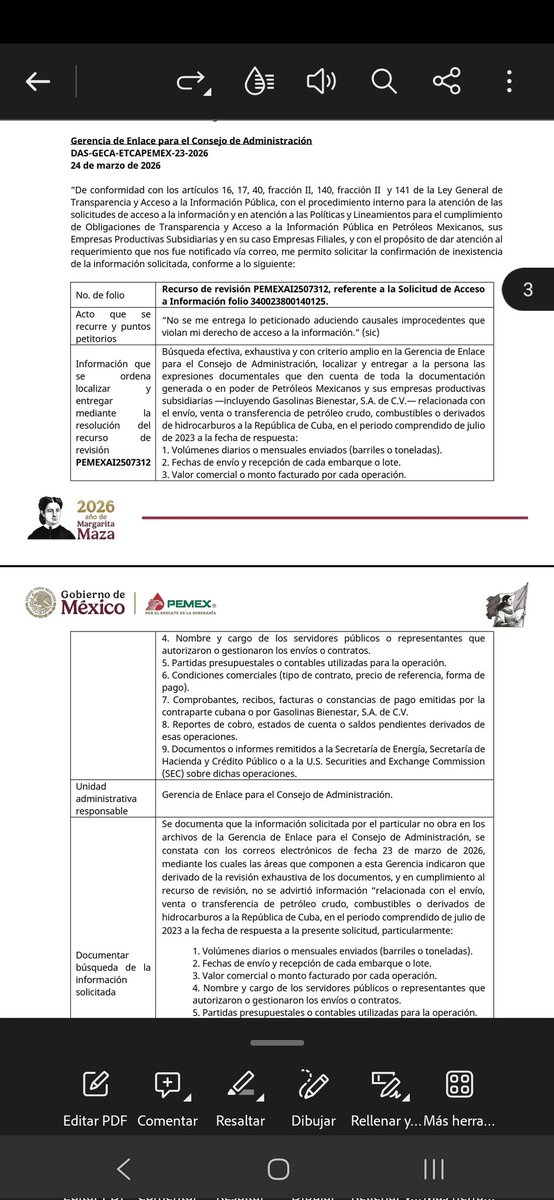
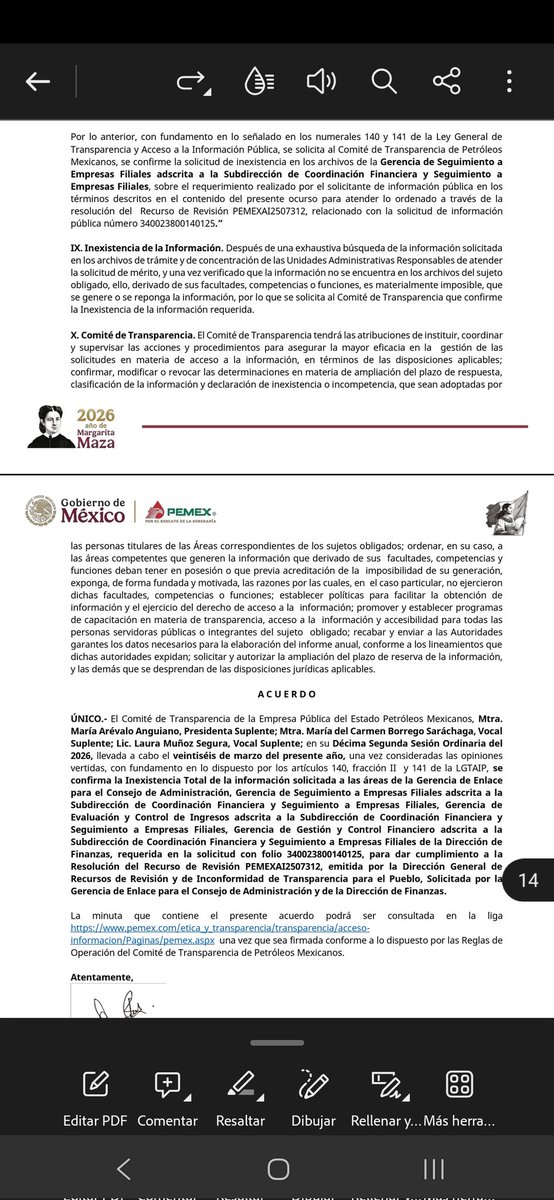
PEMEX negó transparentar toda la documentación sobre envíos de crudo y combustibles a Cuba de julio 2023 a la fecha, incluyendo Gasolinas Bienestar. Dice que "No encuentra la información" (volúmenes, fechas, valores, autorizaciones, contratos, pagos y reportes) @drrocefi
Jorge García Orozco tweet mediaJorge García Orozco tweet mediaJorge García Orozco tweet media
Español
91
2.6K
4.3K
55.3K