Trade Management Mastery

119 posts

Trade Management Mastery

Trade Management Mastery

@TMMastery

Crypto trading education | Daily market analysis | Tools, frameworks & mindset | FREE newsletter sign-up: https://t.co/aC9yy9cHps

เข้าร่วม Şubat 2026
91 กำลังติดตาม54 ผู้ติดตาม
ทวีตที่ปักหมุด
Trade Management Mastery
Trade Management Mastery@TMMastery·
Officially launching Trade Management Mastery. Four years of trading crypto. Thousands of traders trained. Daily analysis. Proprietary indicators. Interactive journals. Dashboards & Education. Most traders don't lose because they can't read charts. They lose because they can't manage their trades, their risk, or their emotions. That's what TMM is built to fix. Daily newsletter is live now and free to start. Indicators, interactive journals, and educational content — coming very soon. This is the home base for serious traders. 👇 trademanagementmastery.carrd.co #CryptoTrading #TradingEducation #Bitcoin #TradeManagement #TMM
English
0
1
9
348
Trade Management Mastery
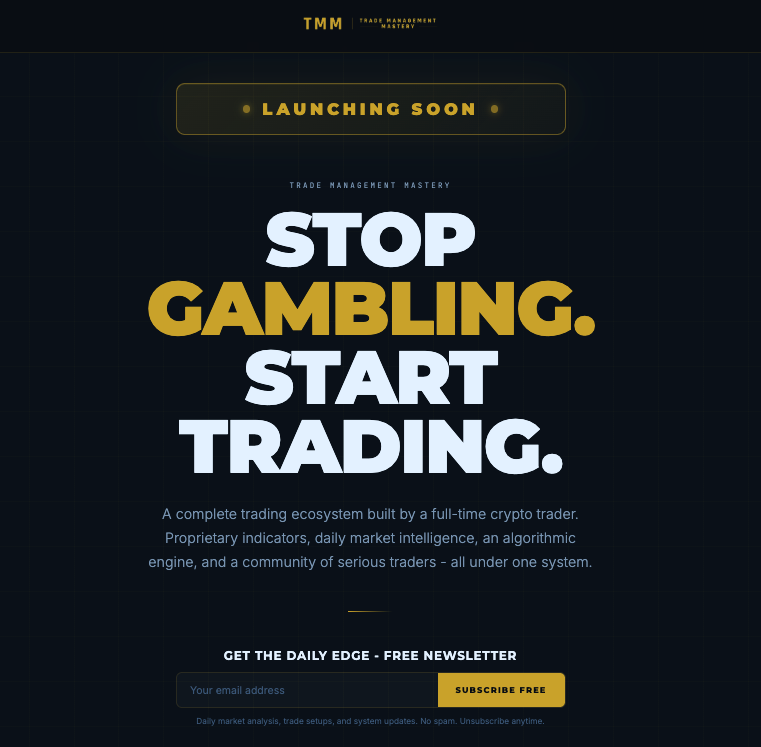
The landing page is live. Not the full site - that comes in 3 days. But you can grab your spot on the free Daily Edge newsletter right now. Daily market analysis. Real trade setups. System updates. No spam. No fluff. Just the edge. Link in bio. We launch in 3 days. Stay sharp, stay disciplined and stay safe.
Trade Management Mastery tweet media
English
0
2
5
26
Trade Management Mastery
Something we've been building for a long time goes live very soon. Stop Gambling. Start Trading. That's the mission. That's what this entire system is built around. Subscribe to the free newsletter now - first access when the doors open. Link in bio. Stay sharp, stay disciplined and stay safe.
Trade Management Mastery tweet media
English
0
1
2
28
Trade Management Mastery
Before a big week, the most important thing you can do is nothing premature. This week has three high-impact macro events. FOMC on Wednesday. GDP and Core PCE on Thursday. Each one carries the potential to move risk assets sharply in either direction. The Powell press conference alone could define the tone for the next four to six weeks of crypto price action. Most traders approach weeks like this by forming a strong view in advance. They decide which way it is going before any of the data arrives and then size accordingly. That is not preparation. That is prediction with leverage attached. A systematic approach defines the week in tiers. Monday and Tuesday are normal sizing - the market is drifting and positioning into the event. Wednesday before the FOMC decision, open risk gets cut by 50%. After the decision and through Thursday morning, the position is flat or hedged until the volatility resolves. Then Thursday afternoon and Friday, once the market has shown its reaction and structure has reformed, normal execution resumes. The protocol does not depend on knowing which way the Fed goes. It depends on knowing that unknown volatility is not the right time to be fully exposed. Preparation is not prediction. It is knowing what you will do regardless of what happens. What is your process for managing positions around major macro events?
Trade Management Mastery tweet media
English
0
2
6
63
Trade Management Mastery
Drawdown is not just a financial concept. It is a psychological one. Most traders understand drawdown as a number - how far an account has fallen from its peak. What they underestimate is what happens to decision-making inside a drawdown. The research on this is consistent. Decision quality degrades under financial stress. Risk appetite becomes inconsistent - traders either become overly conservative (refusing good setups) or overly aggressive (chasing recovery). Neither response serves the strategy. A systematic approach addresses this in two ways. First, by defining maximum drawdown thresholds in advance - at what point does trading stop for the day, the week, or until conditions reset. Second, by building position sizing rules that reduce exposure during drawdown periods, not increase it. The goal is not to avoid all drawdowns. Every strategy has them. The goal is to remain within the psychological zone where you can still execute your process. Beyond that zone, the strategy is no longer being traded - impulse is. The traders who manage drawdown well do not recover faster. They avoid the mistakes that make the hole deeper. How do you manage your own decision-making when you are in a losing run?
Trade Management Mastery tweet media
English
0
1
3
61
Trade Management Mastery
The traders who survive long enough to become good traders all share one thing in common. They learned to lose correctly before they learned to win. Losing correctly sounds counterintuitive. Most traders treat losses as failures to be avoided, minimised, or explained away. A well-executed loss is not a failure. It is evidence that the process is working. If you entered a valid setup, sized correctly for the regime, placed your stop at the level where your thesis is invalidated, and the market took you out - that is not a bad trade. That is the system working exactly as designed. The bad trade is the one where you made all the right calls and got stopped out, then doubled size on the next setup to recover. That trade had nothing to do with market analysis. That was emotion with a position on. Consistency in trading is not a streak of winners. Consistency is executing the same process on trade 47 as you did on trade 1, regardless of what trades 42 through 46 looked like. The market does not grade you on outcomes. It compounds you on process. What has a losing trade taught you that a winning trade could not?
Trade Management Mastery tweet media
English
0
1
3
51
Trade Management Mastery
Trade Management Mastery@TMMastery·
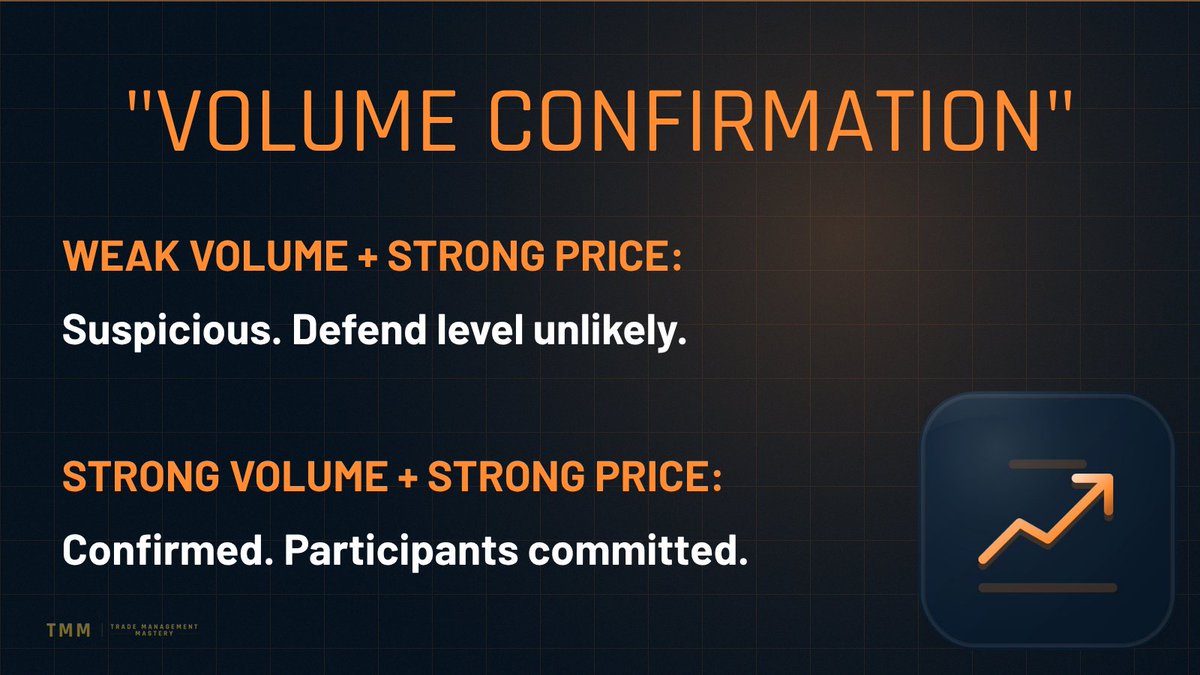
Volume tells you what price cannot. Price tells you where the market went. Volume tells you whether the participants behind that move had conviction. A strong bullish candle on below-average volume is a signal that should be treated with suspicion. The price moved, but the capital commitment was not there. Those moves tend to retrace because there are not enough participants positioned to defend the level. A strong bullish candle on above-average volume is a different proposition. Capital is committed. There are participants with losses if the level fails - which means they will defend it. Right now BTC is in a position where the weekly candle was constructive but the daily volume confluence score - the VCI - is still at a C grade. That gap between price momentum and volume confirmation is the market's way of saying: "the move looks real, but we have not confirmed it yet." A systematic approach does not ignore that gap. It uses it to calibrate position size. Strong price, weak volume confirmation - smaller size until the volume story catches up. What do you use to evaluate whether the volume behind a move is genuine?
Trade Management Mastery tweet media
English
0
1
3
48
Trade Management Mastery
Trade Management Mastery@TMMastery·
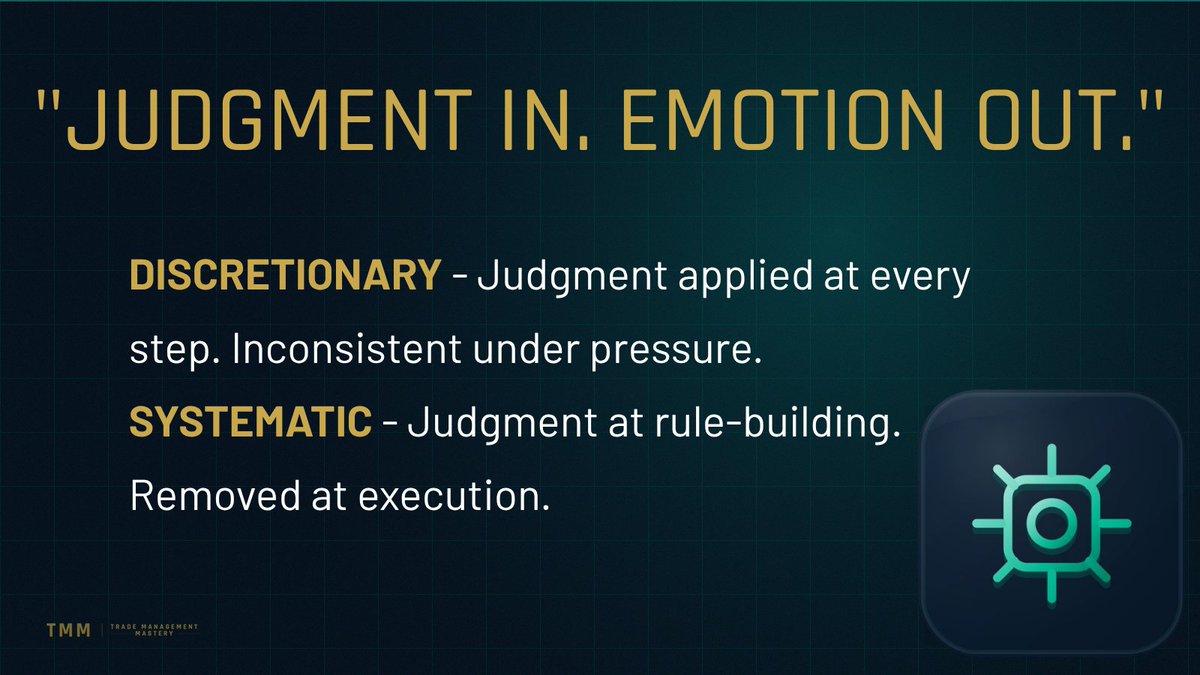
Systematic trading is not about removing human judgment. It is about deciding when and where human judgment is allowed. Most discretionary traders apply judgment everywhere - on the setup, on the entry timing, on the size, on the exit, on whether to hold through volatility or cut early. Each judgment point introduces inconsistency and emotional exposure. A well-designed systematic approach uses human judgment at the rule-building stage and removes it from the execution stage. You judge what makes a valid setup when you are calm, rested, and looking at historical data. The system executes those rules when you are stressed, tired, and watching a position move against you. The bot we are building does exactly this. The rules were defined in backtesting - what setup conditions qualify, which assets, which strategy routes, what risk per trade. When those conditions appear in live markets, execution is automatic. There is no hesitation. There is no override. There is no "this one feels different." The hardest part of systematic trading is not building the system. It is trusting it when it is losing. What is the hardest part of sticking to your own trading rules?
Trade Management Mastery tweet media
English
0
1
3
49
Trade Management Mastery
Trade Management Mastery@TMMastery·
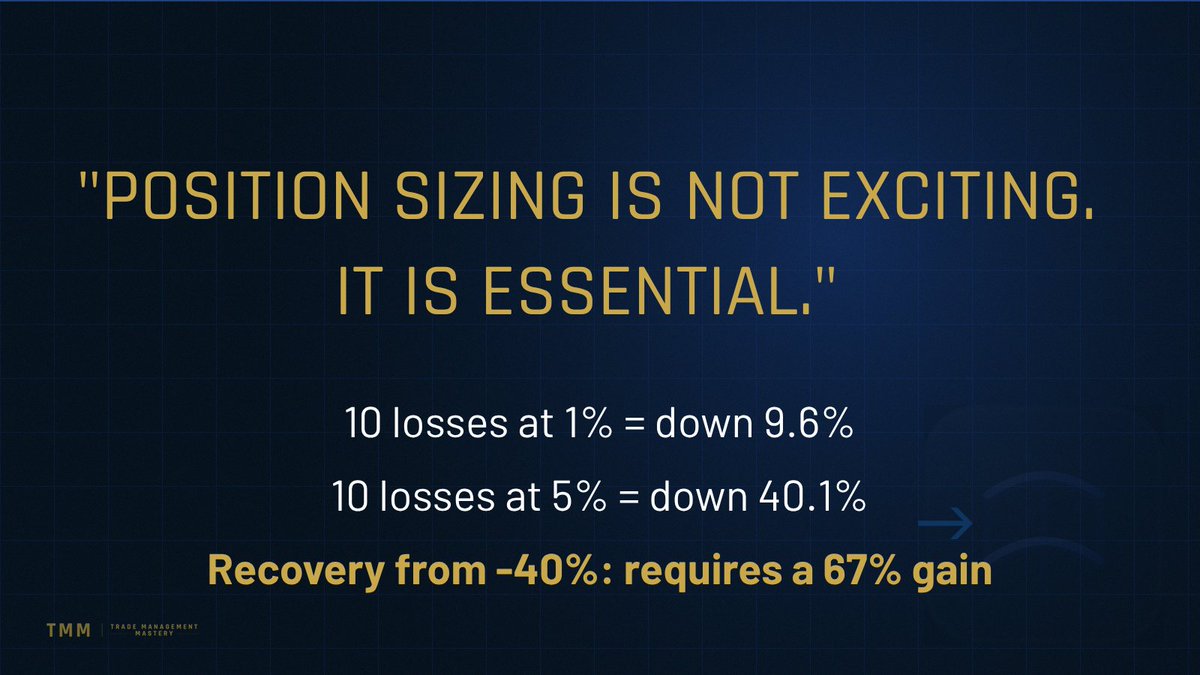
The biggest risk most traders take is not a bad position. It is a bad week. A sequence of losses that compounds faster than the account can absorb because the position sizing was too aggressive from the start. Position sizing is the variable most traders set once and forget. They pick a number that feels reasonable and apply it regardless of market conditions, strategy performance, or what the recent run looks like. A systematic approach treats risk as a dynamic variable. In a high-confidence environment with a trending regime and a high-conviction signal, you size at your defined maximum. In an uncertain regime - transitioning market, mixed timeframe signals, elevated volatility - you reduce. The maths are not complicated. A 10-trade losing run at 1% risk per trade costs you 9.6%. The same run at 5% costs you 40.1%. To recover from 40%, you need a 67% gain on remaining capital. That is not a bad trade. That is a bad risk management policy. Most traders focus on finding better entries to solve their P&L problems. The fix is almost always simpler and less glamorous than that. What percentage do you risk per trade and how did you arrive at that number?
Trade Management Mastery tweet media
English
0
1
4
58
Trade Management Mastery
Trade Management Mastery@TMMastery·
The market does not reward traders for how hard they work. It rewards them for how correct their process is. That distinction matters more than most traders realise. Working harder in trading often means watching more charts, taking more trades, spending more hours in front of screens. None of those things improve the quality of a decision. They often make it worse. A correct process means having defined criteria for every decision: what makes a setup valid, what regime it works in, what the appropriate size is, when to add, when to cut, when to do nothing. The traders who compound consistently are not the ones grinding 16-hour sessions. They are the ones who built a decision framework they trust and then execute it the same way regardless of what the market is doing to them emotionally. There is a reason systematic approaches outperform discretionary ones over large sample sizes. The system does not have bad days. The system does not revenge trade. The system does not cut winners because yesterday was a loss. You are not competing on effort. You are competing on clarity of process. How much of your current approach is defined in writing versus kept in your head?
English
0
0
1
24
Trade Management Mastery
Trade Management Mastery@TMMastery·
Not all volume is the same. A large volume bar tells you something happened. It does not tell you what. It does not tell you whether the capital behind the move was committed or short-term noise. It does not tell you whether open interest built or unwound. It does not tell you whether the money flow was genuine. The Volume Confluence Indicator was built to answer those questions. It combines five separate volume-based inputs - open interest positioning, cumulative volume delta, Klinger oscillator flow, rVol & volume - and scores each one against its own history. Those scores combine into a single grade from F through A+. An A+ reading means all five inputs are aligned and confirming each other. When open interest is building, money flow is positive, and buying volume is dominant simultaneously, the volume behind a move is genuine conviction - not noise. When they diverge, the grade reflects that uncertainty. And uncertain volume conditions are not conditions to size up. Right now the weekly VCI for BTC is reading A. The second highest possible grade. What tools do you currently use to evaluate whether the volume behind a move is real?
Trade Management Mastery tweet media
English
0
0
1
17
Trade Management Mastery
Trade Management Mastery@TMMastery·
@nicrypto Goldman filing after Morgan Stanley last week. The institutional rails are being built in real time. By the time retail catches up, the positions are already set.
English
0
0
0
21
Nic
Nic@nicrypto·
Bullish for Bitcoin! Goldman Sachs just filed for a Bitcoin Premium Income ETF. This follows the launch of Morgan Stanley's BTC ETF last week. Wall St adoption continues - despite what the timeline might tell you.
Nic tweet media
English
15
13
175
4.5K
Trade Management Mastery
Trade Management Mastery@TMMastery·
@KoroushAK Solid foundation. Most traders skip this phase chasing bigger R multiples before they've proven consistency. Master 1R first - then scaling becomes a process, not a gamble.
English
0
0
0
50
Koroush AK
Koroush AK@KoroushAK·
The 1R Rule New traders should target 1R on every trade. The first goal is consistency, and simplicity makes that easy. Take 30 1R trades, and you will have a great starting point to improve your strategy from.
English
16
8
95
7K
Trade Management Mastery
Trade Management Mastery@TMMastery·
@AltcoinDaily When the CEO of BlackRock is publicly bullish on buying dips, the institutional narrative has fully flipped. The smart money isn't waiting for certainty - they're already positioned.
English
0
0
0
33
Altcoin Daily
Altcoin Daily@AltcoinDaily·
Larry Fink: "And in almost every period of time in our lifetime, if you bought the dips every time you would've benefited." "I believe we are just at the beginning of growing the global capital market!" BlackRock is bullish! #bitcoin
English
93
212
1.7K
208.8K
Trade Management Mastery
Trade Management Mastery@TMMastery·
@Vivek4real_ Saylor has been right on the macro thesis for years. Short bear, strong recovery - if the liquidity data backs it, the structure will confirm it. Watching BTC weekly closely right now.
English
0
0
0
147
Vivek Sen
Vivek Sen@Vivek4real_·
MICHAEL SAYLOR SAID THIS BITCOIN BEAR MARKET WILL BE SHORTER THAN PREVIOUS ONES. AND WILL “BE FOLLOWED BY SPRING AND THEN A GLORIOUS SUMMER” 🚀 HE KNOWS WHAT'S COMING 🔥
English
51
178
1.3K
54.5K
Trade Management Mastery
Trade Management Mastery@TMMastery·
Not every market environment is worth trading the same way. There are three conditions a market moves through: trending, ranging, and transitioning. Each one requires a different approach. Trading a ranging market like a trending market is one of the fastest ways to lose a series of trades in a row. The current environment is a transition. BTC reclaimed a critical moving average last week for the first time in months. Sentiment sits at extreme fear. Volume is recovering but not yet confirming at the lower timeframes. The higher timeframe picture has shifted bullish but the daily is still finding its footing. In a transition, a systematic trader waits for confirmation before committing full size. They trade smaller. They look for setups that work in both trending and ranging conditions. They do not force trades that require a specific regime to profit. The skill is not predicting which regime comes next. It is adjusting your approach in real time as the evidence builds. What market regime are you currently in and how is it changing your approach?
Trade Management Mastery tweet media
English
0
0
1
20
Trade Management Mastery
Trade Management Mastery@TMMastery·
A trading system needs a response protocol for macro events. Not a prediction. Most traders treat high-impact data releases as events to predict. They form a view before the number drops, then react when price proves them right or wrong. That is not a trading strategy. That is a guessing game with leverage. A systematic approach defines in advance: how much exposure is held heading into a major release, whether position size is reduced, whether new entries are paused during the volatility spike, and at what point after the release re-entry conditions can be evaluated again. The Producer Price Index releases today. Hot PPI signals sticky inflation - historically risk-off. Cool PPI gives risk assets room to extend. But the outcome is unknown until the number drops. What a system does is remove the need to predict which way it goes. It defines what you will do regardless of which way it goes. That is the difference between a protocol and a reaction. Do you have a defined process for how you handle positions on macro event days?
Trade Management Mastery tweet media
English
0
1
1
51
Trade Management Mastery
Trade Management Mastery@TMMastery·
A system does not give you certainty. It gives you consistency. Most traders build a watchlist and wait for price to do something interesting. Then they decide whether to trade it. That is not a process. That is pattern matching on the fly. And the problem with pattern matching on the fly is that every trade looks different because the person taking it feels different every day. A systematic approach separates the conditions for taking a trade from the mood you are in when you see it. Before the session opens, you define what setup qualifies, what risk is appropriate given the current regime, what the target logic is, and what invalidates the setup. Then price either meets those conditions or it does not. You do not negotiate with it. The mental overhead drops dramatically. Consistency improves. Post-trade review becomes useful because you are comparing like with like. Most traders spend years trying to get better at deciding. A system removes most of that decision load and puts the effort where it belongs - into building and refining the rules before the session starts. What is the most important rule in your current trading process?
Trade Management Mastery tweet media
English
0
0
2
20
Trade Management Mastery รีทวีตแล้ว
Matt 🇦🇺
Matt 🇦🇺@TozerTrades·
BTC at $71,628. Fear & Greed at 16 - Extreme Fear. Market pushed well this week but the ceiling is very real. I'm not trying to predict where it goes. I'm trying to be ready for what it shows me. Three things I'm watching this week: - Whether Monday's volume confirms the weekly A setup or exposes it as a low-participation bounce. - BTC dominance sitting at 57.2% - until that rolls over, altcoins are fighting uphill. Being selective with exposure - Tuesday's PPI - one number could decide whether $69K holds or gets retested Same energy as tonight. Paris-Roubaix. 257km. The Hell of the North. You don't predict the race. You train, you prepare, and you respond to what the road gives you. Cobblestones don't care about your plan. Neither does the market. What's on your radar heading into the week?
English
0
2
9
117
Trade Management Mastery
Trade Management Mastery@TMMastery·
Most traders prepare for the week by looking at price. Where is BTC? Where did it close? Is it up or down? That is not preparation. That is observation. Preparation is asking a different set of questions before the week begins. What regime is the market in right now - trending, ranging, or in a transition? What does that mean for the types of setups that are likely to work this week versus the ones that will fail? Which sessions historically perform best in this regime? What are the key levels where the market has shown it cares - and what would it mean if those levels broke? What is your contingency if the week opens differently to how it closed? The traders who are consistently ready are not the ones who watch more charts. They are the ones who ask better questions before the charts open. What is on your prep checklist before a new trading week?
Trade Management Mastery tweet media
English
0
0
1
24
Trade Management Mastery
Trade Management Mastery@TMMastery·
The most profitable tool in trading costs nothing and most traders never use it. A trading journal. Not a spreadsheet of wins and losses. Not a log of entries and exits. A record of why you took each trade, what you were thinking before you entered, and what actually happened versus what you expected. The spreadsheet tells you your results. The journal tells you your patterns. Without a journal, every losing streak feels random. With one, you start to see that the same three mistakes are costing you the same money in the same types of conditions. Journaling is not about accountability. It is about data. The data you cannot get from your broker history or your backtest. Your edge is not just in the setup. It is in knowing when you execute your setup well and when you execute it poorly. You cannot know that without a record. Do you journal your trades and if so what do you actually track?
Trade Management Mastery tweet media
English
1
1
2
44