MASi

10.6K posts

MASi banner
MASi

MASi

@TOWiU2

Don't count on me - There's an even chance I'll shine or bust.

เข้าร่วม Mayıs 2019
1.1K กำลังติดตาม1.5K ผู้ติดตาม
MASi รีทวีตแล้ว
deathTouch
deathTouch@deathtouch2k·
Based on our conversations with the buy side and sell side, one thing is clear: the market is still struggling to define the actual safety bar for $ABVX. Specifically: how many non-NMSC events would ABTECT Maintenance Part 2 need to show before FDA reviewers or sophisticated pharma BD teams should become concerned that obefazimod may have a true carcinogenic signal, rather than background malignancy events in a refractory UC population? We provide our analysis and conclusions below. Said simply: under our assumptions, $ABVX would need to show a malignancy burden far beyond one or two incremental cancer cases before the bear case becomes statistically and biologically coherent. When a drug trial reports a handful of cancer cases, the natural question is: is this a real signal, or just bad luck? A drug study with 150 patients over one year will almost certainly see some cancers — because UC patients get cancer at a background rate even without any drug. In fact, even otherwise healthy people get cancer at a background rate without any drug. The real question is whether the number of cancers seen on the drug is more than we would expect by chance from that background rate alone. Enter statistics: the formal language of separating signal from bad luck. In this case: what is the event burden and pattern that is high enough, coherent enough, and biologically plausible enough to overcome a low causal prior to obefazimod being carcinogenic? This is exactly the kind of question Bayesian inference is useful for answering. Our Bayesian inference model asks a simple question: Given an estimated background non-NMSC incidence rate of ~0.5/100 PY, how many additional non-NMSC events would need to appear in the next ~450 PY of 50 mg exposure before the pooled 50 mg maintenance dataset begins to look meaningfully above UC background? At ~0.5/100 PY, the expected background incidence over ~450 PY is roughly 2–3 non-NMSC events. Our model suggests the upcoming 50 mg Part 2 update would need to show something closer to 10 additional events above background — roughly 14 total non-NMSC events in the pooled ~600 PY 50 mg maintenance dataset — before the posterior begins to suggest a >50% probability that the true obefazimod non-NMSC rate exceeds the upper bound of UC background. We favor a Bayesian inference framework in these cases because it contemplates the data through a lens similar to that of what we believe an FDA reviewer and pharma regulatory teams would look through: exposure-adjusted rates, confidence intervals around those rates, event heterogeneity, organ clustering, baseline UC cancer risk, prior therapy risk, timing of exposure, investigator attribution, and whether the pattern resembles a broader immunosuppressive AE phenotype. Most importantly, with this approach we do not need to assume obefazimod causes cancer. In fact, the causal prior should be low because there is no obvious a priori hypothesis for obefazimod causing cancer, including clean preclinical work, no clustering to a specific cancer type, no broader adverse event pattern associated with impaired immune surveillance, and investigator assessment that the disclosed prostate and breast cancer cases were unlikely related. Thus, the analysis is not whether “observed cancers divided by patient-years is greater than zero.”; that is coarser than the data allows. The question is whether the observed event pattern is adequate to overcome a low causal prior. We estimated background malignancy IRs across an aggregate 7000+ PY based on a synthesis of Colombel et al. (2017), Rubin et al. (2026), D’Haens et al. (2023), Swissmedic (2024), Sands et al. 2026, Abreu et al. (2022), and Sandborn et al. (2019), and arrived at an estimated non-NMSC IR of 0.5, which is the midpoint of the range provided by management in the Part 2 primer deck published earlier today (ir.abivax.com/static-files/7…). We use 0.5/100 PY as the non-NMSC IR as the background prior of our model. Our analysis allows us to use 7000 PY as the weight of that prior probability. Then, we ask how many non-NMSC events need to be observed in the ~450 PY from Part 2 for the aggregate obefazimod non-NMSC IR to indicate that the true obefazimod non-NMSC rate exceeds the UC patient background upper bound with at least 50% probability. We set the PY reported in ABTECT Maintenance Part 1 according to management feedback. An estimated background non-NMSC IR prior of 0.5/100 PY is at the midpoint of the range provided by $ABVX management and implies an expected 2-3 non-NMSC events per 450 PY. Our model suggests that the ABTECT Maintenance Part 2 update for the 50 mg dose would need to show 10 additional events over and above those background events in 450 PY (i.e., total of 14 non-NMSC events) before the pooled 600 PY maintenance dataset (Part 1 + Part 2) for the 50 mg dose to indicate a greater than 50% probability that the true obefazimod non-NMSC rate is greater than the upper bound of UC background rate, when the observed non-NMSC IR begins to possibly be considered elevated above background expectations. Even when we cut the prior probability weight in half to 3500 PY, the conclusions remain unchanged: ABTECT Maintenance Part 2 update for the 50 mg dose would need to show 7 additional non-NMSC events over and above the number of events expected given the background IR before the pooled 600 PY maintenance dataset (Part 1 + Part 2) for the 50 mg dose to indicate a greater than 50% probability that the true obefazimod non-NMSC rate is greater than the upper bound of UC background rate. Said differently, the key risk is not that another cancer event occurs; the UC and IBD literature documents an expected incident rate for non-NMSC at their background rate (0.3-0.7/100 PY). The key question is whether the next ~450 PY expected from the Part 2 50 mg arm is consistent with the drug-driven malignancy hypothesis: repeated non-NMSC events, organ clustering, biological patterning, exposure-duration logic, or a broader immune-surveillance signal. That is what our model tests. If the next cut instead shows low-count, disparate, background-plausible events, the current obefazimod-driven malignancy argument becomes increasingly difficult to sustain. But what about Rinvoq? They didn’t see a big imbalance? This is not a Rinvoq/Xeljanz-style RA safety signal, where a nearly 4,500-patient outcomes study produced a statistically significant malignancy and immunosuppressive AE cluster in line with an a priori safety hypothesis prior. So far, these few malignancy observations are easily explainable by the background rate of UC cancer in this population especially, and mechanistically, there is also no obvious reason to believe obefazimod should be carcinogenic. If anything, Qin et al. (miRNA-124 in Immune System and Immune Disorders - PMC) discuss miR-124 biology in anti-proliferative and anti-fibrotic contexts, though we would not underwrite an anti-cancer effect here. Against the magnitude of efficacy demonstrated by obefazimod to date: ~50% clinical remission versus ~10% placebo, plus large effects on endoscopic remission, HEMI, steroid-free remission, and sustained remission that is life-altering; these non-NMSC events do not appear to alter the risk-benefit equation. We do not think these disclosed data support a black box. A black box for what appears likely to be background artifact would risk causing net harm to patients by creating unnecessary friction around delivery of a novel and highly efficacious therapy. A brief comment on NMSCs: Based on our diligence, including conversations with former FDA review leadership responsible for evaluating new IBD drug approvals, NMSCs are most commonly basal cell carcinoma and cutaneous squamous cell carcinoma. Importantly, these cancers are: 1) very common; 2) very slow growing; 3) very visible; and as a result, 4) very treatable and curable. These cancers are rarely metastatic, and very rarely fatal. There is published evidence that IBD patients appear to be at elevated rates of NMSCs, hypothesized to result from either higher baseline persistent inflammatory processes and/or thiopurine use. In fact, clinical guidelines published in April 2025 following an expert panel from the American Gastroenterological Association Clinical Practice Update provided specific guidance that all adult patients with IBD should follow skin cancer primary prevention practices by avoiding excessive UV exposure, that patients on immunomodulators, anti-TNF biologic agents, or small molecules should undergo yearly total-body skin exam, and that patients with any history of thiopurine use should continue yearly total-body skin exam even after thiopurine cessation. In the cohort study, the incidence of NMSC was higher among patients with IBD compared to controls (IRR 1.64, 95% CI 1.51–1.78). Recent thiopurine use was associated with NMSC (adjusted OR 3.56, 95% CI 2.81–4.50), and persistent thiopurine use was associated with NMSC (adjusted OR 4.27, 95% CI 3.08–5.92). While, prior to our analysis, we were not concerned that the FDA or pharma would view elevated NMSC rates as a major issue, we were concerned that investors might continue to misclassify them as a serious systemic malignancy signal. However, based on recent conversations with other buysiders, we sense the market is beginning to understand that NMSCs are not a meaningful issue here: they are generally detectable, manageable, and already incorporated into the standard-of-care dermatologic monitoring framework physicians use for UC patients. For completeness, we repeat our Bayesian inference analysis as described above but for NMSC. Taking the NMSC background IR of 1/100 PY provided by management today, we expect 4.5 cases in a 450 PY dataset. Our model suggests that the ABTECT Maintenance Part 2 update for the 50 mg dose would need to show 12 to 13 additional events over and above those background events in 450 PY (i.e., total of 21 NMSC events) before the pooled 600 PY maintenance dataset (Part 1 + Part 2) for the 50 mg dose to indicate a greater than 50% probability that the true obefazimod NMSC rate is greater than the upper bound of UC background rate, when the observed NMSC IR begins to possibly be considered elevated above background expectations. In summary: The right conclusion is not that no cancer events occurred, or that no events will occur in the future. They will occur, not only because cancer risk is elevated in UC, but because cancer can occur in anyone, at any time, including otherwise healthy patients. We think the right conclusion is that the events that did occur look explainable by baseline patient risk, common cancer epidemiology, UC biology, and routine screening detection, rather than acting as evidence of an obefazimod-specific oncogenic signal. We think FDA reviewers and pharma regulatory teams are more likely to reach this conclusion than to view the disclosed cases as a coherent obefazimod-specific malignancy signal, making increasingly clear what we believe is a best-in-disease efficacy/risk profile in the lucrative maintenance setting for UC and substantially de-risking the company’s opportunity in Crohn’s. Disclosure: I/we may be long ABVX and may buy, sell, hedge, or otherwise change exposure at any time without notice. Not investment advice or a recommendation. Analysis reflects current views and assumptions based on public disclosures, published literature, and non-confidential conversations, and may change as new data become available. No compensation from ABVX or any third party.
deathTouch tweet mediadeathTouch tweet media
English
22
27
241
85.3K
MASi รีทวีตแล้ว
MASi รีทวีตแล้ว
basame
basame@basadomente·
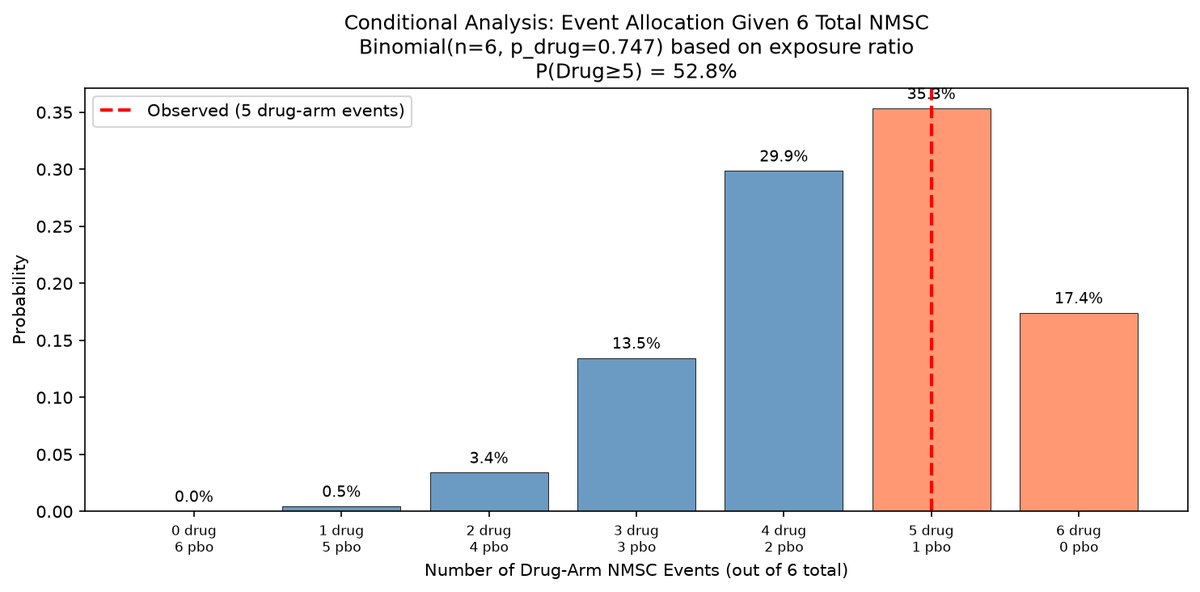
since we got a lot of slop posters on $ABVX, I was inspired by my own tweet to add my own to the mix. enjoy: Under reasonable assumptions, due solely to treatment time imbalance, a 5:1 drug:placebo NMSC ratio was the SINGLE MOST LIKELY OUTCOME in ABTECT maintenance. The setup. ABTECT re-randomized induction responders 1:1:1 to placebo (n=192), 25mg (n=193), and 50mg (n=195) for 44 weeks (~0.85 years). Placebo patients relapsed fast — only 34% completed vs ~80% on drug. To estimate exposure: completers contribute the full 44 weeks, dropouts ~half on average. That gives ~100 person-years for placebo vs ~295 for drug combined. Drug patients contributed ~75% of total exposure time (295 / 395). The model. 6 NMSC cases occurred. If all 6 were background events (age, prior skin cancer, prior immunosuppression — not drug-driven), how would they distribute across arms? Binomial(n=6, p=0.747). Each event independently "lands" in the drug arms with probability proportional to exposure time. Result: 5:1 was the most likely outcome. P(5 drug, 1 placebo) = 35.3% — the mode of the distribution. P(≥5 in drug arms) = 52.8%. A coin flip. [graph 1] The dose split. Within the drug arms, 5 cases split 1:4 between 25mg and 50mg. Exposure was nearly equal (~146 vs ~150 PY), so this is ~Binomial(5, 0.5). P(4+ in one arm) = 19.7% one-sided — like flipping a coin 5 times and getting 4 heads. Unusual but not remotely significant. Two-sided p = 0.375. [graph 2] Total NMSC count. We modeled expected background NMSC using claims-based incidence data (Rogers 2015, Muzic 2017), adjusted for UC risk and prior immunosuppression. Expected events for a trial of this size and duration: ~4.9. Observed: 6. P(≥6) = 37%. The total count is barely above expectation. All cancers. Same logic applies to all 8 cancer cases (7 drug, 1 placebo). Under Binomial(8, 0.747), the most likely outcome is 6:2 at 31.1%. The observed 7:1 is the second most likely at 26.3%. P(≥7) = 36%. Caveat. This is a simplified model meant to illustrate the effect of differential treatment time on event allocation. It uses published epi parameters and standard binomial statistics. It does not prove obefazimod is safe — you can't prove a negative from 6 events — but the observed pattern is exactly what you'd expect from the trial design alone.
basame tweet mediabasame tweet mediabasame tweet media
basame@basadomente

@grok conduct a Monte Carlo simulation to determine the likelihood that $ABVX would see a 7:1 imbalance in cancer cases between drug and pbo groups purely due to chance. Take into account background rates of cancer, as well as differences in time in treatment, age, pre-existing histories, and prior treatment histories between the two groups. Make no mistakes

English
10
2
49
13.3K
MASi
MASi@TOWiU2·
It seems that AH on June 1, 2026, approximately 2700–2800 $ABVX shares changed hands for about $175/share. Poll: Will the buyer(s) see green again by the end of the year?
English
0
0
0
891
MASi รีทวีตแล้ว
Aadit Sheth
Aadit Sheth@aaditsh·
1. Applied Mathematics 2. Bioengineering
Aadit Sheth tweet mediaAadit Sheth tweet media
English
4
14
206
77.4K
MASi
MASi@TOWiU2·
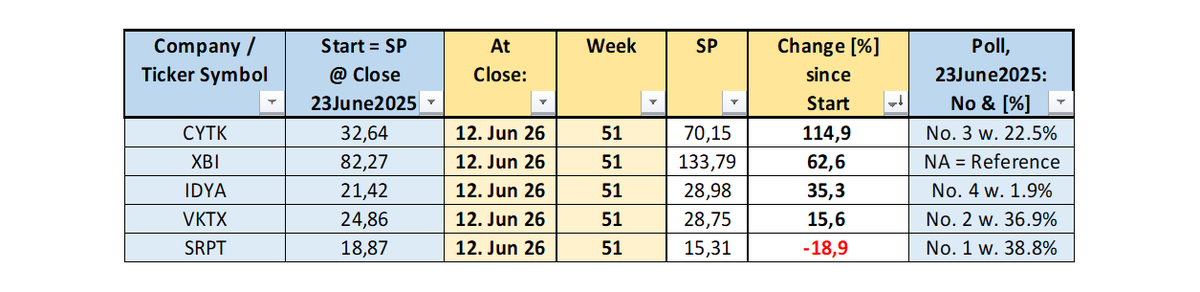
@LTbioinvestor $VKTX $SRPT $CYTK $IDYA Week 51 after Poll:
MASi tweet media
English
0
0
1
954
MASi
MASi@TOWiU2·
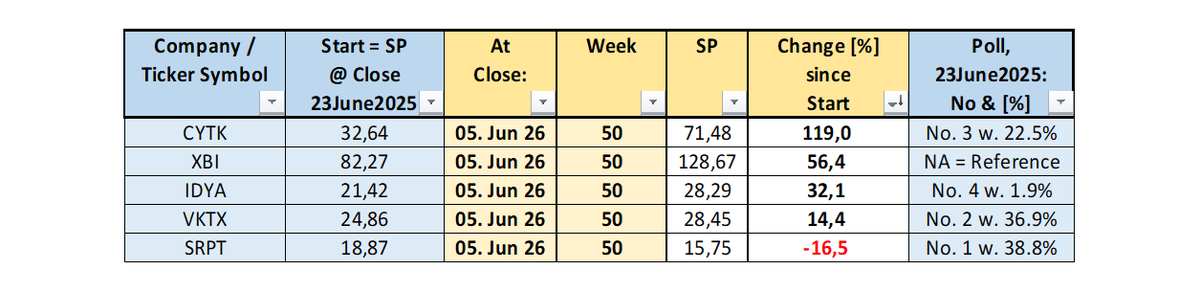
@LTbioinvestor $VKTX $SRPT $CYTK $IDYA Week 50 after Poll:
MASi tweet media
English
1
0
1
859
max
max@LTbioinvestor·
Most disappointing biotechs ytd (mkt cap above 1B)
English
3
0
2
8.9K
MASi รีทวีตแล้ว
Adam May
Adam May@A_May_MD·
I would disagree that there are no surprises in the new $ABVX slides or that this was all shared at guggenheim. For one thing, they were way off on the prostate cancer timing. At gugg they said day 367, but it actually was identified much earlier. Very important. Also, they had said the patient was exposed to prior therapies, but they didn't say which...we now find out that FIVE of them have cancer labels, including 3 with black box cancer labels. Very important info. We also didn't know the cancer subtypes. These could've been very aggressive, rapid growing tumors. Instead we find out, not only were they identified earlier on in the study, they were also more indolent, slower growing subtypes, further supporting the idea that these cancers were PRE-EXISTING before these patients even had any exposure to Obefazimod. New and quite meaningful info IMO. Not sure what's up with the quiet disclosure of it.
English
7
3
97
5.7K
MASi รีทวีตแล้ว
Adam May
Adam May@A_May_MD·
$ABVX seems to have (in the last hour or so?) quietly released a new corporate deck with 3 important slides at the end. All, in my opinion, providing strong new information showing that these cancer cases were unrelated to drug and equivalent to expected background noise. Most important is the slide on the 2 non-nonmelanoma skin cancers. BOTH of these were more indolent, low/intermediate subtypes of their respective cancer (prostate and breast). Not only does this mean that the cancers are less threatening, it also means that THEY ARE SLOWER GROWING CANCERS. Why is this particularly important? Because it means that the development of the cancers very (very) likely PREDATES THEIR ENROLLMENT IN THE TRIAL. Look into the doubling times of grade 2 (Gleason 7) prostate cancer and grade 2 NST breast carcinoma. These are slow-growing tumors that very likely existed before these patients ever even had a dose of obefazimod. That relates to another key finding on this slide - the prostate cancer case was identified via PSA screening at 8.5 months into the study (remember earlier is better). In the Guggenheim conference they had said it was confirmed at day 367...they must have been referring to the biopsy confirmation of the subtype, not PSA confirmation of the prostate cancer diagnosis. This new information speaks to an earlier diagnosis. The breast cancer patient was diagnosed even earlier than that! Only 6.8 months of Obe exposure. Also, these new slides give us actual information on the prior drug exposures - before this afternoon we knew that they were on some prior treatments, but we didn't know what...THE PROSTATE CANCER WAS PREVIOUSLY EXPOSED TO ***5*** DRUGS WITH LABELED CANCER WARNINGS BEFORE ENROLLING IN THE STUDY! 3 OF THEM HAD ***BLACK BOX WARNINGS*** FOR CANCER RISK! -Humira (black box) -Infliximab (black box) -Rinvoq (black box) -Entyvio (warnings and precautions) -Stelara (warnings and precautions) We also just got new info on the NMSC cases (which matter far less but which spooked the market anyway). How you can look at the details of these skin cancer cases and think they are related to the drug is beyond me (but then again, these details just got released - quietly, for some reason). First of all, ***ALL OF THE 4 50MG CASES OF NMSC OCCURED IN 6 MONTHS OR LESS!!! Again, too rapid to be reasonably assumed drug-related. The fact that they all happened in the first half of this study is actually extremely exculpating evidence for $ABVX. Other details: -4/5 were 60+ years old (STRONGLY associated with skin cancer risk) -3/5 had PRIOR SKIN CANCER ALREADY(!!!!!) -4/5 had prior exposure to other drugs that are known to increase skin cancer risk. Finally, they also added a slide discussing that some studies have shown the elevated risks of these cancers for UC patients at baseline. -~5x higher risk of prostate cancer in IBD patients -~2x higher risk of breast cancer in IBD patients Why did $ABVX add these 3 slides to the corporate deck randomly, silently, on a Friday afternoon? IDK. Legitimately good news in those slides! I'd have pressed released this info as soon as I had it, because the details really help alleviate the (already statistically misguided) concern that these cancers could've been caused by Obefazimod. Here's the link: ir.abivax.com/static-files/e…
Adam May tweet mediaAdam May tweet mediaAdam May tweet media
English
30
33
282
83K
MASi
MASi@TOWiU2·
(2/2) treatment of all forms of VKC, a serious allergic eye disease that primarily affects children & may lead to sight-threatening conditions if left un- or undertreated calcineurin inhibitor immunomodulator that targets the underlying inflammatory mechanisms of VKC
English
0
0
0
244
MASi
MASi@TOWiU2·
harrow.com/news-releases/… $HROW ReLaunches VERKAZIA (cyclosporine ophthalmic emulsion) 0.1% now supported by a comprehensive commercial strategy focused on physician education, patient access & affordability initiatives to ensure dependable supply & remove access barriers (1/2)
English
1
0
2
596
TacticzHazel
TacticzHazel@TacticzH·
The Healthcare sector remains unloved and unwanted. If I had $1.000.000 to spend on a healthcare portfolio, it would look like this: $200.000 | $NVO - Novo Nordisk $200.000 | $LLY - Eli Lilly $100.000| $UNH - UnitedHealth Group $100.000 | $TMDX - TransMedics $100.000 | $PME - Pro Medicus $75.000| $BMY - Bristol-Myers Squibb Co $75.000 | $JNJ - Johnson & Johnson $50.000 | $ABBV AbbVie Inc $50.000 | $TEM - Tempus AI $50.000 | $ROG | Roche Agree? What would you change or add?
TacticzHazel tweet media
English
47
24
221
127.7K
MASi
MASi@TOWiU2·
@doepke_michel Plus: $SRPT – believe it or not: market cap below $2b $HROW – perhaps more specialty pharma than biotech, but still: a commercial biotech with a market cap below $2b $RCKT – yes, there are even commercial biotech companies with a market cap under $300m
English
0
0
5
722
MASi
MASi@TOWiU2·
@yachmod @AudonThiggy $SRPT Elevidys growth Japan & International ( = $RHHBY ): +54% Q1/2026, resulting in CHF61m (~ $76m).
MASi tweet mediaMASi tweet media
English
0
1
10
296
Ja Hish
Ja Hish@yachmod·
@AudonThiggy Yep, got that. Wonder if alot are ex-US. By looks of FB seems advocacy groups in Europe debating about Elevidys. Sounded like a big jump from last numbers.
English
1
0
3
182
Thiggy Audon
Thiggy Audon@AudonThiggy·
$SRPT Soo the last call before this one 1300 was the number, in a discussion about safety DI said 1400. That might ( might with a big M) mean 100 kids so far this Q? Anybody else make that connection?
English
11
0
5
1.4K
MASi
MASi@TOWiU2·
@yachmod "And there have been somewhere in the hunt of 11 or so of 14 patients that have been prophylactically dosed with sirolimus. ... But so far, in all of those patients, there has not been any evidence of an increase in liver enzymes if one pretreats with sirolimus."
English
0
0
1
20
Ja Hish
Ja Hish@yachmod·
Correction, after reading transcript he said 11 have had no ALI. Probably no data on 3 yet.
English
2
0
2
180
Ja Hish
Ja Hish@yachmod·
$SRPT Goldman Sachs discussion just ended. Ingram, Estepan, Rodino-Klapac and Wong were present. No big news. Just the execution. Ingram did 90% of talking. Did say 14 non-amb kids dosed with sirolimus so far with zero ALI.
English
3
2
25
2.3K