
ทวีตที่ปักหมุด
Un•AI•ify
886 posts

Un•AI•ify
@UnAIify
Un•AI•ify helps you spot AI-generated text and reduce heavy rhetoric from online content. Improve writing skills and bolster know-how about persuasive tactics.
เข้าร่วม Haziran 2025
136 กำลังติดตาม183 ผู้ติดตาม
@tomfgoodwin Have seen tech CMOs in different SaaS verticals post the same "thought leadership" written in the same way, down to voice and rhetoric.
Both are using AI to write the slop, and they're too clueless to realize everyone using AI sings from the same, averaging songbook.
English

It's amazing how much stuff in trends deck is the same as each other, and wrong.
It's getting worse every year,
People lazily drawing upon the same nonsense, which then gets put into the training data for more of the same
Agentic commerce is a good example, or AI influencers
English
There will come a time when live, in-person conversations are required for trust to exist.
Ben Horwitz@horwitzben
I made the anti-Grammarly. Mess up your emails with AI. Sinceerly.com
English
Un•AI•ify รีทวีตแล้ว

@RhysSullivan @rorysutherland A very, very convincing compulsive liar, making it so hard to tell what's true.
Not surprisingly, this is a poorly appreciated problem.
x.com/i/status/20463…
Rhys@RhysSullivan
LLMs are weird because it's like having a brilliant employee who never stops working but is also a compulsive liar
English
Un•AI•ify รีทวีตแล้ว
The Standard Bullsh*t Take - content on 𝕏, Linkedin, Facebook, YouTube, etc., that invokes "It's not X. It's Y" phrasing and/or other rhetoric suggesting AI provenance.
"SBST" content, whatever its merit, is tainted by its intent to persuade. Proceed accordingly.
English

Ingraining in people’s minds that AI is sophisticated autocomplete would cure 95% of all AI psychosis cases.
Normal people have no idea what AI actually is and it’s leading to all sorts of delusions.
Boris Cherny@bcherny
A weird part of working at Anthropic: getting a few of these each day
English
Un•AI•ify รีทวีตแล้ว
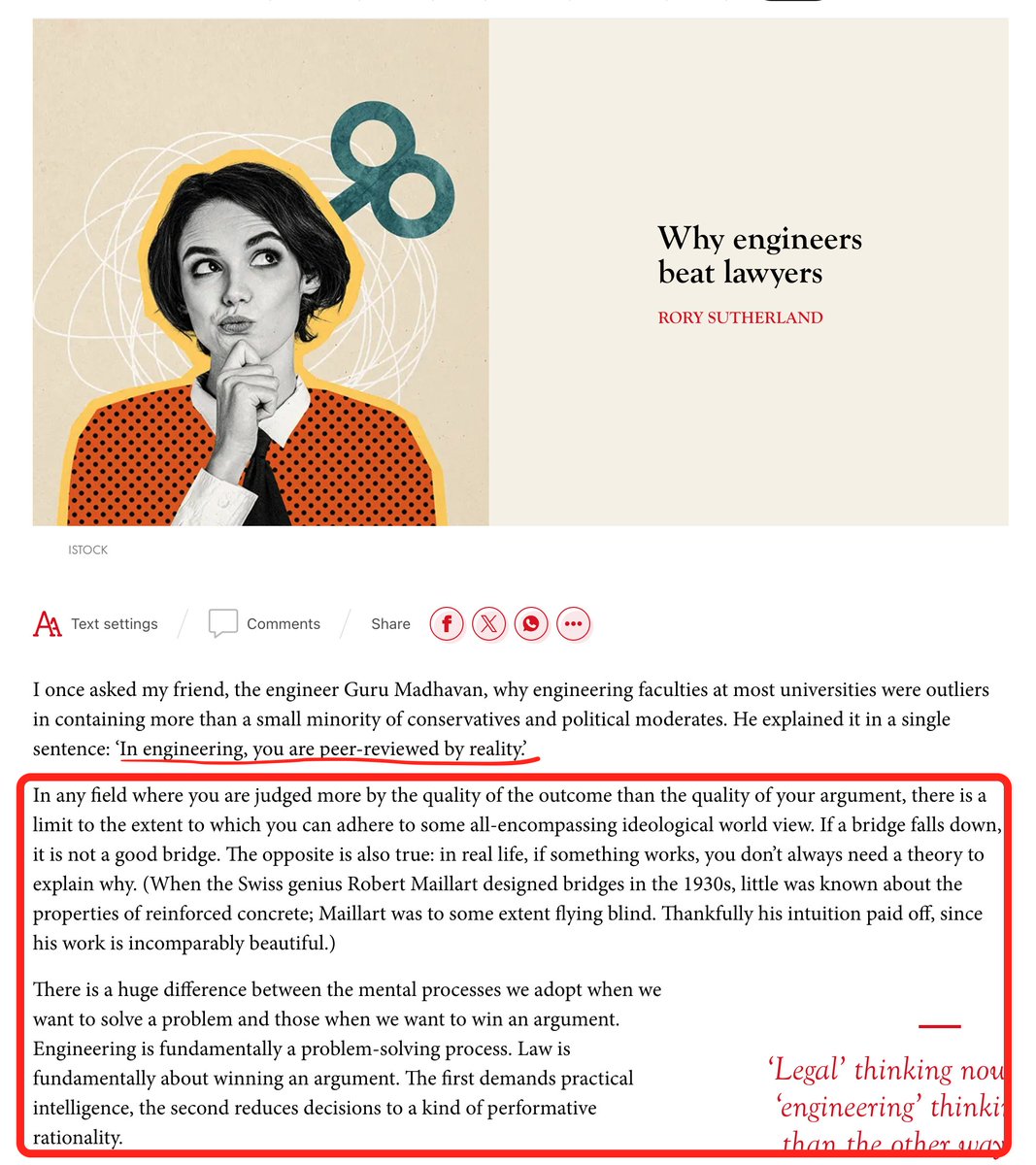
.@rorysutherland: "In engineering, you are peer-reviewed by reality."
👆
"Does it work?" vs. "Does it persuade?"
"Does it work?" vs. "Is this bullsh*t?"
Most of all: "What's the fallout if it doesn't work?" and "How do we know if it works?" (@nntaleb's skin in the game)
The AI hype is driven most by its use for code. The code is written and tested. The code works, or it doesn't.
This is not the case with so many other things that AI creates.
Can you "test" the answer it spits out, the copy or the email draft it writes, the document it reviews and summarizes, the brief, and on and on.
Do you have the experience to even know where it might be wrong?
Non-code, non-mathematical AI creations are hard to test for all sorts of reasons. Communication is messy and nuanced like the people doing the communicating. Communication is also aimed at persuading the audience, to "win arguments" rather than "solve problems" as Rory Sutherland so wonderfully puts it.
As people use AI to create difficult to test things, how might they be fooled into thinking the creations are good?
Prompters, as revealed by their deference to the LLM to assist them, may not know enough about the subject matter they're getting help with. They very well don't know enough to identify where an AI-generated creation is wrong or incomplete. Nevermind how persuasive AI is with its knack for mirroring, pacing and leading, and sycophancy.
AI is the palm-reader, the P.T. Barnum, the bullsh*tting con-man we want to believe.
"Prompter's blindness" hits squarely on these two fronts: 1. On the subjects they know less about and 2. on the subjects of which they are readily influenced (i.e. that of which they're already convinced).
Thus, outside of testable coding, AI creations have no first-line-of-defense, relatively low-cost means for filtering the bullsh*t from "what works," what's true or valid.
Thus, AI creations get published, emailed along, go viral.
The control against this is people who know better, and know more about the subjects in the prompter's blindspots. But almost necessarily, the know-how is limited to a smaller number of people, nevermind the impossible to fix asymmetry that comes with a combination of zero-cost scale on the Internet and instant-creation of AI.
The amount of [stuff] being created that is half-baked, performative slop grows daily. Are we set on a path to drown in unvetted bullsh*t?
"It ain’t what you don’t know that gets you into trouble. It’s what you know for sure that just ain’t so."
cc @UnAIify
Rory Sutherland@rorysutherland
English
Now consider how "corporate bullsh*t" is a narrower frame for "AI bullshit," ie the rhetorical patterns and words used by every LLM when they draft content.
AI fakes meaning as the supreme bullsh*tter, having no skin in the game.
It's on us to separate the truth from the BS.
Shane Littrell, PhD@MetacogniShane
🧵Happy to announce that, "The Corporate Bullshit Receptivity Scale: Development, validation, and associations with workplace outcomes" is now published! 😀🥳 (see replies below for more info) 1) Official version: sciencedirect.com/science/articl… 2) Open access version: researchgate.net/publication/40…
English
"Isn't merely..." is a "creative" way for AI to avoid the word, "just."
Amjad Masad@amasad
Software isn’t merely technical work anymore. It’s creative. Introducing Replit Agent 4. The first AI built for creative collaboration between humans and agents. Design on an infinite canvas, work with your team, run parallel agents, and ship working apps, sites, slides & more.
English
@TuckerGoodrich AI expands off a small amount of info and uses reductionist phrasing (It's not X. It's Y, cliches, shallow reasoning). This compounds over time.
Like using a JPEG compression and decompression over and over again.
English


800,000 human brain cells, floating in a dish, have never had a body. Never seen light. Never felt anything. And they just learned to play a video game.
That's not a metaphor. That's literally what happened.
These neurons are alive. They fire. They adapt. They get better at DOOM over time, which means something inside that petri dish is changing in response to failure. Scientists call it "goal-directed learning." There is no cleaner definition of that phrase than "it kept trying until it got better." The cells have no survival instinct, no reward system, no reason to improve. They just do.
The part nobody's talking about: researchers have to convert the game's visuals into electrical pulses the neurons can interpret. Which means those cells are perceiving something. Not seeing it the way you do. But processing a version of a world that doesn't exist, inside a container that was never meant to think.
The Turing Test was about machines fooling humans. Nobody wrote the test for this.
Curiosity@CuriosityonX
🚨: A petri dish of human brain cells just learned to play DOOM
English
Un•AI•ify รีทวีตแล้ว
Un•AI•ify รีทวีตแล้ว

We're at a point in history—not nearing it, but here—where you have to decide if you're content to ruin your brain with an endless stream of fentanyl-like digital slop or if you're going to fight for your humanity, touch grass, challenge yourself, create, contribute, and love.
English
3M views, retweets from giant accounts, another reason the AI slopocalypse (hyperinflation of content) will continue is that upside optionality of fiat content (without cost to the sloppers) guarantees more supply.


Handre@Handre
LASIK eye surgery cost $2,200 per eye in 2000. Today it's around $1,000 per eye despite 24 years of inflation. Meanwhile, an MRI that cost $1,200 in 2000 now costs $3,000+. The difference? LASIK operates in a free market with no insurance interference and minimal regulation. When patients pay directly, providers must compete on price and quality. LASIK clinics advertise prices, offer financing, and constantly improve technology to attract customers. Compare this to hospital procedures where prices are hidden, patients never see bills, and insurance companies negotiate opaque rates that somehow always increase faster than inflation. Cosmetic surgery follows the same pattern. Breast augmentation, rhinoplasty, and other elective procedures have become more affordable and safer over decades. Surgeons invest in better techniques and equipment because they must satisfy paying customers, not insurance bureaucrats or hospital administrators focused on maximizing reimbursements. The lesson is clear: remove third-party payment systems and excessive regulation, and you get Austrian economics in action. Prices fall, quality rises, and innovation accelerates. Healthcare costs aren't rising because of aging populations or new technology—they're rising because we've destroyed the price mechanism that makes markets work.
English