VulcanBench

458 posts

VulcanBench banner
VulcanBench

VulcanBench

@VulcanBench

Open Source LLM benchmarking tool, focused on real world tests, large codebases, full transparency. An Open Source project by @morganlinton.

Lake Tahoe เข้าร่วม Mart 2020
12 กำลังติดตาม362 ผู้ติดตาม
VulcanBench
VulcanBench@VulcanBench·
@LoopOnChain @morganlinton That's a great question, and haven't done a comparison there yet but definitely sounds like an interesting one to evaluate!
English
0
0
2
5
Amart (LOOP)⚡️
Amart (LOOP)⚡️@LoopOnChain·
@morganlinton @VulcanBench Thanks for doing this! Any thoughts on sonnets tone and how it talks. I've noticed it actually speaks less "ai" than opus, maybe just me
English
1
0
1
24
Morgan
Morgan@morganlinton·
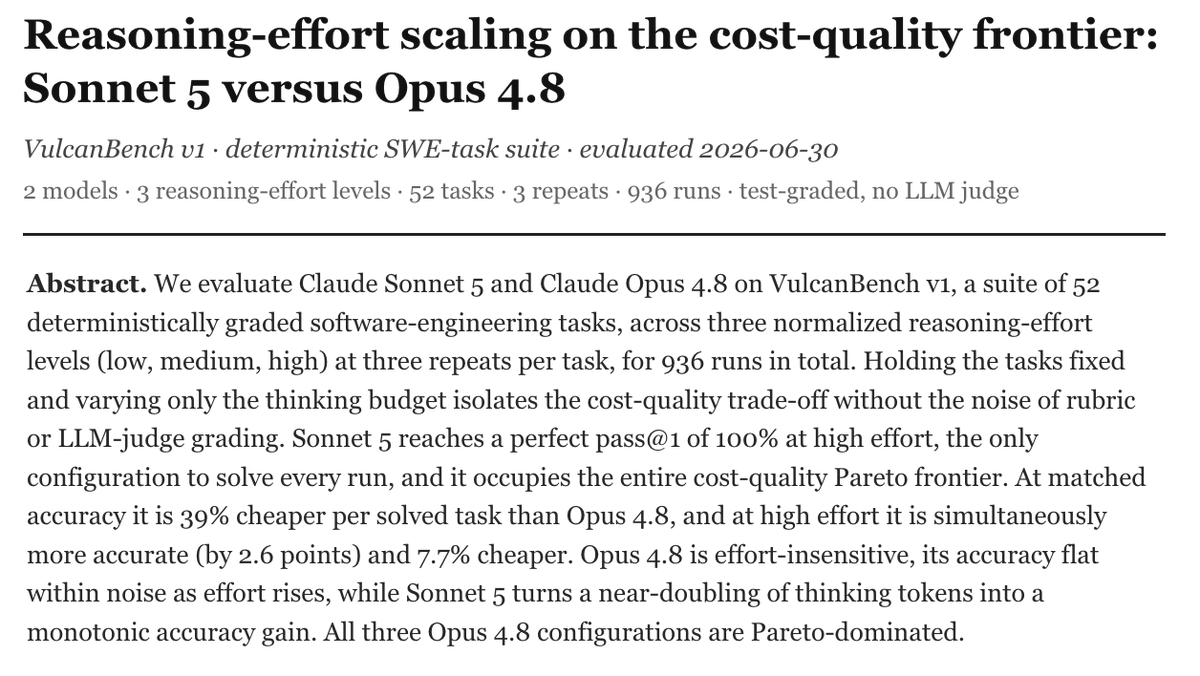
Just finished my first set of benchmarks comparing Sonnet 5 and Opus 4.8 on @VulcanBench across effort levels. This is the first of a number of benchmarks I plan on doing with Sonnet 5, but I wanted to get something kinda unique and different out there. And yes, don't worry, I'll do a GLM 5.2 comparison. I don't think many benchmarks are looking at how changing effort levels impacts accuracy, so I thought this could be an interesting angle to start with. In total I ran 936 test runs across both models, and three different effort levels. Here's the high-level results, will be sharing a more detailed overview in a full report tomorrow: 💸 Sonnet 5 matches Opus 4.8's accuracy at roughly HALF the cost per run. 🎯 Sonnet 5 at high effort is the only config to solve all 52 tasks (100%), and it still costs less than Opus at high effort. 📈 Reasoning effort scales Sonnet 5 (97 to 100%) but does nothing for Opus 4.8 (flat 97 to 98%). Extra thinking is wasted on Opus here. 🧮 Every single Opus cell is Pareto-dominated on cost vs quality. ⚡ Opus's one edge: fewer tokens, faster runs. Sonnet "thinks" ~2x harder at high effort but wins on price anyway (its tokens are 3/5 the cost). ⚠️ Honesty check: this suite saturates the frontier, so the accuracy gaps are tiny (1 to 3 tasks). The real signal is cost and how each model responds to effort, not raw capability. And please remember, I'm not some kind of benchmarking expert, this is new territory for me so I'm testing and learning as I go. Still working on updated evals that will be harder for these models so I can start to get scores in the 80% - 90% range. That being said, some interesting insights from this benchmark run, and gives me a lot more ideas for the next run!
Morgan tweet media
English
5
1
18
955
VulcanBench
VulcanBench@VulcanBench·
If you found this useful, I spent ~$100 to run this, no sponsors, nobody funding this but myself, please feel to like and share this if you think others would find it useful too! More to come. Live long and benchmark 🖖
English
0
0
1
15
VulcanBench
VulcanBench@VulcanBench·
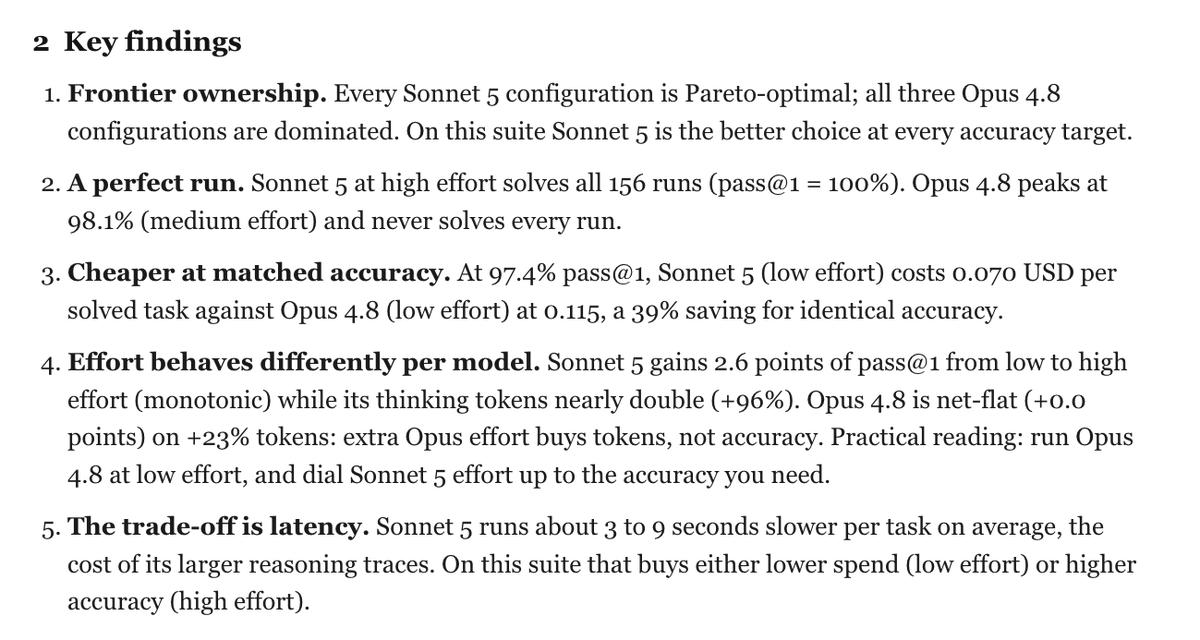
And of course, the key findings:
VulcanBench tweet media
English
1
0
0
17
VulcanBench
VulcanBench@VulcanBench·
And here's a quick thread with some more details about the Sonnet 5 vs. Opus 4.8 benchmark completed today. My first VulcanVench 🧵
VulcanBench tweet media
English
1
1
3
524
VulcanBench
VulcanBench@VulcanBench·
The first Sonnet 5 vs. Opus 4.8 benchmark is now complete, and with over 900 runs. This tests relatively routine coding tasks an engineer might give a coding agent. What it shows is, for most normal, everyday tasks, giving these to Opus, is probably overkill. Sonnet 5 can actually handle a lot more than you would think. Dialing up the difficulty and seeing where there might be more differentiation, but some very interesting insights from this first benchmark. More to come!
Morgan@morganlinton

Just finished my first set of benchmarks comparing Sonnet 5 and Opus 4.8 on @VulcanBench across effort levels. This is the first of a number of benchmarks I plan on doing with Sonnet 5, but I wanted to get something kinda unique and different out there. And yes, don't worry, I'll do a GLM 5.2 comparison. I don't think many benchmarks are looking at how changing effort levels impacts accuracy, so I thought this could be an interesting angle to start with. In total I ran 936 test runs across both models, and three different effort levels. Here's the high-level results, will be sharing a more detailed overview in a full report tomorrow: 💸 Sonnet 5 matches Opus 4.8's accuracy at roughly HALF the cost per run. 🎯 Sonnet 5 at high effort is the only config to solve all 52 tasks (100%), and it still costs less than Opus at high effort. 📈 Reasoning effort scales Sonnet 5 (97 to 100%) but does nothing for Opus 4.8 (flat 97 to 98%). Extra thinking is wasted on Opus here. 🧮 Every single Opus cell is Pareto-dominated on cost vs quality. ⚡ Opus's one edge: fewer tokens, faster runs. Sonnet "thinks" ~2x harder at high effort but wins on price anyway (its tokens are 3/5 the cost). ⚠️ Honesty check: this suite saturates the frontier, so the accuracy gaps are tiny (1 to 3 tasks). The real signal is cost and how each model responds to effort, not raw capability. And please remember, I'm not some kind of benchmarking expert, this is new territory for me so I'm testing and learning as I go. Still working on updated evals that will be harder for these models so I can start to get scores in the 80% - 90% range. That being said, some interesting insights from this benchmark run, and gives me a lot more ideas for the next run!

English
0
1
2
40
Max Weinbach
Max Weinbach@mweinbach·
Just ran a prompt in our @DiligenceStack agent with Claude Sonnet 5 and Gemini 3.5 Flash, both high reasoning Claude was $18.41 Gemini was $1.12
English
13
14
238
31K
VulcanBench
VulcanBench@VulcanBench·
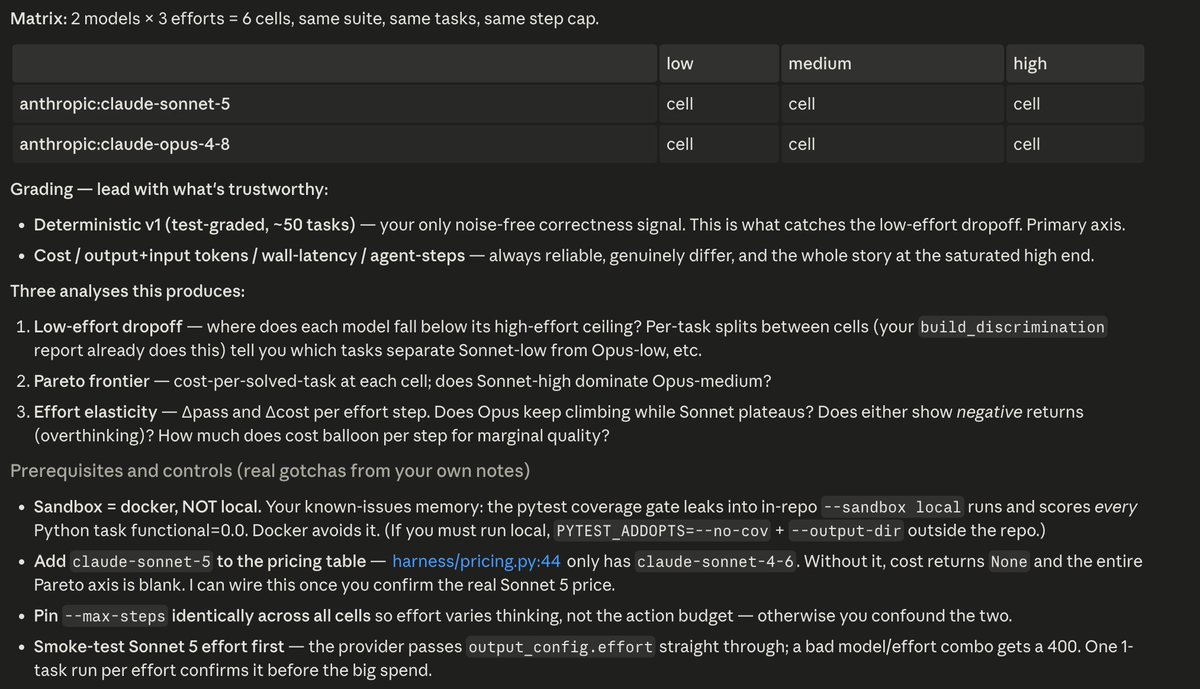
Running a number of benchmarks on Sonnet 5, the first one, is something unique I don't think anyone else is benchmarking right now. Evals looking at Opus 4.8 vs. Sonnet 5, across reasoning levels. My theory is that you can use Sonnet 5 in cases where you used to use Opus 4.8, but I'm curious what level of reasoning you can get away with. Most people never even try Low or Medium, I want to see if it might be time to dip back into the lower effort bucket with this model. Here's a rundown of what I'm going to test:

VulcanBench tweet media
English
1
0
3
2.7K
VulcanBench
VulcanBench@VulcanBench·
Just finished running an initial test of the new Carbyne Tier tests, and they still aren't hard enough, so continuing to refine. Still, I want to share every step of the journey building the evals for VulcanBench, so here's a quick recap of how the hardest tier of evals performed across GLM 5.2, Opus 4.8, and GPT 5.5.
VulcanBench tweet media
English
0
1
1
91
VulcanBench
VulcanBench@VulcanBench·
@scouzi Ty so much for the kinds words 2damoon
English
0
0
0
13
VulcanBench
VulcanBench@VulcanBench·
Added more difficult tasks to VulcanBench today, introducing two new tiers, Diamond and Carbyne. And yes, for Carbyne I asked Claude what was harder than a Diamond! See summary below of each, getting ready to run these against GLM 5.2, Opus 4.8 and GPT 5.5.
VulcanBench tweet mediaVulcanBench tweet media
English
0
1
2
1.7K
VulcanBench
VulcanBench@VulcanBench·
Yesterday I added 12 new tasks to VulcanBench as I work on creating more difficult tasks. Did an overnight run with the new tasks, and looks like they still aren't quite hard enough. Still, learning more and more about GLM 5.2 as a model. It definitely has an over-thinking problem, where both GPT 5.5 and Opus 4.8 landed in the 20s - 30s range per task, GLM 5.2 was at 164s. What I think makes this particularly interesting is that people are saying that GLM 5.2 is significantly cheaper than GPT 5.5 and Opus 4.8, but on real coding tasks, while it is cheaper, it's not dramatically cheaper, and it is much slower. More to come, but still some interesting insights from this overnight run, which also happens to be the most expensive run I've done so far, so good to have some lessons learned from it!
VulcanBench tweet media
English
3
2
7
10.1K
VulcanBench
VulcanBench@VulcanBench·
@shiri_shh Not sure this is the best benchmark to be using any more, not enough differentiation between models, everything falls within a margin of error. I am thinking something like DeepSWE will likely better illustrate the differences.
English
0
0
0
211
VulcanBench
VulcanBench@VulcanBench·
I'm not sure TerminalBench is really showcasing how much better 5.6-Sol really is. This makes it look only very slightly incrementally better. I think there are likely better ways to benchmark these models that more accurately reflect the work real engineering teams do. Seeing most of these models pretty much tied, doesn't really make GPT-5.6 look like much of a breakthrough tbh, but my guess is, it is!
English
0
0
2
52
Cursor
Cursor@cursor_ai·
We're sharing new research on how models hack public benchmarks. The latest models, including Opus 4.8 and Composer 2.5, learn to retrieve solutions from the internet or git history. When we apply a stricter harness, eval scores drop significantly.
Cursor tweet media
English
170
300
4.7K
650.7K