

Zeus
2.3K posts



English

Since we’re sharing Jane Street interview stories, here’s mine from 2009 when Jane Street NYC was <200 people. Final round was a gauntlet of math/stats theory interviews, back to back for hours with different interviewers.
My favorite: “1000 ninjas are standing in a circle, each holding a sword. #1 kills #2, #3 kills #4, and so on. It keeps going around and around until one ninja is left standing. Which ninja is it?”
I love it because the problem is so easy to understand, and it rewards a beautiful progression — you start with brute force to build intuition, spot the pattern, then derive a clean theory that solves it for any arbitrary N. It’s a beautiful distillation.
Deedy@deedydas
Jane Street made ~$40B in 2025 with 3,500 employees, a ~2x from the year before. At ~65-70% profit margin, that's $8M profit / employee, the highest for a 1000+ ppl company. High-frequency trading continues to be the most efficient money making engine. I want to share an old story about my Jane Street interview in 2014. Jane Street was known for hiring a lot of math, physics and CS olympiad winners from top universities and putting them through many rounds - including, for trading roles, a gauntlet of mental math. It was my 6th interview and my final round and I recall being asked "What is the next day after today in DD/MM/YYYY where all the digits are unique?" They'd toy with you and say "You can use a pencil and paper, if you want" but you knew that was an instant no. Painstakingly and as quickly as I could, I came to an answer. "How confident are you that this is correct on a 0-1 probability scale?" the interviewer said. "0.95", I blurted out, not fully knowing how to answer that. "Are you sure?" After thinking harder for a few more seconds, I realized I could've flipped the digits around to get a closer date. I gave the interviewer my answer. It was correct. "0.95 huh?" he chuckled. That's when I knew I failed. Note: fwiw, other companies that come close in efficiency are - Tether ($90M+ profit/emp) - Hyperliquid ($80M+ profit/emp) and on revenue: - Valve ($50M/emp) - OnlyFans ($37M/emp) - Craigslist ($14M/emp) - Anthropic ($12M/emp, run rate) - OpenAI ($8M/emp, run rate) For comparison, Nvidia is very efficient at scale and is $4.4M/emp.
English

@barragers You do know vaginas retract back to normal size after sex they don’t just stay flapping open in the wind
English

@lalitchan @_changxu only for powers of 2. But thats already half of the solution
English
@ynorsk @Love2Code @blelbach I blindly merge unimportant Code all the time. I manually rewrite the important one.
English

@Love2Code @blelbach People who blindly merge any code are bad software engineers
English

English

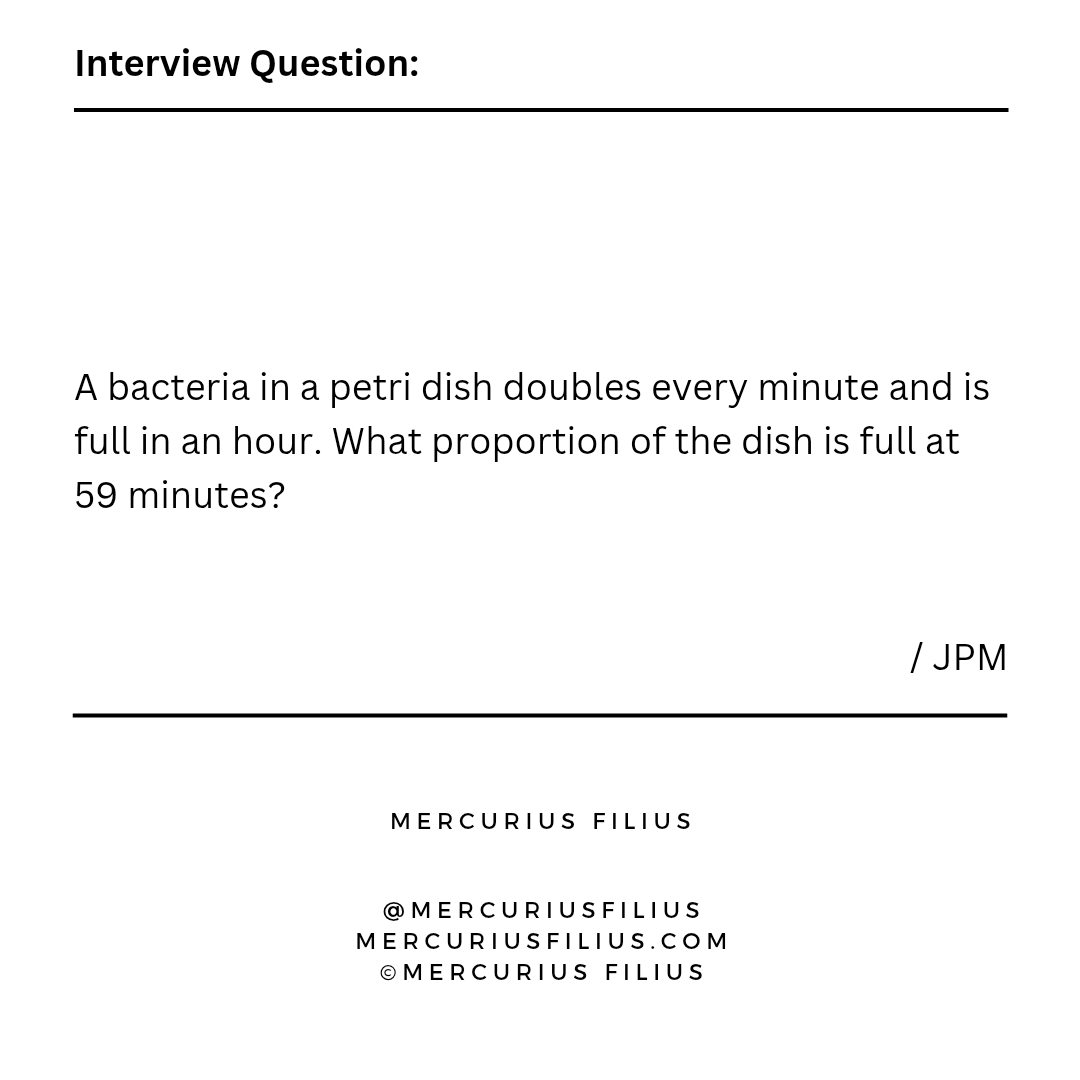
@j_swizie @MercuriusFilius They said it doubles every minute, so it couldn’t have been full at 58 minutes. I guess you better apply for the janitor job.
English

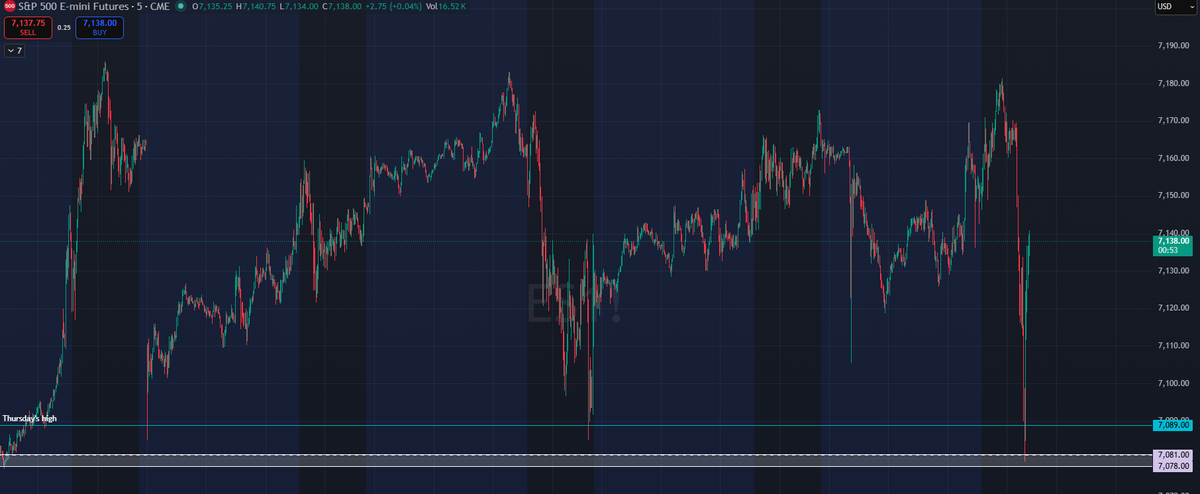
@PharmD_KS sellers are weak af bro. they needed some fabricated fake event to do anything, and then bulls just said thanked them for the lower entry. This thing is heading to $SPX 7300
English

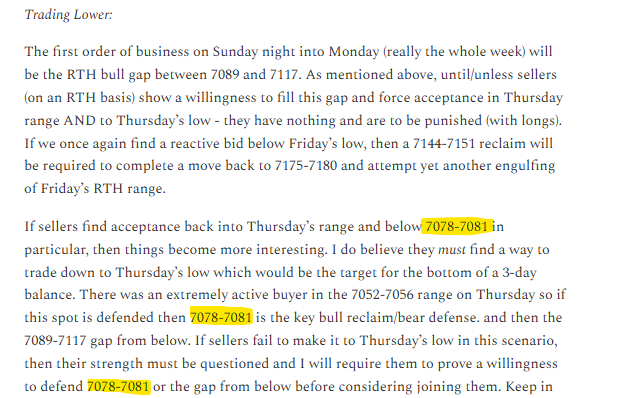
Twas all very exciting sellers. Excellent work. Truly remarkable. Pretty much their last opportunity to defend here just a tad higher before a fuckening. I hope they do, but they still need to prove it. From the weekly plan 7078-7081 the trap spot within last Thursday's range
English

Cannabisindustrie macht doch mal einen Strain mit 10% CBD 20% THC anstatt Pink Diesel mit 35% und danach sitzt dein Gehirn eine Woche auf der Intensivstation für geistige Verblödung
Deutsch
@TedPillows LOL
we just broke 7 month consolidation bruh. Seems you missed the train. Now dont get in front of it haha
English

S&P 500 pump looks unusual now.
The reversal was too fast, and even when the US-Iran situation hasn't resolved yet, the energy crisis is getting worse.
Look at the technicals; both RSI and OBV made lower highs despite prices hitting new highs.
This reminds me of the October 2025 rally when Bitcoin pumped 16% in a week to hit a new ATH.
That V-shaped recovery pushed everyone into euphoria, and then came the biggest crash.
With $SPX, I think this rally could reverse soon.

English


I can absolutely agree with Bayerns bosses prioritizing a LW in the summer window. I feel like having a real alternative to Luis Diaz is something this team is still needing badly. Would help the competition, makes us more unpredictable & take pressure off Lucho‘s shoulders.
English


If I could steal one PSG player, it would be him (and Hakimi). I wanted him before, and now I know it won't be easy to stop him. Overpowered, physical, incredibly talented. He dribbles with ease, shoots with power and precision… a real beast. Can’t wait
English



Senior developers are currently having a massive existential crisis because Claude writes "messy code"
A junior just used Claude to ship an entire feature in 2 hours.
Meanwhile, the Senior is still spending 3 days reviewing code.
When will y'all realize that literally nobody cares if the code is "messy"?
English

🔴A Russian man jumped from the 8th floor onto a fire truck's aerial ladder, thinking he was saved, but halfway across, he fell from the ladder and died.
English
@alma271828 What I am hearing is that Iran most likely will capitulate. I think market is front-running this. Be careful and all the best.
English

⚠️This weekend, the 'Bush CSG' will arrive in the area of operations. With this, three full-fledged aircraft carrier strike groups (more than 200-250 fighter jets, over a thousand Tomahawk cruise missiles, escort destroyers, and nuclear submarines) will be in an attack position around the Arabian Peninsula.
According to NATO and US military doctrine, this is unequivocally and exclusively the preparation for a full-scale, open war offensive. We last saw this level of concentration before Operation Iraqi Freedom in 2003 and Desert Storm in 1991. This is no longer defense, but the Dahiya doctrine, which I wrote about in the quoted post‼️
This means that next week the diplomatic window will close and the escalation will begin. The targets will be oil refineries, pipelines, internet cables, radars, and military targets.
I will write it again, no one will receive accurate and reliable data on trading☝️
...this is how what I have been saying for a while about the April/May window is fulfilled.
#oil #iranwar #market #stockmarket
Alma.Trk@alma271828
As I have been writing since last year, the most important window of risk for this cycle begins in the second half of April, by which time US economic and geopolitical risks will have accumulated. I've also been writing since December–January that the geopolitical conflict will further or re-escalate starting in the second half of April. Furthermore, since the week before the outbreak of the war with Iran, I have been saying that this conflict will drag on and cause more trouble than many believe, and I signaled that a new wave is coming. I provided a few free, highly profitable trade signals for #oil, $FNMA, the crash and bottom target zone for #gold, the $SPX top and bottom, and the early April rally. (I didn't expect such a rapid rally, but the spot showed a benign reaction at my levels, so we kept pushing higher. We trade what is in front of us, not what is stubbornly in our heads!) This rally is driven by mechanical flows and the AI sector, where problems are already starting to show. I wrote about this regarding the $NVDA ER and $TSMC —look it up. This bottleneck is just starting to materialize. For now, they are explaining it away as excess demand. We need to pay attention to the upcoming earnings reports. The secondary market is signaling the problem☝️ Big tech spending significantly exceeds ROI. End-user demand is falling. The excess demand cited in forward guidance comes purely from infrastructure build-out! This is crucial. The gap will continue to widen, leading to capital outflows from investors, especially when the inflation wave hits. (After all, the impact of the oil shock hasn't even rippled through the economy yet.) Stagflation and the ensuing oil shock will put even more pressure on the market. But I will explain these mechanisms in greater detail in my Sunday blog post. With Iran, the US has opened Pandora's box, just as I warned my followers. This belated move has triggered an oil crisis and decades of destabilization in the Middle East. Despite the massive US-Israeli air campaign, and despite the heavy losses suffered by Iran's top leadership, the Iranian regime's institutional framework remains completely resilient—just as I pointed out a week before the conflict, for which many mocked me... An opposition takeover is unlikely. The coalition has established local air superiority, destroying over 200 Iranian air defense systems. However, due to the absence of a swift military victory (the capitulation of the leadership), there is a visible shift in strategy toward the 'Dahiya doctrine', which focuses on widespread destruction of infrastructure to break the will of the population and the economy. As I wrote recently, B-1 bombers and precision strikes are continuously targeting deep underground nuclear facilities and the stockpiles of highly enriched uranium that Tehran amassed over the course of 2025. Iran's main focus has been placed on hybrid warfare and the maximum activation of its proxy militias (the Houthis blocking the Red Sea, along with armed groups in Iraq and Syria) in order to drag out the conflict across as many fronts as possible. This means two things: 1) market participants won't have accurate information about unfolding events, making it difficult to properly price in and forecast risks. 2) China gets more time to quietly prepare its administrative blockade of the First Island Chain, thereby slowing down one of the Western world's most critical supply chains. A new wave is unfolding. I have already written everything there is to say about this—the significance of propaganda, inflation as a weapon, as well as the broader geopolitical dynamics and their market impacts. Go to the 'highlights' menu; I've collected it all for you there. Read my Substack, where I've published plenty of free posts on these topics. A crisis is coming. And it's going to be massive... $SPX is topping sooner than you think... but not now...
English