ทวีตที่ปักหมุด

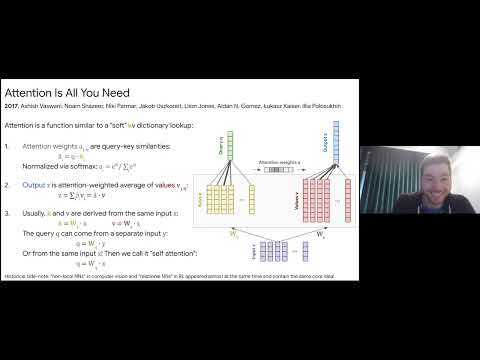
Lucas Beyer's phenomenal "Transformers" lecture is now online! 🤖👩🏻💻 youtu.be/EixI6t5oif0
YouTube

English
MLT & AI Communities
9.9K posts
@__MLT__
ML community and former award-winning nonprofit org working on open and accessible Machine Learning. Led by @suzatweet 🤖🧠





What happens when you put competing neural networks in a Petri Dish and start changing the rules while they adapt? Last year we released Petri Dish NCA, where neural nets are the organisms that learn during simulation. Today we're releasing Digital Ecosystems: a browser-based platform for interactive artificial life research. The setup: several small CNNs share a 2D grid, each seeing only a 3x3 neighborhood. No global plan. They compete for territory by attacking neighbours and defending against incoming attacks, learning via gradient descent online while the simulation runs. What we didn't expect was the role of the learning itself. Gradient descent isn't just optimising each species' strategy. Instead, it acts to stabilize the whole system during simulation. Species that overextend get pushed back by the loss. Species that stagnate get nudged to grow. This means you can push parameters toward edge-of-chaos regimes: a zone characterised by emergent complexity. Letting the neural networks learn acts to hold the complex system together while you explore and interact. The platform lets you steer all of this interactively. You can draw walls to create niches, erase parts of the system online, and tune 40+ system parameters to explore the most interesting configurations. We find it mesmerizing to watch species carve out territories and reorganise when you perturb them. Everything runs client-side in your browser, no install needed. Blog: pub.sakana.ai/digital-ecosys… Code: github.com/SakanaAI/digit…



you can outsource your thinking but you cannot outsource your understanding





We’re excited to introduce KAME: Tandem Architecture for Enhancing Knowledge in Real-Time Speech-to-Speech Conversational AI, accepted at #ICASSP2026! 🐢 Blog pub.sakana.ai/kame/ Paper arxiv.org/abs/2510.02327 Can a speech AI think deeply without pausing to process? In real conversation, we don’t wait until we’ve fully worked out what we want to say—we start talking, and our thoughts catch up as the sentence unfolds. Fast speech-to-speech models achieve this, but their reasoning tends to stay shallow. Cascaded pipelines that route through a knowledgeable LLM are smarter, but the added latency breaks the flow—they fall back to "think, then speak." In our new paper, we propose a way to break this trade-off. We call it KAME (Turtle in Japanese). A speech-to-speech model handles the fast response loop and starts replying immediately. In parallel, a backend LLM runs asynchronously, generating response candidates that are continuously injected as "oracle" signals in real time. This shifts the AI paradigm from "think, then speak" to "speak while thinking." The backend LLM is completely swappable. You can plug in GPT-4.1, Claude Opus, or Gemini 2.5 Flash depending on the task without changing the frontend. In our experiments, Claude tended to score higher on reasoning, while GPT did better on humanities questions. Try the model yourself here: huggingface.co/SakanaAI/kame