
Arun C Murthy รีทวีตแล้ว
Arun C Murthy
12.9K posts


Arun C Murthy
@acmurthy
Founder @isotopes_ai Past life: CTO, @scale_ai, CPO, @cloudera. Co-Founder/CPO, @Hortonworks. Engineer sheepdog. Self-confessed old soul.
Never still, mostly move ahead เข้าร่วม Mayıs 2009
235 กำลังติดตาม17.7K ผู้ติดตาม

Arun C Murthy รีทวีตแล้ว

The work can now speak for itself.
The ability to send your boss a session and have the agent answer "Why did you assume that?" instead of pinging you back on slack required making agents play multi-player.
Arun C Murthy@acmurthy
Most AI products give you a chatbot. You ask, it answers. But that doesn’t work for serious analytical work. Your team doesn't watch every step. They start an analysis, go to meetings, come back the next day. Colleagues need to understand what happened. Sometimes you need to rewind and try a different path. A chatbot can't do any of that. So we threw out the chatbot model and rebuilt around one idea: the event stream. Every action aidnn takes is emitted as a structured, ordered event. That single decision unlocks everything: → Teammates jump in, ask questions anchored to specific moments, and keep going → Close your laptop, come back tomorrow — zero lost progress → Branch from any checkpoint and compare results → See assumptions and reasoning before execution, not after The result feels less like querying a black box and more like working with a teammate who documents their work and can be reviewed for methods, not just results. Full breakdown on the @isotopes_ai blog: blog.isotopes.ai/building-a-col…
English
Most AI products give you a chatbot. You ask, it answers. But that doesn’t work for serious analytical work.
Your team doesn't watch every step. They start an analysis, go to meetings, come back the next day.
Colleagues need to understand what happened.
Sometimes you need to rewind and try a different path.
A chatbot can't do any of that.
So we threw out the chatbot model and rebuilt around one idea: the event stream.
Every action aidnn takes is emitted as a structured, ordered event. That single decision unlocks everything:
→ Teammates jump in, ask questions anchored to specific moments, and keep going
→ Close your laptop, come back tomorrow — zero lost progress
→ Branch from any checkpoint and compare results
→ See assumptions and reasoning before execution, not after
The result feels less like querying a black box and more like working with a teammate who documents their work and can be reviewed for methods, not just results.
Full breakdown on the @isotopes_ai blog:
blog.isotopes.ai/building-a-col…
English
Getting phenomenal feedback, and resonance, from the Isotopes AI "Team of Rivals" technical paper published in arXiv.
Here is the summary from DAIR.AI:
"The paper introduces the idea of organizational intelligence for AI:
→ 50+ specialized agents organized into teams (planners, executors, critics, experts)
→ Hierarchical veto authority; critics can reject outputs entirely, triggering internal retry
→ Pre-declared acceptance criteria established before any work begins
→ Remote code execution keeps raw data separate from reasoning context
→ Different model providers for writers vs critics to avoid monoculture
It turns out that coherence emerges from opposing forces.
Planners push for clarity, executors push for pragmatism, and critics push for correctness. Their conflicting incentives create boundaries that prevent drift in the system."
lnkd.in/gZ9hR3yQ
It's great to see how this idea is intuitively resonating with many folks - for this is the best way to make reliably accurate, and consistent, multi-agent systems for production.
Needless to say, we are excited to actually have this in production *today* unlike anyone else! Head over to isotopes.ai/signup to try it out!
Meanwhile, geek out on actual production traces of multiple analysis with multiple teams of agents... each blue box is an sub-agent and the sequence diagram represents the interaction between them.
English
Arun C Murthy รีทวีตแล้ว

Specialized agent teams organized to achieve clear goals, utilizing a remote code executor to separate data transformations from reasoning. Agents execute code remotely, returning only relevant summaries, thereby maintaining a separation between perception and execution.
Arun C Murthy@acmurthy
We recently talked about the "Team of Rivals" architecture which we bring to bear @isotopes_ai to scale sophisticated AI Agents, here is our paper on @arxiv: arxiv.org/abs/2601.14351 Discuss: news.ycombinator.com/item?id=468023…
English
Arun C Murthy รีทวีตแล้ว

We just published our whitepaper on building production-grade agentic AI.
Core thesis: analytics isn’t a chatbot problem - it’s an orchestration problem.
Get the whitepaper → isotopes.ai/whitepapers/or…
Arun C Murthy@acmurthy
We just published our latest whitepaper "The Orchestration Imperative for AI Agents" and this one is especially interesting for leaders who want to learn about the next evolution of AI. Here's the core insight: Production-grade AI Agents aren't a chatbot problem. They are an orchestration problem. Most multi-agent AI systems fail for predictable reasons—coordination overhead scales nonlinearly, context gets contaminated and rots progressively, and debugging becomes impossible. We've watched teams spend months building "agentic" solutions only to hit these walls. This whitepaper distills the principles @isotopes_ai uses to make sophisticated AI agents work in production: structured workflows, plans as contracts, hierarchy that tames complexity, and humans owning the "what" while the system handles the "how", and more. If you're evaluating any agentic AI for your business - or building one - this is definitely worth a read! Get the whitepaper to learn more → isotopes.ai/whitepapers/or…
English
We just published our latest whitepaper "The Orchestration Imperative for AI Agents" and this one is especially interesting for leaders who want to learn about the next evolution of AI.
Here's the core insight: Production-grade AI Agents aren't a chatbot problem. They are an orchestration problem.
Most multi-agent AI systems fail for predictable reasons—coordination overhead scales nonlinearly, context gets contaminated and rots progressively, and debugging becomes impossible.
We've watched teams spend months building "agentic" solutions only to hit these walls.
This whitepaper distills the principles @isotopes_ai uses to make sophisticated AI agents work in production: structured workflows, plans as contracts, hierarchy that tames complexity, and humans owning the "what" while the system handles the "how", and more.
If you're evaluating any agentic AI for your business - or building one - this is definitely worth a read!
Get the whitepaper to learn more → isotopes.ai/whitepapers/or…

English
Many thanks to several folks who gave incredible feedback on several iterations of the paper: @goldenkatepark, RSM (@Meta), SMS and more!
English
We recently talked about the "Team of Rivals" architecture which we bring to bear @isotopes_ai to scale sophisticated AI Agents, here is our paper on @arxiv:
arxiv.org/abs/2601.14351
Discuss: news.ycombinator.com/item?id=468023…
English
Arun C Murthy รีทวีตแล้ว
This idea that "AI models will not keep scaling" was conjecture in Nov 2024 when we wrote the first prototype.
Through 2025, we have built a system which does not depend on context windows growing and lossy compactions, but go faster with lots of fast flash LLMs
Arun C Murthy@acmurthy
Orchestrating a Team of Rivals We @isotopes_ai just published our in-depth technical paper on how aidnn achieves production-grade reliability! Model scaling is slowing down. But AI impact doesn't have to plateau. The path forward isn't faster clock-speeds. It's multi-core. Instead of waiting for a single smarter model, aidnn orchestrates multiple LLMs with opposing incentives. No business relies on one employee to handle critical operations. We shouldn't architect AI systems around single-agent execution either. aidnn deploys 50+ specialized agents organized as specialized teams: * Planners create execution strategies * Executors perform the work * Critics validate outputs with veto authority * Remote code execution keeps data isolated from reasoning models Each of these agents are coding agents resulting in a highly repeatable & reliable agentic system. We call it "orchestrating a team of rivals." Multiple agents with different failure modes catch what individual models miss. Hierarchical veto authority prevents errors from propagating. The result: 90%+ error prevention through layered validation. And your data stays secure. This is the architecture behind financial close automation at Invisible Technologies and others — turning weeks of manual work into hours of validated analysis. Read the full technical paper here: isotopes.ai/technology
English
Arun C Murthy รีทวีตแล้ว
architecture behind aidnn: agentic teams with opposing incentives validating each other’s work.
This is how we’re getting production-grade reliability for financial analysis.
Read more → isotopes.ai/technology
Arun C Murthy@acmurthy
Orchestrating a Team of Rivals We @isotopes_ai just published our in-depth technical paper on how aidnn achieves production-grade reliability! Model scaling is slowing down. But AI impact doesn't have to plateau. The path forward isn't faster clock-speeds. It's multi-core. Instead of waiting for a single smarter model, aidnn orchestrates multiple LLMs with opposing incentives. No business relies on one employee to handle critical operations. We shouldn't architect AI systems around single-agent execution either. aidnn deploys 50+ specialized agents organized as specialized teams: * Planners create execution strategies * Executors perform the work * Critics validate outputs with veto authority * Remote code execution keeps data isolated from reasoning models Each of these agents are coding agents resulting in a highly repeatable & reliable agentic system. We call it "orchestrating a team of rivals." Multiple agents with different failure modes catch what individual models miss. Hierarchical veto authority prevents errors from propagating. The result: 90%+ error prevention through layered validation. And your data stays secure. This is the architecture behind financial close automation at Invisible Technologies and others — turning weeks of manual work into hours of validated analysis. Read the full technical paper here: isotopes.ai/technology
English
Orchestrating a Team of Rivals
We @isotopes_ai just published our in-depth technical paper on how aidnn achieves production-grade reliability!
Model scaling is slowing down. But AI impact doesn't have to plateau.
The path forward isn't faster clock-speeds. It's multi-core. Instead of waiting for a single smarter model, aidnn orchestrates multiple LLMs with opposing incentives.
No business relies on one employee to handle critical operations. We shouldn't architect AI systems around single-agent execution either.
aidnn deploys 50+ specialized agents organized as specialized teams:
* Planners create execution strategies
* Executors perform the work
* Critics validate outputs with veto authority
* Remote code execution keeps data isolated from reasoning models
Each of these agents are coding agents resulting in a highly repeatable & reliable agentic system.
We call it "orchestrating a team of rivals." Multiple agents with different failure modes catch what individual models miss. Hierarchical veto authority prevents errors from propagating.
The result: 90%+ error prevention through layered validation. And your data stays secure.
This is the architecture behind financial close automation at Invisible Technologies and others — turning weeks of manual work into hours of validated analysis.
Read the full technical paper here:
isotopes.ai/technology
English
May you have ever more prosperous probabilities as the wave functions collapse,
entropy marches forward, and we begin another elliptical journey on the spacetime curve caused by our local stellar
object…
Happy New Year! 🚀
English
Arun C Murthy รีทวีตแล้ว

@acmurthy @far33d @a16z @isotopes_ai Exactly! One analyst spent 3 hours on Q3 working capital analysis. With aidnn they can just share a notebook, CFO clicks explain on anything they want, VP Finance branches it to test scenarios. Done in 20 minutes...
English
Arun C Murthy รีทวีตแล้ว
People really get it when they see branching. You share monthly expense analysis. Someone highlights a weird AWS spike, clicks "Explain," gets the breakdown. Then thinks "what if we switched regions?" and branches to test it. That's the moment!
Arun C Murthy@acmurthy
Recently, @far33d from @a16z nailed it: AI 1.0 gave individuals superpowers. AI 2.0 will give teams superpowers. With aidnn from @isotopes_ai you can live in the future. We built aidnn to be multiplayer with shared Organizational Memory from day one. Everyone sees the same context, numbers, assumptions, and process - updated in real time. While others are trying to make single-player AI tools work for individuals, we're already delivering multiplayer intelligence with collaboration, shared history, and organizational memory built in - today.
English
Arun C Murthy@acmurthy
Recently, @far33d from @a16z nailed it: AI 1.0 gave individuals superpowers. AI 2.0 will give teams superpowers. With aidnn from @isotopes_ai you can live in the future. We built aidnn to be multiplayer with shared Organizational Memory from day one. Everyone sees the same context, numbers, assumptions, and process - updated in real time. While others are trying to make single-player AI tools work for individuals, we're already delivering multiplayer intelligence with collaboration, shared history, and organizational memory built in - today.
English

In 2026, multi-player AI will eat single-player AI.
Right now, most AI tools are built for one human + one model in a private workspace. ChatGPT, Cursor, Claude. Incredibly powerful, but currently optimized for individuals. The impact is massive: drafts, code, specs, campaigns, workflows. But almost none of it is shared, aligned, or contextualized across a team.
We've seen this movie before. Cloud 1.0 was just "the same software, but online". The real breakthrough was collaboration. Google Docs beat Word. Figma beat Sketch. Notion beat Evernote. Every single-player tool lost to its multi-player counterpart.
AI is about to go through the same transformation. AI 1.0 gave individuals superpowers. AI 2.0 will give teams superpowers. And just like cloud, single-player tools will go multi-player or get replaced.
If you're building here, I'd love to talk.
English
With aidnn, the AI agent for analytics from @isotopes_ai, with multi-player capability from day one:
→ Share notebooks so anyone on your team can collaborate on analyses
→ Track a shared, and auditable, history of past methods and numbers
→ Branch a teammate's analysis to explore related scenarios
→ Enable shared context across teams for alignment with Organizational Memory
→ Continuously improve Organizational Memory with collective feedback
Check it out: isotopes.ai/signup
English
Here is a link to @far33d's original post:
x.com/far33d/status/…
Fareed Mosavat@far33d
In 2026, multi-player AI will eat single-player AI. Right now, most AI tools are built for one human + one model in a private workspace. ChatGPT, Cursor, Claude. Incredibly powerful, but currently optimized for individuals. The impact is massive: drafts, code, specs, campaigns, workflows. But almost none of it is shared, aligned, or contextualized across a team. We've seen this movie before. Cloud 1.0 was just "the same software, but online". The real breakthrough was collaboration. Google Docs beat Word. Figma beat Sketch. Notion beat Evernote. Every single-player tool lost to its multi-player counterpart. AI is about to go through the same transformation. AI 1.0 gave individuals superpowers. AI 2.0 will give teams superpowers. And just like cloud, single-player tools will go multi-player or get replaced. If you're building here, I'd love to talk.
English
Recently, @far33d from @a16z nailed it: AI 1.0 gave individuals superpowers. AI 2.0 will give teams superpowers.
With aidnn from @isotopes_ai you can live in the future.
We built aidnn to be multiplayer with shared Organizational Memory from day one.
Everyone sees the same context, numbers, assumptions, and process - updated in real time.
While others are trying to make single-player AI tools work for individuals, we're already delivering multiplayer intelligence with collaboration, shared history, and organizational memory built in - today.
English
Arun C Murthy รีทวีตแล้ว
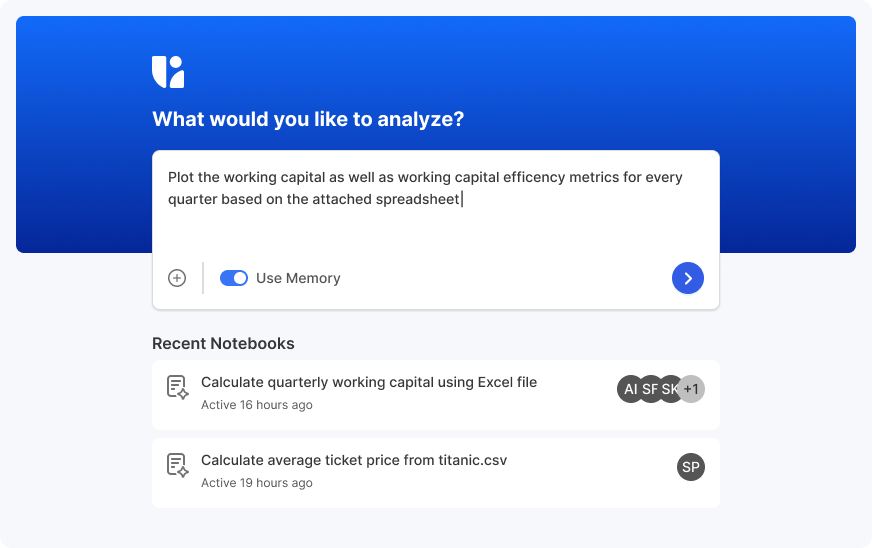
Your analytics stack just became AI-assisted. Starting today, we @isotopes_ai opened aidnn to everyone!
Teams at @InvTechInc and others are automating their analytics—KPI refreshes, margin analysis, anomaly detection, board prep.
Not a BI dashboard. Not ChatGPT. A true agentic platform specifically for analytics.
isotopes.ai/signup
English