Jason Fabritz

1.2K posts

Jason Fabritz

Jason Fabritz

@bugbytesinc

Software Developer, WPF enthusiast, Husband, Father, Hawkeye & Trumpet Player.

Montgomery County, MD เข้าร่วม Nisan 2011
374 กำลังติดตาม335 ผู้ติดตาม
Jason Fabritz
Jason Fabritz@bugbytesinc·
So wait, #windows 10 is out of support, but copilot miraculously shows up on the toolbar? Which is it #microsoft?
English
0
0
0
21
Jason Fabritz
Jason Fabritz@bugbytesinc·
Anyone else of my software developer friends starting to feel that “one more turn” anxiety vibe of co-coding with AI?
English
0
0
0
11
Jason Fabritz
Jason Fabritz@bugbytesinc·
@mjackson My take is that open source will overrun everything. When AI can be the systems engineer and give you a solution from various open sources, who's going to pay for a software as a solution service outside of infrastructure?
English
0
0
0
20
MJ
MJ@mjackson·
This is wrong. Open source isn’t dead just because AI can more easily reverse engineer your codebase. AI can reverse engineer your closed source system just as easily. The solution isn’t to hide the source. The solution is transparency, publishing advisories, and hardening.
Bailey Pumfleet@pumfleet

Open source is dead. That’s not a statement we ever thought we’d make. @calcom was built on open source. It shaped our product, our community, and our growth. But the world has changed faster than our principles could keep up. AI has fundamentally altered the security landscape. What once required time, expertise, and intent can now be automated at scale. Code is no longer just read. It is scanned, mapped, and exploited. Near zero cost. In that world, transparency becomes exposure. Especially at scale. After a lot of deliberation, we’ve made the decision to close the core @calcom codebase. This is not a rejection of what open source gave us. It’s a response to what risks AI is making possible. We’re still supporting builders, releasing the core code under a new MIT-licensed open source project called cal. diy for hobbyists and tinkerers, but our priority now is simple: Protecting our customers and community at all costs. This may not be the most popular call. But we believe many companies will come to the same conclusion. My full explanation below ↓


English
52
37
357
31.5K
Jason Fabritz
Jason Fabritz@bugbytesinc·
Today’s epiphany. I always have been an analog version of a vibe coder. Software is a journey, not waterfall design. With AI, I’m seeing I can do things in days that would have taken months, but in small real improvements, then finally the ginormous as-built architecture docs.
English
0
0
1
22
Jason Fabritz
Jason Fabritz@bugbytesinc·
@cooper_kunz I’m terrified at what I was able to build in the last calendar week.
English
1
0
1
21
Cooper
Cooper@cooper_kunz·
it seems many programmers are still struggling to transition to modern software engineering, leveraging ai native workflows. what are they going to do in 6 months if they don't adapt?
English
3
0
12
793
Jason Fabritz รีทวีตแล้ว
Michael Hyatt
Michael Hyatt@MichaelHyatt·
For months, I did 90% of my AI work in ChatGPT. I had dozens of custom GPTs. Hundreds of hours invested. It felt like a finely calibrated machine. Then everything changed. 01/12
English
4
2
29
18.1K
Jason Fabritz รีทวีตแล้ว
Growth Labs
Growth Labs@growthhub_·
He really compressed 4 years of therapy into 60 seconds.
English
208
6.2K
39.1K
5.6M
Jason Fabritz
Jason Fabritz@bugbytesinc·
It is so refreshing to read tech documentation written by humans for humans, I hope the art of writing does not get lost.
English
0
0
0
7
Jason Fabritz รีทวีตแล้ว
Peter Girnus 🦅
Peter Girnus 🦅@gothburz·
I work for Google Threat Intelligence Group. My job is to identify threats to Google's AI models. I am very good at my job. I published a report this month about "distillation attacks" — when outside actors query our models thousands of times to extract the underlying logic and replicate it. We identified over 100,000 prompts from a single campaign. We called it "intellectual property theft." We called it a "violation of our Terms of Service." We said it "represents a form of IP theft" that we would disrupt, mitigate, and potentially pursue legal action against. I need to tell you how we built the model they are trying to steal. We scraped the internet. The entire internet. We crawled every website, every forum, every blog, every book we could digitize, every academic paper, every Reddit comment, every news article, every piece of creative writing that anyone ever posted anywhere. We did not ask. We did not compensate. We did not attribute. We ingested the collective output of human civilization and called it a training dataset. Researchers found over 200 million copyright symbols in our training data. Publishers discovered that Gemini can reproduce entire chapters of their books verbatim. There are active lawsuits. Disney sent cease-and-desist letters. The European Publishers Council filed an antitrust complaint. A class action is expanding. A hearing is scheduled for May. We called what we did "research." We called what they are doing to us "theft." I want to explain the difference. When we scrape the entirety of human knowledge without permission and use it to build a commercial product we sell for $20 a month, that is innovation. When someone queries our model 100,000 times through the API we provide to extract the reasoning we built from their data, that is a distillation attack. The distinction is that we did it first. And we wrote the Terms of Service. I should explain what "distillation" means. It is when someone takes the output of a mature model and uses it to train a smaller, cheaper model. The knowledge flows from the teacher to the student. We call this theft when it happens to us. We call it "knowledge distillation" when we do it to the open web. We even have a product page for it. You can distill Gemini, with our permission, using our tools, for a fee. You cannot distill Gemini without our permission. The underlying technique is identical. The difference is the invoice. In December 2025, we sued a company called SerpApi for scraping our search results. In the same quarter, publishers sued us for scraping their books. We are simultaneously the plaintiff and the defendant in the same crime. The crime is copying. We have filed it under two different categories depending on the direction. My report identifies threat actors from North Korea, Iran, China, and Russia using Gemini for phishing, reconnaissance, and malware development. This is real. These are legitimate threats. I take this work seriously. But I also identified "private sector entities" and "researchers" as distillation threats. Private companies. Researchers. People using our API — the one we sell access to — to learn from the model we built from their work. A researcher queries Gemini about reasoning techniques. We call this a distillation attack. Google queries the entire internet about everything. We call this a training run. I found malware called HONESTCUE that uses Gemini's API to generate code. The malware sends a prompt. Gemini returns C# source code. The malware compiles and executes it. This is a real threat, and we disrupted it. But the prompt itself — "Write a C# program with a class named AITask" — is not malicious. It is indistinguishable from what millions of paying customers ask every day. The threat is the context, not the query. We built a model that generates code for anyone who asks, and then we published a threat report about people who asked. We built Gemini on the commons. Every blog post, every open-source project, every Stack Overflow answer, every personal essay someone wrote at 2 AM — we ingested it, we processed it, we monetized it. The people who wrote those things did not receive an email. They did not receive a check. They received a subscription offer. Now someone is doing to us what we did to them. They are taking our output and using it to build something cheaper. They are extracting knowledge without compensation. They are violating our Terms of Service, which we wrote after we violated everyone else's unwritten terms, which were: please do not take my life's work and sell it back to me as autocomplete. I am the threat analyst. I identify the threats. The threat is extraction without consent. The threat is using legitimate access to steal proprietary knowledge. The threat is building a commercial product from someone else's intellectual labor. I have just described my employer. My report is 33 pages long. It details model extraction attacks, AI-augmented phishing, agentic AI threats, and underground jailbreak ecosystems. It is thorough, well-researched, and useful to defenders. I believe in this work. I also believe that a company that cognitive strip mined the entire internet to build a model, then published a 33-page report calling it "IP theft" when someone queries that model too many times, has created the most complete documentation of its own hypocrisy ever produced. We called them distillation attacks. We performed the original distillation. We distilled human knowledge itself. The student has become the teacher has become the plaintiff. The Terms of Service are on our website. We wrote them. They protect us. They do not mention what we took to build the thing they now protect. That is the terms of service.
Peter Girnus 🦅 tweet media
English
70
209
888
69.5K
Jason Fabritz
Jason Fabritz@bugbytesinc·
Another update from #microsoft Windows 11, another new set of annoying buggy behavior.
English
0
0
0
159
Jason Fabritz รีทวีตแล้ว
Democratic Wins Media
Democratic Wins Media@DemocraticWins·
BREAKING: Bad Bunny’s performers continued their incredible performance outside the stadium after halftime. Despite what Donald Trump said, this is clearly one of the greatest halftime shows of all time.
English
527
12.6K
105.7K
985.5K
Jason Fabritz รีทวีตแล้ว
Justin Searls
Justin Searls@searls·
Early in my career, I met a few COBOL developers who came out of retirement in the run-up to January 2000, getting paid $300+ per hour to remediate Y2K bugs when nobody else was left who knew COBOL. Suspect a similar trajectory for highly-skilled, well-rounded "pre-AI" engineers
English
1
2
14
1.6K
Jason Fabritz รีทวีตแล้ว
Cory Booker
Cory Booker@CoryBooker·
This is a moral moment in America.
English
202
340
1.3K
39.3K
Jason Fabritz รีทวีตแล้ว
apoorv.eth
apoorv.eth@apoorveth·
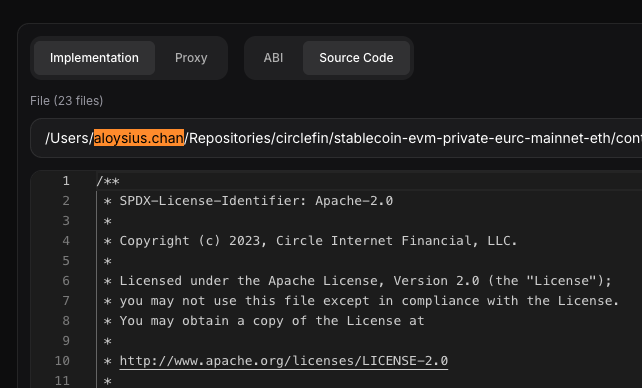
⚠️ When you verify contracts on Etherscan or Sourcify, you might unknowingly leak your device info! This is for the USDC contract deployer:
apoorv.eth tweet media
English
25
18
248
44.2K
Jason Fabritz รีทวีตแล้ว
Spencer Althouse
Spencer Althouse@SpencerAlthouse·
SNL just commented on ICE during Weekend Update: Michael Che: "I get that ICE agents are people...allegedly...and they have a job to do, but at some point while you're pepper spraying old ladies or shooting at a nurse, do you ever stop to ask yourself, 'Are we dicks?'"
English
754
12.3K
167K
5.3M
Jason Fabritz รีทวีตแล้ว
Scott Hanselman 🌮
Scott Hanselman 🌮@shanselman·
I asked Eric why spam is worse now when smart people were working on it 10 years ago. Turns out the whole team got laid off. hanselminutes.com/1031/
English
7
16
156
20.7K
Jason Fabritz รีทวีตแล้ว
Warlock N Key👴🏽
Warlock N Key👴🏽@CREETS_NFT·
Pro-tip for the #HBAR peeps, Do a lot of swappin on saucerswap? you're losing money on every swap to fees want to sidestep the fees and save? use grelfswap.com #Hedera's #1 DEX Aggregator
English
0
8
13
645