Cédric Lion

284 posts

Cédric Lion banner
Cédric Lion

Cédric Lion

@cdriclion

On the limits of AI creativity | Building @oparine_ai

Paris เข้าร่วม Eylül 2023
493 กำลังติดตาม1.9K ผู้ติดตาม
ทวีตที่ปักหมุด
Cédric Lion
Cédric Lion@cdriclion·
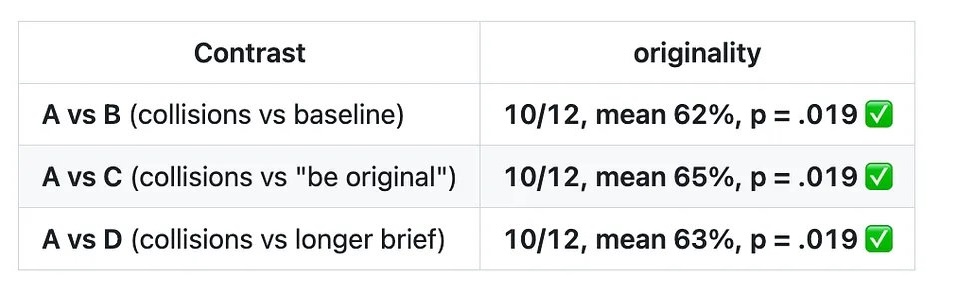
Introducing Open Collider: an open-source engine that mechanically improves LLM creativity. It generates non-trivial, high-quality ideas at scale, for any ideation problem. LLMs collapse on the same ideas. Sample the same brief 100 times → most outputs land in the same place. Researchers call it the Artificial Hivemind (Jiang et al., 2025). "Be more creative" moves the LLM's output by ~0.04 in embedding space. Forcing structurally distant domain collisions moves it by ~0.28. 7× more. Same model, same brief. So I built Open Collider: a pipeline based on the theory of bisociations (Koestler 1964), the same model that drives human creativity. 📊 Across 12 real-world ideation problems: •⁠ ⁠12/12 sign-test wins on embedding distance (p = .0002) •⁠ ⁠60%+ originality wins on 4,320 blind LLM-judge verdicts •⁠ ⁠4–13× further from the default cloud than "be original" prompts or longer context •⁠ ⁠Idea relevance holds (win rate >50% on overall quality) 💻 Engine: first reply 👇 📝 Launch study: pinned tweet Try it, Break it, Tell me what you find!
Cédric Lion tweet mediaCédric Lion tweet media
Cédric Lion@cdriclion

x.com/i/article/2056…

English
27
81
689
231.2K
Yohei
Yohei@yoheinakajima·
last night i got an agent to fork itself, propose a modification to itself on the fork, run through tests (sandbox, etc), and only accept the change into itself after the tests passed
English
20
6
66
5.6K
Cédric Lion
Cédric Lion@cdriclion·
It’s getting better, but hours is not months. And there is a BIG difference between « being able to write in a database » (which any bad LLM can do) and « manage memory and tasks properly over months without human intervention ». As far as I know, today’s agent compounds sh*t very very quickly into their database when you let them run without any intervention.
English
0
0
1
25
Felix Drost
Felix Drost@felix_drost·
@nic_carter @cdriclion It's getting pretty good at that as well, can run autonomously on a task for hours. It can write its findings to a database and work from there over days. It can chat to other intelligences and gain new instructions or ideas and carry a vision into reality.
English
1
0
0
36
nic carter
nic carter@nic_carter·
The “it’s not AGI because machine intelligence is jagged” is dumb cope. It’s obviously AGI. If you had a friend who had a 130 IQ, could write production code flawlessly, could write academic papers of a high research caliber, pass any exam in any field with flying colors, create a sophisticate LBO model, draw technical diagrams perfectly, compose poetry in any language, and could find solutions to significant unsolved mathematical problems, you would call that person a world historical genius. Certainly, no single human has ever had intelligence that “general” before. Now you think it’s “not AGI” because it sometimes slips up and makes mistakes - so does any human that you would consider “extraordinarily intelligent.” The professor might forget a colleagues name that he has known for a decade. He is still considered intelligent. The math genius might be a little autistic and shy, unable to maintain polite conversation. Still intelligent. You might stare at the fridge for 30 seconds unable to find the butter, despite 5 million years of evolution perfecting your visual intelligence. We give intelligent humans a pass when they have jagged intelligence. So why the double standard? The qualities people list as “necessary for AGI” are important traits to have, but no longer pertain to intelligence. People will say things like “true AGI requires agency, long term goal setting, embodiment, self-direct action”. But none of those things are intelligence. Those are “things that humans have that AI lacks”. Raw intelligence, AI has it in spades. That other stuff - important yet, but broader than and different from intelligence. The unwillingness of people to acknowledge that AGI obviously exists and has existed for a while is due to a kind of anthropic chauvinism - a psychological need to believe that humans are superior in every respect, that we possess soft skills that no machine could replicate. Yes humans are different from machines, but if we are limiting the discussion solely to general intelligence, AI has it already. That battle is over. If you want to reframe the discussion to matters of human dignity and personhood, fine, but that’s not an AGI question. That’s something else. Just take the loss on AGI already. It’s over.
English
493
230
2.4K
669.1K
Cédric Lion
Cédric Lion@cdriclion·
@cliftonk @nic_carter Yes I agree on that, and I think a bit more progress on that is what likely unlocks AGI. Current model are definitely capable of AGI if orchestrated well, but I have not seen satisfying output yet - always collapsing quite quickly without human in the loop. That's my point
English
0
0
0
45
Cédric Lion
Cédric Lion@cdriclion·
It's not - any agent using "harness (context management/compaction, subagents, forking, evals, etc)." that would perform long duration AGI without any human intervention, and be good at pursuing the goals we gave it (or it chose) over months and months without collapsing would be an AGI to me. But I have not seen anything like that in action (although I'm sure it might happen very soon)
English
2
0
0
181
Clifton King
Clifton King@cliftonk·
@cdriclion @nic_carter if your criteria is that a limited-context, high dimensionality next token predictor should be able to perform long duration AGI then maybe there's no point in arguing, because in that case i would also agree with you.
English
1
0
0
163
Algod
Algod@AlgodTrading·
This is the best investment thesis you can have for $tao
Hedgie@HedgieMarkets

🦔Microsoft canceled its internal Claude Code licenses this week after token-based billing made the cost untenable, even for a company with effectively infinite cloud resources. Uber's CTO sent an internal memo warning the company burned through its entire 2026 AI budget in just four months. American AI software prices have jumped 20% to 37%, and GitHub (owned by Microsoft) is dropping flat-rate plans for usage-based billing across its products. My Take The AI subsidy era is ending in real time. The same company that put $13 billion into OpenAI and built the Azure infrastructure powering most of Anthropic's compute just looked at the bill from a competitor's coding tool and decided it was not worth paying. That is not a productivity failure on Anthropic's end. Token-based pricing is forcing every enterprise customer to confront the actual cost of running these models at scale, and the number turns out to be far higher than the flat-rate experiments suggested. This ties directly to my Gemini Flash post yesterday. Anthropic, OpenAI, and Google all raised effective prices in the last six months. Enterprises that built workflows assuming AI costs would keep falling are now watching annual budgets evaporate in months. Two outcomes look likely from here. Either enterprises scale back AI usage to fit budgets, which slows the revenue ramp the labs need to justify their valuations ahead of IPOs, or the labs cut prices and absorb the losses, which makes the unit economics worse at exactly the wrong moment. Both paths land in the same place, the numbers stop working, and somebody has to take the writedown. Hedgie🤗

English
23
63
429
62.8K
Cédric Lion
Cédric Lion@cdriclion·
It can be solved with harness, likely, so what? It hasn't been yet. Very far from satisfying to date. So if you include that in AGI, it's definitely not there. Btw, AGI is not about how it's reached - model alone, model + harness - it's just a bunch of criteria, that a fully artificial entity meets or doesn't meet. Currently doesn't meet the criterion of agency properly, that's a fact. Including agency in the criteria is another debate
English
1
0
2
180
Cédric Lion
Cédric Lion@cdriclion·
Well, without that, it remains fundamentally less "capable" than humans, because not autonomous. AWS seems to include autonomy in it's definition of AGI at least (first result I get from typing AGI on google) : "AGI is a theoretical pursuit to develop AI systems that possess autonomous self-control, a reasonable degree of self-understanding, and the ability to learn new skills." aws.amazon.com/what-is/artifi… Of course you can argue that "they are autonomous to some extent", but the scale of this autonomy is still very unsatisfaying.
English
1
0
5
268
nic carter
nic carter@nic_carter·
@cdriclion that was covered in my above discussion you are shifting the goalposts from "generally intelligent" to "long term task setting" ok? AI can't do that yet. but since when is that included in anyone's definition of intelligence?
English
3
0
11
1.7K
Cédric Lion
Cédric Lion@cdriclion·
Well, would need to define accurately what he means by "sophisticated reasonning problems" to discuss properly. But the point is: his position is very fragile as it is based on absolute superiority of AI, which breaks with only one counter example. And humans work so much differently than (current) AI that it's very likely that it remains superior at least for some very specific dimension(s) for quite some time. But again, depends on how widely you define "sophisticated reasonning problems"
English
1
0
0
24
François Fleuret
François Fleuret@francoisfleuret·
Serious take: The optimistic "AI will not replace humans for sophisticated reasonning problems, the best will be collaboration" has no rationale of any sort. If AI > Human, then \forall alpha > 0, AI > (1-alpha)*AI + alpha*Human
English
47
2
105
26.3K
Cédric Lion
Cédric Lion@cdriclion·
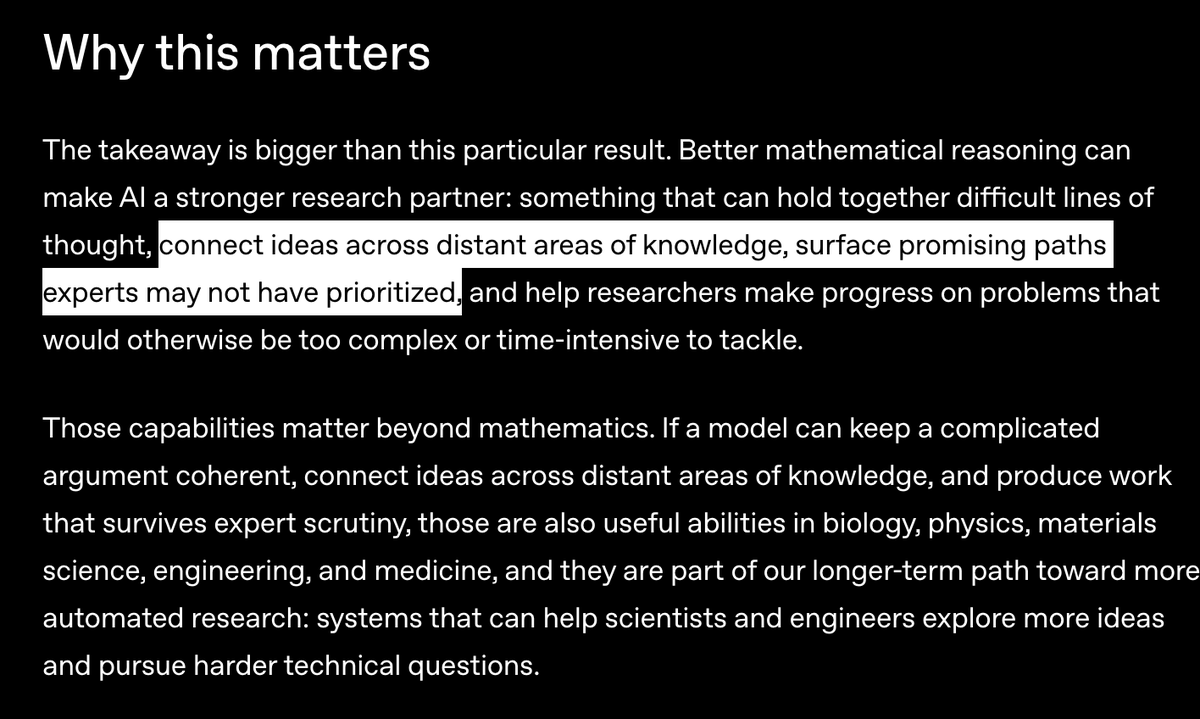
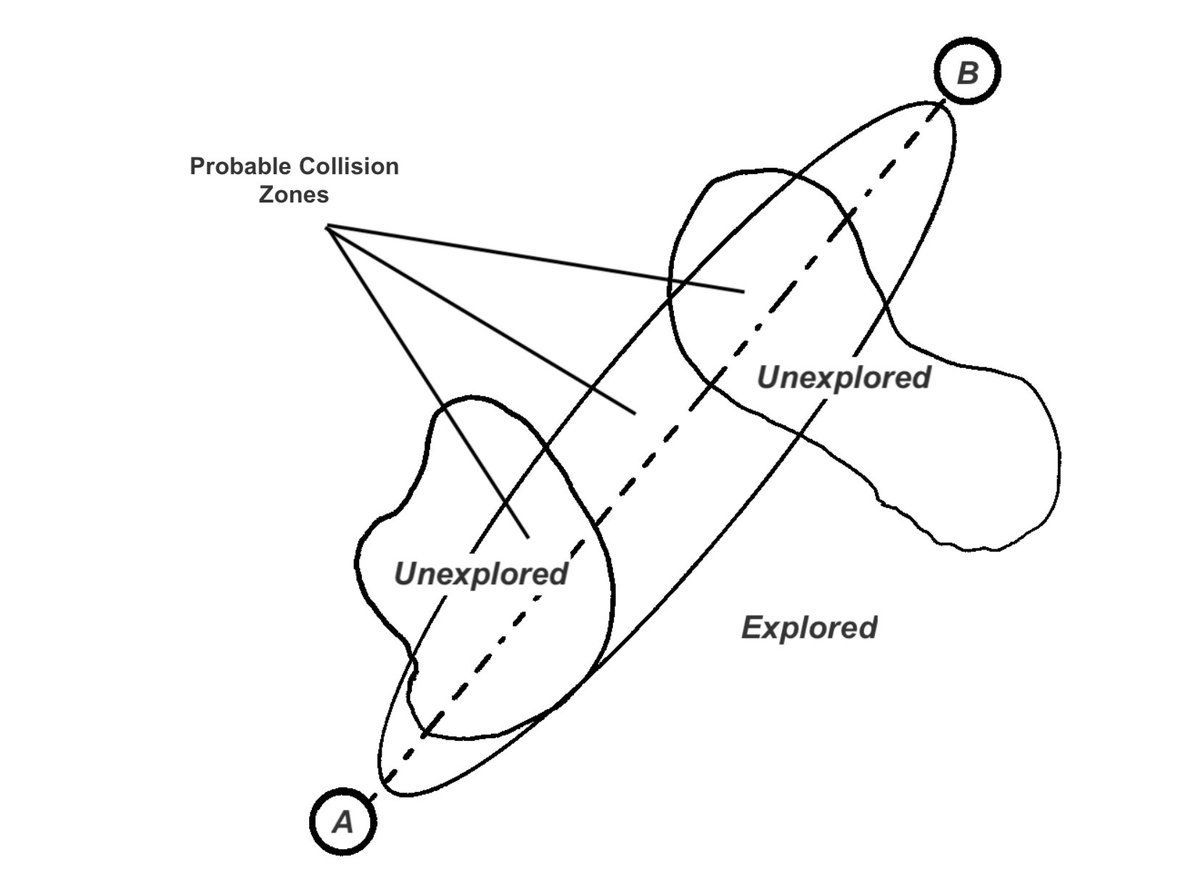
How can we make AI more creative? @OpenAI just answered that, and you can pull the EXACT same move in your everyday use of AI to generate better ideas. For years the line was: "AI can't produce anything new. It's trained on the past, so it just parrots it." And by default, LLMs do collapse onto the obvious: researchers have measured it, they call it the "Artificial Hivemind" (Jiang et al., 2025). But that's a floor, not a ceiling. Here's the ceiling: OpenAI's model just disproved a conjecture Erdős posed in 1946, one of the most famous open problems in geometry. It is NOT a remix of known answers; it's a genuinely new result. How did it get there? It bridged two fields nobody expected to connect: algebraic number theory and discrete geometry. In OpenAI's own words, the model can "connect ideas across distant areas of knowledge." This isn't a new idea about creativity, it's one of the oldest ones. Koestler called it bisociation in 1964: novelty comes from colliding two distant frames of thought. Humans have always created this way, and turns out AI can too. So the real question: can you do it on purpose, for any problem, instead of waiting for a frontier lab to point a model at a famous conjecture? That's what I've spent the last 4 months building. Open Collider: an engine that forces LLMs into distant-domain collisions to generate novel, non-trivial ideas at scale. With empirical evidence to back it. Open source, just try it 👇
Cédric Lion tweet media
Cédric Lion@cdriclion

Introducing Open Collider: an open-source engine that mechanically improves LLM creativity. It generates non-trivial, high-quality ideas at scale, for any ideation problem. LLMs collapse on the same ideas. Sample the same brief 100 times → most outputs land in the same place. Researchers call it the Artificial Hivemind (Jiang et al., 2025). "Be more creative" moves the LLM's output by ~0.04 in embedding space. Forcing structurally distant domain collisions moves it by ~0.28. 7× more. Same model, same brief. So I built Open Collider: a pipeline based on the theory of bisociations (Koestler 1964), the same model that drives human creativity. 📊 Across 12 real-world ideation problems: •⁠ ⁠12/12 sign-test wins on embedding distance (p = .0002) •⁠ ⁠60%+ originality wins on 4,320 blind LLM-judge verdicts •⁠ ⁠4–13× further from the default cloud than "be original" prompts or longer context •⁠ ⁠Idea relevance holds (win rate >50% on overall quality) 💻 Engine: first reply 👇 📝 Launch study: pinned tweet Try it, Break it, Tell me what you find!
English
1
0
3
688
Cédric Lion รีทวีตแล้ว
Bruno Raillard
Bruno Raillard@brunoraillard·
Luc Julia en apoplexie : un modèle généraliste d'OpenAI vient de résoudre un problème mathématique vieux de 80 ans. Mieux, pour atteindre ce résultat époustouflant le modèle a utilisé des approches novatrices et inattendues, qu'aucun mathématicien humain n'avait considéré auparavant. On parle beaucoup de cette mystérieuse "créativité" dont les IA seraient dépourvues. Mais alors comment appeler la capacité à sortir du cadre et à faire fi des idées reçues ?
Timothy Gowers @wtgowers@wtgowers

If you are a mathematician, then you may want to make sure you are sitting down before reading further.

Français
23
33
231
52.3K
Cédric Lion รีทวีตแล้ว
Alex Dimakis
Alex Dimakis@AlexGDimakis·
A breakthrough by OpenAI in a very famous Combinatorics problem, the Planar Unit Distance problem by Erdos 1946. The problem is amazing because it can be described to a first-grader: Find a way to place n points on the plane to maximize the number of pairs that have distance exactly 1. For example, if you have n=4 points on a square (of side-length 1) you have 4 pairs of distance 1. The diagonals have length sqrt(2) so don't count. But you can squeeze one diagonal and create a point-set with n=4 points and 5 pairs of distance 1. And you can't get more than 5 pairs from n=4 points, so we are done with n=4 points. Now, if you place n points on a line, you have n-1 pairs of distance 1. In general, all known constructions of n points had a number of pairs scaling essentially linearly: n^{1+something vanishing} It seems that the model found a way to place n points on the plane so that their unit distances scale super-linearly: like n^{1+delta} for some *constant* delta. Delta was not explicitly specified apparently, but a forthcoming refinement by Will Sawin shows delta=0.014 works, according to the announcement. This is incredible progress for mathematics, since this is (unlike previous Erdos problems solved by AI) a major breakthrough, in one of the most studied problems in combinatorial geometry. If you're in mathematics research now, you feel the AGI. Lijie Chen said it honestly in the video: "It's very hard to sleep, man"
Alex Dimakis tweet media
English
16
36
236
115.9K