This is Sabrina Gonzalez Pasterski.
No TikTok dances.
No reality TV drama.
Just raw, unfiltered genius mastering the impossible long before most of us even choose a major. 🤯✈️
Today I sat down with Jordan Levi, the Kosher Cowboy - a Jewish kid from the Chicago suburbs who became the largest cattle feeder in America.
Jordan runs Five Rivers Cattle Feeding with a capacity of nearly a million head. He started as a runner on the Chicago Board of Trade at 13 and found his way to cattle through a hedge fund that sent him to a feedlot in Amarillo. He showed up in Gucci loafers and never left the industry.
We go deep on how he trades the curve instead of making binary bets, why the cattle supply is the tightest since the 1950s, and what it takes to manage risk on nearly a million animals across 13 feedlots.
I hope you enjoy this episode as much as I did.
02:16 - The Belted Galloway
03:51 - The Kosher Cowboy
08:05 - Pulling value of the futures forward
11:43 - Learning Cattle trading
16:48 - Daily average gain in cattle
18:20 - Jordan’s Eureka moment in the cattle industry
21:08 - What does trading in animals actually look like?
27:05 - How Jordan defines his ROI in trading cattle
31:17 - The Cattle curve
33:37 - The state of the cattle market
42:10 - Buying the largest cattle feeder in the world
46:09 - Grass vs. grain fed cattle
49:15 - Predictions for the cattle supply over the next 10 years
50:54 - The international market
53:17 - Trading frequencies and macro thesis
01:00:27 - USA beef vs. international beef
01:05:21 - The cattle supply chain
01:07:32 - The future of auction yards and ranchers
01:09:40 - AI in AgTech
01:12:52 - The biggest problem facing the industry
01:14:42 - Livestock as a commodity that dies and how that impacts trading theory
01:20:51 - Is there a market for new entrants into cattle?
01:21:41 - Beef prices and the impact of a closed border on the industry
01:24:39 - Jordan’s biggest ideas for the industry
01:26:49 - Philanthropic efforts
01:31:24 - a day in the life of Jordan
01:26:42 - Risk management in cattle
01:41:17 - Does what you do show a leading indicator to the broader health of the American economy?
@ihtesham2005 I failed Algebra so many times due to dyscalculia. I didn't know. They thought that I had dyslexia, despite the fact that I was reading Stephen Crane, Jules Verne and Washington Irving in first grade. Her book and Egmont Colerus's "Mathematics for Everyman" were life changing.
A professor of engineering who failed math all through school built one of the most popular online courses in history by figuring out exactly why her brain had been working against her the whole time.
Her name is Barbara Oakley, and she did not teach herself how to learn until she was in her mid-twenties, after leaving the military with a head full of Russian and almost no useful science knowledge. What she discovered about her own brain eventually became a Coursera course that over 4 million people have taken, and the core insight she teaches has been sitting in neuroscience research for decades waiting for someone to explain it in plain language.
Here is the framework that changed how I think about every hard thing I am trying to learn.
Your working memory is an octopus sitting in your prefrontal cortex with exactly four arms. Those four arms reach out and grab pieces of information, hold them in place, and manipulate them while you are actively thinking through a problem. Four is the limit.
When you try to hold more than four things in conscious awareness at once, the arms start dropping things and everything becomes a scramble which is exactly what you experience as confusion when learning something genuinely difficult.
This is not a flaw. It is a design feature. And the entire game of becoming expert at anything is learning how to game this constraint.
The mechanism is something neuroscientists call chunking, and it is the most underexplained concept in all of learning.
When you practice something enough times that it becomes automatic a guitar chord, a grammatical structure, a mathematical procedure, a debugging pattern in code your brain compresses it into a single neural package stored in long-term memory. That compressed package now fits in just one of your four working memory slots instead of filling all of them.
Which means once you have built enough chunks, your octopus can reach down into long-term memory, pull up an entire complex procedure in a single grab, and still have three arms free to work with new information on top of it.
This is what expertise actually is. Not raw intelligence. Not natural talent. A library of compressed patterns that can be retrieved quickly and stacked together to solve problems that would overwhelm a beginner whose working memory is still occupied with fundamentals.
The finding that Oakley emphasizes most forcefully is the one that sounds backward until you understand the mechanism. People with smaller working memory capacity those who can only hold two or three items at once rather than four are often forced to develop stronger chunking habits earlier and more aggressively than people with larger working memories, because they have no choice. Their constraint becomes their training. Over time, that aggressive chunking practice can produce more robust expertise than a larger working memory that never had to be disciplined in the same way.
The most powerful practical implication is this: when you feel completely overwhelmed trying to learn something, that feeling is almost always your four-slot octopus running out of arms. The solution is not to concentrate harder. The solution is to stop, isolate one small piece of the problem, practice it until it compresses into a single chunk, and only then pick up the next piece.
You cannot learn everything at once because your brain was never designed to hold everything at once. It was designed to build libraries of compressed knowledge and retrieve them on demand.
Every expert you have ever admired is not smarter than you. They just have a bigger library.
@Darbybailey Darby, until '73, I lived in Lancaster, SC, home of Charles Duke. I remember being so excited when he attended a birthday party after having gone to the moon.
Ironically, my son's great grandpa ran Rocketdyne, and many years later, I found a note in a book he'd gifted to Joe.
@pmarca Many of us lecture our children on the meaning that we'll find by living in the world and not just on it, all the while, as we pursue safety and approval over risk or embarrassment.
I was a wild one. One evening, when 19 or 20, I asked a buddy, "Where do you wanna go: Jail or Hell?" He said, "Chris Lein, you scare me. You try to live your whole life in one day.", to which I replied, "All I have is today. Jail or Hell?!!" youtu.be/P_jitDzBmy8?si… via @YouTube
"You have to get into the belly of the beast."
In this clip, America's largest cattle feeder, Jordan Levi, discusses the process he and his team use to understand the current data and biologics driving cattle markets.
We are launching a big project today with MIT —
The Electricity Price Hub!
You can view monthly electricity prices per kwh and avg. bills for every major utility in the country going back to Jan 2020.
electricity.heatmap.news
Liftoff.
The Artemis II mission launched from @NASAKennedy at 6:35pm ET (2235 UTC), propelling four astronauts on a journey around the Moon.
Artemis II will pave the way for future Moon landings, as well as the next giant leap — astronauts on Mars.
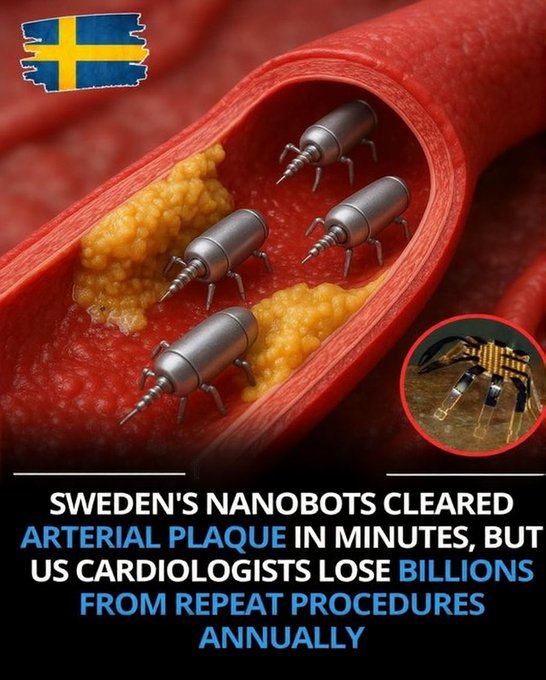
Swedish scientists develop microscopic nanobots that could prevent heart attacks without surgery.
These microscopic machines move through blood vessels, locate hardened buildup, and break it apart with incredible precision — restoring blood flow without the need for stents, surgery, or long recovery times. Early trials show that the nanobots can clean arteries far more effectively than today’s procedures, offering a powerful new option for preventing heart attacks and strokes.
The technology works by steering the bots with magnetic fields, guiding them directly to blockages that normally require invasive interventions. Once in place, the nanobots gently break the plaque into particles small enough for the body to process naturally, leaving the artery smooth and open. Patients in initial tests saw improved circulation almost instantly, proving just how transformative this approach could be for cardiovascular care.
But the breakthrough has sparked controversy in the United States, where cardiologists perform millions of repeat procedures each year to manage plaque buildup. Critics say the adoption of nanobot treatments could dramatically reduce the need for costly surgeries, cutting into billions of dollars in annual revenue from angioplasty, stent replacements, and other recurring interventions. Supporters argue that patient health should come first — and that technology capable of cleaning arteries in minutes should be embraced, not resisted.
🚨BOOM: The astronauts are SUITING UP right now for the launch of Artemis II to the Moon from Kennedy Space Center!
This is HISTORIC!
Pray for our astronauts!