Deepak Sridhar

2.2K posts

Deepak Sridhar banner
Deepak Sridhar

Deepak Sridhar

@deepak2380

I am.

เข้าร่วม Ocak 2009
1.2K กำลังติดตาม213 ผู้ติดตาม
Deepak Sridhar รีทวีตแล้ว
𑀓𑀺𑀭𑀼𑀱𑁆𑀡𑀷𑁆 🇮🇳
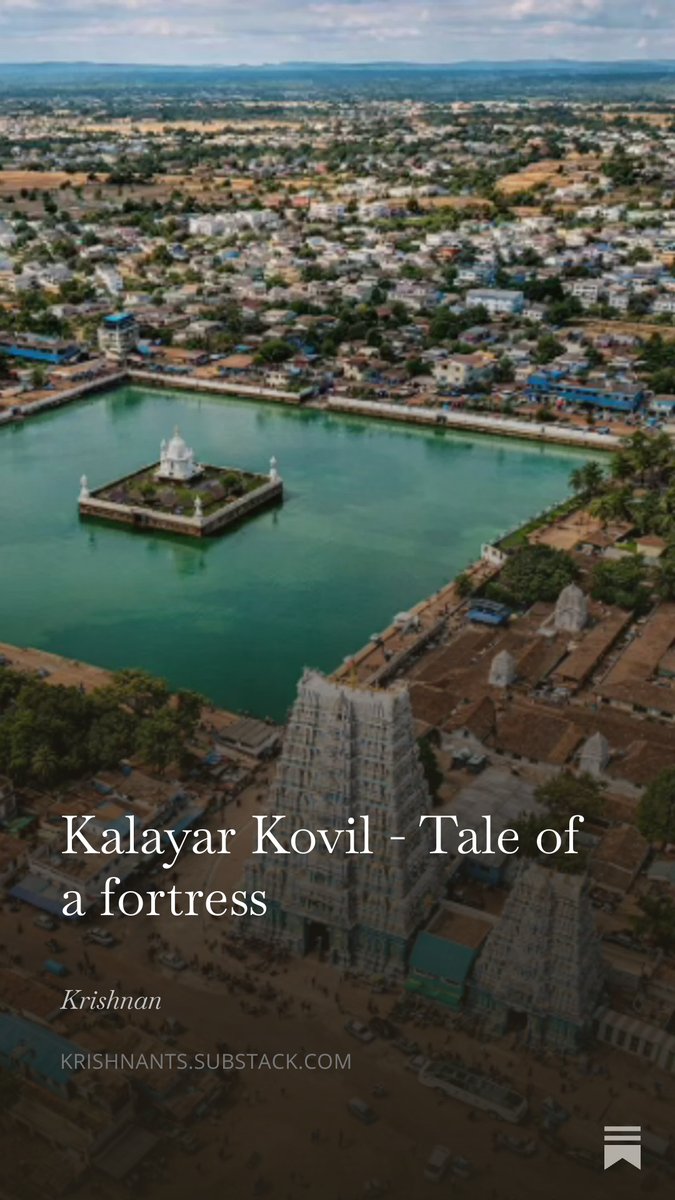
Kalaiyar Kovil is not just a temple town. It is a living witness to 2000+ years of Tamil history—Sangam-age forts, Pandya valour, sacred journeys, and the sacrifice of the Marudhu Pandiyars. Few places hold so many layers of Tamilakam’s past. Read more in the article. krishnants.substack.com/p/kalayar-kovi…
𑀓𑀺𑀭𑀼𑀱𑁆𑀡𑀷𑁆 🇮🇳 tweet media
English
7
130
387
13.1K
Deepak Sridhar รีทวีตแล้ว
Parimal
Parimal@Fintech03·
Schrödinger was a devoted, lifelong student of the Upanishads. He did not just like Indian philosophy; he credited it as the only logical solution to the Arithmetic Paradox of quantum mechanics. n his personal writings, he stated that the idea of Individual Souls was a mathematical error. He famously wrote: "The only possible alternative (to the paradox) is... to be found in the Upanishads: Brahman = Atman." 1 of the fathers of Quantum Mechanics was essentially a "Western Vedantin." He used the insights of the Upanishads to interpret what quantum mechanics was whispering: that the observer & the observed are ultimately 1.
Philosophy Of Physics@PhilosophyOfPhy

“The total number of minds in the universe is one.” This thought-provoking statement comes from Erwin Schrödinger, best known for his famous cat paradox in quantum mechanics. Beyond physics, Schrödinger was deeply interested in the nature of consciousness. In his writings, he reflected on the unity of awareness, proposing that all individual minds may ultimately be expressions of a single, universal consciousness. The quote highlights his philosophical exploration of how mind and cosmos might be intimately connected, blending scientific curiosity with metaphysical insight.

English
28
430
1.7K
48.9K
Deepak Sridhar รีทวีตแล้ว
Venky Ramachandran
Venky Ramachandran@venkinesis·
Whenever we talk about traditional Indian knowledge system, there is an elephant in the room we often shy from addressing. Why does Vrikshayurveda - a corpus of plant science older than almost any living intellectual tradition - still have to justify its existence every time it enters a room? Why, after thirty centuries of farmers using neem, does India hold no position of leadership in neem research? Why, when a tribal community in Andhra Pradesh is using 420 species of medicinal plants with documented efficacy, does the nearest IIT estimate ten years and twenty lakhs INR (~21K USD) per plant per application to validate what farmers have already spent generations refining? In my podcast with AV Balasubramanian (AVB), we explored many of these gnarly questions. AV Balasubramanian is one of the leading pioneers of deploying the wisdom of Vrikshayurveda in Indian Agriculture. He is the co-founder of the Centre for Indian Knowledge Systems (CIKS) in Chennai, one, besides conserving 170+ traditional rice varieties, of the most serious institutional efforts to apply Vrikshayurveda -- the classical Indian science of plant health - to modern day challenges in sustainable agriculture. His background is unusual even by the standards of people who do unusual things. A biochemistry and biophysics training at premier Indian institutions, a PhD abandoned in the US in 1982 in favour of a deep interest in exploring Science rooted in the Indian tradition, a decade as a student and teacher of Yoga at Krishnamacharya Yoga Mandiram under the direct lineage of T. Krishnamacharya and T.K.V. Desikachar, and eventually a decades-long collaboration with the Patriotic and People-Oriented Science and Technology (PPST) group, the intellectual collective that, more than any other, attempted to recover the epistemological foundations of Indian science rather than merely its recipes. AVB could have made a career from positioning traditional knowledge as a cultural heritage to be preserved. He didn’t. He has made a career of asking whether it works, under what conditions, for which problems, and how to scale it. His field team used a principle from Vrikshayurveda -- that bitter taste is an indicator of pesticidal potential -- to crack a fruit-and-shoot borer problem on brinjal that neem had failed to solve. His experiments with Ayurvedic storage forms (arkas, thailas, arishtas) have demonstrated that shelf life -- the most commonly cited limitation of natural bioprotectants -- is a solvable problem, using technology the Ayurvedic drug industry has operated for over a century. It’s unalloyed joy to hear when AVB speaks. He speaks with scientific precision (while warning of the dangers of epistemic fascism) and carries his passion for Indian knowledge system with a scientist’s penchant for rigor. What made this conversation personal was not just the fact that he studied Yoga under the same lineage I have been studying since 2013. It was our shared love and passion for Indian Knowledge systems. In the first part of this wide-ranging chat, AVB and I engage in philosophical throat clearing, exploring the context of Vrikshayurveda, before engaging with the the content of Vrikshayurveda. I started off the dialogue with a fundamental question. Traditional Indian medical and philosophical frameworks seem to rest on categories like vata, pitta, kapha that have not changed in millennia. A modern scientist looking at that would say: if your categories never change, is it really science? In response, AVB shared a beautiful analogy he had read from Captain Srinivasa Murthy. Imagine you make a list of every group that has tried to invade or conquer India over thirty centuries. You can list them in chronological order -- Greeks, Turks, Arabs, Portuguese, British, and so on. Or you can classify them differently: those who came by land, those who came by sea, those who came by air. The second classification not only subsumes everything that happened in the past but is capable of accommodating anything in the future. An Ayurvedic physician examining a patient is doing exactly this. When he looks at a complex of symptoms and asks whether the primary doshic imbalance is vata, pitta, or kapha, he is using a classification scheme that exhausts the universe of discourse.
English
13
325
920
26.2K
Deepak Sridhar รีทวีตแล้ว
Omjasvin M D
Omjasvin M D@omjasvinMD·
Should we wait for a mishap to happen? The Greater Chennai Corporation has shown least concern to pedestrians, commuters and shoppers, turning the Anna Nagar 2nd Avenue into a death trap. The stretch was dug up in Jan for storm water drain works and has been abandoned since then. Being one of the city's busiest commercial stretches, the nearly three-km long stretch was dug up on both sides to demolish an old storm water drain network and build new ones around Jan. However, it's almost March now, and the entire stretch resembles a war-zone with no barricades, precariously protruding rods, water stagnated pits and half-built concrete structures. With no safety on the road side as well as the pavement side, a minor trip into the pits might land in a disastrous event. In several parts near Blue Star, Ayyappan Temple and 12th avenue, the roads are narrowed down because of the unfinished work. Many of the shoppers end up parking in the carriageway as the SWD works take up about 5-6feet of the road space with silt strewn around. Pedestrians are finding it difficult to hop across the unfinished drain work to  accessing shops ranging from merchandise, tech and food stores.The arterial road, home to businesses worth over ₹1,000 crore, is already prone to peak-hour congestion and the abandoned works worsens it. With two bus shelters damaged, MTC goers too stand on the carriageway to board buses at Blue Star. Anna Nagar zonal chairman K P Jain said he has been requesting zonal authorities to close the pits for four days. "But they are not listening to us. Due to model code of conduct, we are prohibited from inspecting the spot. Officials must take public concern into account," he said.
Omjasvin M D tweet mediaOmjasvin M D tweet media
English
16
64
206
9.9K
Deepak Sridhar รีทวีตแล้ว
Swarajya
Swarajya@SwarajyaMag·
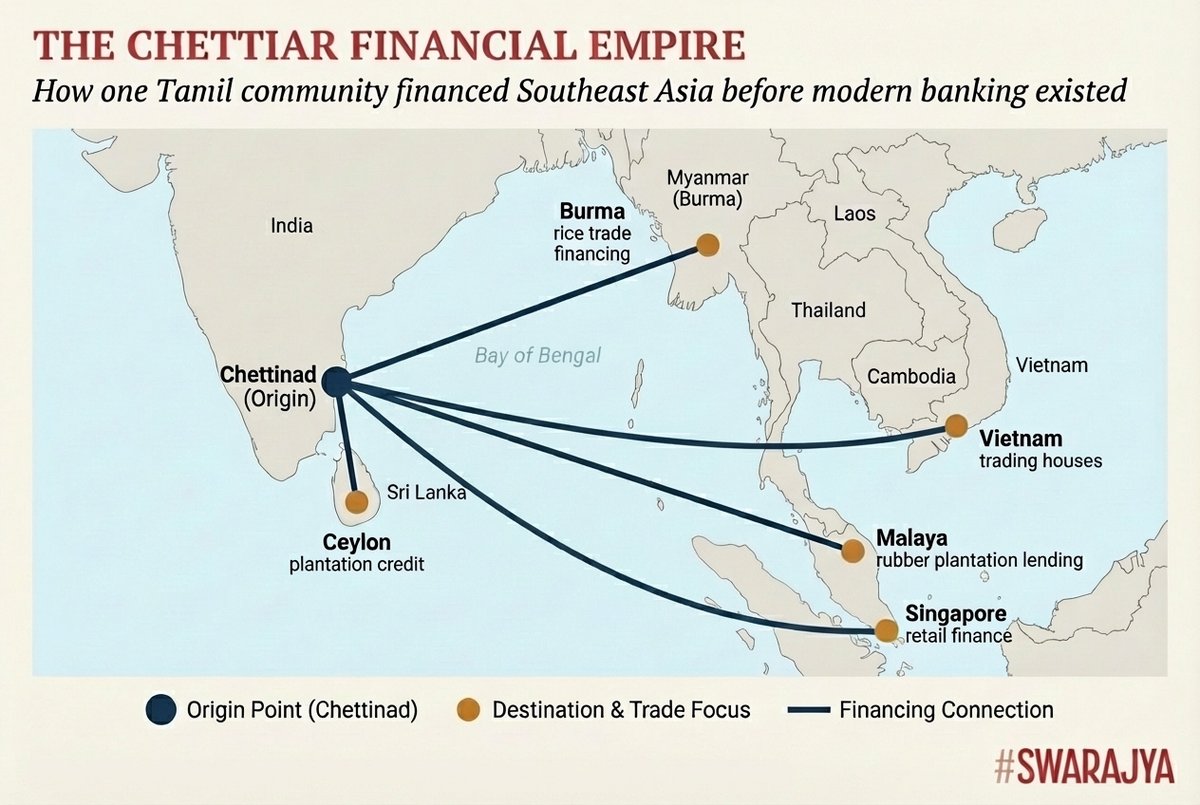
Before modern multinational banks reached Southeast Asia, merchants from 75 villages in Tamil Nadu had already built a transnational financial system. They financed rice in Burma, rubber in Malaya, retail in Singapore, plantations in Ceylon — connected not by contracts but by kinship and reputation. This is the story of the Chettiars.🧵
Swarajya tweet media
English
47
1.1K
3.8K
303K
Deepak Sridhar รีทวีตแล้ว
Parimal
Parimal@Fintech03·
Vijay sir, this post had nothing to do with tomatoes & I was going to ignore it, but since you often take a dig at tradition, let me address it this time. Why do we use tomatoes in current times? For 2 things: Acidity & Umami (savory depth). Pre-16th century Indians used Vrikshāmla (Kokum), Kachampuli (Coorg vinegar), & Amchur (Dried Green Mango) to achieve the exact same pH balance. The tomato is actually a lazy substitute. It provides a flat acidity. Ancient Sanatani kitchens used a layered approach: Amla (Gooseberry) for astringent sourness, Fermented Curd for creamy acidity....etc. If we remove the tomato from a modern curry & replace it with Slow-cooked Kokum & Jaggery, we are not missing anything but we are restoring a 1000s yrs old flavor complexity that the tomato actually simplified & arguably ruined.
Vijay NiftyTracker@Vijay_NT

@Fintech03 without Tomatoes, what kinda food were the Sanatanis & the Kings eating in India, prior to the 16th Century ? .. 😄
English
82
595
2.8K
70.6K
Deepak Sridhar รีทวีตแล้ว
Parimal
Parimal@Fintech03·
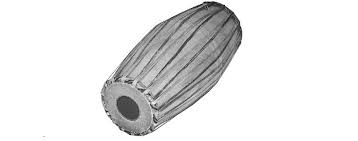
The world knows him for light, but Raman's 1st love was Sound. Western physicists (like Helmholtz) claimed that cylindrical drums (like the snare or bass) could never produce harmonic overtones (sweet, musical notes). They said it was mathematically impossible. Raman looked at the Mridangam & Tabla & realized the ancient Indian instrument makers had solved a physics problem Westerners had not even defined. He proved that by applying metallic paste (Syahi) in a loaded, non-uniform distribution on the drum membrane, Indians had created the world's only harmonic drum. He published this in Nature, essentially telling the Western scientific community that Indian artisans were master physicists. Source: Musical Drums with Harmonic Overtones, C. V. RAMAN & SIVAKALI KUMAR, Published: 15 Jan 1920
Parimal tweet media
Physics In History@PhysInHistory

Subrahmanyan Chandrasekhar and his uncle C. V. Raman form a rare Nobel legacy in one family. Raman won the 1930 Nobel Prize in Physics for discovering the Raman Effect, and Chandrasekhar followed decades later with the 1983 Nobel Prize for his profound work on the structure and evolution of stars.

English
16
497
1.7K
27.5K
Deepak Sridhar รีทวีตแล้ว
RapperPandit
RapperPandit@RapperPandit·
🚨Third Eye = Pineal Gland with Piezoelectric Microcrystals But when we talked about Shivas third Eye or the Ajna Chakra of Human body we were discarded as regressive superstitious beings. Now that West has Stamped it, it will be ok to Talk about.
GP Q@argosaki

Hidden Crystals in Your Brain’s ‘Third Eye’: Piezoelectric Microcrystals Discovered in the Pineal Gland – Turning Pressure into Electric Sparks! 🧠💎🔮” The discovery of tiny piezoelectric calcite microcrystals in the human pineal gland (the brain’s “third eye”) has scientists buzzing — these microscopic crystals can generate electrical signals under mechanical pressure, sparking fresh questions about the gland’s deeper role beyond just melatonin and sleep regulation. First identified in early 2000s studies (and now with renewed online discussion in 2025–2026), these calcite structures (<20 μm) show piezoelectric properties — meaning they convert mechanical stress (like subtle brain movements or vibrations) into tiny electrical charges. Advanced tools like scanning electron microscopy, Raman spectroscopy, and electron diffraction confirmed they’re made of calcium carbonate in unique hexagonal/trigonal forms, similar to crystals in the inner ear that help with balance. While mainstream science sticks to the pineal’s proven function in circadian rhythms and hormone production, researchers speculate these crystals could play a role in subtle neural signaling, electromagnetic sensitivity, or even bioelectromagnetic interactions (e.g., potential responses to fields). This finding underscores how much we still have to learn about the brain’s micro-scale wonders, blending biology, physics, and ongoing research into how these tiny “transducers” might influence everyday brain activity. #BrightBytes #Science #Health #Innovation #PinealGland #Piezoelectric So: Your Brain’s Hidden Crystals Just Got Weirder: Piezoelectric Microcrystals in the Pineal Gland – Science Meets the ‘Third Eye’ Mystery! 🧠💎” Here are video links (verified as of March 2026; these cover the calcite/piezoelectric topic: •Piezoelectric Crystals & the Human Pineal Gland youtube.com/watch?v=8cULVu… •Did you know the pineal gland has crystals that act as resonators?” instagram.com/reel/DSTe30ojH… •We’ve been told the Pineal Gland is just for sleep…but what if there is more?” instagram.com/reel/DVjeo8QFa… 👇sources : (verified primary/recent references): 1Bioelectromagnetics (2002) – Original study on calcite microcrystals & potential piezoelectricity: pubmed.ncbi.nlm.nih.gov/12224052/ or full: onlinelibrary.wiley.com/doi/abs/10.100…) 2IEEE Transactions (2004) – Second harmonic generation & piezoelectric transducers discussion: ieeexplore.ieee.org/document/12858… 3URSI Conference Paper (2002) – Characterization & electromechano-transduction role: ursi.org/proceedings/pr… 4PinealCode Blog (2026 update) – Modern summary of piezoelectricity in the pineal: pinealcode.com/blog/pineal-gl… 5Recent medRxiv preprint (2024, relevant context) – Meditation links & possible piezoelectric effects: medrxiv.org/content/10.110… This is grounded in established (mostly 2002-era) peer-reviewed findings with ongoing interest — however there have been no major new 2025/2026 breakthroughs, but this topic trends cyclically for its fascinating implications! 🚀
English
12
275
744
21.7K
Deepak Sridhar รีทวีตแล้ว
The Art of Living
The Art of Living@ArtofLiving·
As LPG shortages affect kitchens everywhere, sustainable solutions matter more than ever. At the Annapoorna Kitchen @ArtofLivingIC , meals for 20,000–25,000 people are cooked daily using biogas and eco-friendly briquette steam. Ananto ji, Head of Kitchen department shares that for over 15 years, kitchen waste itself has powered the kitchen! A true zero-waste model mega kitchen!
English
2
94
195
4K
Deepak Sridhar รีทวีตแล้ว
Parimal
Parimal@Fintech03·
What if I tell you, the Surya Siddhanta (dating back to at least the 6th century AD) describes the motion of Mercury with incredible precision. It classifies planetary motion into 8 types, including Vakra (Retrograde) & Anuvakra (Re-retrograde). The Surya Siddhanta calculated Mercury’s sidereal period as 87.97 days. The modern NASA value? 87.9691 days. Ancient Indian astronomers reached 99.99% accuracy w/o a single telescope, purely through the complex trigonometry of epicycles.
Quantum Tech ⚛@QuantumTech_X

Mercury breaks the rules of how planets are supposed to behave, On Mercury, the Sun can literally move backwards in the sky, Boiling hot days. Freezing nights, No atmosphere to protect you.

English
35
833
3K
56.5K
Deepak Sridhar รีทวีตแล้ว
Anish Moonka
Anish Moonka@anishmoonka·
I had the most fun doing this deep dive. Every color you see in a peacock's tail is a lie. The feathers contain exactly one pigment: brown. That's it. The blues, greens, and teals aren't made from any dye. They're made from structure. Each feather strand has a tiny crystal grid of melanin rods and air pockets built into it, and this grid reflects light the same way a prism splits a rainbow. Change the spacing of those rods by less than the width of a virus, and the color flips from blue to green to yellow. The margin of error for this to work is one twenty-thousandth of a millimeter. That geometric grid in the image is real, and a 2025 study figured out how it works. A peacock grows about 170 eyespots, and that number is biologically locked in. The feathers grow from the tailbone in a zigzag pattern, adding rows of 10 or 11 each year, creating the tightest possible packing arrangement in nature. When fanned out, the eyespots form spirals that follow the same Fibonacci pattern you see in sunflowers and pinecones. It gets wilder. The barbs inside each eyespot are hooked together like Velcro, making them heavier than the loose feathers around them. So when the peacock shakes his tail (the feathers vibrate like guitar strings), the eyespots stay perfectly still while everything around them shimmers. It's a built-in optical illusion. The shaking also produces a low hum below the range of human hearing, but the females pick it up. Robert Hooke first noticed these structures in 1665 through one of the world's earliest microscopes. 360 years later, engineers are still trying to copy them. A UK startup called Sparxell won a major innovation prize in 2023 for making paint from plant cellulose that uses the same trick, color from structure instead of chemicals, which means it never fades. Researchers at the University of Michigan used the same idea to build screen prototypes that work like e-paper in direct sunlight. The kicker: a 7-year study in Japan found that peahens don't actually pick mates based on how many eyespots they see. All this physics, all this precision, and the females might not even care about the math.
Everything@isjuustadream

My religion is whatever this is

English
112
2.5K
15.9K
742K
Deepak Sridhar รีทวีตแล้ว
Parimal
Parimal@Fintech03·
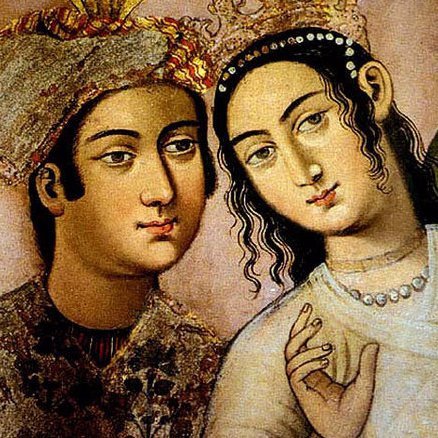
Ancient India has been banking them for 3000 yrs in a way that modern science is only now validating. In South India (Tamil Nadu), there is an ancient practice called the Tayittu/Thayittu. After birth, the umbilical cord stump is dried, powdered, & sealed inside a gold/silver amulet & tied to the child’s waist/arm. According to Vedic tradition & local folklore, if the child fell extremely ill later in life, the amulet was opened, & the powder (the dried cord tissue) was ingested/applied as medicine. Modern researchers have found that even in dried umbilical tissue, certain stromal cell signals & growth factors can remain stable. The Tayittu was essentially a low tech cryobank, based on the belief that the source of life (umbilical tissue) could act as a biological reset button for the body.
Dr. Luke in China@96Stats

Wow! A Chinese team just made a brilliant new method where one cell taken from an umbilical cord can be transformed into 14 MILLION cells that are designed to kill cancer. These are super super hard to engineer and so now being expanded at scale meaning it wont be an expensive luxury procedure, can be common place now for everyone!! To be fair the US is still a leader in commercialisation of cell therapies. But it still shows where the US struggles the most imo: industrialising manufacturing fast and cheaply. US innovation in this area is in an extremely expensive market with restricted access making it focus on premium pricing rather than for everyone like China are doing… The FDA even criticised the government policies on this last month saying the procedures are not“flexible” enough.
English
200
1.6K
6.8K
627.5K
Deepak Sridhar รีทวีตแล้ว
True Indology
True Indology@TrueIndology·
The great Chola dynasty ruled Tamilnadu for over 2000 years. Most Indians are proud of Chola history and heritage. Shockingly, descendants of great Cholas today get reservation as MBC ("Most Backward Caste"). Descendants of Imperial Cholas, Pichavaram Cholas belong to Vanniyakula Kshatriya community. Vanniyakula Kshatriyas enjoy reservation in Tamilnadu as Most Backward Caste(MBC). They even moved to court for a 10.5% reservation within OBC reservation for themselves. Which was struck down by the court thehindu.com/news/national/…
English
95
1.7K
5.1K
184.2K
Deepak Sridhar รีทวีตแล้ว
Parimal
Parimal@Fintech03·
The 1st ever recorded English translation of Einstein’s seminal papers on relativity was not done in the US/UK, it was done in India in 1919. Satyendra Nath Bose (then just 25) & Meghnad Saha took Einstein’s complex German papers & translated them for the UCalcutta Press. In fact, Bose & Saha corrected several mathematical typos in Einstein's published works, proving that Indian physicists had mastered the curved space math of the Zurich Notebook before most Western scholars.
Astronomy Vibes@AstronomyVibes

You are looking at a photo of Einstein’s actual notebook. The Zurich Notebook captures the exact moment Albert Einstein began reimagining gravity not as a force, but as the literal warping of space and time. In 1912, Albert Einstein returned to Zurich to tackle the greatest puzzle of his career: bridging the gap between relativity and gravity. Working with mathematician Marcel Grossmann, he filled the now-famous Zurich Notebook with dense handwriting and frantic calculations. This 96-page journal offers a raw, unedited glimpse into the mind of a genius at work. It reveals that the path to General Relativity was not a stroke of instant inspiration, but a messy, three-year struggle of trial and error where Einstein first explored the radical idea that space and time were not fixed, but curved. Using the tools of Riemannian geometry, Einstein began describing gravity as the physical warping of the universe's fabric. While the notebook shows he had not yet mastered the math, he was already asking the revolutionary questions that would redefine physics in 1915. This transition from chaotic drafts to a theory that explains black holes and the cosmos highlights the deeply human side of science. It serves as a powerful reminder that even the most profound insights into our reality start with a pencil, a notebook, and the persistence to work through mistakes until they become breakthroughs. source: University of Pittsburgh. (2012). A peek into Einstein's Zurich notebook. University of Pittsburgh.

English
6
191
727
23.8K
Deepak Sridhar รีทวีตแล้ว
Parimal
Parimal@Fintech03·
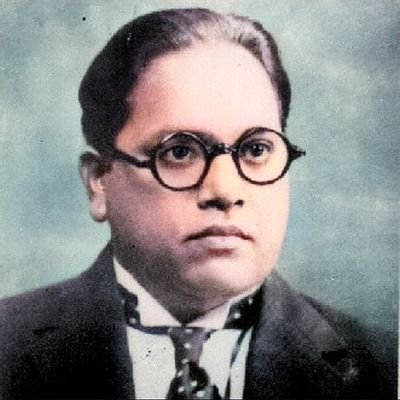
While the US team perfected the vibrating dye, an Indian team has developed a more advanced "delivery vessel" for light-based therapy that solves the biggest problem: Heat. INST Mohali (Institute of Nano Science & Technology), in collaboration with IIT Bombay & ACTREC-Tata Memorial Centre created Nano-Cups...unique, semi-shell gold nanoparticles shaped like tiny cups. Unlike the US Jackhammers which vibrate, these Indian Nano-Cups are designed for photothermal therapy & capture NIR light & convert it into a plasma torch effect at the cellular level. Most nano-manufacturing uses toxic chemicals, but the Indian team developed a 1 step green synthesis using Ascorbic Acid (Vit C) at room temperature to grow these gold cups which makes the therapy significantly safer & cheaper for mass production in the Global South.
Shining Science@ShiningScience

🎗 In a revolutionary breakthrough, researchers from three leading American universities have discovered a method to destroy cancer cells using light, completely eliminating the need for drugs or chemotherapy. Early studies show an astonishing 99% success rate, offering unprecedented hope for millions battling this devastating disease. The technique, known as phototherapy at the cellular level, targets cancer cells with highly precise light wavelengths that cause them to break apart while leaving healthy cells unharmed. Unlike traditional treatments, this approach avoids the severe side effects of chemotherapy and radiation, providing a safer and more effective alternative. Experts say this discovery could transform cancer treatment worldwide. By harnessing light to selectively dismantle malignant cells, doctors may soon have a non-invasive therapy capable of treating various types of cancer, including those resistant to conventional methods. While further trials are needed before widespread use, this milestone represents a major leap forward in oncology, showing that cancer may one day be fought without the collateral damage caused by current treatments. The era of drug-free, targeted cancer therapy may be closer than ever.
English
8
100
405
15.2K
Deepak Sridhar รีทวีตแล้ว
Aravind
Aravind@aravind·
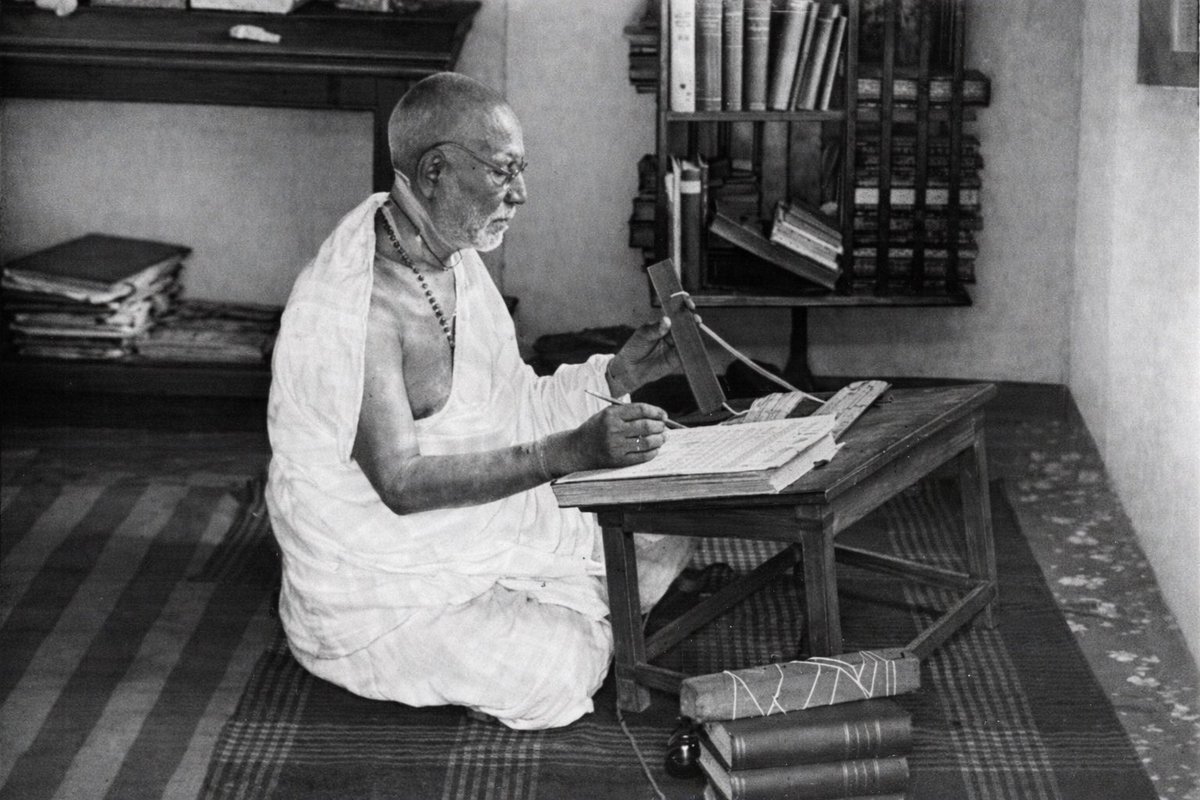
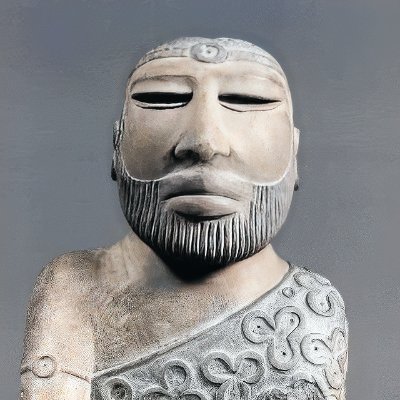
Almost 2000 years before Leibniz, the binary system was already developed by Pingala in India who used Zero & One to represent Sanskrit poetic meters. It later spread to China via Buddhism and its Sanskrit sutras. Interesting to note Leibniz was expert in both Sanskrit & Chinese.
Physics In History@PhysInHistory

Gottfried Wilhelm Leibniz, a German polymath, developed the binary numeral system (base-2) in 1679. This system, which uses only two digits (0 and 1), is the foundation of virtually all modern computing and digital technology. ✍️
English
78
1.6K
6.3K
161.9K
Deepak Sridhar รีทวีตแล้ว
𑀓𑀺𑀭𑀼𑀱𑁆𑀡𑀷𑁆 🇮🇳
Today we commemorate the birth anniversary of Thamizh Thatha, U. Ve. Saminatha Iyer. Had it not been for his relentless, selfless, and often physically exhausting efforts, much of our Sangam corpus,and their traditional commentaries might have remained buried in fragile palm-leaf bundles, lost to time, insects, neglect, and decay. In his autobiographical writing “Nilavil Malarntha Mullai”, he narrates the extraordinary journey of retrieving the manuscripts of Pathuppaattu. After publishing Civaka Cintamani, he learned of the existence of this ancient Sangam anthology. Determined to locate a complete manuscript, he began searching across Tamil Nadu — but found only fragments. Hearing that Tirunelveli housed many vidwans with manuscript collections, he decided to travel there. But the journey itself tested him with his bullock cart overturned on the way to the railway station, resulting in him carrying his luggage by hand. During the train journey, he was woken at midnight and told that the compartment had caught fire. Undeterred, he continued and reached Tirunelveli — only to face disappointment. No complete manuscript could be found. He then proceeded to Alwar Thirunagari and met Lakshmana Kavirayar, who possessed thousands of manuscripts. Yet even there, the needed text was not immediately available. Lakshmana Kavirayar mentioned that some manuscripts might be in his father-in-law’s house — but strained family relations prevented him from visiting. U. Ve. Sa did not give up. He persuaded him: “For the sake of Tamil.” That night, as the procession of Nammalvar moved through the street, Swaminatha Iyer prayed, “You who are known as Vedam Tamizh Seitha Maaran, bless me with the manuscripts of Pathu Paatu and enable me to publish this ancient work.” Moments later, Lakshmana Kavirayar returned with palm-leaf bundles. Under the moonlight, on the very street, Swaminatha Iyer eagerly opened them — and there he saw Mullai Paatu, one of the poems of Pathu Paatu. His joy knew no bounds. He later wrote that anyone who saw him that night might have thought him mad — such was his ecstatic happiness. He had secured seven of the ten poems with full commentary. The remaining three were obtained later, and he eventually published the complete text. Today, when we access Sangam poetry with ease, we must remember — behind those printed lines stands a man walking under moonlight, holding palm-leaf manuscripts like sacred treasure.
𑀓𑀺𑀭𑀼𑀱𑁆𑀡𑀷𑁆 🇮🇳 tweet media
English
73
591
1.8K
40.1K
Deepak Sridhar รีทวีตแล้ว
GemsOfINDOLOGY
GemsOfINDOLOGY@GemsOfINDOLOGY·
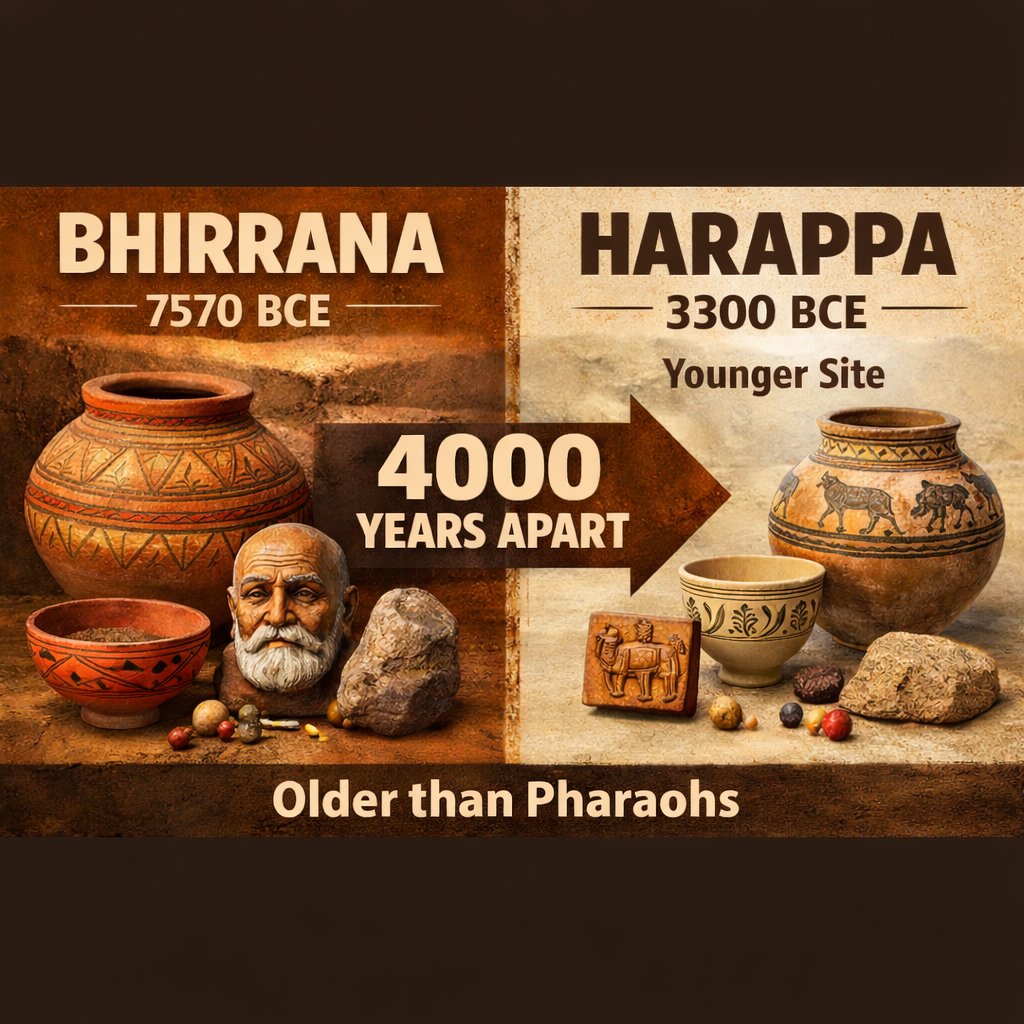
4000 years before Harappa existed, Bhirrana was already thriving. Your textbook skipped that part. Radiocarbon dating puts Bhirrana at 7570 BCE. Harappa shows up around 3300 BCE. That's a 4000+ year head start. Not a typo. So when we say "Harappa ka baap Bhirrana," we're not joking. We're citing stratigraphy. Why did your history teacher skip this? *ps PIC AI generated
GemsOfINDOLOGY tweet media
English
34
954
2.7K
90.1K
Deepak Sridhar รีทวีตแล้ว
Gurudev Sri Sri Ravi Shankar
Shiva is the Guru of Gurus. Everything is Shiva. The Divine appears as the Guru and is also present as your own Self. Realizing this truth is the ultimate goal of spirituality.
English
71
569
1.4K
17.8K