

Daren Trousdell
13.3K posts

Daren Trousdell
@dtrous
AI-pilled investor and partner to the best management teams in Software, Critical Infrastructure and Tech-Enabled Services @ KOAT Capital 🇨🇦 + 🇺🇸
Palm Beach + Toronto เข้าร่วม Aralık 2008
1.2K กำลังติดตาม2.4K ผู้ติดตาม

So one less point and the Leafs would've finished third last based on tiebreakers and guaranteed to keep their pick. How they did not prioritize that with even the slightest effort could be a misstep that haunts them for years.

English
@rexsalisbury Why not just increase property tax for all non-resident homeowners? Most non-resident homeowners will be the ‘rich’ they’re looking to attack. And this will probably raise much more than $500M worrying about Ken Griffin
English

Hot take -- Mamdani's pied-à-terre tax is a win for NYC.
why?
b/c the alternatives are way worse.
this tax is performative. it gives him an easy visible win that is not that destructive.
will probably raise around $200mm in revenue (0.2% of NYC's budget).
less distortive than other income or wealth taxes he might have done.
English
This is going to change everything. No local governments and city councils to deal with. Just offshore regulation and friendly governments. Who can intro me to one of these CO’s??
Ashlee Vance@ashleevance
I mean. This is pretty sick. Full pod on @_panthalassa right here youtube.com/watch?v=Q4PCJR…
English
A friend was sued recently for something they have zero idea about or connection to. Not to mention it’s days from the statute of limitations.
The curious thing they noticed was the disclaimer in the claim that it was prepared by AI.
Thanks to AI, litigation will start happening like junk mail and everyone is at risk for baseless claims requiring time and money to understand and defend. The good news is AI can be used to defend claims and support Pro Se defendants. However, litigation is stressful and infuriating. Courts need to build strict governance frameworks to protect citizens from each other because when hard things become this easy, it’s a free for all
English
Daren Trousdell รีทวีตแล้ว

Boris Cherny created Claude Code. he thinks IDEs are dead by end of year.
This is a 28-minute masterclass on how Anthropic uses it internally.
I wrote 5 pipelines you can sell with it. none of them are coding.
Rohit@rohit4verse
English

If you can afford a multi-million dollar second home in New York City, you can afford to join its residents in supporting the greatest city in the world.
nytimes.com/2026/04/14/nyr…
English
I always thought KeyFood was government run 🤷♂️. And those are sub $10m to build apparently. This government KeyFood alternative is going to be great 🤣
TheBlaze@theblaze
Zohran Mamdani says NYC will begin programs for government-run grocery stores where everything is cheaper: “It is time for a grand experiment.”
English
The beginning of the death by taxes phase of NYC. This will likely expand through the state too so The Hamptons may be on sale soon too
Mayor Zohran Kwame Mamdani@NYCMayor
We will be taxing the ultra-wealthy and global elites.
English
Tell me this is a joke pls
Rink Rat Report@RinkRatReport
“Alexa, should I wait until the last minute to trade Laughton and McMann?”
English
@nejatian Was just sharing this the other day with one of our product teams. blog.prototypr.io/galls-law-93c8…
English

Software companies should have Gall’s law tattooed in their psyche.
A complex system designed from scratch never works and cannot be patched up to make it work.
English
My distain for all of this aside it’s what Canadians voted for and continue to support. Let them run it into the ground I guess 🤷♂️
wealthmoose@wealthmoose
🚨 Mark Carney says we must “prepare for sacrifices.” Meanwhile, here’s where 🇨🇦 tax dollars are going abroad under “Global Affairs”: 🇹🇳 African Development Bank (Tunis) — $118,400,000 🇵🇭 Asian Development Bank (Manila) — $30,136,466 🇧🇧 Caribbean Development Bank (Barbados) — $20,352,750 IFAD (Rome) — $25,000,000 🇰🇪 Montreal Protocol Fund (Nairobi) — $10,434,071 🇺🇸 World Bank (Washington DC) — $132,990,000 🇨🇭 UN (Geneva) — $3,450,000 🇨🇭 UN Biodiversity — $1,569,171 🇸🇬 APEC (Singapore) — $691,975 🇰🇪 Basel Convention (Nairobi) — $208,281 🇵🇰 Balochistan Rural Support (Quetta) — $100,000 💰 Total visible foreign payments: ≈ $343M+ #cdnpoli #Budget2025 #Economy #TaxpayerMoney #Canada #PublicSpending #Accountability
English

Fintech funding news!
@atlascardhq (fka Point) raised a $40M Series C led by @eladgil & Verified Capital at a $420M val
Atlas is an invite-only charge card + AI-powered concierge for ultra-HNW individuals. $999/yr annual fee, text-based concierge for restaurant reservations, private jets, hotel bookings, event access, and a mirror-finished steel card. Targeting Amex Centurion & JPMorgan Reserve cardholders
Some stats on the biz:
- $20M+ gross revenue run rate
- 2k members
- 80% retention after year one, 70% after year two
- All organic acquisition to date
Pretty wild journey for the company --> @patrickmro originally built Point Card as a mass-market rewards debit card for millennials, raised a $46.5M Series B from Valar Ventures in Sep '21 at a $275M val. Then their bank partner Column pulled their agreement in '22, wiping out their entire customer base. Forbes had them on a "zombie fintechs" list in early '23
One of their data scientists found 90% of card txns came from 15% of customers, so Patrick laid off a third of the team, rebranded to Atlas, moved to NYC, partnered w/ Lead Bank & relaunched in Aug '23 as a premium charge card for ultra-HNW individuals
forbes.com/sites/jeffkauf…
English
@ttunguz This will allow the focus to narrow to mostly important work versus the endless light experimentation and AI schlock that seems to be going on currently
English

The Beginning of Scarcity in AI
For the first time since the 2000s, technology companies are confronting the limits of their supply chain.
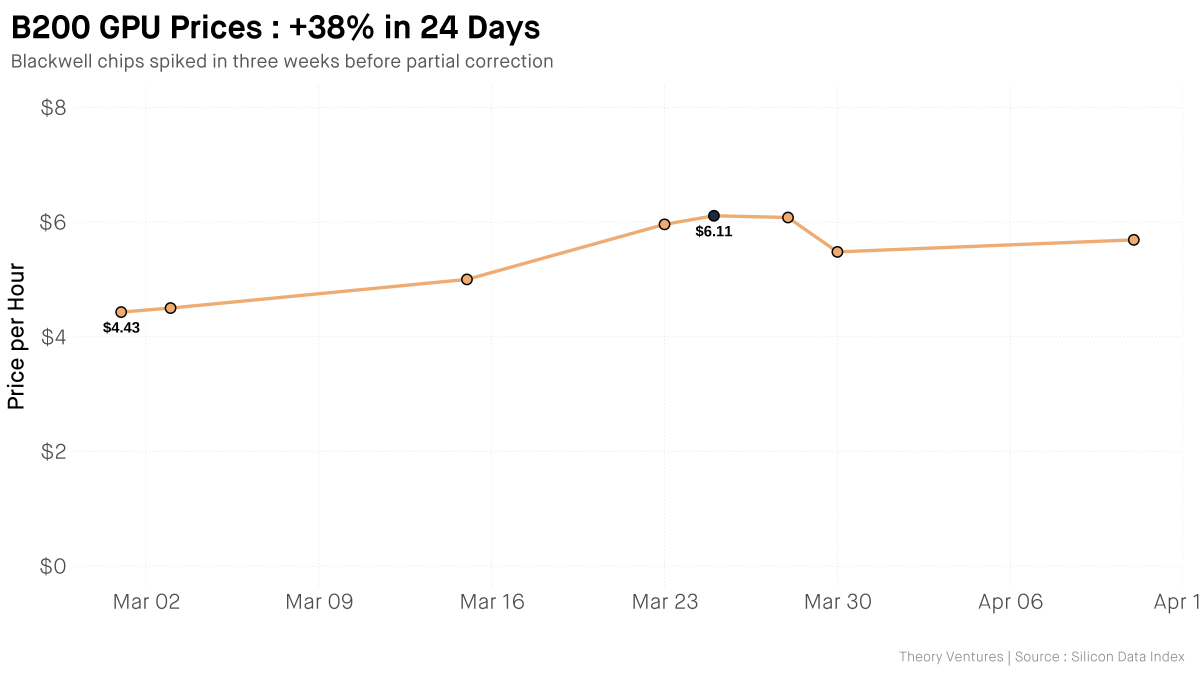
GPU rental prices for Nvidia's Blackwell chips hit $4.08 per hour this week, up 48% from $2.75 just two months ago. CoreWeave raised prices 20% & extended minimum contracts from one year to three.
"We're making some very tough trades at the moment on things we're not pursuing because we don't have enough compute." - Sarah Friar, OpenAI CFO
This scarcity is already reshaping access. Anthropic has limited its newest model to roughly forty organizations. Access to the bleeding edge is becoming a gated privilege, for both capacity & security.
If the largest AI companies are having problems, startups face a tougher proposition. Five hallmarks define this era :
1. Relationship Based Selling : State-of-the-art models may no longer be open to everyone as providers limit access to their most profitable or strategic customers.
2. AI to the Highest Bidder : Even when they do become available, SOTA models may become prohibitively expensive. Companies that can raise large amounts of capital or generate strong profits will have an advantage.
3. Available but Slow : Even if you can pay, there may not be guarantees the models will be fast.
4. Inflationary Commodity : This imbalance will inevitably drive prices higher as demand compounds against a fixed supply. Procurement & margin management will become key disciplines in software companies.
5. Forced Diversification : Developers will be forced to look elsewhere, from smaller models to on-premise deployments, until energy infrastructure & data center buildouts catch up, which could take years.
The age of abundant AI is over, & it will remain so for years.
tomtunguz.com/ai-compute-cri…
English
This is going to be huge. Looking to deploy capital here. DM me ideas
Jordan@HyperAICapital
🚨 SHIPS ARE BECOMING DATA CENTERS Mitsui O.S.K. Lines is exploring turning ageing vessels into floating data centers. Faster build times. Mobile capacity that can move where demand is highest.
English

it feels unfair that you go through a whole career without any hint of controversy, but you have one bad moment here and everyone judges you for it
ESPN@espn
A whole series of events from Sergio Garcia earlier on Sunday at the Masters 😳 😬 Slams his driver in frustration 😬 Breaks his driver against a cooler 😅 Carries Jon Rahm's bag while Rahm's caddie tends to a bunker
English
@PeterDiamandis A world of endless solo experts and implementers. Those with the biggest social credibility and networks will win here.
English

The One-Person AI Conglomerate Is Here:
Forbes analysis confirms the trend -- AI now enables ultra-lean, one-person companies replacing entire teams. This is the "organizational singularity" playing out in real-time - transforming business structure, efficiency, and taxation norms globally.
forbes.com/ai/
English
Daren Trousdell รีทวีตแล้ว

This is an INCREDIBLE post. Everyone working with AI needs to read IMMEDIATELY.
Becoming incredibly obvious that the most secure, best paying job in the next 1-3 years will be AI orchestrator - basically someone that coordinates AI agents to solve any problem a business has with EXTREMELY EFFICIENT token usage.
Whoever figures out how to squeeze 90%-95%+ Opus 4.6 performance, 90%+ of the time, at 1/10th the cost is going to make AN ABSOLUTE KILLING.
Aaron Levie@levie
Another week on the road meeting with a couple dozen IT and AI leaders from large enterprises across banking, media, retail, healthcare, consulting, tech, and sports, to discuss agents in the enterprise. Some quick takeaways: * Clear that we’re moving from chat era of AI to agents that use tools, process data, and start to execute real work in the enterprise. Complementing this, enterprises are often evolving from “let a thousand flowers bloom” approach to adoption to targeted automation efforts applied to specific areas of work and workflow. * Change management still will remain one of the biggest topics for enterprises. Most workflows aren’t setup to just drop agents directly in, and enterprises will need a ton of help to drive these efforts (both internally and from partners). One company has a head of AI in every business unit that roles up to a central team, just to keep all the functions coordinated. * Tokenmaxxing! Most companies operate with very strict OpEx budgets get locked in for the year ahead, so they’re going through very real trade-off discussions right now on how to budget for tokens. One company recently had an idea for a “shark tank” style way of pitching for compute budget. Others are trying to figure out how to ration compute to the best use-cases internally through some hierarchy of needs (my words not theirs). * Fixing fragmented and legacy systems remain a huge priority right now. Most enterprises are dealing with decades of either on-prem systems or systems they moved to the cloud but that still haven’t been modernized in any meaningful way. This means agents can’t easily tap into these data sources in a unified way yet, so companies are focused on how they modernize these. * Most companies are *not* talking about replacing jobs due to agents. The major use-cases for agents are things that the company wasn’t able to do before or couldn’t prioritize. Software upgrades, automating back office processes that were constraining other workflows, processing large amounts of documents to get new business or client insights, and so on. More emphasis on ways to make money vs. cut costs. * Headless software dominated my conversations. Enterprises need to be able to ensure all of their software works across any set of agents they choose. They will kick out vendors that don’t make this technically or economically easy. * Clear sense that it can be hard to standardize on anything right now given how fast things are moving. Blessing and a curse of the innovation curve right now - no one wants to get stuck in a paradigm that locks them into the wrong architecture. One other result of this is that companies realize they’re in a multi-agent world, which means that interoperability becomes paramount across systems. * Unanimous sense that everyone is working more than ever before. AI is not causing anyone to do less work right now, and similar to Silicon Valley people feel their teams are the busiest they’ve ever been. One final meta observation not called out explicitly. It seems that despite Silicon Valley’s sense that AI has made hard things easy, the most powerful ways to use agents is more “technical” than prior eras of software. Skills, MCP, CLIs, etc. may be simple concepts for tech, but in the real world these are all esoteric concepts that will require technical people to help bring to life in the enterprise. This both means diffusion will take real work and time, but also everyone’s estimation of engineering jobs is totally off. Engineers may not be “writing” software, but they will certainly be the ones to setup and operate the systems that actually automate most work in the enterprise.
English