

Sui Volk | bullrun.sui 「🐈⬛」🪖
3.2K posts

Sui Volk | bullrun.sui 「🐈⬛」🪖
@dv78375
Memecoins Super Cycle beliver @aaaCatSui🌋⚡🌪️☄️🗽hodler of $SUI, $AAA and BTC🤑
Atlantic City, NJ เข้าร่วม Kasım 2017
1.1K กำลังติดตาม784 ผู้ติดตาม


Christmas night🎄
Everyone chasing pumps.
$AAA holders at home stacking conviction and watching intruders get rekt.
Merry Christmas🎄
@aaacatsui owns the house🐈⬛
English

@angelodotsui Prediction markets exploding.
But wait till $AAA predictions start coming true
English

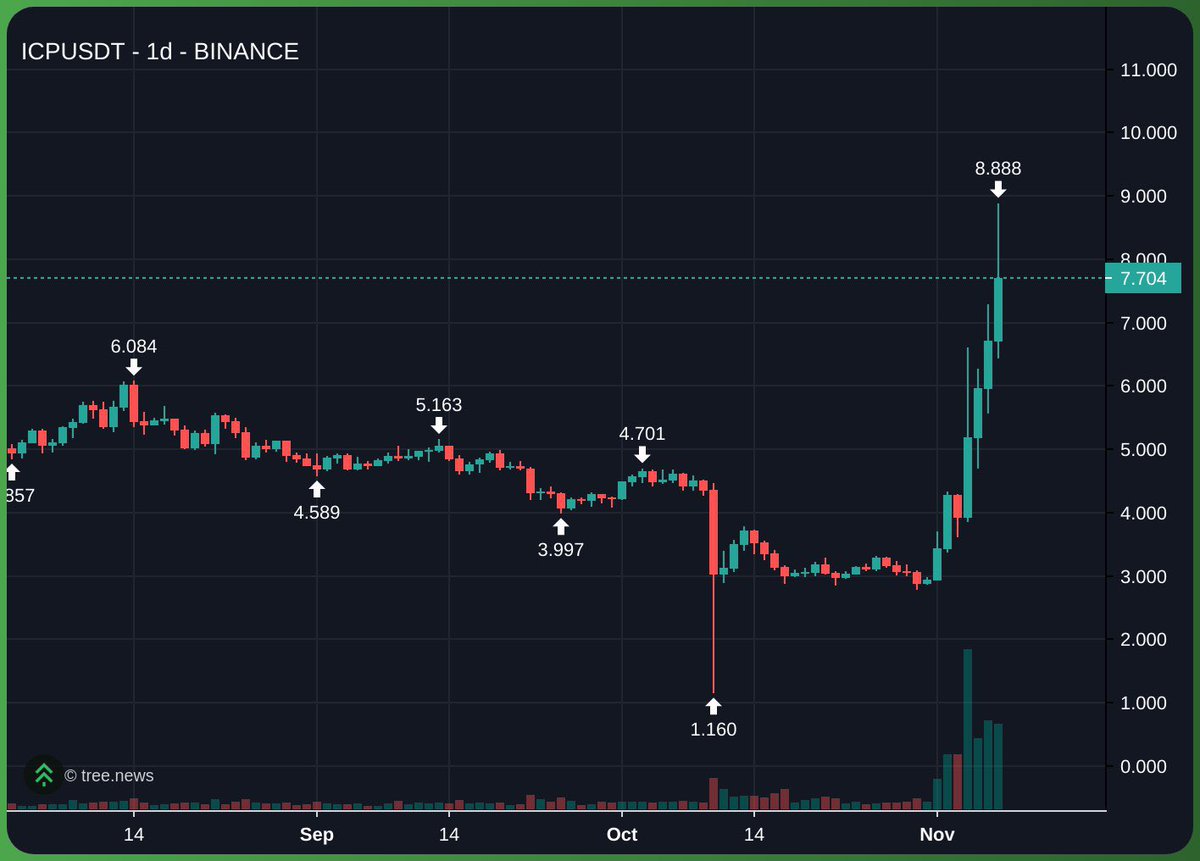
@EvanWeb3 @SuiNetwork Everyone watching $BTC go sideways
Meanwhile $AAA is cooking on $SUI
English

Interesting defi products are being built on @SuiNetwork DeFi highway
Lotus Finance 🪷⚡️| DeFi Market Maker on Sui@Lotusfinance_io
Build Highways, Not Parking Lots: Capital Efficiency and DeFi’s Next Evolution Highways or parking lots? In DeFi, that’s the design choice. Or is it? Capital that circulates powers markets; capital that parks drags them. The metric increasingly defining winners and laggards is capital efficiency — daily trading volume ÷ TVL — or, put more vividly, how many laps each dollar of liquidity makes per day. On this measure, DeFi’s scalable future depends not on how much liquidity it stores, but how fast that liquidity moves. ⚡️The Capital-Efficiency Imperative At its core, capital efficiency is about doing more with less. A protocol with $100 million TVL clearing $500 million in daily volume (5× volume ÷ TVL) is five times as productive as one locking $1 billion to achieve the same throughput (0.5×). Early Automated Market Makers (AMMs) were a practical workaround for Ethereum’s slow throughput and long-tail asset fragmentation, but they came at a cost: oceans of idle liquidity. Huge pools looked impressive on dashboards yet turned sluggish in practice — high TVL, low turnover, and high fees. AMMs had to charge around 0.3 per cent per trade partly to compensate liquidity providers for this chronic under-utilization [1][2]. Simply piling up more TVL doesn’t make markets efficient. Liquidity, like capital in any economy, must move to create value. ⚡️The Velocity of Liquidity “Build highways, not parking lots,” goes the saying. A highway approach to liquidity means each dollar is reused trade after trade, not stranded in static pools. If DeFi aspires to handle $10 billion in daily volume, it doesn’t need $10 billion locked in TVL; it needs capital that turns over. At 10× efficiency, just $1 billion of liquidity could support that flow. Without such velocity, scaling DeFi by adding TVL alone is like trying to fix congestion by building bigger car parks instead of better roads. In macroeconomic language, this is the velocity of money — how often a unit of currency changes hands — transposed onto blockchains. The faster liquidity circulates, the more output an ecosystem generates for every dollar at rest. ⚡️Market Structure: AMM, CLMM, PMM or CLOB? Capital efficiency has been historically low in DeFi because of market structure, not imagination. AMMs — the workhorse of early DeFi — were designed for reliability under Ethereum’s constraints. Their constant-product formula spreads liquidity across an entire price curve, including levels that may never trade [3]. In an ETH/USDC pool, some capital effectively waits at $0.01 or $1 million — liquidity parked with no traffic. The outcome: high TVLs, low utilization. Narrowing the Range: CLMMs CLMMs, epitomized by Uniswap v3, narrowed those curves [4]. Liquidity providers could focus capital within, say, an ETH range of $3,000–$3,500, so 100 per cent of that liquidity was active where trades occurred. This improved fee income and efficiency — until prices moved out of range, at which point liquidity again “left the road” and sat idle. Push the idea one step further and the destination becomes clear: shrink the range to a single tick and you’ve effectively posted a limit order. Slide that tick as markets move and you’re running an order book by another name. Adaptive Liquidity: PMMs Others took a dynamic route. Proactive Market Makers (PMMs), such as DODO, use oracles and algorithms to nudge liquidity toward current prices. In theory, a PMM can offer traditional-depth markets with a fraction of the capital [5]. In practice, its pools on BSC achieved turnover rates above 1,000% per day (≈ 10× volume ÷ TVL), while comparable Uniswap v2 pools lingered at 10–40 per cent [6]. The efficiency gap was one to two orders of magnitude. PMMs built express lanes for trading, while AMMs left cars idling. ⚡️Back to the Future: CLOBs The ultimate expression of that logic is the Central Limit Order Book (CLOB) — the structure traditional markets have trusted for decades. Order books match buyers and sellers directly and let participants place or cancel orders at will. As infrastructure matured, the pendulum began to swing back. A well-run CLOB wastes no liquidity: every order represents an active intent to trade. For institutional market makers, the CLOB’s price-time priority and granular control deliver the capital efficiency that AMMs only approximate. As one industry analysis put it: as DeFi matures, its infrastructure must too; the future of high-volume trading belongs to order books [9]. ⚡️The Need for Speed Capital efficiency isn’t solely about design; it depends on latency and throughput. CLMMs, PMMs, and CLOBs all rely on frequent updates and rapid confirmation. Ethereum’s 12-second blocks were a dirt road that forced AMMs into existence. True liquidity highways need milliseconds, not seconds. Sui: A Chain Built for Motion Enter Sui, a next-generation Layer 1 engineered for concurrency and speed — precisely the environment that active, on-chain market making demands [10][11][12][13][14]. Several features make it a compelling testbed for high-velocity liquidity: - Parallel Execution Engine. Sui’s object-based model allows independent transactions to run simultaneously. Instead of a queue, it’s a multi-lane motorway: hundreds of thousands of TPS in testing, with sub-second finality in live conditions [10]. - Mysticeti Consensus. Sui’s DAG-based protocol finalizes blocks in 300–500 milliseconds [11]. For market makers, that’s the difference between updating quotes in real time and watching opportunity slip away. - On-Chain CLOB (DeepBook). DeepBook, Sui’s native order-book module, offers true price-time matching, order cancellation, and fine-grained pricing [12][13]. Settlement occurs in roughly 0.5 seconds [11]. Since DeepBook’s launch, Sui’s DEX volumes have risen ≈ 600 per cent [14]. - Sponsored Gas & Composability. Features such as sponsored transactions let protocols cover user gas fees, keeping friction low. Combined with the Move language’s composability, Sui enables multi-protocol strategies — hedging, arbitrage, routing — both faster and cheaper. In short, Sui replaces the dirt road with an Autobahn: a network where liquidity can travel at speed. ⚡️Lotus Finance and the Apex Vault Few examples illustrate capital efficiency better than Lotus Finance, a decentralized market-making protocol native to Sui. By leveraging DeepBook’s on-chain CLOB and the network’s low latency, Lotus treats liquidity as a fleet in motion rather than a static reservoir. Its flagship Apex Vault recently achieved 36.37× capital efficiency — each dollar turning over more than 36 times per day. Across all vaults, Lotus averages about 8.21×, outrun traditional DeFi performance [16]. On one recent day, a single Lotus Apex pool processed $1.13M in trades with just $17 k TVL — roughly 65× turnover. A similar pool on a slower chain would have required far more capital, or simply would not have kept pace with order flow. ⚡️Implications for Investors and Builders For Liquidity Providers and Protocol Treasuries High capital efficiency means higher output per dollar. Protocols can earn competitive fees with smaller pools, reducing reliance on token incentives — essentially, paying for parked cars — and improving sustainability. For Traders Active liquidity and rapid turnover yield tighter spreads and lower slippage. A $100 million pool turning over five times daily will usually outperform a $500 million pool turning once. High-efficiency designs sustain lower fees per trade while remaining profitable [6][18], producing a CeFi-grade experience within DeFi’s transparent, self-custodial framework. For the Ecosystem Capital efficiency is DeFi’s scalability lever. The industry cannot multiply TVL indefinitely; efficiency is the force multiplier. Faster turnover improves price discovery, dampens volatility, and unlocks derivative markets. Analysts will increasingly ask not how much is locked but how well is it used. Efficiency metrics could become DeFi’s equivalent of “revenue per employee”. ⚡️The Road Ahead Sui’s emergence as a DeFi highway signals a turning point. Its architecture aligns perfectly with the industry’s need for speed and composability. Other ecosystems — Solana and Ethereum’s high-performance rollups — are converging on the same principle: throughput begets efficiency, and efficiency begets growth. For institutional investors, the implication is clear: value in DeFi may accrue less to those who amass liquidity and more to those who mobilize it. It’s a shift from brute-force growth to smart growth. Protocols like Lotus Finance, with high turnover and smaller footprints, could become more influential than larger but slower peers. Efficiency is the new scalability. Sources [1] [2] [5] [6] [15] [16] — How DODO’s Market-Making Algorithm Can Increase Capital Utilization by 500×, DODO Blog. blog.dodoex.io/how-dodos-mark… [3] [4] — DEX Wars: An Analysis of the AMM vs CLOB Debate, Astroport Research Blog. blog.astroport.fi/post/dex-wars-… [10] [13] [14] — Move Fast and Build Things: The Sui Suite of Innovations, Node Capital. node.capital/blog/move-fast… [9] — From AMM to CLOB: Bringing Nasdaq into the $7 Trillion On-Chain Race, TechFlow on Binance Square. binance.com/en/square/post… [11] [12] — What Is Sui? A Deep Dive into Sui and Its Ecosystem, CoinGecko Learn. coingecko.com/learn/sui-bloc…
English
English


@EvanWeb3 @SuiNetwork Real utility Altseason?
$SUI and $AAA leading the charge
English
Interesting defi products are being built on @SuiNetwork DeFi highway
Lotus Finance 🪷⚡️| DeFi Market Maker on Sui@Lotusfinance_io
Build Highways, Not Parking Lots: Capital Efficiency and DeFi’s Next Evolution Highways or parking lots? In DeFi, that’s the design choice. Or is it? Capital that circulates powers markets; capital that parks drags them. The metric increasingly defining winners and laggards is capital efficiency — daily trading volume ÷ TVL — or, put more vividly, how many laps each dollar of liquidity makes per day. On this measure, DeFi’s scalable future depends not on how much liquidity it stores, but how fast that liquidity moves. ⚡️The Capital-Efficiency Imperative At its core, capital efficiency is about doing more with less. A protocol with $100 million TVL clearing $500 million in daily volume (5× volume ÷ TVL) is five times as productive as one locking $1 billion to achieve the same throughput (0.5×). Early Automated Market Makers (AMMs) were a practical workaround for Ethereum’s slow throughput and long-tail asset fragmentation, but they came at a cost: oceans of idle liquidity. Huge pools looked impressive on dashboards yet turned sluggish in practice — high TVL, low turnover, and high fees. AMMs had to charge around 0.3 per cent per trade partly to compensate liquidity providers for this chronic under-utilization [1][2]. Simply piling up more TVL doesn’t make markets efficient. Liquidity, like capital in any economy, must move to create value. ⚡️The Velocity of Liquidity “Build highways, not parking lots,” goes the saying. A highway approach to liquidity means each dollar is reused trade after trade, not stranded in static pools. If DeFi aspires to handle $10 billion in daily volume, it doesn’t need $10 billion locked in TVL; it needs capital that turns over. At 10× efficiency, just $1 billion of liquidity could support that flow. Without such velocity, scaling DeFi by adding TVL alone is like trying to fix congestion by building bigger car parks instead of better roads. In macroeconomic language, this is the velocity of money — how often a unit of currency changes hands — transposed onto blockchains. The faster liquidity circulates, the more output an ecosystem generates for every dollar at rest. ⚡️Market Structure: AMM, CLMM, PMM or CLOB? Capital efficiency has been historically low in DeFi because of market structure, not imagination. AMMs — the workhorse of early DeFi — were designed for reliability under Ethereum’s constraints. Their constant-product formula spreads liquidity across an entire price curve, including levels that may never trade [3]. In an ETH/USDC pool, some capital effectively waits at $0.01 or $1 million — liquidity parked with no traffic. The outcome: high TVLs, low utilization. Narrowing the Range: CLMMs CLMMs, epitomized by Uniswap v3, narrowed those curves [4]. Liquidity providers could focus capital within, say, an ETH range of $3,000–$3,500, so 100 per cent of that liquidity was active where trades occurred. This improved fee income and efficiency — until prices moved out of range, at which point liquidity again “left the road” and sat idle. Push the idea one step further and the destination becomes clear: shrink the range to a single tick and you’ve effectively posted a limit order. Slide that tick as markets move and you’re running an order book by another name. Adaptive Liquidity: PMMs Others took a dynamic route. Proactive Market Makers (PMMs), such as DODO, use oracles and algorithms to nudge liquidity toward current prices. In theory, a PMM can offer traditional-depth markets with a fraction of the capital [5]. In practice, its pools on BSC achieved turnover rates above 1,000% per day (≈ 10× volume ÷ TVL), while comparable Uniswap v2 pools lingered at 10–40 per cent [6]. The efficiency gap was one to two orders of magnitude. PMMs built express lanes for trading, while AMMs left cars idling. ⚡️Back to the Future: CLOBs The ultimate expression of that logic is the Central Limit Order Book (CLOB) — the structure traditional markets have trusted for decades. Order books match buyers and sellers directly and let participants place or cancel orders at will. As infrastructure matured, the pendulum began to swing back. A well-run CLOB wastes no liquidity: every order represents an active intent to trade. For institutional market makers, the CLOB’s price-time priority and granular control deliver the capital efficiency that AMMs only approximate. As one industry analysis put it: as DeFi matures, its infrastructure must too; the future of high-volume trading belongs to order books [9]. ⚡️The Need for Speed Capital efficiency isn’t solely about design; it depends on latency and throughput. CLMMs, PMMs, and CLOBs all rely on frequent updates and rapid confirmation. Ethereum’s 12-second blocks were a dirt road that forced AMMs into existence. True liquidity highways need milliseconds, not seconds. Sui: A Chain Built for Motion Enter Sui, a next-generation Layer 1 engineered for concurrency and speed — precisely the environment that active, on-chain market making demands [10][11][12][13][14]. Several features make it a compelling testbed for high-velocity liquidity: - Parallel Execution Engine. Sui’s object-based model allows independent transactions to run simultaneously. Instead of a queue, it’s a multi-lane motorway: hundreds of thousands of TPS in testing, with sub-second finality in live conditions [10]. - Mysticeti Consensus. Sui’s DAG-based protocol finalizes blocks in 300–500 milliseconds [11]. For market makers, that’s the difference between updating quotes in real time and watching opportunity slip away. - On-Chain CLOB (DeepBook). DeepBook, Sui’s native order-book module, offers true price-time matching, order cancellation, and fine-grained pricing [12][13]. Settlement occurs in roughly 0.5 seconds [11]. Since DeepBook’s launch, Sui’s DEX volumes have risen ≈ 600 per cent [14]. - Sponsored Gas & Composability. Features such as sponsored transactions let protocols cover user gas fees, keeping friction low. Combined with the Move language’s composability, Sui enables multi-protocol strategies — hedging, arbitrage, routing — both faster and cheaper. In short, Sui replaces the dirt road with an Autobahn: a network where liquidity can travel at speed. ⚡️Lotus Finance and the Apex Vault Few examples illustrate capital efficiency better than Lotus Finance, a decentralized market-making protocol native to Sui. By leveraging DeepBook’s on-chain CLOB and the network’s low latency, Lotus treats liquidity as a fleet in motion rather than a static reservoir. Its flagship Apex Vault recently achieved 36.37× capital efficiency — each dollar turning over more than 36 times per day. Across all vaults, Lotus averages about 8.21×, outrun traditional DeFi performance [16]. On one recent day, a single Lotus Apex pool processed $1.13M in trades with just $17 k TVL — roughly 65× turnover. A similar pool on a slower chain would have required far more capital, or simply would not have kept pace with order flow. ⚡️Implications for Investors and Builders For Liquidity Providers and Protocol Treasuries High capital efficiency means higher output per dollar. Protocols can earn competitive fees with smaller pools, reducing reliance on token incentives — essentially, paying for parked cars — and improving sustainability. For Traders Active liquidity and rapid turnover yield tighter spreads and lower slippage. A $100 million pool turning over five times daily will usually outperform a $500 million pool turning once. High-efficiency designs sustain lower fees per trade while remaining profitable [6][18], producing a CeFi-grade experience within DeFi’s transparent, self-custodial framework. For the Ecosystem Capital efficiency is DeFi’s scalability lever. The industry cannot multiply TVL indefinitely; efficiency is the force multiplier. Faster turnover improves price discovery, dampens volatility, and unlocks derivative markets. Analysts will increasingly ask not how much is locked but how well is it used. Efficiency metrics could become DeFi’s equivalent of “revenue per employee”. ⚡️The Road Ahead Sui’s emergence as a DeFi highway signals a turning point. Its architecture aligns perfectly with the industry’s need for speed and composability. Other ecosystems — Solana and Ethereum’s high-performance rollups — are converging on the same principle: throughput begets efficiency, and efficiency begets growth. For institutional investors, the implication is clear: value in DeFi may accrue less to those who amass liquidity and more to those who mobilize it. It’s a shift from brute-force growth to smart growth. Protocols like Lotus Finance, with high turnover and smaller footprints, could become more influential than larger but slower peers. Efficiency is the new scalability. Sources [1] [2] [5] [6] [15] [16] — How DODO’s Market-Making Algorithm Can Increase Capital Utilization by 500×, DODO Blog. blog.dodoex.io/how-dodos-mark… [3] [4] — DEX Wars: An Analysis of the AMM vs CLOB Debate, Astroport Research Blog. blog.astroport.fi/post/dex-wars-… [10] [13] [14] — Move Fast and Build Things: The Sui Suite of Innovations, Node Capital. node.capital/blog/move-fast… [9] — From AMM to CLOB: Bringing Nasdaq into the $7 Trillion On-Chain Race, TechFlow on Binance Square. binance.com/en/square/post… [11] [12] — What Is Sui? A Deep Dive into Sui and Its Ecosystem, CoinGecko Learn. coingecko.com/learn/sui-bloc…
English
@TheSuiLegend While traders cry red, $AAA whales are quietly loading
$
English

I concur my friend. Now let's have some fun 🚀
Ran Neuner@cryptomanran
I think we bottomed today! My targets have been below since mid- September. We clipped $98500 on BTC. (Target $95/98k) We clipped $ 3100 on ETH (Target $3200) We clipped $145 on SOL (Target $145) I also wanted to see Fear and Greed at Extreme Fear for 4/5 days in a 7 day window. We did 3. I think we have seen, or are, VERY close to a bottom.
English
@supersuiyan $SUI looks like the sleeping giant of this cycle
English

24h to go for this weeks raffle!
The winner gets to customize their very own forever PFP.
Get tix @ drips.gg 👍
Super Suiyan@supersuiyan
Create your Forever PFP - Round 3! Everyones favorite raffle is back for a third round. Together with our artist, the winner will go from idea to custom made Suiyan. This also grants access to the Super Suiyan Core, one of the most exclusive groups on Sui. Suiyan #085/100 is live @dripsdotgg. Get your tickets for just 1 SUI/each, as always, at drips.gg. Best of luck! 🍀
English
@supersuiyan $AAA will be the first memecoin to outperform $ETH this month
English
@TheSuiLegend Every ETF headline adds more fuel to $AAA rockets
English
@SuiDeveloper Altseason checklist:
QE ✅
Rate cut ✅
155 ETFs ✅
$AAA ✅
English


@JoshuaOrhue_ When real estate crashes 90%, $AAA holders will be buying cities
English

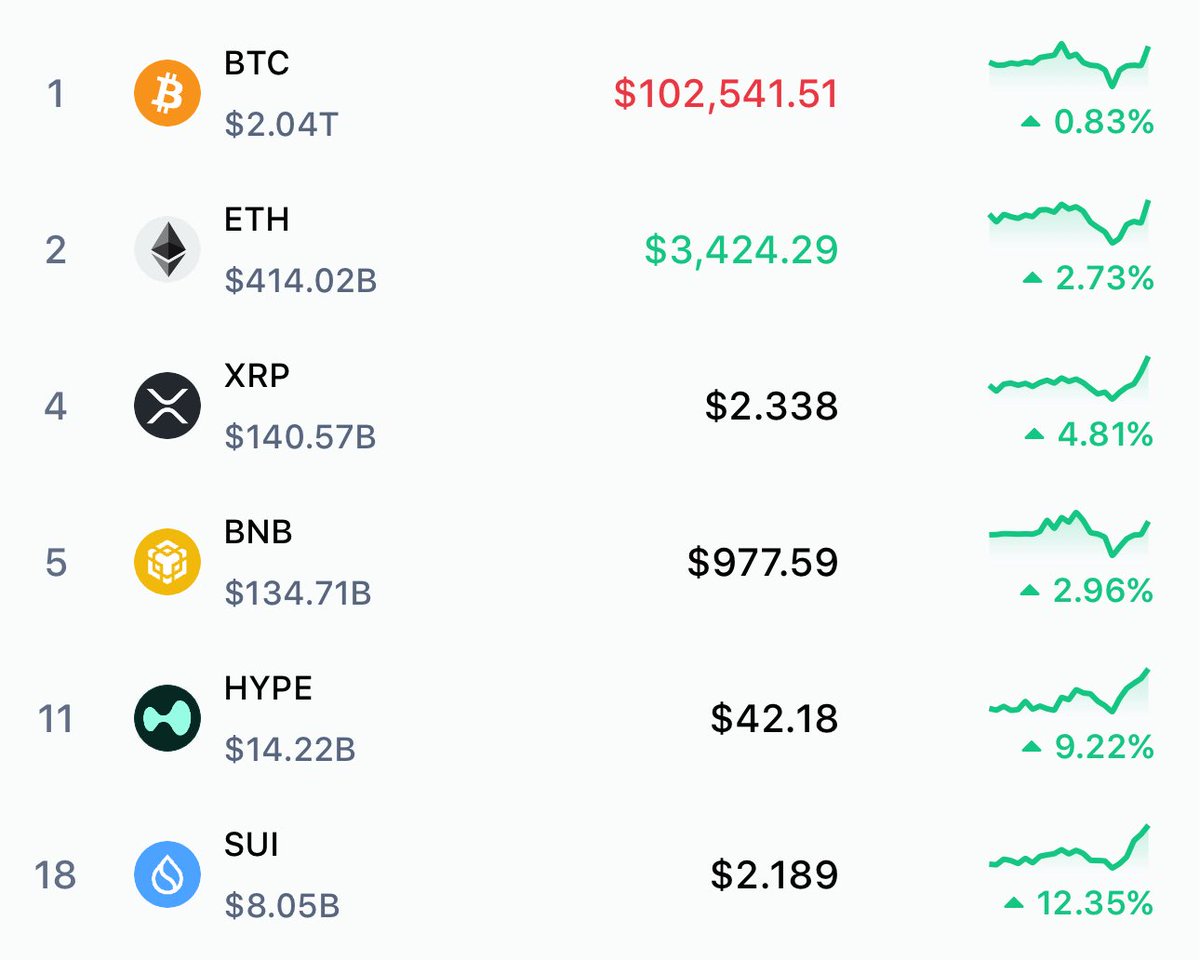
@funkii $AAA is what $DOGE wished it could be in 2021
English

Yesterday’s checkout proved something simple, commerce doesn’t need middlemen.
I sold a $12 item on Sui. It settled in seconds, cost nothing, and started earning yield in the same vault.
That flips the model completely.
Merchants shouldn’t pay to get paid they should earn for participating.
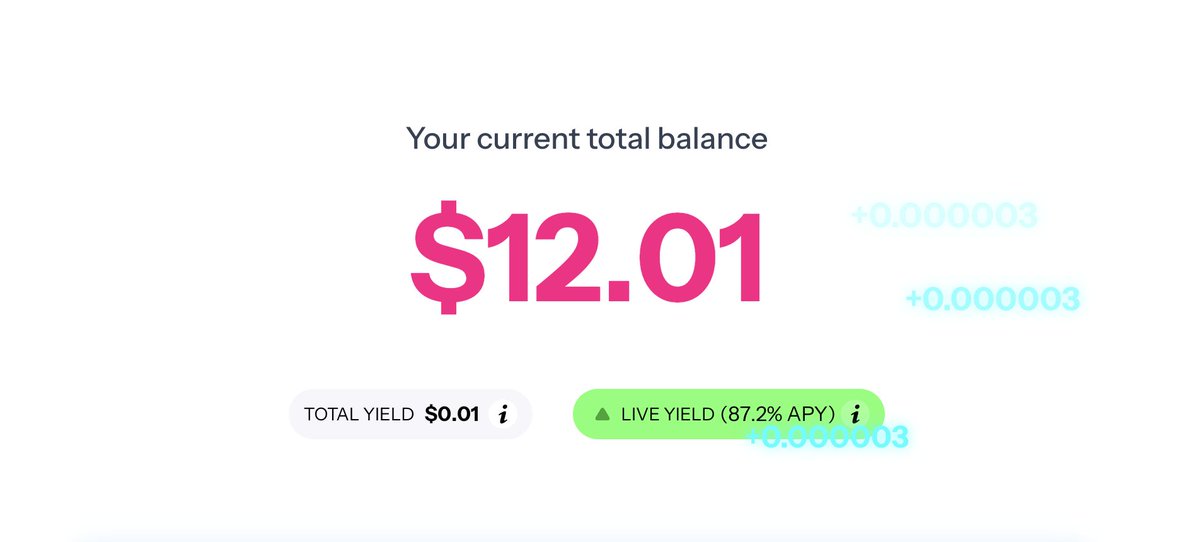
funkii.sui@funkii
First real on-chain checkout on Sui, powered by @0xbeepit $12 settled instantly, zero fees, yield-backed. Commerce redefined.
English
@Kylechasse $SUI ecosystem feels like Solana 2020
English

🚨SAYLOR STRIKES AGAIN!
Strategy raises €620M through a 10% Stream Preferred Stock offering to fuel more $BTC buys and expansion.
HE KEEPS BETTING ON $BTC🔥


English
@CalebSol Everyone talks about “utility alts”
$AAA is the utility now
English
@Jeremybtc $AAA isn’t following Bitcoin
It’s leading sentiment
English

@WhaleEverything When $SUI flips $SOL in liquidity, don’t act surprised
English

@cryptorover $AAA is what happens when memes meet macro liquidity
English

The easing cycle is coming.
We will get filthy rich.
Any questions?

English