Fireside Alpha@firesidealpha
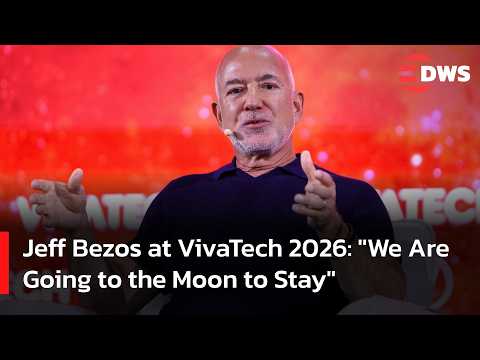
Great fireside. Jeff Bezos (@JeffBezos) and Dave Limp (@davill) w/ host Mike Massimino (@Astro_Mike). Discussion centered around cost of launch as the key variable for things like orbital data centers to off-planet heavy industry, and more.
Relevant for $SPCX. Notes below:
1/ The launchpad explosion was a gut punch that barely moved the timeline, and the recovery itself is the culture argument. Bezos says the long-lead items that usually set a schedule, the propellant tank farm holding liquid hydrogen and liquid oxygen, survived, and a booster sitting in the nearby integration facility took shrapnel but lived. Blue Origin pulled in 400 pieces of heavy equipment from a construction crew down the road working around the clock, cleared the debris, and started rebuilding the day before this talk. He still commits to flying New Glenn again before the end of the year, which makes the failure a stress test of the team rather than a reset of the program.
2/ The entire thesis is that space needs the same cheap shared infrastructure the internet had, so small players can do big things. Bezos frames Blue Origin's job as building the road to space, the heavy infrastructure other companies ride, the way global networks let two kids in a dorm room build a giant company over the last two and a half decades. The cost of admission to space is still very high, and lowering it is the precondition for any dynamic space economy. From an investment standpoint, the read is that he is positioning Blue Origin as a picks-and-shovels layer, not a single end product.
3/ Demand for launch is the proof the space economy is real, and the constraint is supply, not demand. Bezos calls demand for launch insatiable right now, with a tremendous backlog already on the books and every launch company in the same position. He names the drivers as LEO communications, national security missions, and, ahead, orbital compute and lunar resources. His one-line summary, that they are supply constrained and not demand constrained, is the cleanest signal in the whole conversation for where the bottleneck and the pricing power sit.
4/ Launch cost runs on a virtuous circle, and reusability plus rate manufacturing is how you spin it. Bezos lays out the loop directly: expensive launch forces satellites to carry long lifetimes and high cost, cheaper launch lets satellites get cheaper, cheaper satellites drive more launch demand, more demand means more practice, and practice drives cost down again. Reusable boosters are the entry point because a booster that lands can be reused many times, and rate manufacturing keeps the flywheel fed. He is explicit that you cannot count on the exact timing, only the direction.
5/ The hard part is not building one rocket, it is building the machine that builds the machines. Limp, who says he came from consumer electronics and has done aerospace for two and a half years, argues that any single engine or rocket is tractable, and that the factories pushing them out at rate are what take time and thought. Blue Origin is standing up an engine factory in Huntsville and a rocket factory in Orlando, with heavy vertical integration down to raw materials. The stated goal is a hundred flights a year, which means a hundred second stages and hundreds of engines, so the factory is the product. Bezos adds that a BE-4 engine now comes off the line every four days.
6/ Rocket engines live right at the limit of physics, and the BE-7 just set a multi-decade endurance record. Bezos puts main combustion chamber temperatures at 5,000 to 6,000 degrees Fahrenheit, past the melting point of any material, which forces lightweight high-performance turbo pumps and regeneratively cooled channels just to keep the hardware intact. The BE-7, the roughly 10,000-pound-thrust lunar lander engine, ran continuously for 41 minutes, beating a 36-minute space shuttle main engine test from about 30 years ago. He frames reliability on that engine as paramount because it is what lands humans on the moon.
7/ Choosing liquid hydrogen for the lander is a bet on refueling from lunar ice, not just on performance. Bezos explains that liquid hydrogen outperforms hydrocarbon fuels but is so low in density it would make a booster stage gigantic, so it earns its place on upper stages, the same split the Apollo Saturn V used. The forward-looking reason is that water ice in permanently shadowed craters near the lunar poles can be electrolyzed into liquid oxygen and liquid hydrogen. By matching the lander's fuel to what the moon can produce, he sets up in-situ refueling on the surface rather than hauling every kilogram from Earth.
8/ Moon first is a sequencing discipline, and the moon's case is proximity plus a shallow gravity well. Bezos calls the moon a gift, reachable in three and a half days each way, available anytime rather than on the two-year planetary window Mars demands. The economic hook is that the moon's gravity well is so much lower that lifting materials off it takes 28 times less energy per kilogram than lifting them off Earth, which makes lunar-produced liquid oxygen cheap to move into space. His framing that skipping steps does not actually make you faster is the sequencing argument behind going to the moon before Mars.
9/ Blue Origin's near-term lunar cadence is concrete, and it ramps fast. Limp lays out a Mark 1 lander early next year carrying three metric tons to the surface as a Pathfinder, the largest object ever landed on the moon, then a mid-year Artemis 3 rendezvous with the human-rated Mark 2 lander meeting near 450 kilometers in low Earth orbit, then a second Mark 1 landing NASA's VIPER rover late in the year. He says Artemis 3 was announced the prior week and that an astronaut named Luca from Italy will be on the flight. He stresses these are coming off an assembly line now, and the team is named the lunar permanence group, which signals the intent to stay rather than visit.
10/ As a species we are barely warming up, which is how Bezos frames every timeline. Bezos pushes back on the idea that the world has caught up to Blue Origin, saying that in space terms humanity has not even begun and this is the earliest of early days. He separates the Apollo landings, which he calls a real accomplishment, from the permanence Blue Origin is now after. The investor consequence is patience, because he treats current capability as a starting line, which is consistent with the multi-decade horizon Limp describes him holding.
11/ Apollo was pulled forward in time at an unsustainable price, and Bezos argues now is the affordable moment. He notes the United States spent almost 3 percent of GDP to reach the moon during the race with the Soviets, a level no one would sustain today. His point is that the first lunar program was a geopolitical sprint done before the economics were ready, while the current push can be built on cost-effective, repeatable hardware. His aside that 3 percent of GDP would buy fusion is the same idea sharpened: cost discipline, not raw spending, is the constraint he respects.
12/ A lot of compute is heading to orbit, and Bezos thinks the chips eventually get made there too. He expects compute and solar cells built in space using asteroids, near-Earth objects, and the moon, with answers beamed back to Earth, and says ultimately even the chips the compute runs on get manufactured off-planet. He pairs this with Project Sunrise, an orbital-compute constellation in sun-synchronous orbit. The framing turns space from a launch market into a manufacturing and compute market, which is a far larger pool than payload delivery.
13/ Orbital data centers are a cost question, not a physics question, and Bezos says the lines will cross. He dismisses heat rejection as an easily solvable physics problem and reframes the whole debate as the cost of producing solar cells, satellites, and launch. Project Sunrise sits in sun-synchronous orbit where satellites are in sunlight more than 99 percent of the time, so solar collection runs nearly continuously instead of the half-darkness of a typical 90-minute low Earth orbit. He concedes he does not know exactly when terrestrial and orbital compute costs cross, only that you have to build now to be ready when they do.
14/ Blue Origin is building two constellations aimed at the high end, and the scale is what keeps launch constrained. The high-bandwidth LEO network, TeraWave, is described as fast earth-to-space optical links optimized for enterprises, hyperscalers, and governments, distinct from the consumer focus of Starlink and Amazon's LEO. Its first phase alone is 5,000-plus satellites in LEO plus another hundred in medium Earth orbit, with shells that want to be 5,000 to 20,000 each. Each constellation can absorb hundreds of launches, which is exactly why launch capacity stays the binding constraint.
15/ Prometheus is Bezos's bet that AGI for engineering needs different training data than a language model. He describes Prometheus as a set of tools to let engineers invent and build faster, and says it cannot be done with traditional large language models. His analogy is that an LLM has read the entire corpus of human knowledge and is unbelievably good at symbol manipulation, but reading a thousand books on gymnastics would still leave you a terrible gymnast. Designing real physical objects needs a different kind of training data, so Prometheus is a model built specifically to do engineering.
16/ The payoff Bezos wants from Prometheus is compressing the dream-to-build cycle from a decade to a year. He says a modern jet engine with 10 percent more thrust is a ten-year program even for someone who has built fifty of them, counting design, testing, and standing up the factory. The Prometheus goal is to take that to five years, then three, then two, then one. He ties it back to a civilizational claim, that all wealth comes from invention, from the plow to the steam engine, so accelerating the invention loop compounds into real productivity and prosperity.
17/ Bezos argues AI creates a labor shortage rather than redundancy, because invention is bottlenecked by capability, not ideas. He says he totally disagrees that AI makes humans redundant, and that it instead lets people identify and tackle an endless backlog of problems. His claim is that we are limited today not by imagination but by what we can actually build, and that most good ideas die in someone's head because executing them is too hard. He points to vibe coding as the early version, where he can now write an iOS app in an afternoon, and wants the same speed for physical objects coming off a 3D printer.
18/ Decisiveness is a sorting problem between one-way and two-way doors, and treating every call as irreversible is what slows big companies. Bezos says Blue Origin, now 14,000 to 15,000 people, has to fight the one-size-fits-all thinking that makes every decision feel the same size, using the image of a one-size robe that never fits. Consequential and nearly irreversible decisions should be made slowly and carefully, while reversible ones, even important ones, should be pushed to single individuals with good judgment. He says traditional aerospace gets slow precisely because life-safety-critical missions tempt teams to treat every decision as life-safety-critical.
19/ Resourcefulness still carries full weight, and Bezos frames it as an attitude that any problem is solvable. Asked whether his grandfather's lesson holds in an age of AI, he tells the story of summers on a South Texas ranch from age four to sixteen, repairing bulldozers and even making veterinary needles from heated wire. The lesson he draws is an approach to life, that any problem is solvable is a good starting point, even when a solution takes a long time. His warning is the inverse, that starting from the belief a problem is unsolvable becomes a self-fulfilling prophecy.
20/ Limp's read on Bezos is the best line on management style in the conversation. He calls Bezos the most tactically impatient and the most strategically patient person he has ever met, an oxymoron that somehow works, and notes that after two and a half years he thinks Bezos now knows more about rockets and rocket engines than about e-commerce. Limp also admits he arrived a skeptic on the claim that Blue Origin could become a bigger business than Amazon and has since become a believer, which is the candid version of the bet the whole conversation is selling.