Paul @glastris.bsky.social Glastris

28.9K posts

Paul @glastris.bsky.social Glastris banner
Paul @glastris.bsky.social Glastris

Paul @glastris.bsky.social Glastris

@glastris

EIC of @monthly from my dining room table; former Bill Clinton speechwriter; co-author, The Other College Guide; co-founder, @voteathome; St. Louis Cards fan

Washington, DC เข้าร่วม Kasım 2008
1.3K กำลังติดตาม4.4K ผู้ติดตาม
Paul @glastris.bsky.social Glastris รีทวีตแล้ว
Visegrád 24
Visegrád 24@visegrad24·
Passengers on a commercial flight captured the launch of Artemis II on camera The plane happened to pass near the launch trajectory at the exact moment of liftoff, giving passengers a rare view of the rocket launch right from their windows.
English
391
4.6K
24.5K
1.2M
Paul @glastris.bsky.social Glastris รีทวีตแล้ว
Josh Kraushaar
Josh Kraushaar@JoshKraushaar·
Puck: “The audience has largely been ignored in this debate. The demand for high-quality, trustedjournalism will continue to grow, especially as more organizations and platforms take the easy, clicks-first, A.I.-aided approach and A.I. continues to proliferate—further reducing our capacity to trust what we see online. The people and organizations delivering on that demand will, even five years from now, not have automated that process of journalism. We’ll see A.I. being used when it makes sense—the way we email or text sources today whom, 30 years ago, we would’ve called on the phone, or the way we spend 10 seconds on Google instead of a few hours in the library. We’ll have another tool in the arsenal, a tool that’s great for data analysis, quick transcription, and targeted web searching. I think it’s fair to say that real reporting—source building, researching, conversations, relationship building, trust—will continue to get rarer. Fewer organizations will invest the money or time in that process, but the ones who do will win.”
English
2
8
18
6.3K
Paul @glastris.bsky.social Glastris รีทวีตแล้ว
Conor Friedersdorf
Conor Friedersdorf@conor64·
I am optimistic about this country's ability to assimilate immigrants and their children into American values, and less optimistic about our ability to assimilate citizens with a seething hatred of immigrants into American values.
David Marcus@BlueBoxDave

It seems clear that the Supreme Court is going to find that the 250,000 babies born to illegal immigrants each year are our fellow citizens. I posit we must then focus on assimilating them, and making them proud to be American.

English
370
458
3.1K
191.6K
Paul @glastris.bsky.social Glastris รีทวีตแล้ว
Barrett Linburg
Barrett Linburg@DallasAptGP·
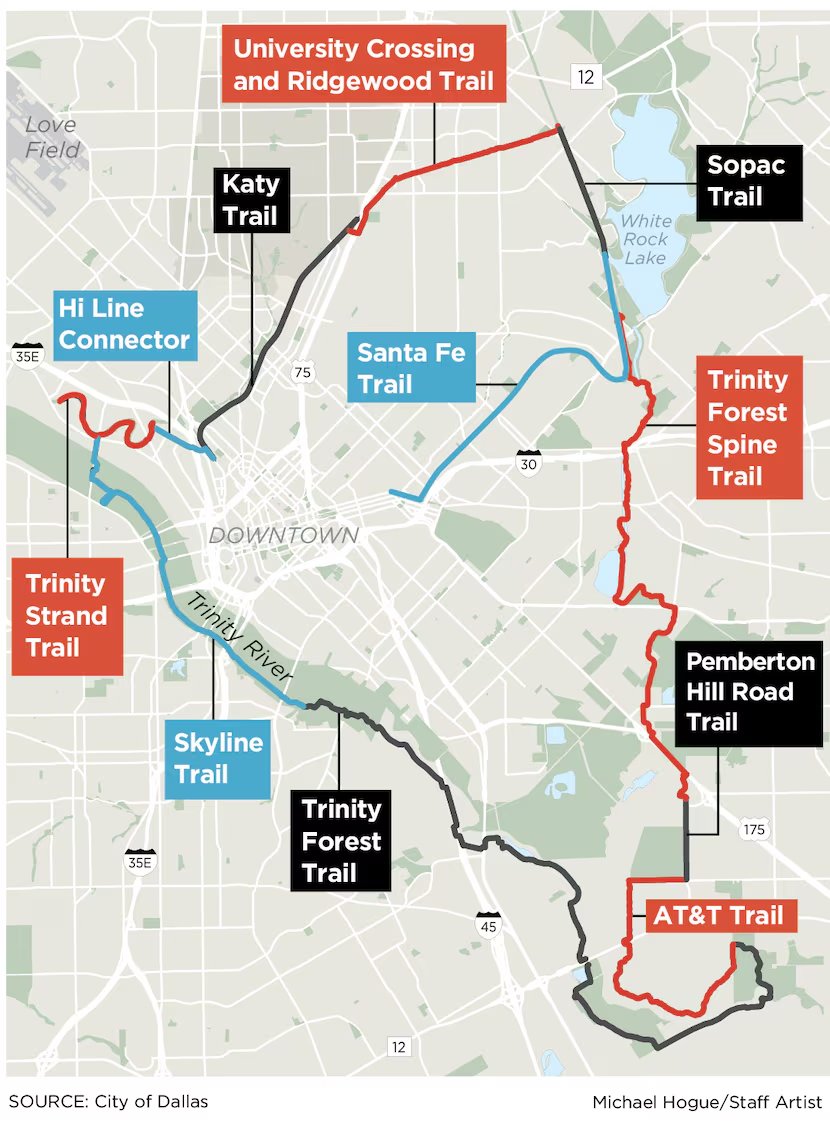
Trails predict where land will reprice. Years before the cranes show up. New York saw it. Chicago saw it. Atlanta saw it. Dallas is next. And it's running the largest version of this experiment any American city has ever attempted. Here's the pattern: Every major American city is fighting the same battle. The suburbs keep growing. The urban core fights to hold its tax base. People say they want walkability and community. Then they leave for places that feel safer and easier to navigate. Cities have big ambitions. Dallas. Chicago. Atlanta. They want to attract people, businesses, and jobs. That takes money. Aging infrastructure needs replacing. New amenities need building. The tax base isn't shrinking. But it's not growing fast enough to fund those ambitions without raising rates. And raising rates pushes more people out. There's another approach. Build infrastructure that makes land more valuable. Not highways. Not stadiums. Trails. It sounds too simple. When you build a connected trail network, you create the walkability people crave. Neighborhoods that were cut off become accessible. Land values rise. Tax revenue grows without raising anyone's rate. The evidence is hard to argue with. New York built the High Line. Property values jumped 35%. Chicago built The 606. Home prices spiked 48%. Atlanta built the BeltLine. Developers have poured more than $9 billion into land along it. The pattern holds whether the city runs red, blue, or purple. Build the connection. Land reprices. Dallas is now running this experiment at the largest scale any American city has attempted. The Loop Dallas is a 50-mile trail circuit. It connects the Katy Trail, White Rock Lake, the Trinity Forest, Fair Park, the Design District, and Pleasant Grove. Every quadrant of the city. The Design District already proves the thesis. The city built a short connector to plug the area into the Uptown trail network. Before, it was an isolated pocket of warehouses. After, it became part of the Uptown ecosystem. Taxable value climbed 383%. Developers flipped their blueprints. Buildings now face the trail, not the street. South Dallas is next. A 1,200-foot bridge is opening the Trinity Forest Spine Trail. Neighborhoods cut off for decades by the river, the railroad, and the highways are about to become connected. Every city that built a loop trail system saw the same result. Remove the barriers. Capital follows. Trails aren't expenses. They're leading indicators. They tell you where land is about to reprice, years before the cranes arrive. If you want to understand where Dallas is heading, don't watch the skyline. Follow the trail.
Barrett Linburg tweet media
English
101
183
1.4K
340.4K
Paul @glastris.bsky.social Glastris รีทวีตแล้ว
Chris Martenson
Chris Martenson@chrismartenson·
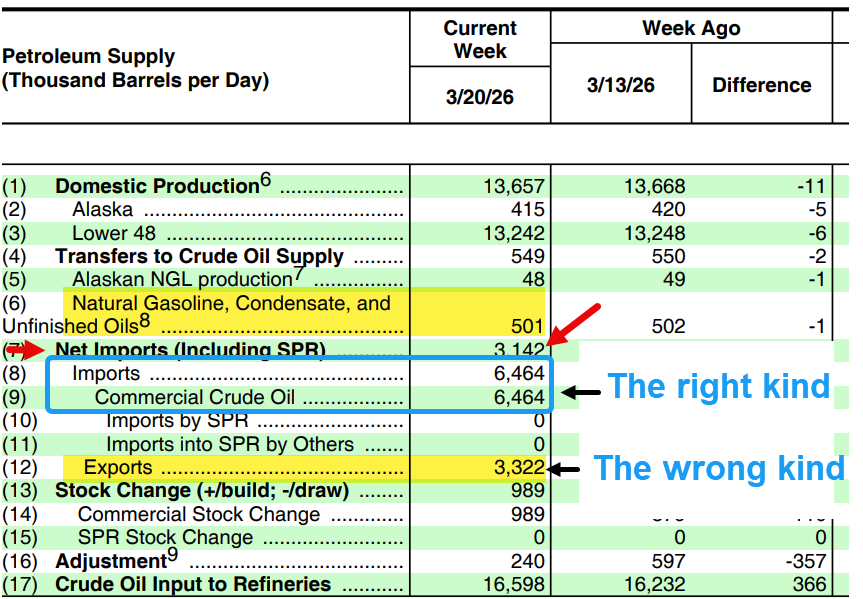
There's a lot of confusion out there, including with Trump, that the US has lots of oil to sell to the world. We do not. We're a net importer of crude (~+3 Mb/d). The EIA reports that fact in great detail every week. The confusion stems from using the term "petroleum exports" which includes the bodacious amounts of natural gas liquids (NGL) that come from our wet gas plays. That stuff isn't "oil" and it is exported because it's wildly overproduced compared to our needs. Yes, the US is a net exporter of "petroleum," but it's also a net IMPORTER of crude oil. In other words, the US has none to sell. There's more complexity to why we export 3M b/d of crude (it's the wrong kind for our refineries) and also import 6.4 M b/d of crude (which is the right kind).
Chris Martenson tweet media
John Ʌ Konrad V@johnkonrad

BREAKING: US Navy will not open the Strait of Hormuz Trump gives nations who import oil from the Middle East three options: 1) Buy your oil from US and Venezuela instead 2) Secure the Strait themselves with limited US support Or 3) Wait for Hormuz to reopen naturally

English
263
2.6K
6.9K
610.8K
Paul @glastris.bsky.social Glastris รีทวีตแล้ว
FactPost
FactPost@factpostnews·
Trump: We can't take care of daycare. We're a big country. We're fighting wars. It's not possible for us to take care of daycare, Medicaid, Medicare, all these things.
English
5.8K
9.6K
31K
16.6M
Paul @glastris.bsky.social Glastris รีทวีตแล้ว
Eric Michael Garcia
Eric Michael Garcia@EricMGarcia·
It's not fashionable to say this, but basically Schumer, Jeffries and the Democratic Caucuses forced Trump, Johnson and Thune to tap out. They didn't give an inch and now Republicans are going to have to go through the meat grinder that is a SECOND reconciliation bill.
English
100
926
7.2K
402.1K
Paul @glastris.bsky.social Glastris รีทวีตแล้ว
Patrick De Haan
Patrick De Haan@GasBuddyGuy·
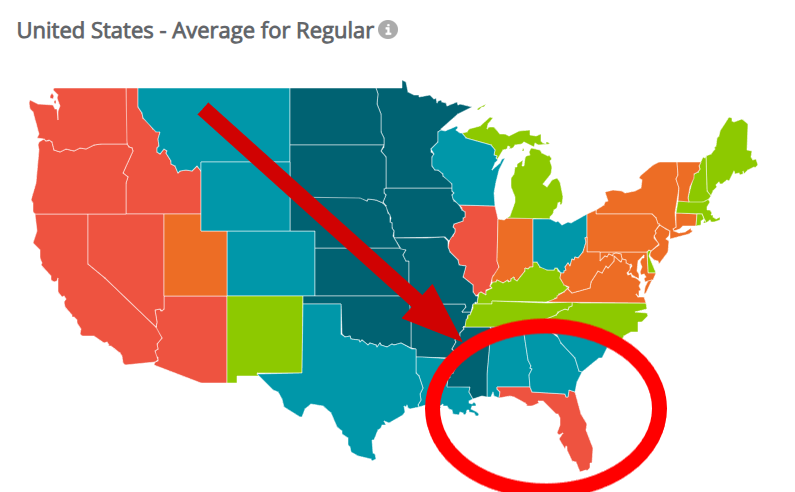
why is FL suddenly one of the most expensive states for gasoline? it’s one of the largest gasoline consumers in the country, and has ZERO refining capacity. every gallon has to be shipped in- and right now, Florida is having to outbid other markets to get it. could get worse.
Patrick De Haan tweet media
English
148
605
2.7K
306.7K
Paul @glastris.bsky.social Glastris รีทวีตแล้ว
Akshat Rathi
Akshat Rathi@AkshatRathi·
Half of US data centers planned for 2026 are expected to be delayed or canceled. One big reason is shortage of electrical equipment, such as transformers, switchgear and batteries. US doesn't have manufacturing capacity, forcing it to rely on imports. 🎁🔗 bloomberg.com/news/features/…
English
206
2K
5.6K
899.4K
Paul @glastris.bsky.social Glastris รีทวีตแล้ว
David Weigel
David Weigel@daveweigel·
Young, handsome, talks about corruption in ways everyone in party likes.
TheBigSkipbowski@TheSkipbowski

@daveweigel I still can’t figure out what makes Ossoff a legitimate presidential candidate.

English
25
19
579
32.9K
Paul @glastris.bsky.social Glastris รีทวีตแล้ว
Alice
Alice@AliceFromQueens·
Kristi and Bryon Noem met at a support group for people with misspelled names.
English
19
51
780
28.7K
Paul @glastris.bsky.social Glastris รีทวีตแล้ว
Washington Monthly
Washington Monthly@monthly·
An unheralded provision in the “big beautiful” tax act creates a beachhead for quality control in higher education that both parties have worked towards for three-quarters of a century, @glastris and @WeisbergNate write. Will it survive? washingtonmonthly.com/2026/04/01/the…
English
0
2
3
255
Paul @glastris.bsky.social Glastris รีทวีตแล้ว
Drew Pavlou 🇦🇺🇺🇸🇺🇦🇹🇼
“Is it a little bit homophobic to focus on the straights of Hormuz rather than the gays of Hormuz?” No Kings protester, completely serious: “Yes, absolutely, I agree.”
English
4.4K
16.6K
96.8K
5.8M
Paul @glastris.bsky.social Glastris รีทวีตแล้ว
Ilan Goldenberg
Ilan Goldenberg@ilangoldenberg·
I woke up this morning with a pit in my stomach. From the beginning, I worried this war could drag on for months or even years. That was one of the reasons I opposed it. But I also believed the most likely outcome was a short conflict – a few weeks. I may be wrong about this, and I hope I am, especially as Trump posts on Truth Social every other day or the White House leaks that negotiations are constructive and the war might end soon. But from where I sit today, a short war now seems unlikely. Instead, we may be staring at something far worse: A war with no clear endpoint, drifting toward something that feels uncomfortably familiar. I remember being at the Pentagon at the start of Ukraine in 2022, when many thought it would be over quickly. I remember being at the White House on October 7, assuming the Gaza war would last a few months. The more I think about where this is headed, the more worried I get. There is no clear path to end this war. The United States does not appear to have a realistic strategy, and the Trump Administration seems to misunderstand the position it is in. The 15-point plan floated last week – demanding Iran give up all Highly Enriched Uranium, shut down its nuclear program, dismantle its missile capabilities, and end support for proxies – is not a serious diplomatic framework. It suggests either a profound overestimation of U.S. leverage, a refusal to accept reality, or a basic inability to conduct effective diplomacy. At the same time, Iran shows no urgency to end the conflict. Iranian officials are now talking about reparations, guarantees that the United States and Israel will not attack again in six months, and broader demands about the U.S. role in the region. They may not expect to achieve all of this, but that is not really the point. The point is that they do not feel pressure to end the war. And when neither side feels urgency to stop, wars tend to last. I worry first about American troops and U.S. land operations. There has been increasing discussion of potential moves against Kharg Island or other Iranian-controlled territory around the Strait of Hormuz, and in the next few days, my guess is we enter a window where such an operation becomes imminent. A raid to seize highly enriched uranium from deep inside Iran is far more difficult and less likely, but even limited operations in the Gulf carry real risks. I do not have a clear sense of potential casualties, but I hope for this to be as bloodless as possible. Some in the Trump Administration seem to believe a sharp, decisive blow that takes out a large part of Iran’s ability to export oil could force Iran to back down and end the war. That theory feels deeply unrealistic. If anything, it is more likely to cause Iran to double down and escalate its attacks on energy infrastructure. I worry about what this means for Israel. The vibrant, dynamic and innovative Israel so many of us have come to love. Even before this war, Israel was facing a growing brain drain, increasing global isolation and a society living with so much trauma since October 7. Now imagine living under sustained ballistic missile and UAV attacks for months, maybe years. Not the kind we saw after October 7, but the much more significant and damaging attacks we are seeing today all over the country. What does that do to families, to businesses, to investment, to the broader society Israelis have worked so hard to build? If normal life becomes impossible, the long-term impact could be profound. I also worry about what this war is doing internally to Israeli society. War breeds extremism. Since the war with Iran started a month ago, we have seen a spike in Jewish terror against Palestinians in the West Bank. An incident this weekend involving a CNN crew led to a rare disciplinary response, but only because it was caught on camera. Settler attacks are happening every day, often without consequences. The Israeli government is not just failing to stop this – it is complicit. This is not the Israel I have known. I worry about the Gulf states. In recent years, countries like Saudi Arabia, the UAE and Qatar have deliberately taken a deescalatory approach toward Iran and focused on economic development, diversification and global integration. It was exciting and refreshing to see, when visiting the Gulf, how much the region was changing. The region’s development had jumped to the top of the agenda while some of the traditional security issues receded. But that vision depends on stability. If these countries face sustained missile attacks for six months or more, does that model survive? Do investors stay? Does that future still feel possible? I worry about Iran – and especially the Iranian people. For years, comparisons to North Korea felt overstated. Iran is more open, more complex, with multiple centers of power. But what happens after a prolonged war? Does the regime become more hardline, more militarized, more isolated? Do pragmatic elements lose what influence they have left? Are we looking at a much larger, more dangerous version of North Korea – 90 million people increasingly cut off, impoverished and repressed? That is no longer unthinkable. I worry about Lebanon. There are increasing signs this could become the next major front. If Israel launches a large-scale ground operation – and the Israeli Defense Minister is openly talking about turning southern Lebanon into the next Gaza – the human consequences could be catastrophic. And alongside the suffering of Lebanese civilians, Israeli soldiers are already facing significant casualties in another grinding ground campaign. I worry about Gaza. Have you heard much about it in the past month? Aid is down. Reconstruction has not begun. Plans for the post-conflict are stalled. As attention shifts to Iran, Gaza is fading from view – but conditions on the ground are not improving. When focus moves elsewhere, things in Gaza tend to quietly get worse. I worry about the global economy – and our own. In 2019, I worked on war game scenarios with energy and security experts examining what a conflict like this could do to oil markets. Scenarios in which the Strait of Hormuz stayed shut for 4-10 weeks, estimated prices would rise to $185 to $200 per barrel. We are at around $115, but it feels to me like markets are still underreacting and waiting for a near end that isn’t coming. The Strait of Hormuz is also a critical pathway for so many other goods, including many of the components that make up fertilizer, with the potential for a major drop in crop yields. This could bring catastrophe for parts of the world as well as a sharp rise in food prices. We may not have even scratched the surface of the economic consequences of this war. And I worry about what this means for the United States. How many wars of choice can we undertake before the world loses faith in the system we helped build after World War II? That system – imperfect as it is – has always been underwritten by American military power. But it was also anchored by American leadership, alliances and a commitment to stability and rules. Each unnecessary war erodes that foundation. At some point, the damage becomes irreversible. There is still a way out – but it requires a shift. The United States should make clear that it is prepared to end military operations in exchange for a limited, realistic set of conditions: Constraints on Iran’s nuclear program, an end to attacks on its neighbors, and no interference in shipping through the Strait of Hormuz. In return, the United States would halt operations and restrain Israel. Even if Iran does not immediately accept, such an offer would shift global pressure onto Tehran and could create a pathway to end the war. Right now, that pressure is not there. So yes, I have a pit in my stomach. Because this war has the potential to go nowhere good and to do far more damage than anyone anticipated. It could reshape the Middle East in deeply negative ways, damage the global economy and further erode America’s standing in the world. At this point, the best we can do is push for a change in course, for a serious strategy to end this war and for a more responsible path forward.
English
81
120
450
168K
Paul @glastris.bsky.social Glastris รีทวีตแล้ว
Nakul Sarda
Nakul Sarda@nakul_sarda·
I've stopped reading Gulf war headlines. Here's what I track instead. We run an India-focused equity fund. 85% of India's crude comes from imports. Half of that normally passes through Hormuz. So yes — this crisis is personal. But the information environment right now is garbage. Trump says the war ends tomorrow. Iran says Hormuz is shut forever. One analyst says $150 oil, another says $60. You can't build a portfolio view on this. So I've narrowed it down to 4 signals. These are priced by people with real money on the line. They don't lie. 1. Ship insurance premiums through Hormuz This is the single best signal. Lloyd's underwriters have billions at stake on every pricing call. Before the war, insuring a tanker through Hormuz cost 0.25% of the ship's value. Today it's 3.5–10% — and almost nobody is buying. A $100M tanker that cost $250K to insure now costs up to $10M. When this drops below 2%, the people with the most to lose are telling you it's getting safer. No press conference can replicate that. 2. How many ships are actually crossing Every ship carries a GPS tracker (AIS). You can count exactly how many cross Hormuz each day. Before: 100+. Now: 8. That's a 92% collapse. You can't spin a ship being somewhere it isn't. Iran is letting some Chinese and Indian ships through, but it's a trickle. When this number crosses 30–40, trade is resuming. You can track this free on the WTO Hormuz Trade Tracker. 3. Paper oil vs real oil This one most people miss entirely. Brent crude (the headline price) is at $112. But Dubai physical — what Asian buyers actually pay for delivered oil — is at $126. That's a $14 gap. It exists because Trump's comments keep pushing paper prices down. Traders call it jawboning. But the refiners buying cargo aren't getting any discount. If you're looking at Brent to assess India's oil bill, you're looking at the wrong number. 4. The mid-April cliff Multiple emergency measures expire around the same time. The 400 million barrel SPR release runs dry ~April 15. The US waiver letting India buy Russian crude expires. Formosa Plastics has declared force majeure from April 1. Right now these stopgaps are keeping the supply gap at ~5 mb/d. Without them, BCA Research estimates it doubles to 10 mb/d — the largest crude disruption ever. If Hormuz doesn't reopen by mid-April, we're in uncharted territory. Bottom line: track the insurance premium, the ship count, the paper-physical spread, and the April timeline. Everything else is noise.
English
126
1.1K
5K
600.1K