

Nathan Paterson
1.6K posts

Nathan Paterson
@graphicalphabet
Empowering leaders, teams, and organisations to unleash creativity through design — creating meaningful and lasting impact | #AlwaysBeCurious
Tokyo, Japan เข้าร่วม Ocak 2009
505 กำลังติดตาม391 ผู้ติดตาม
Nathan Paterson รีทวีตแล้ว

Nathan Paterson รีทวีตแล้ว

A few months ago, I went to a $15 open mic in Austin.
Dude gets on stage. The crowd goes bonkers. It's Shane Gillis, one of the most popular comedians in the world.
He pulls out a notebook and a pen, grabs the mic, and starts telling jokes.
When the crowd gives one of those loud, genuine laughs, he jots down a note. When the crowd looks at each other, confused, he jots down a note. When the crowd stares at him, expecting more, he jots down a note. When the crowd gives that knowing chuckle, he jots down a note.
You get the idea. He's testing jokes. Making a note of what's connecting and, even more importantly, what's not.
Then, I imagine, he cuts or changes the parts that don't connect. Tests them again at another open mic. And repeats the process until the joke, his story, is tight and compelling throughout.
He made me realize:
This is how you can treat Storytelling, too.
Your story is flexible. You can constantly test, get feedback, improve, repeat. Like Shane, what you're looking for is moments of connection:
• Your boss starts nodding along.
• Someone leans forward in their chair.
• There's a spark of interest in your partner's eye.
You get the idea. You're searching for that visceral reaction in your audience.
When you see it, double down. Iterate until you get there.
English
Nathan Paterson รีทวีตแล้ว

“Learning, with a lowercase L, is how individuals and teams work with one another, it’s how failures become valuable lessons, it’s how companies innovate and find opportunities. It lives at the cultural level, influencing policy, programs, and tools.”
@andreplaut/minding-the-organizational-gaps-4c4f104a0620" target="_blank" rel="nofollow noopener">medium.com/@andreplaut/mi…
English
Nathan Paterson รีทวีตแล้ว

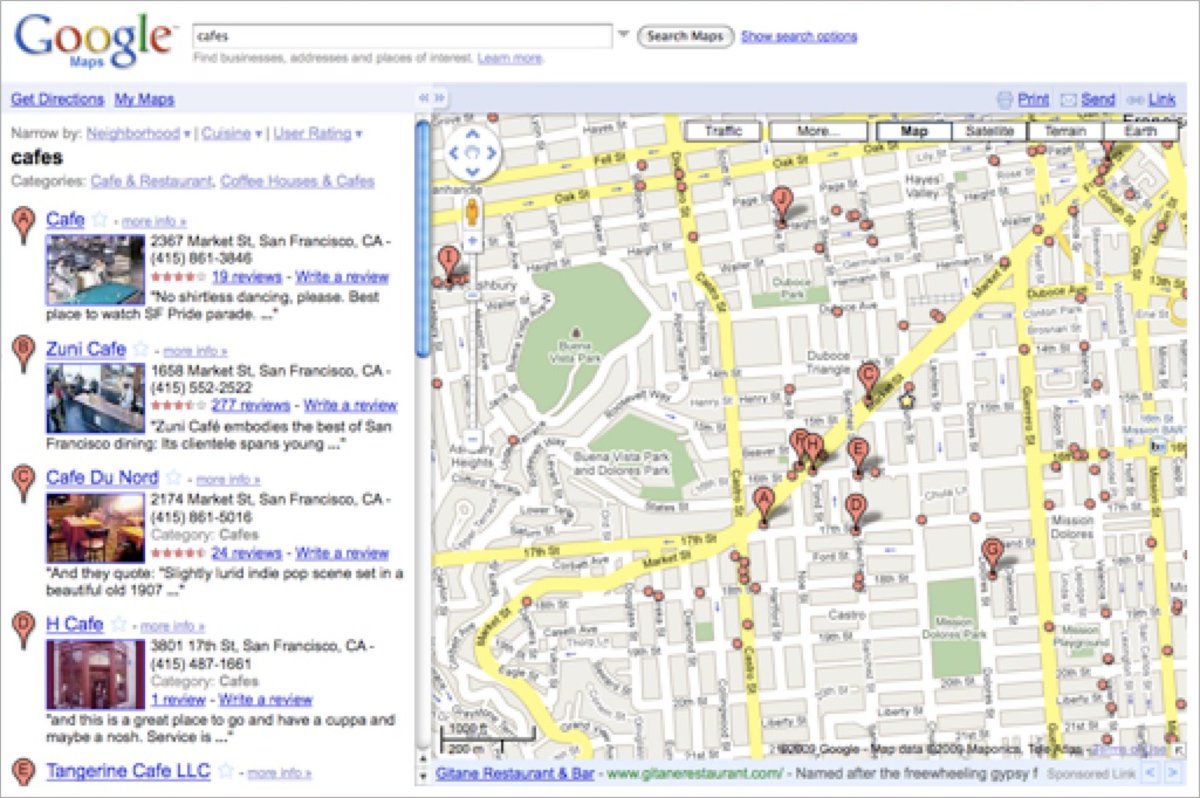
In 2007, I was 1 of 2 designers on Google Maps.
The app was growing like wildfire.
But it was becoming a cluttered mess — new features were being shoved into every pixel.
Here’s the 4-step process we used to redesign Google Maps into one of the most loved apps in the world: 🧵
–––
But first, it’s important to understand it is normal to build a product based on the underlying technical structure.
In 2005, Google Maps queried one of three databases for any search:
• Maps data
• Local business data
• Directions data
Not surprisingly, the first version of the website had three tabs, one for each of these databases: Maps, Local Search, Directions.
–––
By 2007, Google Maps still wasn’t the dominant mapping application.
But it had hit PMF, its user base was growing quickly, and we were rapidly adding new content and features like:
• Satellite and Terrain views
• Streetview, 3D buildings, Traffic
• Editable map data, Reviews, Photos
• Transit Data
We were wedging new features into any space we could find in the UI.
It became clear the user experience was suffering and the product was growing increasingly complicated.
At that time, our VP, Marissa Mayer likened Google Maps to a Christmas tree that we kept adding more and more ornaments to until it started to fall over…
We tried many different ways to rearrange the UI to accommodate new features.
Eventually we had to step back and rethink Google Maps based on what we knew was working, what brought people to the product, and what we believed the future might look like.
–––
These were the 4 key steps we took to simplify the design of Google Maps to be the intuitive, durable, much-loved product that 1B people still use today:
1. Deconstruct
We wrote down all of the product’s current and upcoming content, features, and functionality and loosely grouped them into categories:
• Core features — The most common tasks people came to do (search, get directions, find businesses)
• Aspirational use cases — Tasks we wanted people to start doing (adding their own content, correcting inaccurate information, using Maps to explore new places, etc.)
• Global actions — Actions that impacted the entire page (print, share, save, etc.)
• Use case specific actions — Actions that were relevant only within a specific use case (eg while getting directions, being able to drag a route or add a destination)
• Related features — Things that weren’t a part of Google Maps at the time, but existed and were closely related. (eg transit information, business searches on Google.com)
–––
2. Reframe
We leveraged a combination of user research, business goals, and our own intuition to make the product better, simpler, and scalable over time. We focused on understanding:
• What brought people to the product
• How they navigated through the product
• What was working well
• What flows were confusing
• What things were missing
• What information was valuable when
• What functionality was redundant
We emerged with several key points:
• “Searching” was the most pivotal task in Maps
• Searching addresses, businesses, parks, mountains, cities, etc could all be thought of as searching for “places”
• Getting directions was important, but rarely happened between two specific addresses. Directions searches usually had a known start or end point, like home or work. It was also more intuitive to be able to search for directions by a place name e.g., Carmel Library rather than having to look up the address first.
• It was strategically important for people to be able to contribute content to Google Maps and to be able to explore the world around them.
–––
3. Reconstruct
Based on what we learned, we then explored ways to reshape the product.
We held these general usability principles in mind:
• Entry points to core use cases should be prominent
• Flows within core use cases should be intuitive
• Common actions, interactions, and views should be consistent
• Contextual actions should be accessible when relevant
This is one exploration of clustering tasks and connecting relevant content:
Our explorations of how to reconstruct the site around people’s needs and flows led to several key design changes:
• There would be only one search box for everything
• Directions would live as a secondary feature
• Other features would appear in context (eg, transit became a mode within directions)
–––
4. Scale for the future
This was 2007. We knew the product would continue to evolve, the information set would grow exponentially, and the feature set would continue to expand.
But by focusing on key use cases and folding information in to the UI where it was relevant, we created a framework to support future growth.
16 years later, Google Maps has continued to evolve, yet is still a simple, intuitive, much-loved product that 1B people use around the globe.
For more on design, follow @elizlaraki


English
Nathan Paterson รีทวีตแล้ว

Every professional should start an email list, but not everyone should write a weekly newsletter.
Here's what you should do instead:
1. Choose a topic that you know well. That could be UI design, real estate floor plans, buying businesses, e-commerce, or something else.
Something that your friends and co-workers ask you for help on.
2. Write a 5 email series (in a Google doc) teaching that topic. Each email should be 250-500 words. Write like you're explaining it to a friend. Ask 2-3 friends to review it for you.
3. Create a landing page in @ConvertKit for the course. There are 30+ templates to choose from and it's easy to set up. Write the headline around the value you're delivering.
4. Load your emails into a ConvertKit email sequence connected to your landing page. Now any new subscriber will get the emails on autopilot, timed to when they subscribed.
5. Link to the landing page from your social media bios. Now anytime you are active on social you're driving people back to your email course.
6. Ask for replies on what questions readers have or anything else you should add. Filter those into a label in GMail. Then once a month spend an hour and make any suggested updates or improvements.
That's it!
You can go back to practicing your craft on a regular basis, without the burden of creating consistently.
But you've done three things for yourself:
1. You have public documentation of your expertise. That will lead to many more opportunities that you can't predict.
2. You're saving yourself time. When someone asks you "hey, what are your best tips on learning [your topic]?" you can send them to your free email course rather than having to explain it all one off to them.
3. You're building an audience. If you ever decide to double down on content creation you've given yourself a head start. At first you'll have 25 subscribers, but if the course is valuable that will quickly grow to hundreds.
I know people who have used this strategy and picked up thousands of email subscribers before they took it seriously. Those subscribers resulted in hundreds of thousands of dollars in business for their agency.
10-20 hours of work to set this up will pay dividends for years to come!
English
Nathan Paterson รีทวีตแล้ว

What happened to productivity apps in the past decade?
We all deserve better. Try the new Clear:
🧘♀️ Pristine with no clutter
🤌 100% gesture fluent
🎨 Beautiful + personalizable
🏆 Addictive to get things done with it
🆓 Free to use
Treat yourself: apps.apple.com/us/app/clear-t…
English
Nathan Paterson รีทวีตแล้ว

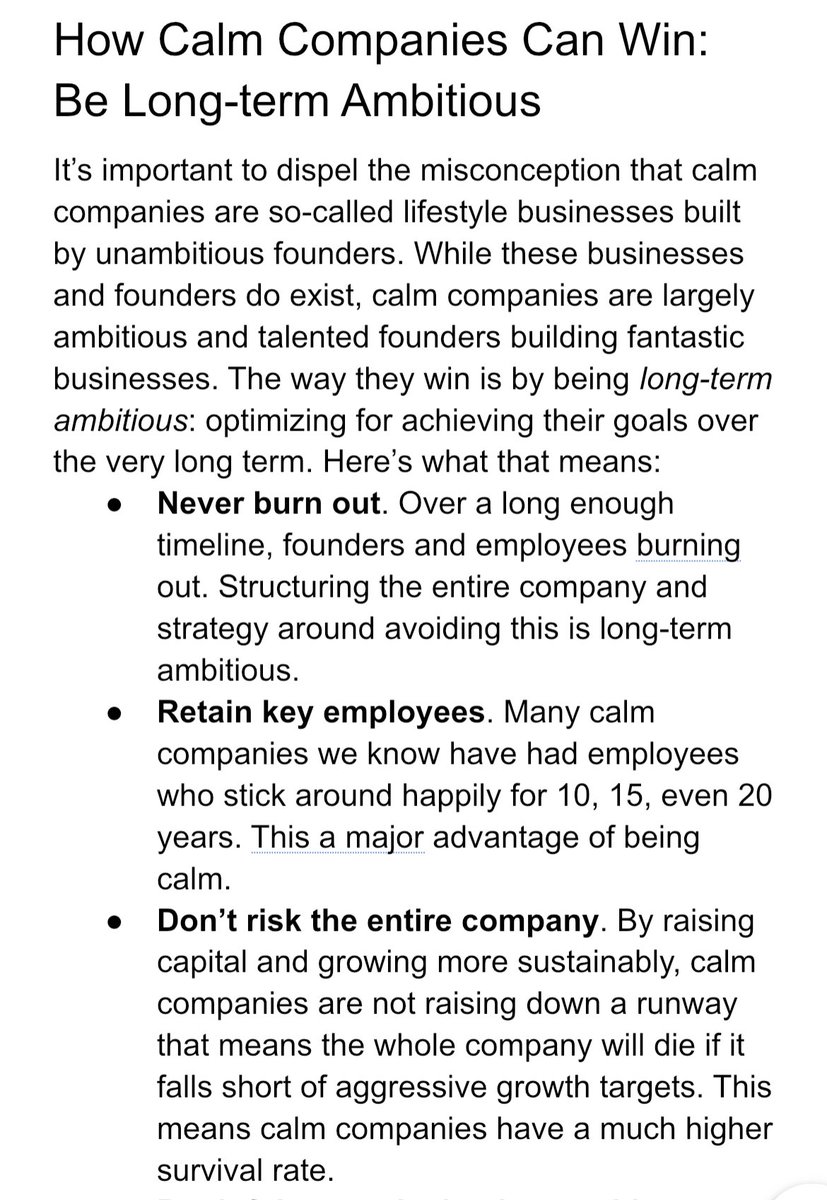
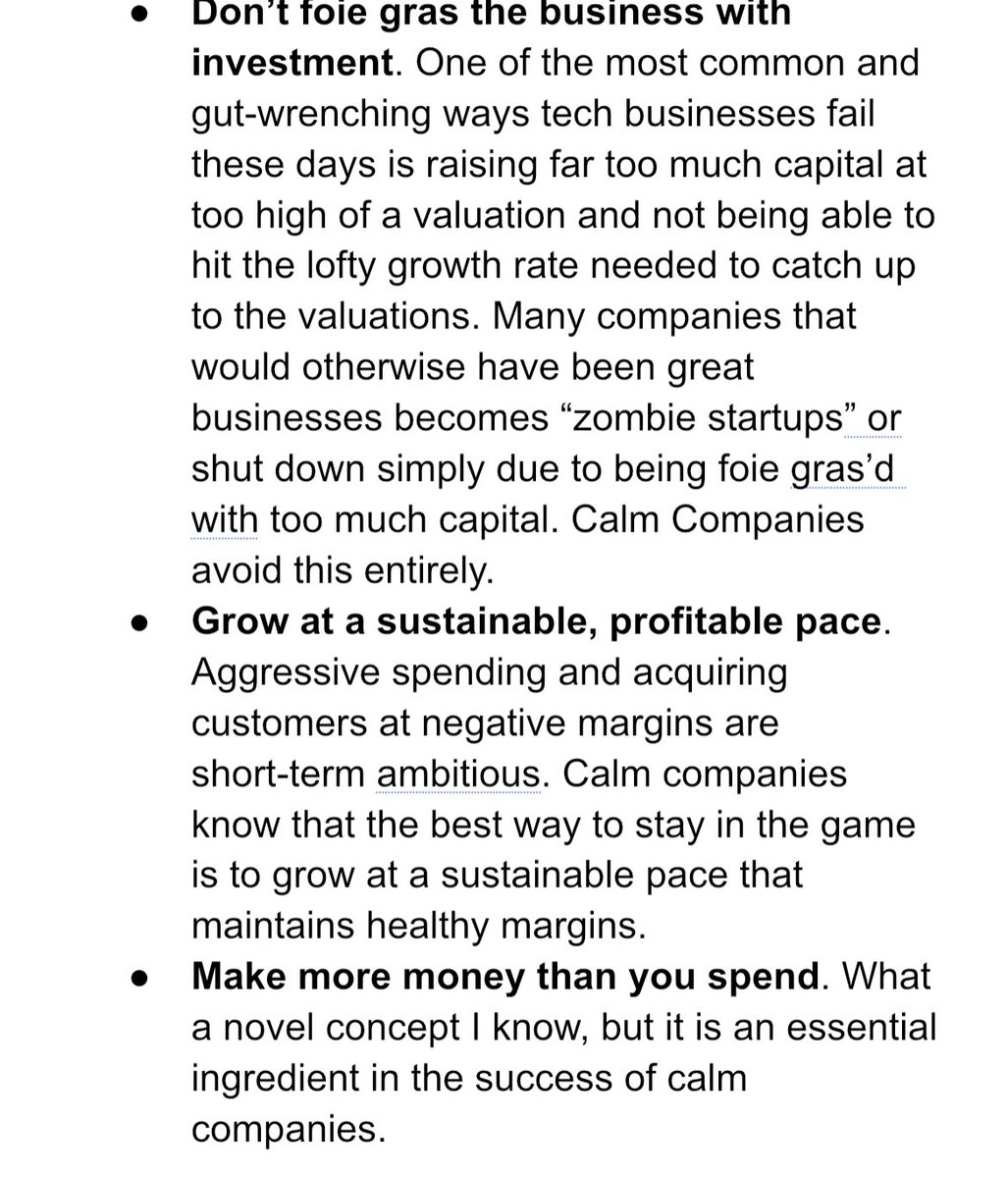
European SMEs raise issue with potential AI Act changes siliconrepublic.com/machines/eu-ai… via @siliconrepublic
English
Nathan Paterson รีทวีตแล้ว

A lot of ppl ask me about how @a16z ended up investing in us..
So I wanna share it for the first time.
Here's the story of a kid who had no idea what the hell he was doing.
Few things:
1) I'm a solo founder.
2) I had never raised money before.
3) I had been building companies since 13 and built a bunch of stuff to 1M+ users -- but, never a startup.
I was kinda dumb in 2019.
I didn't know how to pitch and didn't wanna learn because pitching was cringe.
My philosophy has always been that if I build something really cool and talk about it online -- people would reach out + just invest in me.
So, I did just that.
I built a piece of software to help parents create a legal homeschool for their child (kinda like Stripe Atlas, but for homeschools).
I built the MVP + got my first customer in the first week.
4-mo later, Zip was doing well.
I built the product, I had my first 50 customers, I had some solid momentum, users loved it.
Being dumb was working out.
The more I talked about my progress online, the more I had amazing people reach out to help out.
Side note.
This was a brutal period of my life.
I was insanely hard on myself.
Friends are important.
I had my buddy @FurqanR to lean on. Talking to him even once a week about my co's problems gave me a lot of strength.
He was always there for me, still is.
Ty Furqan.
In May 2020...
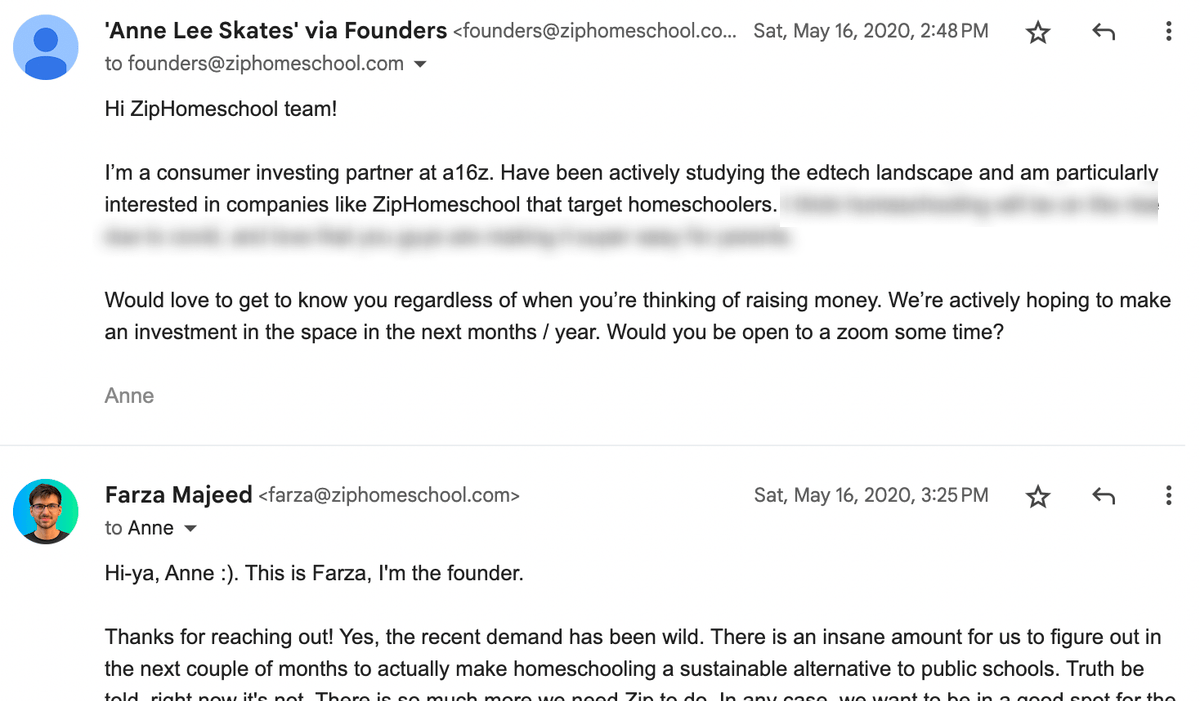
I got a cold email.
a16z hits me up.
They think I have a team.
Mom get the camera.
The call ends up going well.
I just talked about stuff like our customers, growth, and my vision for a whole operating system for the next 10M homeschoolers.
After the call -- they ask details around how much I am raising.
I wanna make it clear to you all:
I had no idea what I was doing.
If you know me in person, you know I am honest to a fault -- I will say exactly what I am thinking.
So when a16z asked me how much I was raising, I literally said that I was a "noob"
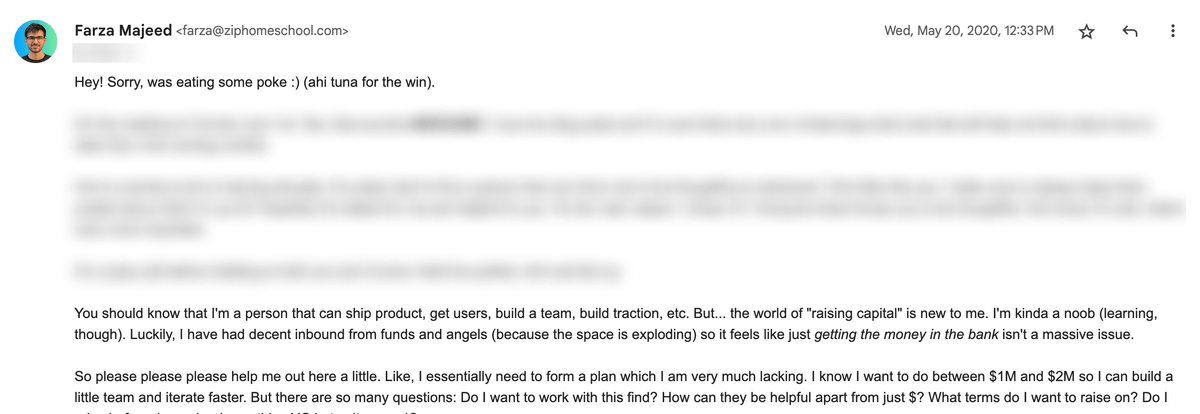
Screenshot of email I sent after the call below.
Go ahead and zoom in on those last two lines there.
Yes. I actually sent this lol.
Surprisingly @anneleeskates + @conniechan didn't leave me on read.
We end up arriving at a next step.
For the next 2-mo, I would talk to them once per week for 30m and give them a progress update + brainstorm new ideas.
I was told by many to not do this.
To instead run a "competitive" process but I just felt that was dumb game.
These weekly calls ended up being great.
It was perfect for them -- they could get more data on me.
And, it was perfect for me -- I could just keep building and if my co blew up up either:
a) they'd probably invest:
b) i just end up profitable lol.
In those 2-mo, I end up doing a big pivot.
I pivot from legal software to building Twitch for teachers where teachers streamed their classes live to thousands of kids.
For me, I grew up in a livestream native world -- so, it felt weird to me that everyone was obsessing over "small zoom room" type classes.
I build it in a week and ship it.
Users end up loving the pivot, especially kids -- within ~2-mo we end up getting 100,000 class joins per week + millions of mins streamed per week.
At this point, the company is still just me.
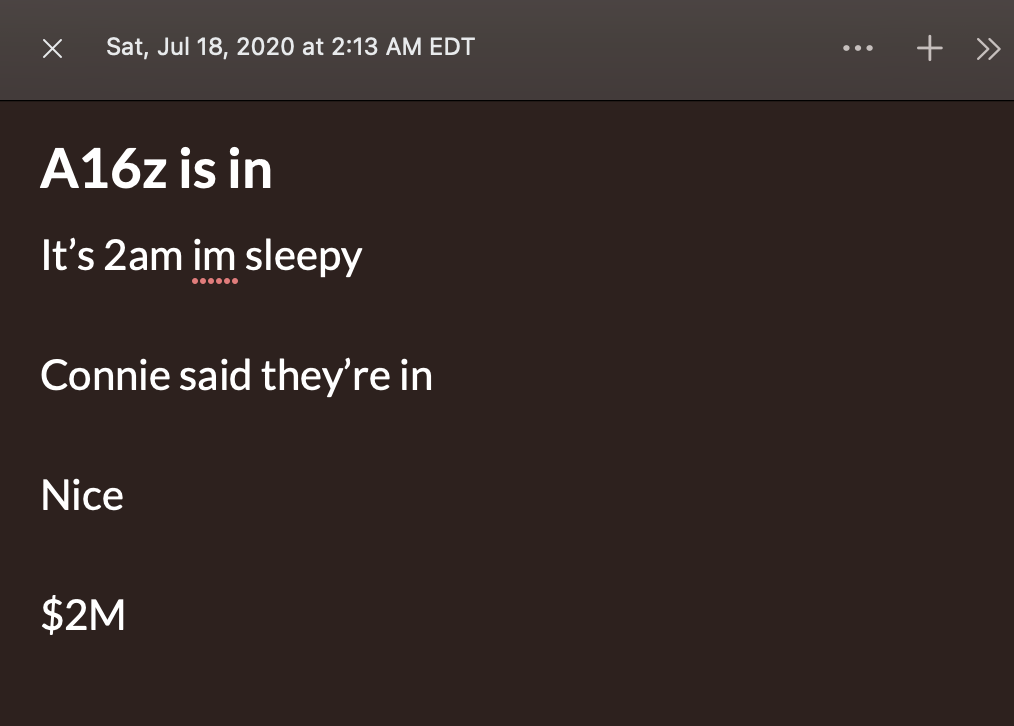
After those 2-mo, a16z decides to invest $2M.
I got the valuation I wanted.
Here's the actual entry from my journal on that day I got the call lol.
1-mo later papers signed + money wired.
I tell this story because I see a lot of people wasting so much time playing the game of finding investors or using that as an excuse for their lack of progress.
In reality, you simply need to put out really good work to an audience that grows over a long horizon.
That is it.
2 years later we pivot away from K-5 edu.
Same team, same company, same cap table.
We started working on this curious new idea called @_buildspace...
It ends up getting pretty big and raises $10M -- half that coming from a16z who ended up doubling down on us.
Life is truly weird.
Keep your head up.
Stay shipping.

English
Nathan Paterson รีทวีตแล้ว

Our love letter to podcasts:
ListenToSomethingWonderful.com
Discover timeless episodes from great shows.
[🔊 Volume up]
English
Nathan Paterson รีทวีตแล้ว

雨の後の筍のように、樹木伐採を起こす公共事業がどんどん計画されています。😢
新しい署名を是非サポートしましょう。
「杉並の自然を壊さないで!!<善福寺緑地、関根文化公園、井荻公園、原寺分橋の湧水>を破壊してしまう1000億円工事計画の再考を!」
chng.it/Pr4WMzkMKP
日本語
Excellent issue of DD about how we are “living in the ‘Consumer Story’”, and how Jon Alexander believes “it’s time to change to a ‘Citizen Story’ to take control of our collective agency and transform our communities, our institutions and our politics”. densediscovery.com/issues/264
English
