

Martin Murtonen
19.5K posts


Every Protestant eventually hits the same wall.
The Bible doesn’t match what they were taught.
So where did the teaching come from?
English
@BillArnoldTeach @Cath_SteelMan Sigh. It was a joke.
What unites the church?
English
Every Protestant denomination claims the Spirit.
They just never agree with each other.
Strange way to define truth.
English
@Cath_SteelMan The Spirit doesn’t produce competing truths.
So which one has continuity from the apostles without rupture?
That’s your answer.
English
Protestantism begins with protest.
Catholicism begins with Christ.
One needed a rebellion to exist.
English
@23wjohnston @BillArnoldTeach My question is foundational:
Do you make images of Mary or not?
English
@ihorace @BillArnoldTeach My question is foundational : “No matter how you try to slice it” means you will accept no explanation regardless of the facts in the explanation.
Do I understand you correctly?
It establishes the baseline- are you seeking the truth or do you worship your own beliefs.
English
@BillArnoldTeach If you are Born Again...you. are. The. Church.
God does not dwell in buildings or institutions.
And what does it matter who gave us the Bible or New Testament? It's not authoritative anyway.
English
@ihorace You’re welcome to engage the argument.
The Church existed before the New Testament was compiled.
So where did the Bible come from?
English
The Bible didn’t create the Church.
The Church gave you the Bible.
Strange thing to reject your own source.
English
@BillArnoldTeach So Jesus does not directly forgive. Fascinating.
English
@ihorace Yes.
And He chose to do it through His Church.
“Whose sins you forgive are forgiven.”
John 20:23
English
The deeper you read, the less Protestantism makes sense.
The closer you get to history, the more Catholic it looks.
That is not an accident.
English
@23wjohnston @BillArnoldTeach The "facts" start with:
1. You make images of someone in heaven
That is step 1.
English
@ihorace @BillArnoldTeach My question: “No matter how you try to slice it” means you will accept no explanation regardless of the facts in the explanation.
Do I understand you correctly?
English
@MgrSebastianus Right. So we are in agreement. So far so good.
But don't rely in or on works for salvation. You are justified in Christ. They are the fruit of salvation.
English

Thank you for the question - that's an important distinction. When I talk about "repentance," I mean the biblical "metanoia" (Greek: μετάνοια) - a change of mind, conversion, remorse for sins, and turning toward God. Jesus speaks about this many times:
"Unless you repent (μετανοήσητε), you will all likewise perish" (Luke 13:3, 5)
"Repent (μετανοεῖτε), for the kingdom of heaven is at hand" (Matthew 4:17; 3:2)
To the seven churches in Revelation, Jesus repeatedly says: "Repent!" (Revelation 2:5, 2:16, 3:3, 3:19)
So, repentance isn't some "invention of the Church" - Jesus himself commands it.
Regarding John 6:28-29: yes, Jesus says that the work of God is to believe. But in the Bible, faith is never just an intellectual act - it is obedience and perseverance.
Because what does it actually mean to believe? St. James distinguishes between 'dead faith'—which is merely an acknowledgment of facts (purely intellectual)—and 'living faith', which expresses itself through works. This is the Biblical faith that St. Paul also has in mind when he says: "For in Christ Jesus neither circumcision availeth anything, nor uncircumcision; but " (Galatians 5:6). It's not just faith, but faith expressing itself through love for God and neighbor—this is the commandment of love that Jesus speaks of.
So, to believe means to live according to one's faith. There is no living, justifying faith without good works. They are one. "Faith without works is dead" (James 2:26).
English
Protestantism Directly Contradictory to the Bible Once Again – New Examples
Protestant doctrines also openly contradict the Bible in these matters:
XI. Protestant: Baptism does not save! It is only an outward sign of faith, a symbol of what has already happened!
Bible: “Whoever believes and is baptized will be saved, but whoever does not believe will be condemned” (Mark 16:16). “Peter replied, ‘Repent and be baptized, every one of you, in the name of Jesus Christ for the forgiveness of your sins. And you will receive the gift of the Holy Spirit.’” (Acts 2:38). “Jesus answered, ‘Very truly I tell you, no one can enter the kingdom of God unless they are born of water and the Spirit.’” (John 3:5). “He saved us through the washing of rebirth and renewal by the Holy Spirit” (Titus 3:5). “Or don’t you know that all of us who were baptized into Christ Jesus were baptized into his death? We were therefore buried with him through baptism into death in order that, just as Christ was raised from the dead through the glory of the Father, we too may live a new life.” (Romans 6:3-4). “and this water symbolizes baptism that now saves you also—not the removal of dirt from the body but the pledge of a clear conscience toward God. It saves you by the resurrection of Jesus Christ” (1 Peter 3:21).
XII. Protestant: You cannot fall from grace! Once saved, always saved!
Bible: “You have fallen away from grace” (Gal 5:4). “It is impossible for those who have once been enlightened… and then have fallen away, to restore them again to repentance” (Heb 6:4-6). “If we deliberately keep on sinning after we have received the knowledge of the truth, no sacrifice for sins is left” (Heb 10:26). “If you do not remain in me, you are like a branch that is thrown away and withers; such branches are picked up, thrown into the fire and burned” (John 15:6). “If they have escaped the corruption of the world by knowing our Lord and Savior Jesus Christ and are again entangled in it and are overcome, they are worse off at the end than they were at the beginning” (2 Pet 2:20). “I discipline my body… so that after preaching to others, I myself will not be disqualified” (1 Cor 9:27). “Continue to work out your salvation with fear and trembling” (Phil 2:12). “If you do not persist in his kindness, you also will be cut off” (Rom 11:22). “The one who stands firm to the end will be saved” (Matt 24:13).
XIII. Protestant: The veneration of relics is paganism! Christians never collected or used items belonging to the saints! God does not work through relics!
Bible: “God did extraordinary miracles through Paul, so that even handkerchiefs and aprons that had touched him were taken to the sick, and their illnesses were cured and the evil spirits left them” (Acts 19:11-12). “Once while some Israelites were burying a man, suddenly they saw a band of raiders; so they threw the man’s body into Elisha’s tomb. When the body touched Elisha’s bones, the man came to life and stood up on his feet” (2 Kings 13:21). “She said to herself, ‘If I only touch his cloak, I will be healed’” (Matthew 9:21). “He took the cloak that had fallen from Elijah and struck the water with it. ‘Where now is the Lord, the God of Elijah?’ he asked. When he struck the water, it divided to the right and to the left, and he crossed over” (2 Kings 2:14).
XIV. Protestant: Blessing water, oil, and scapulars is magic and superstition!
Bible: “Elisha picked up the cloak that had fallen from Elijah… When the company of the prophets from Jericho saw him, they said, ‘The spirit of Elijah is resting on Elisha.’” (2 Kings 2:13-15). “Then he went out to the spring and threw the salt into it, saying, ‘This is what the Lord says: I have healed this water. Never again will it cause death or make the land unproductive.’” (2 Kings 2:21). “The priest is to take some holy water in a clay jar…” (Numbers 5:17). “They drove out many demons and anointed many sick people with oil and healed them.” (Mark 6:13). “Is anyone among you sick? Let them call the elders of the church to pray over them and anoint them with oil in the name of the Lord.” (James 5:14). “For everything God created is good, and nothing is to be rejected if it is received with thanksgiving, because it is consecrated by the word of God and prayer.” (1 Timothy 4:4-5).
XV. Protestant: Icons and images are idolatry! God forbids all images!
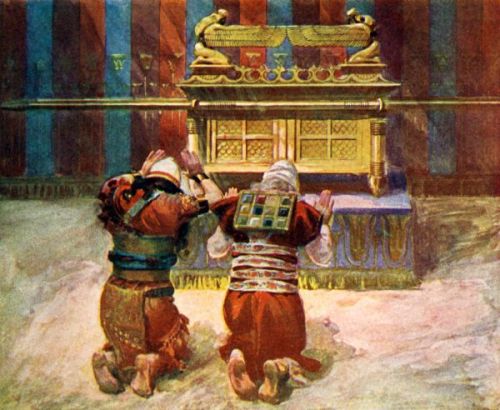
Bible: “And make two cherubim out of hammered gold at the ends of the cover. Make one cherub on one end and the second cherub on the other; make the cherubim of one piece with the cover, at the two ends. The cherubim are to have their wings spread upward, overshadowing the cover with them. The cherubim are to face each other, looking toward the cover” (Exodus 25:18-20). “Three cups shaped like almond flowers with buds and blossoms are to be on one branch, three on the next branch, and the same for all six branches extending from the lampstand. And on the lampstand there are to be four cups shaped like almond flowers with buds and blossoms” (Exodus 25:33-34). “Make a curtain of blue, purple and scarlet yarn and finely twisted linen, with cherubim woven into it by a skilled worker” (Exodus 26:31). “On the walls all around the temple, both in the inner and outer rooms, he carved cherubim, palm trees and open flowers” (1 Kings 6:29). “The Lord said to Moses, ‘Make a snake and put it up on a pole; anyone who is bitten can look at it and live.’ So Moses made a bronze snake and put it up on a pole. Then when anyone was bitten by a snake and looked at the bronze snake, they lived” (Numbers 21:8-9). “Above the ark were the cherubim of the Glory, overshadowing the atonement cover” (Hebrews 9:5).
XVI. Protestant: The Bible does not forbid divorce. Our denomination allows divorce and remarriage!
Bible: “What therefore God has joined together, let no one separate” (Matthew 19:6). “Anyone who divorces his wife and marries another commits adultery, and he who marries a woman divorced from her husband commits adultery” (Luke 16:18). “To the married I give this command — not I but the Lord — that the wife should not separate from her husband (but if she does separate, let her remain single or else be reconciled to her husband), and that the husband should not divorce his wife” (1 Corinthians 7:10-11). “A married woman is bound by law to her husband as long as he lives… so then if, while her husband is alive, she marries another man, she will be called an adulteress” (Romans 7:2-3).
XVII. Protestant: Only the Bible! Sola Scriptura. No Tradition is needed or binding!
Bible: “So then, brothers and sisters, stand firm and hold fast to the traditions we passed on to you, whether by word of mouth or by letter” (2 Thessalonians 2:15). “I praise you for remembering me in everything and for holding to the traditions just as I passed them on to you” (1 Corinthians 11:2). “In the name of the Lord Jesus Christ, we command you, brothers and sisters, to keep away from every believer who is idle and disruptive and does not live according to the tradition you received from us” (2 Thessalonians 3:6). “I have much to write to you, but I do not want to use paper and ink. Instead, I hope to visit you and talk with you face to face” (2 John 1:12). “Now, brothers and sisters, I want to remind you of the gospel I preached to you, which you received and on which you have taken your stand. By this gospel you are saved, if you hold firmly to the word I preached to you. Otherwise, you have believed in vain. For what I received I passed on to you as of first importance…” (1 Corinthians 15:1-3). “What you heard from me, keep as the pattern of sound teaching, with faith and love in Christ Jesus. Guard the good deposit that was entrusted to you—guard it with the help of the Holy Spirit who lives in us” (2 Timothy 1:13-14).
XVIII. Protestant: You don’t have to listen to any man in matters of faith! Jesus never passed on teaching authority to the apostles, and they never appointed anyone to this ministry who would have teaching authority.
Bible: “Whoever listens to you listens to me; whoever rejects you rejects me; but whoever rejects me rejects him who sent me” (Luke 10:16). “Have confidence in your leaders and submit to their authority, because they keep watch over you as those who must give an account. Do this so that their work will be a joy, not a burden, for that would be of no benefit to you” (Hebrews 13:17). “Keep watch over yourselves and all the flock of which the Holy Spirit has made you overseers. Be shepherds of the church of God, which he bought with his own blood” (Acts 20:28). “Be shepherds of God’s flock that is under your care, watching over them—not because you must, but because you are willing, as God wants you to be; not pursuing dishonest gain, but eager to serve” (1 Peter 5:2). “The reason I left you in Crete was that you might put in order what was left unfinished and appoint elders in every town, as I directed you” (Titus 1:5). “If they still refuse to listen, tell it to the church; and if they refuse to listen even to the church, treat them as you would a pagan or a tax collector” (Matthew 18:17). “The elders who direct the affairs of the church well are worthy of double honor, especially those whose work is preaching and teaching” (1 Timothy 5:17).
XIX. Protestant: After death the soul “sleeps” until the last day — there is no consciousness, joy or suffering. Everyone waits for the resurrection of the body.
Bible: “Truly I tell you, today you will be with me in paradise” (Luke 23:43). “I desire to depart and be with Christ, which is better by far” (Philippians 1:23). “We would rather be away from the body and at home with the Lord” (2 Corinthians 5:8). “Do not be afraid of those who kill the body but cannot kill the soul” (Matthew 10:28). “I am the God of Abraham, the God of Isaac and the God of Jacob. He is not the God of the dead but of the living” (Mark 12:26-27). “When he opened the fifth seal, I saw under the altar the souls of those who had been slain because of the word of God… They called out in a loud voice, ‘How long, Sovereign Lord, holy and true, until you judge…’ Then each of them was given a white robe” (Revelation 6:9-11). “The time came when the beggar died and the angels carried him to Abraham’s side. The rich man also died and was buried. In Hades, where he was in torment, he looked up and saw Abraham far away, with Lazarus by his side” (Luke 16:22-23).
XX. Protestant: Jesus does not command fasting. There are no examples of a 40-day fast in the Bible. Do you think you can earn salvation this way? Works mean nothing!
Bible: “Even now,” declares the Lord, “return to me with all your heart, with fasting and weeping and mourning” (Joel 2:12). “Then Jesus was led by the Spirit into the wilderness to be tempted by the devil. After fasting forty days and forty nights, he was hungry” (Matthew 4:1-2). “When you fast, do not look somber as the hypocrites do, for they disfigure their faces to show others they are fasting” (Matthew 6:16). “The time will come when the bridegroom will be taken from them; then they will fast” (Matthew 9:15). “While they were worshiping the Lord and fasting, the Holy Spirit said, ‘Set apart for me Barnabas and Saul for the work to which I have called them’” (Acts 13:2-3). “Paul and Barnabas appointed elders for them in each church and, with prayer and fasting, committed them to the Lord” (Acts 14:23). “I strike a blow to my body and make it my slave so that after I have preached to others, I myself will not be disqualified for the prize” (1 Corinthians 9:27). “She never left the temple but worshiped night and day, fasting and praying” (Luke 2:37).
These are some examples that have come to mind recently. I understand that not all of these points will apply to every kind of Protestantism — perhaps some of them do not reflect what you believe at all. Nevertheless, I can point to numerous discussions in which Protestants have openly expressed exactly these views. What I have presented here is not found in every Protestant denomination — but if a certain group of Protestants openly holds these positions, do they not then form part of the face of Protestantism?
English
@23wjohnston @BillArnoldTeach 1. Do you make images of something in heaven?
English
@ihorace @BillArnoldTeach “No matter how you try to slice it” means you will accept no explanation regardless of the facts in the explanation.
Do I understand you correctly?
English
@Xtopher_Uzo No. They are worshiping God on the Mercy Seat. Not bowing to the angels.
If they did bow to the angels, they would be violating God's command.
English

By Protestants and Penticostals standards, Joshua and the elders would be accused of idolatry for bowing before the Ark of the Covenant. 😬😬

English
@MgrSebastianus Where does Jesus speak on doing penance?
I see Him telling us to do John 6:28-29.
English
The gift is free. But it's about something a bit different: How do we receive this gift? - That is the question. And according to the Bible, it doesn't happen "automatically," but requires the right attitude on our part, and that's where we differ. Jesus speaks about doing penance—and Protestantism says that it's no longer necessary, and so on.
English
@23wjohnston @BillArnoldTeach No. I'm saying that no matter how you try to slice it, the actions taken regarding Mary are in violation of Exodus 20:3-5.
I have yet to meet a Catholic explain it away.
English
@ihorace @BillArnoldTeach Are you saying that, if evidence was given to you, that shows your opinion is in error, that Catholics don’t worship Mary the Mother of Jesus, that you would reject that evidence?
English
@MgrSebastianus Is the free gift of God a gift?
Does He revoke it?
English
"Jesus paid it all" is a popular slogan, but it isn't biblical in the sense that you're using it.
Here is what the Scripture says:
"Continue to work out your salvation with fear and trembling" (Phil 2:12) — St. Paul says this to believers who have already accepted Christ.
"A person is considered righteous by what they do and not by faith alone" (Jas 2:24)
"The one who stands firm to the end will be saved" (Mt 24:13)
"Not everyone who says to me, ‘Lord, Lord,’ will enter the kingdom of heaven, but only the one who does the will of my Father" (Mt 7:21)
What exactly does "And He paid it all!" mean? - When you look at the Greek text, you will see how translation can lead to erroneous conclusions. The Protestant reading of Hebrews 10 ignores the Greek grammar (the continuous participle). The expressions "once for all" (Hebrews 10:10: 'ephapax') and "has perfected for all time" (Hebrews 10:14: 'teteleiōken eis to diēnekes') do not imply the automatic forgiveness of all future sins without repentance. They mean that Christ's single sacrifice is sufficient for the forgiveness of sins at any time—provided there is contrition and conversion. This stands in contrast to the repeated sacrifices of the Old Covenant (Hebrews 10:11-12). The Greek "those who are being sanctified" ('tous hagiazomenous') is a present continuous participle—an ongoing process, not something completed once and for all. "Perfection" ('teleioō') refers to being fully equipped with grace to reach the goal (heaven), rather than an immediate, sinless holiness in this life.
This is an analysis that I've posted here before:
x.com/MgrSebastianus…
I know this might come as a "shock" to you, but the original Greek text points to something different than what you were told about the Bible in English in such a simplified and distorted way. It's never too late to learn! 🙂
English
@23wjohnston @BillArnoldTeach Bowing/adoring to images Mary and then praying to her saying you will give your life to her fully and then serving her.
No amount of word salad will convince me that this is acceptable.
English
@ihorace @BillArnoldTeach Start with one, the one you think is the most egregious.
English

@ihorace Once again, read the attached article BEFORE you comment.
English
Do you know that God wants us to use images and statues as part of our religious devotion to him? Yes, God actually likes some graven images! It says so in the Bible.👇🏻
English
@MgrSebastianus Jesus didn't pay it all?
He doesn't request our life in return.
You guys need help.
English
I think it's worth reading this first: x.com/MgrSebastianus…
Actually, the argument "Jesus paid it all. All to Him we owe" was Biblically debunked by me in the previous thread, in point IV. The Bible clearly states that we will be held accountable for what we have done, and Jesus' sacrifice does not consist of completely replacing our penance:
IV. Protestant: Whoever has faith is no longer subject to any judgment — Jesus takes everything upon Himself!
Bible: Jesus says: “Anyone who is angry with a brother or sister will be subject to judgment. Again, anyone who says to a brother or sister, ‘Raca,’ is answerable to the court. And anyone who says, ‘You fool!’ will be in danger of the fire of hell” (Mt 5:22). “Each of us will give an account of ourselves to God” (Rom 14:12). “Because of your stubbornness and your unrepentant heart, you are storing up wrath against yourself for the day of God’s wrath, when his righteous judgment will be revealed. God will repay each person according to what they have done” (Rom 2:5-6).
It turns out that this entire list I prepared is very accurate. Protestantism really seems to differ from the Bible on so many topics that it's hard not to notice.
Parus Minor@MgrSebastianus
Protestantism Directly Contradictory to the Bible Protestant doctrine openly contradicts the Bible in many places. Here are examples that struck me particularly strongly: I. Protestant: You are not allowed to repeat the same words in prayer! Bible: Jesus “prayed the third time, saying the same thing” (Mt 26:39-44). II. Protestant: Every sin brings death. The distinction between light sins and mortal sins is a Roman invention! Bible: There are sins that do not bring death: “All wrongdoing is sin, and there is sin that does not lead to death” (1 Jn 5:16-17). III. Protestant: Your works have absolutely no influence on your salvation! Nothing depends on you. Only faith in Jesus justifies! Bible: Jesus said to the rich young man: “If you want to enter life, keep the commandments” (Mt 19:17). “Continue to work out your salvation with fear and trembling” (Phil 2:12). “A person is considered righteous by what they do and not by faith alone” (Jas 2:24). IV. Protestant: Whoever has faith is no longer subject to any judgment — Jesus takes everything upon Himself! Bible: Jesus says: “Anyone who is angry with a brother or sister will be subject to judgment. Again, anyone who says to a brother or sister, ‘Raca,’ is answerable to the court. And anyone who says, ‘You fool!’ will be in danger of the fire of hell” (Mt 5:22). “Each of us will give an account of ourselves to God” (Rom 14:12). “Because of your stubbornness and your unrepentant heart, you are storing up wrath against yourself for the day of God’s wrath, when his righteous judgment will be revealed. God will repay each person according to what they have done” (Rom 2:5-6). V. Protestant: I know I will be saved! I have faith and have confessed with my mouth that Jesus is Lord. Bible: “Not everyone who says to me, ‘Lord, Lord,’ will enter the kingdom of heaven, but only the one who does the will of my Father who is in heaven. Many will say to me on that day, ‘Lord, Lord, did we not prophesy in your name and in your name drive out demons and in your name perform many miracles?’ Then I will tell them plainly, ‘I never knew you. Away from me, you evildoers!’” (Mt 7:21-23). VI. Protestant: Jesus did not die for everyone! God decided to save only some, so Jesus died only for the elect! Bible: God “wants all people to be saved and to come to a knowledge of the truth. For there is one God and one mediator between God and mankind, the man Christ Jesus, who gave himself as a ransom for all people” (1 Tim 2:4-6). “He is the atoning sacrifice for our sins, and not only for ours but also for the sins of the whole world” (1 Jn 2:2). VII. Protestant: The “saints in heaven” are simply dead people. They have no idea what is happening on earth and are not even interested! They do not present our prayers to God! Bible: God said to Moses: “I am the God of Abraham, the God of Isaac, and the God of Jacob”. He is not the God of the dead, but of the living. You are badly mistaken (Mk 12:26-27). “I tell you that in the same way there will be more rejoicing in heaven over one sinner who repents than over ninety-nine righteous persons who do not need to repent” (Lk 15:7). “In the same way, I tell you, there is rejoicing in the presence of the angels of God over one sinner who repents” (Lk 15:10). “The twenty-four elders fell down before the Lamb. Each one had a harp and they were holding golden bowls full of incense, which are the prayers of God’s people” (Rev 5:8). The martyrs in heaven know what is happening on earth and cry out for justice: “How long, Sovereign Lord, holy and true, until you judge the inhabitants of the earth and avenge our blood?” (Rev 6:9-10). VIII. Protestant: All sins have already been forgiven in the sacrifice of Christ! You don’t need any other forgiveness of sins, and Christ never commanded a man to forgive sins. That is a Roman invention! Bible: “Peace be with you! As the Father has sent me, I am sending you.” And with that he breathed on them and said, “Receive the Holy Spirit. If you forgive anyone’s sins, their sins are forgiven; if you do not forgive them, they are not forgiven” (Jn 20:21-23). IX. Protestant: The Eucharist is only a memorial. Jesus never said that the bread is His real body! It must have been some allegory or symbol! Bible: While they were eating, Jesus took bread, and when he had given thanks, he broke it and gave it to his disciples, saying, “Take it; this is my body” (Mk 14:22). “My flesh is real food and my blood is real drink. Whoever eats my flesh and drinks my blood remains in me, and I in them. Just as the living Father sent me and I live because of the Father, so the one who feeds on me will live because of me. This is the bread that came down from heaven. Your ancestors ate manna and died, but whoever feeds on this bread will live forever” (Jn 6:55-58). On the night he was betrayed, the Lord Jesus took bread, and when he had given thanks, he broke it and said, “This is my body, which is for you; do this in remembrance of me.” In the same way, after supper he took the cup, saying, “This cup is the new covenant in my blood; do this, whenever you drink it, in remembrance of me.” For whenever you eat this bread and drink this cup, you proclaim the Lord’s death until he comes. So then, whoever eats the bread or drinks the cup of the Lord in an unworthy manner will be guilty of sinning against the body and blood of the Lord. Everyone ought to examine themselves before they eat of the bread and drink from the cup. For those who eat and drink without discerning the body of Christ eat and drink judgment on themselves (1 Cor 11:23-29). X. Protestant: Every believer has the Holy Spirit, so everyone can interpret the Bible for themselves! We don’t need any Church or its Magisterium! Bible: Then Philip ran up to the chariot and heard the man reading Isaiah the prophet. “Do you understand what you are reading?” Philip asked. “How can I,” he said, “unless someone explains it to me?” (Acts 8:30-31). “Above all, you must understand that no prophecy of Scripture came about by the prophet’s own interpretation” (2 Pet 1:20). “Bear in mind that our Lord’s patience means salvation, just as our dear brother Paul also wrote you with the wisdom that God gave him. He writes the same way in all his letters, speaking in them of these matters. His letters contain some things that are hard to understand, which ignorant and unstable people distort, as they do the other Scriptures, to their own destruction” (2 Pet 3:15-16). The Church is “the pillar and foundation of the truth” (1 Tim 3:15).
English