Jesal Gadhia

2.3K posts

Jesal Gadhia banner
Jesal Gadhia

Jesal Gadhia

@jesalg

building @cora_ai | prev @thoughtful_ai @BetterUp

เข้าร่วม Şubat 2009
1.7K กำลังติดตาม856 ผู้ติดตาม
Jesal Gadhia รีทวีตแล้ว
ndx (agentic arc)
ndx (agentic arc)@netdragon0x·
I have seen how they built this, and it is one of the best examples of applying good taste to agentic business flows. You can be a company that adds high risk agents like OpenClaw, or you can offload autonomy to a team that gets it.
cora.ai@cora_ai

It's time to break-up with the old way of running post-sales. @cora_ai - the first proactive AI agents for customer success. Winning the deal is just Day 0. Cora is the AI for everything that comes next.

English
0
2
4
300
Jesal Gadhia
Jesal Gadhia@jesalg·
Excited to introduce the world to Cora. @a_ghowsi and I have spent our careers scaling B2B companies. We've tried every post-sales solution out there. Support chatbots, customer success platforms, and custom internal tools. But in the B2B world, a reactive support chatbot won't save your customer relationship. Neither will more dashboards and CRM fields. Now we have Cora.
cora.ai@cora_ai

It's time to break-up with the old way of running post-sales. @cora_ai - the first proactive AI agents for customer success. Winning the deal is just Day 0. Cora is the AI for everything that comes next.

English
0
1
9
81
Jesal Gadhia รีทวีตแล้ว
Deedy
Deedy@deedydas·
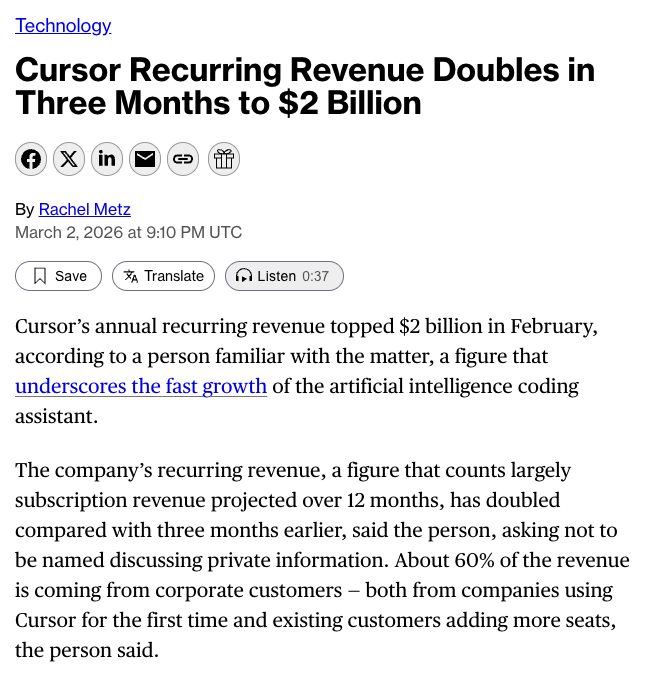
Narrative violation. Cursor goes $1B to $2B in 3mos. Claude Code went $0 to $2.5B in 8mos. Everyone in the tech/X bubble think people are wholesale ditching Cursor, but enterprise diffusion is glacial. Most of the world just got a hold of it.
Deedy tweet media
English
99
54
1.1K
412.5K
Jesal Gadhia รีทวีตแล้ว
Ejaaz
Ejaaz@cryptopunk7213·
LMFAO be anthropic: > wake up, make coffee > scroll boomer companies worth billions of dollars > pick one > "hi claude make a better version of this make no mistakes ty" > wait 1 hour > "looks good" > *push to prod* > post tweet about how you just displaced boomer company with new feature > profit
The Kobeissi Letter@KobeissiLetter

BREAKING: IBM stock, $IBM, falls over -10% after Anthropic announces that Claude can streamline COBOL code. It’s becoming increasingly clear how pivotal the times we are in right now truly are.

English
115
325
6.4K
1.1M
Jesal Gadhia รีทวีตแล้ว
Symoné B. Beez
Symoné B. Beez@SymoneBeez·
Tech careers are now split into 3 tracks
English
115
837
5.2K
509.6K
Jesal Gadhia รีทวีตแล้ว
Jack Clark
Jack Clark@jackclarkSF·
People leaving regular companies: Time for a change! Excited for my next chapter! People leaving AI companies: I have gazed into the endless night and there are shapes out there. We must be kind to one another. I am moving on to study philosophy.
English
138
936
11.6K
548.1K
Jesal Gadhia
Jesal Gadhia@jesalg·
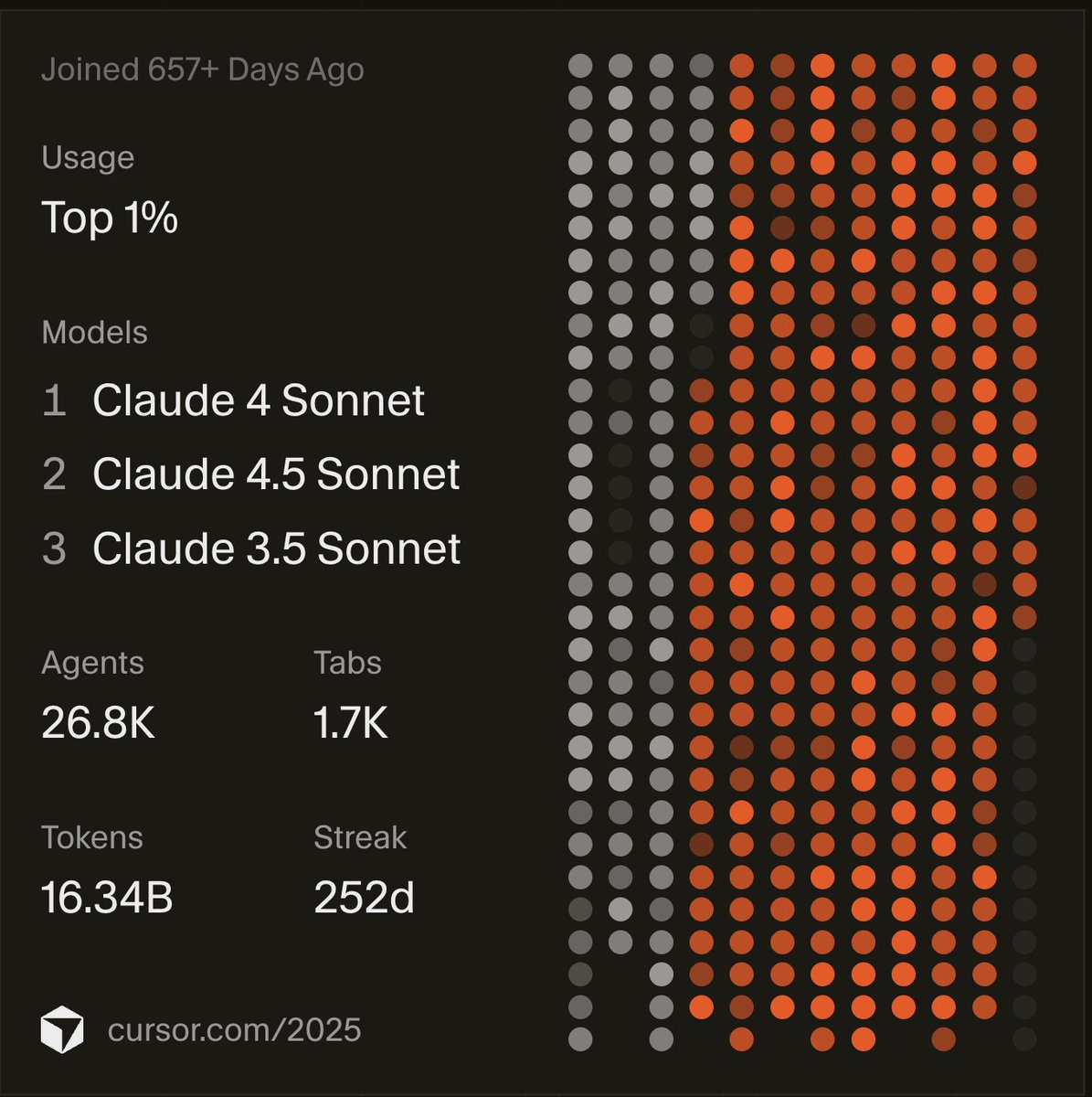
What a year. I used Cursor for 252 days straight 🤯
Jesal Gadhia tweet media
English
1
0
3
145
Jesal Gadhia
Jesal Gadhia@jesalg·
So well put. Small teams win on shared context, not a zoo of services. Mothership & shuttles are the way to go: One codebase where everyone can reason end-to-end. Async and bursty work is offloaded to functions that run on serverless runtimes. Ship a great monolith first. Earn your distributed system later.
DHH@dhh

Microservices is the software industry’s most successful confidence scam. It convinces small teams that they are “thinking big” while systematically destroying their ability to move at all. It flatters ambition by weaponizing insecurity: if you’re not running a constellation of services, are you even a real company? Never mind that this architecture was invented to cope with organizational dysfunction at planetary scale. Now it’s being prescribed to teams that still share a Slack channel and a lunch table. Small teams run on shared context. That is their superpower. Everyone can reason end-to-end. Everyone can change anything. Microservices vaporize that advantage on contact. They replace shared understanding with distributed ignorance. No one owns the whole anymore. Everyone owns a shard. The system becomes something that merely happens to the team, rather than something the team actively understands. This isn’t sophistication. It’s abdication. Then comes the operational farce. Each service demands its own pipeline, secrets, alerts, metrics, dashboards, permissions, backups, and rituals of appeasement. You don’t “deploy” anymore—you synchronize a fleet. One bug now requires a multi-service autopsy. A feature release becomes a coordination exercise across artificial borders you invented for no reason. You didn’t simplify your system. You shattered it and called the debris “architecture.” Microservices also lock incompetence in amber. You are forced to define APIs before you understand your own business. Guesses become contracts. Bad ideas become permanent dependencies. Every early mistake metastasizes through the network. In a monolith, wrong thinking is corrected with a refactor. In microservices, wrong thinking becomes infrastructure. You don’t just regret it—you host it, version it, and monitor it. The claim that monoliths don’t scale is one of the dumbest lies in modern engineering folklore. What doesn’t scale is chaos. What doesn’t scale is process cosplay. What doesn’t scale is pretending you’re Netflix while shipping a glorified CRUD app. Monoliths scale just fine when teams have discipline, tests, and restraint. But restraint isn’t fashionable, and boring doesn’t make conference talks. Microservices for small teams is not a technical mistake—it is a philosophical failure. It announces, loudly, that the team does not trust itself to understand its own system. It replaces accountability with protocol and momentum with middleware. You don’t get “future proofing.” You get permanent drag. And by the time you finally earn the scale that might justify this circus, your speed, your clarity, and your product instincts will already be gone.


English
0
0
1
99
Jesal Gadhia รีทวีตแล้ว
dharmesh
dharmesh@dharmesh·
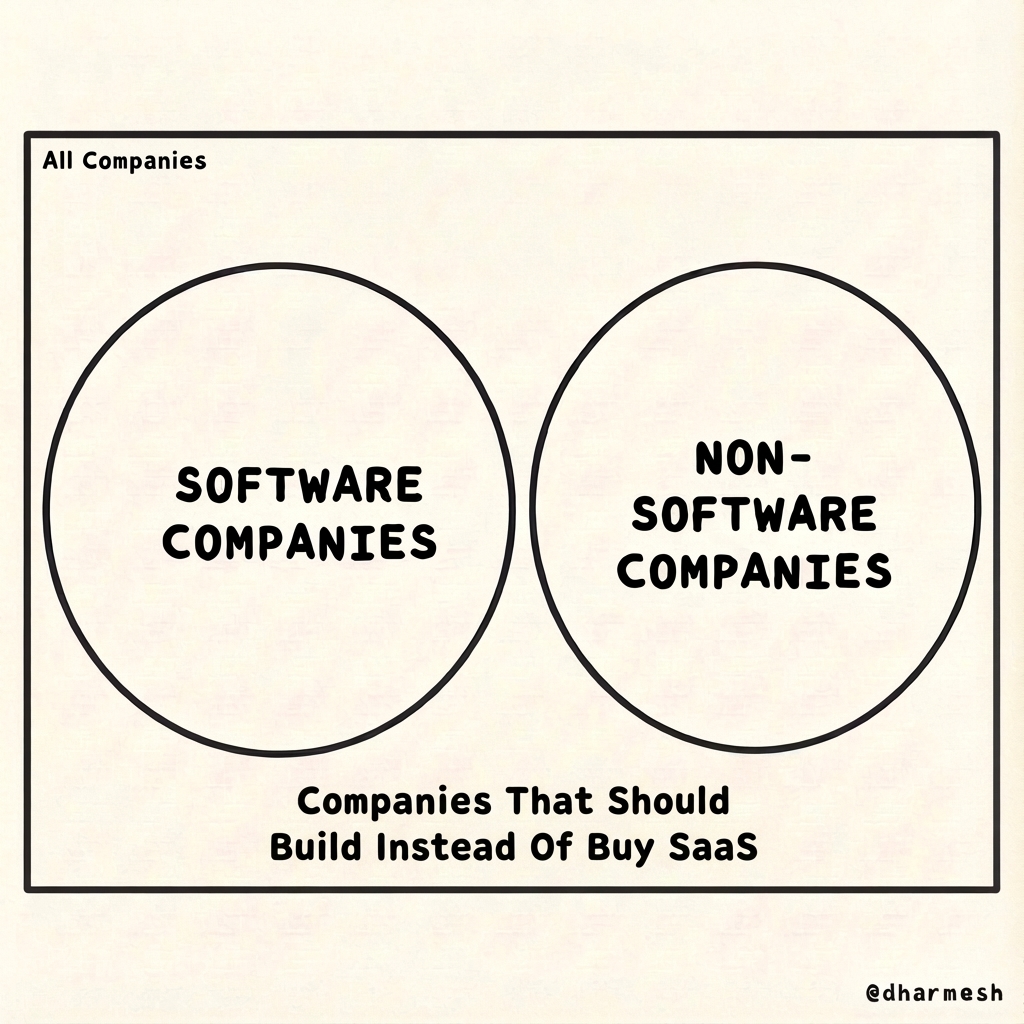
"Why should companies pay for SaaS (HR/CRM/ERP/etc.) when they could just vibe code them?" I get variations of this question or comment with some regularity (granted, it's sometimes just me talking to myself). Here are some biased (but hopefully, well-considered) thoughts: 1) I am a big proponent and user of vibe coding (what I call "agentic coding"). I do it every day, 7 days a week, including Sundays. It's amazing. 2) My company, HubSpot is a software company. We have hundreds of professional engineers -- just about all of them use AI for product development too. They are brilliant and know how to build production-grade products. 3) Even with this powerful army of talent, the number of internal, core SaaS applications that we have replaced with a vibe-coded variant is exactly ZERO. The number of applications we plan to replace is also exactly ZERO. 4) It's not the absence of talent that keeps us from rolling our own SaaS apps, it's the presence of focus. It would be silly to try and replace our HR, team collaboration, expense tracking and 100+ other SaaS apps we use when we can just buy them. Just doesn't make sense. 5) That's us -- as a software company at some scale. If you're a non-software company it makes even less sense for you. Doesn't matter how good the AI coding tools get. Let's say you *could* vibe code a replacement for that SaaS app you're using, who's going to maintain it? Who's going to keep up with industry trends? What are you going to do when the 20-something genius that vibe coded it over a weekend leaves the company? Who do you call when there's a major bug? 6) If you're a Fortune 500 company at some scale, perhaps you could pull this off for some discrete use cases and the tradeoffs are worth it. You have an IT/Engineering department that is larger than the population of some countries. You can take on the pain in return for the positives. For the millions of others, my advice is: Spend every calorie possible on creating value for your customers.
dharmesh tweet media
English
225
199
1.4K
218.4K
Jesal Gadhia รีทวีตแล้ว
Aaron Levie
Aaron Levie@levie·
We’re starting to get a clearer sign of how vast the surface area of context engineering is going to be. To build AI agents, in theory, it should be as simple as having a super powerful model, giving it a set of tools, having a really good system prompt, and giving it access to data. Maybe at some point it really will be this simple. But in practice, to make agents that work today, you’re dealing with a delicate balance of what to give to the global agent vs. a subagent. What things to make agentic vs. just a deterministic tool call. How to handle the inherent limitations of the context window. You had to figure out how to retrieve the right data for the user’s task, and how much compute to throw at the problem. How to decide what to make fast, and suffer potential quality drops, vs. slow but maybe annoying. And endless other questions. So far there’s no one right answer for any of this, and there are meaningful tradeoffs for any given approach you take. And importantly, getting this right requires a deep understanding of the domain you’re solving the problem for. Handling this problem in AI coding is different from law, which is different from healthcare. This is why there’s so much opportunity for AI agent plays right now.
English
120
118
894
151.4K
Jesal Gadhia รีทวีตแล้ว
Akshay Kothari
Akshay Kothari@akothari·
My team: what’s our 2026 plan? Me:
English
145
241
3.1K
258.2K
Jesal Gadhia รีทวีตแล้ว
Aaron Levie
Aaron Levie@levie·
The counter dynamic to the AI model doing everything is that, at least in enterprise, bridging the AI models’ capabilities to the customer’s environment still requires a tremendous amount of long tail work. The gap between an AI agent working for 90% or 95% of the solution and 100% is usually about 10X more work than most realize. Getting access to the enterprise data, connecting to the enterprise workflows, delivering the change management that employees need to adopt the technology, handling the regulatory and compliance requirements of that industry, and so on all require some degree of highly dedicated focus in a domain. There’s a strong analogy to vertical SaaS here actually. One would have thought that horizontal technologies could solve all problems in SaaS. But in fact there are endless very large companies that just hyper focus on a single domain, because that level of specialization is valued by the enterprise. We will likely see the same play out with AI Agents in the enterprise as well. And in fact these domains will be far larger than traditional software categories because the TAM isn’t software, it’s work to be done. Very fun debate, but I’m taking the other side.
Yishan@yishan

My AI investment thesis is that every AI application startup is likely to be crushed by rapid expansion of the foundational model providers. App functionality will be added to the foundational models' offerings, because the big players aren't slow incumbents (it is wrong to apply the analogy of "fast startup, slow incumbent" here), they are just big. Far more so than with any other prior new technology, there is a massive and fast-moving wave that obsoletes every new app almost as fast as it can be invented. There is almost no time to build a company and scale it. There are two ways AI application startup founders can make money: - Make a flash-in-the-pan app that generates a ton of cash and bank the cash (my estimate is that you have about 12-18 months cashflow generation) - Make a good enough app that you get acquired by one of the big players for sufficient equity The situation is highly unstable - we don't know if it's going to crash or go to the moon but both scenarios make it very unlikely that any AI application startup will independently become a generational supercompany (baseline odds are low to begin with). The best odds are finding an application niche in a highly specialized field with extremely unique and specific data barriers, ideally ones relating to real atoms (hardware or world-related) data and not software/finance.

English
57
67
465
123.4K
Jesal Gadhia รีทวีตแล้ว
Santiago
Santiago@svpino·
If you buy an expensive camera, your photos will suck as much as before. If you buy an expensive golf club, you won't start swinging 300-yard bombs overnight. It's not the tools. It's the person using them. Building good software has nothing to do with whether you use Claude Code, Codex, or Cursor and everything to do with how you think and use them. Great software doesn't come from better models. It comes from better thinking.
English
60
43
436
58.3K
ndx (agentic arc)
ndx (agentic arc)@netdragon0x·
this is cool, but in some ways... it feels like we have basically replaced what used to be a 5 minute Wordpress install with plugins and jumped straight to custom builds many vibe coders out there who are so excited about their ability to launch a website should probably just be on wordpress or some other CMS lol
eric zakariasson@ericzakariasson

i ran cursor agent for 24 hours continuously this weekend the task was to "build a project management tool". i was surprised the application completely works obviously this isn't production ready, but the future is exciting

English
3
0
7
2.1K
Jesal Gadhia รีทวีตแล้ว
Dmitrii Kovanikov
Dmitrii Kovanikov@ChShersh·
Software Engineers are not paid for writing code. They’re paid for solving problems. The faster you accept this, the better your life and career will be.
English
475
1.6K
17.2K
753.7K
Jesal Gadhia รีทวีตแล้ว
Santiago
Santiago@svpino·
Building software is only 10% about writing code, and 90% about thinking what code to write, why you should write it, and how to do it well. You can delegate the code-writing part to an LLM, but so far, they have shown they can’t handle the thinking part. It’s called “vibe-coding” and not “vibe-thinking” for a reason.
Santiago@svpino

Vibe-coders can’t build the type of software $400,000/year salaries pay today. If you believe companies pay that money to build vibe-code-able apps, you should crack a book and get off Twitter.

English
139
134
1.5K
166.3K
Jesal Gadhia รีทวีตแล้ว
Dave Kline
Dave Kline@dklineii·
Major life cheat code: Taking radical ownership of your outcomes. High performers don't blame secret forces, unclear direction, or market conditions. They create their reality through relentless action. Stop inventing reasons you can't and you'll start finding ways that you can.
English
9
10
141
10K