Jerry Mortimer รีทวีตแล้ว
Jerry Mortimer
6.5K posts

Jerry Mortimer
@jmortimer73
Hall of Fame basketball coach - EMS volunteer - Badgers, Brewers, Bucks, Packers fan and Big Radio color analyst for football and basketball.
Monroe, WI เข้าร่วม Kasım 2016
44 กำลังติดตาม448 ผู้ติดตาม
Jerry Mortimer รีทวีตแล้ว

"Here's something the NFL doesn't put in its highlight reels. 1961, Vince Lombardi gets word that Columbus, Georgia, a city hosting its very first professional football game, expects his black players to sleep somewhere separate from the rest of the team. What Lombardi did next was never reported by a single major newspaper.
His players rarely spoke about it publicly for years, but every man who wore green and gold in that era, white and black, carried it with them for the rest of their lives. This is the story of the night Vince Lombardi drove his entire team to a United States Army base rather than let one single player be treated as less than equal and dared the entire American South to say something about it.
Now, before we go to that Army base, before we hear what Lombardi said and what he did, you need to understand the world this man walked into because in 1961, the National Football League was not a progressive institution. It was a business, a very profitable business that had learned very carefully, very deliberately, not to make enemies of the men who controlled the stadiums, the television deals, and the political machinery of the American South.
Preseason games in southern cities meant money, good money, sellout crowds in cities hungry for professional football. And for that money, NFL coaches had learned a simple, ugly ritual. When the team bus pulled up to a hotel in a segregated city, the white players went inside. The black players were driven quietly, separately, without ceremony to a boarding house on the other side of town, in the black neighborhood, away from their teammates.
Nobody talked about it. Nobody wrote about it. It was just the way things were. Coaches called it respecting local customs. Players called it something else entirely. And for years, for years, every black man who played professional football in America had absorbed this ritual as the price of admission.
You want to play in the NFL? You put your head down. You get on the other bus. You tell yourself it doesn't matter. It mattered. Willie Davis knew it mattered. Emlyn Tunnell knew it mattered. Every black Packer who pulled on that green and gold jersey and then watched the team bus disappear into a southern evening, they knew.
But in 1961, nobody in a position of power was willing to say so out loud. Nobody except one Italian kid from Brooklyn who had absolutely no interest in learning how to stay in his lane. Vince Lombardi was not supposed to be here. Let's be about that. He was 45 years old when the Green Bay Packers came calling in January 1959.
45, an offensive coordinator at the New York Giants who had spent his entire career waiting for a chance that never seemed to arrive. Passed over for head coaching jobs at Notre Dame, at Army, at multiple NFL franchises. Too intense, they said. Too demanding. His daughter, Susan, would explain it years later with a clarity that cut straight to the bone.
My father was discriminated against as a dark-skinned Italian American. He felt he was passed up for coaching jobs he deserved. He knew what it felt like to be judged before you opened your mouth. Green Bay was a city of 62,000 people in the frozen northwest corner of Wisconsin. When Lombardi arrived in 1959, the Packers had gone one and 10 and won the previous season.
Their locker room was a collection of talented men who had forgotten, or perhaps never learned, what it meant to believe in something larger than themselves. When Lombardi joined, the Packers had exactly one black player on their roster. One. Within his first year, he had added 12 more.
He brought Emlyn Tunnell over from the New York Giants, a man who would become the first black player ever inducted into the Pro Football Hall of Fame. Tunnell didn't come to Green Bay just to play. He came to help Lombardi build something. And from the very first day of training camp, Lombardi made the rules of that building project absolutely clear.
He stood at the front of the room. He looked at every face, white, black, from the north and the south, and he spoke in the quiet, controlled voice of a man who had already decided and was simply informing the room of his decision. ""If I ever hear the word or or or anything like that around here, regardless of who you are, you're through with me.
You cannot play for me if you have any kind of prejudice."" Not a suggestion, not a speech, a statement of policy delivered by a man whose eyes told you with complete certainty that he had meant every syllable before he said the first one. In his first season, the Packers went seven and five. In 1960, they won the NFL Western Conference for the first time since 1944.
Lombardi's second year. He then took them all the way to the NFL Championship game against the Philadelphia Eagles, a game the Packers lost by a single point on the final play, inches from the goal line. After the press corps left the locker room that night, Lombardi stood before his players in the silence of that loss and said, ""This will never happen again.
You will never lose another championship."" He wasn't predicting, he was announcing. But before those championships, before the dynasty, before the five titles and the two Super Bowls and the trophy that would carry his name forever, there was a road trip to Georgia that almost nobody outside that team ever knew about.
Columbus, Georgia, summer of 1961. The city was preparing for the biggest moment in its sporting history, the first professional football game ever played within its limits. Green Bay Packers versus the Washington Redskins. An exhibition game, yes, but in a city that had never hosted the NFL, it was an event of enormous civic pride.
The game's organizers wanted maximum spectacle. They reached out to both teams and asked them to arrive early, help promote the city, practice in Columbus all week, give the local newspapers something to write about. Washington agreed immediately. The Redskins flew into Columbus six days before the game. They practiced in the city, held press availability, gave interviews, and generated exactly the kind of content the organizers had hoped for.
Then the organizers called Green Bay and they reached Vince Lombardi. The coach listened to the request. He understood the promotional logic. He understood what they wanted. And then he asked a simple question. Where would his players be staying? The answer came back through the way answers always came back in Jim Crow Georgia. Politely, apologetically, with the practiced casualness of people who had long since stopped questioning a system that worked in their favor, the white players would stay in Columbus proper.
Fine hotels, good accommodations. The black players, there were facilities on the other side of town. Very nice, actually. The kind of places that Lombardi stopped the conversation there. He thanked them for their time and then he made a phone call of his own. Lombardi had Army connections from his time coaching at West Point in the early 1950s.
He understood military culture, its directness, its structure, its complete indifference to the social hierarchies of civilian life. He called Fort Benning. Fort Benning was a United States Army installation located 10 miles outside Columbus. It was federal land. Federal rules applied. Jim Crow laws did not.
The conversation was brief. Could the Green Bay Packers, all of them, stay on base the night before the game? The answer was yes. Lombardi then informed the game's organizers of the revised arrangement. The Packers would not be arriving six days early. They would not be practicing in Columbus all week.
They would not be generating local newspaper content or participating in the promotional schedule. The Green Bay Packers would fly into Lawson Army Airfield the day before the game. They would stay together, every man on that roster, white and black, first string and scout team, in the bachelor officers quarters at Fort Benning.
They would practice on the base. They would eat together on the base. They would sleep under the same roof on the base. And then they would play the game. The organizers pushed back. There was a promotional commitment. There were contracts. There were expectations. Lombardi's response was simple enough that it required no elaboration.
""Those are your expectations. These are mine. When word reached the players about the arrangements, different men processed it differently. For the white players who had grown up in the north, it was a logistics update. Fort Benning instead of a Columbus hotel, fine. For the black players, it was something else entirely.
Willie Davis, who would go on to play 11 seasons with the Packers, make five Pro Bowls, and eventually be inducted into the Pro Football Hall of Fame, would reflect on this period in interviews years later. He spoke about the way Lombardi approached race, not as a problem to be managed, but as a simple matter of arithmetic.
He treated us as equals, just players competing for a spot on the team. Davis said, ""It was as if he felt the best way to fix the problem of segregation was to actually pretend it didn't exist, at least to us. That was the genius of what Lombardi did, not the grand gesture, not the press conference, not the letter to the league office announcing his position on civil rights.
He simply refused to operate any other way."" Quietly, consistently, without drama, the Packers flew into Lawson Army Airfield the day before the game. Every man, white and black, walked off that plane together. Every man loaded onto the same buses. Every man stayed in the bachelor officers quarters at Fort Benning, 10 miles outside a city that had decided some of them weren't welcome.
Dave Robinson, the linebacker who would become the first black player to start regularly at outside linebacker in NFL history, described what Lombardi had built in that locker room with a sentence so precise it requires no embellishment. ""It never enters my mind that I'm being chewed out because I'm a negro.
The important thing is everybody gets equal treatment. Equal treatment. In 1961, from an NFL head coach, it sounds simple. It was radical. The game was played. The crowd that turned out in Columbus that night for the city's great professional football debut, for the spectacle they had spent months promoting, numbered 18,000, about 6,500 below capacity.
The absence of the Packers from Columbus all week had cost the organizers exactly what Lombardi knew it would cost them, the newspaper content, the practice sessions open to the public, the promotional momentum. Lombardi never mentioned this, not publicly, not privately, as far as anyone recorded. He didn't need to. The math was self-explanatory.
What he did say, in his own way, through his actions over years, was that this was not a one-time stand. It was a standard. Back in Green Bay, Lo- mbardi had already made it known to the owners of every restaurant, every bar, every establishment in the city that if they did not serve his black players with the same welcome they gave his white players, that business was off-limits to every single member of the Green Bay Packers.
In a city where having Packers players walk through your door was a commercial event in itself, this was not a subtle threat. When the Packers traveled, Lombardi made the policy absolute. The team stayed only in places that accepted all of them. By 1967, the Packers were the only team in the entire National Football League with such a policy, the only one.
In 1960, when black players on his roster struggled to find housing in a Green Bay real estate market that quietly excluded them, Lombardi approached a local developer and then worked alongside him to push a fair housing bill through the Wisconsin State Legislature, fighting against fierce opposition from the real estate industry and from both political parties.
In April 1965, he submitted a written endorsement before a Senate Judiciary Committee. He wrote, ""On the football field, players are judged not on their race or religion, but by their performance, and this is as it should be. Since I so firmly believe in equality of opportunity in athletics, I think the same degree of opportunity should prevail in other areas, as well.
"" In 1962, the Packers returned to Columbus and Fort Benning. The arrangement was the same, every player together. In 1963, when game organizers pro- posed a segregated seating plan for a third Columbus exhibition, Lombardi simply canceled the game. No negotiation, no counter-proposal. The game moved to Cedar Rapids, Iowa.
The message, delivered three times over three years without a single press release, was now impossible to misread. Vince Lombardi did not adjust his standards to fit the room he was in. The room adjusted to him. Vince Lombardi died on September 3rd, 1970, intestinal cancer. He was 57 years old. The Wisconsin State flag flew at half-staff.

English
Jerry Mortimer รีทวีตแล้ว

JUST IN: Kettle Moraine Boys Basketball HC Brian Richert announced his retirement from coaching this morning after 37 years in a Facebook post. #wisbb #wiaabb
@KMLasersbball
English
Jerry Mortimer รีทวีตแล้ว

2004 Portage grad Daniel Harkins, an All-State player in high school who later played at North Dakota, has been hired as the new boys basketball coach at Portage. #wisbb
English
Jerry Mortimer รีทวีตแล้ว

Chad Hayes has stepped down as head boys basketball coach at Watertown due to a family move to Florida.
The Goslings will also lose top scorer Macallister Hayes for next season #wisbb
Credit: Watertown Daily Times
English
Jerry Mortimer รีทวีตแล้ว

This young man on the mound, a senior in high school, started the game and threw one pitch in the game on senior day.
The back story is that he was injured by a line drive in March ending his career with a brain bleed. The young man up to bat is a senior and the son of the mom who filmed this. He agreed to not swing at the pitch.
They said there wasn't a dry eye in the ballpark. This game is so much greater than that little white ball!
In a world of such chaos and hate, I love, love, love this so much.❤️
How can you not be romantic about baseball?
👉M-Û-R-Č-H👈@TheEXECUTlONER_
This umpire was calling a 9U baseball game. A player came up to bat and hit a home run. What happened next is anyone’s guess. Most are saying the umpire blew up after he lost his mind and robbed a 9 year old of a home run. What do you think the call should be? Do you think k he blew it big time or do you agree with the call?

English
Jerry Mortimer รีทวีตแล้ว

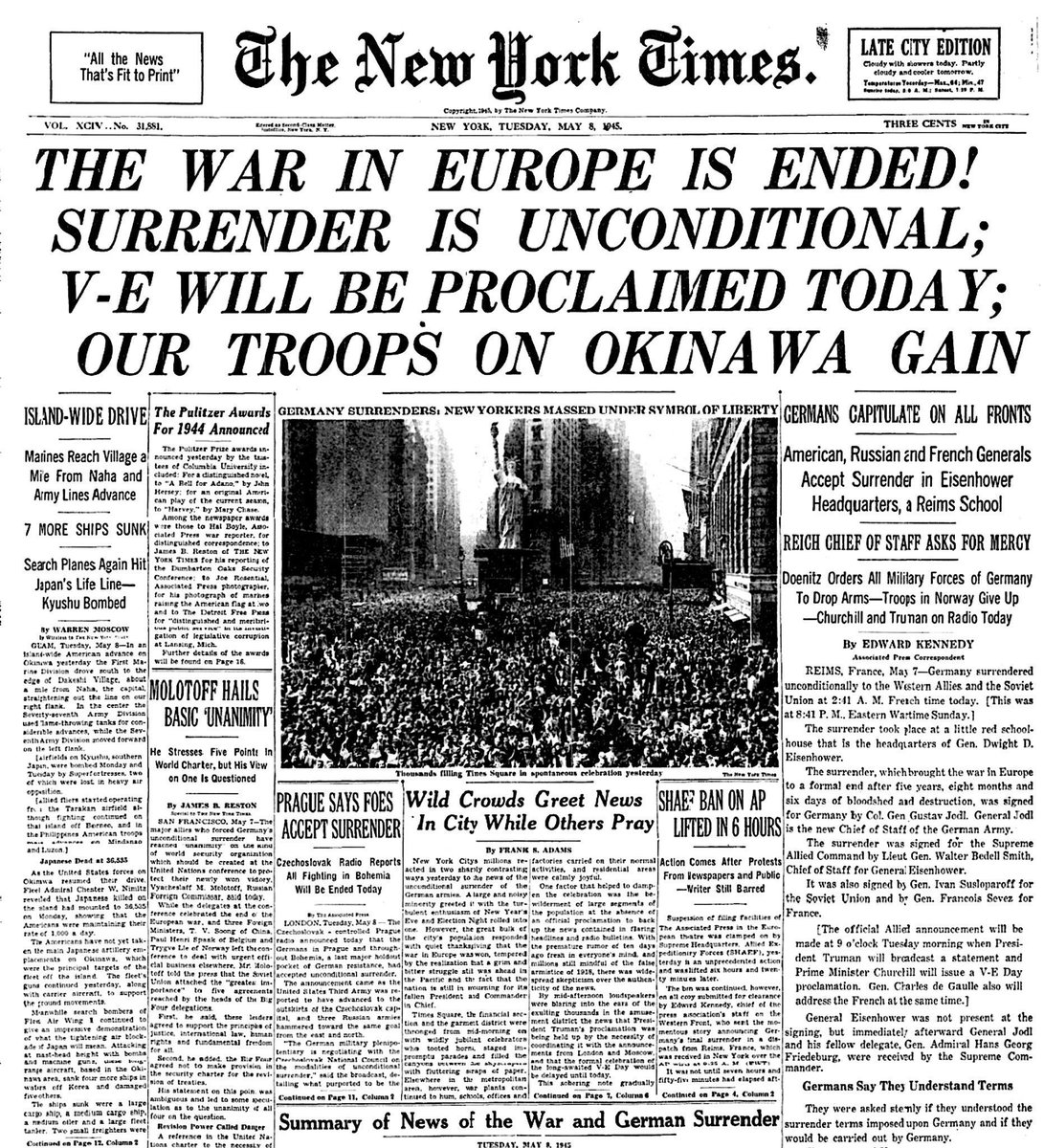
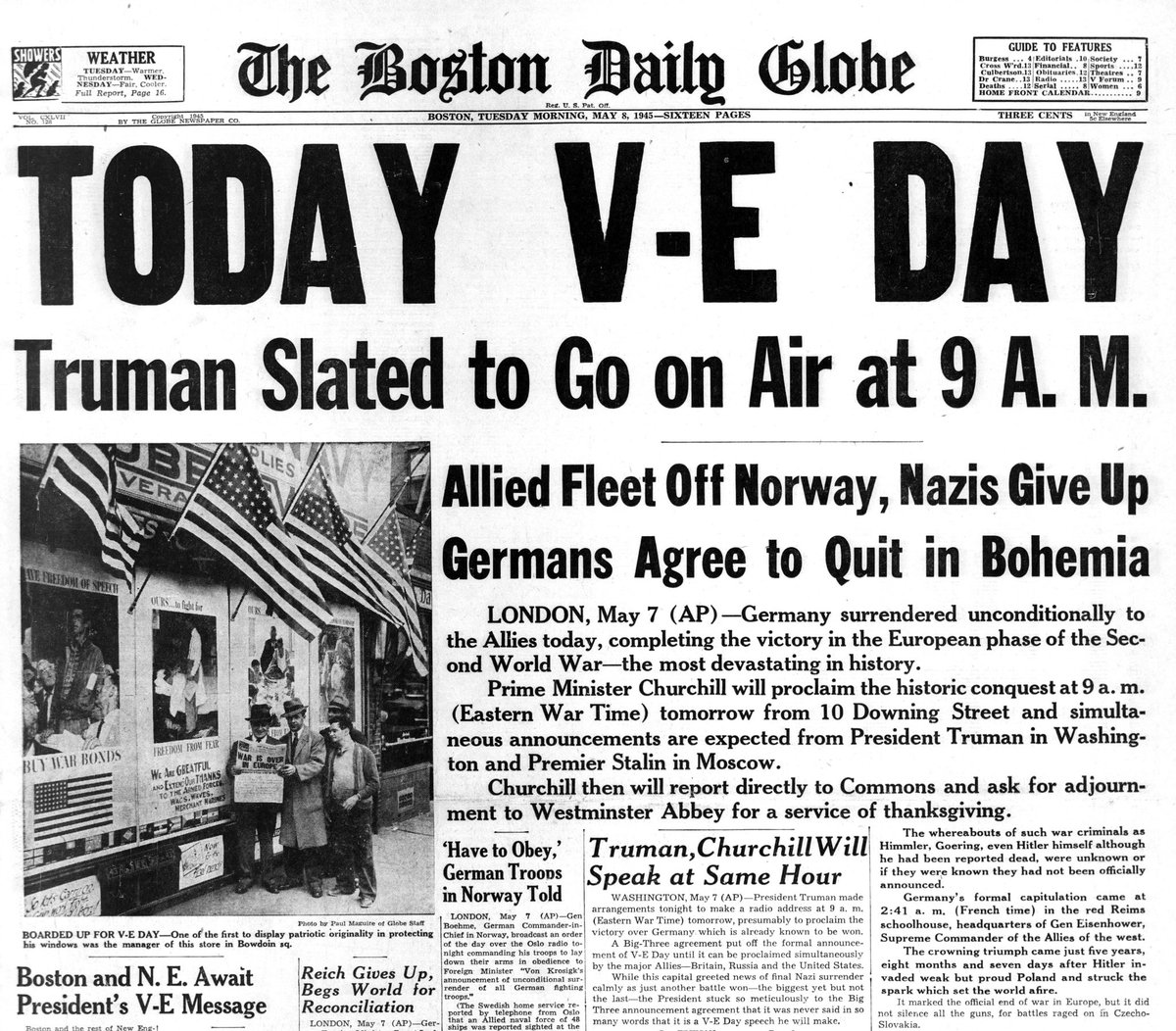
On May 8, 1945, the United States, Great Britain and other Allied nations celebrated Victory in Europe Day, better known as V-E Day, marking Germany’s formal surrender and the end of World War II combat in Europe.
Crowds filled the streets in cities like London and New York City as people celebrated the long-awaited victory, though the war in the Pacific would continue until Japan’s surrender later that year


English
Jerry Mortimer รีทวีตแล้ว

Today marks the 81st anniversary of Allied victory in Europe, bringing an end to World War II on the continent.
At the World War II Memorial, stone and bronze honor the millions who served, remember those who never came home, and mark a turning point in the fight to restore freedom.
As the generation who lived this history grows smaller, places like this ensure their stories endure. We honor their courage, their service, and the sacrifice that made victory possible. 🇺🇸
Photo by Carol M. Highsmith

English

@OnaBoysBball @WisBCA Congratulations to Coach Kowal and those that put this video tribute together. We hear of so many coaches who are pushed away but this is a great example of a community and current and former players and coaches expressing their true feelings. We need more of this!
English
Jerry Mortimer รีทวีตแล้ว

Jerry Mortimer รีทวีตแล้ว

NEW: The D-I men's and women's basketball committees have officially voted to expand the NCAA tournament to 76 teams, @MattNorlander reports.
on3.com/news/ncaa-vote…

English
Jerry Mortimer รีทวีตแล้ว

Boys Basketball Coaching Openings for 2026-27 prephoops.com/2026/04/boys-b…
English
Jerry Mortimer รีทวีตแล้ว

Scott Uppena has stepped down as boys basketball coach and superintendent at Royall.
In 13 years he won over 200 games.
Scott has taken the superintendent position at North Crawford #wisbb
Full list of boys basketball coaching changes
boundwisconsin.com/p/wisconsin-hi…
English
Jerry Mortimer รีทวีตแล้ว

If this comes to fruition every person in America -- Democrat, Republican, Independent -- should be outraged. Example No. 4,385,952 illustrating how elected officials will screw over their constituents w/out an ounce of guilt.
Kirsten Gillibrand@SenGillibrand
Somehow not a "dime" turned into $1 billion…
English