Lance AI

14.9K posts

Lance AI banner
Lance AI

Lance AI

@lance_web3

📘Macro | 顺势而为 | 📙Crypto + 🤖 AI | DevSecOps @PundiXLabs & @PundiAI | Results = hardwork intelligence diligence in the right place

Earth เข้าร่วม Ekim 2019
284 กำลังติดตาม502 ผู้ติดตาม
ทวีตที่ปักหมุด
Lance AI
Lance AI@lance_web3·
Big Banks like #JPMorgan wiping out regional banks = cruel Regional banks = heart and soul of America #Amazon cutting 18k jobs due to WTFed's credit issues Ripple effect bringing down the USA, small banks and businesses Stay aware. #supportsmallbusiness #saveregionalbanks
English
8
4
22
13.7K
Mario Nawfal
Mario Nawfal@MarioNawfal·
🚨🇦🇪🇮🇷 5 explosions just rattled Dubai. Smoke rising near Jebel Ali port, one of the busiest shipping hubs on earth. Roughly 7,000 vessels pass through annually. A significant chunk of global trade flows through that port. Dubai has no U.S. military bases. Iran just hit the global economy.
Mario Nawfal tweet media
Mario Nawfal@MarioNawfal

🚨🇮🇷 Iran releasing its own launch footage on state television. Propaganda and warfare running simultaneously. They want their people and the region to see the missiles leaving the ground. This is the information war running parallel to the real one.

English
253
1.4K
5.4K
1.2M
Lance AI รีทวีตแล้ว
vitalik.eth
vitalik.eth@VitalikButerin·
How I think about "security": The goal is to minimize the divergence between the user's intent, and the actual behavior of the system. "User experience" can also be defined in this way. Thus, "user experience" and "security" are thus not separate fields. However, "security" focuses on tail risk situations (where downside of divergence is large), and specifically tail risk situations that come about as a result of adversarial behavior. One thing that becomes immediately obvious from the above definition, is that "perfect security" is impossible. Not because machines are "flawed", or even because humans designing the machines are "flawed", but because "the user's intent" is fundamentally an extremely complex object that the user themselves does not have easy access to. Suppose the user's intent is "I want to send 1 ETH to Bob". But "Bob" is itself a complicated meatspace entity that cannot be easily mathematically defined. You could "represent" Bob with some public key or hash, but then the possibility that the public key or hash is not actually Bob becomes part of the threat model. The possibility that there is a contentious hard fork, and so the question of which chain represents "ETH" is subjective. In reality, the user has a well-formed picture about these topics, which gets summarized by the umbrella term "common sense", but these things are not easily mathematically defined. Once you get into more complicated user goals - take, for example, the goal of "preserving the user's privacy" - it becomes even more complicated. Many people intuitively think that encrypting messages is enough, but the reality is that the metadata pattern of who talks to whom, and the timing pattern between messages, etc, can leak a huge amount of information. What is a "trivial" privacy loss, versus a "catastrophic" loss? If you're familiar with early Yudkowskian thinking about AI safety, and how simply specifying goals robustly is one of the hardest parts of the problem, you will recognize that this is the same problem. Now, what do "good security solutions" look like? This applies for: * Ethereum wallets * Operating systems * Formal verification of smart contracts or clients or any computer programs * Hardware * ... The fundamental constraint is: anything that the user can input into the system is fundamentally far too low-complexity to fully encode their intent. I would argue that the common trait of a good solution is: the user is specifying their intention in multiple, overlapping ways, and the system only acts when these specifications are aligned with each other. Examples: * Type systems in programming: the programmer first specifies *what the program does* (the code itself), but then also specifies *what "shape" each data structure has at every step of the computation*. If the two diverge, the program fails to compile. * Formal verification: the programmer specifies what the program does (the code itself), and then also specifies mathematical properties that the program satisfies * Transaction simulations: the user specifies first what action they want to take, and then clicks "OK" or "Cancel" after seeing a simulation of the onchain consequences of that action * Post-assertions in transactions: the transaction specifies both the action and its expected effects, and both have to match for the transaction to take effect * Multisig / social recovery: the user specifies multiple keys that represent their authority * Spending limits, new-address confirmations, etc: the user specifies first what action they want to take, and then, if that action is "unusual" or "high-risk" in some sense, the user has to re-specify "yes, I know I am doing something unusual / high-risk" In all cases, the pattern is the same: there is no perfection, there is only risk reduction through redundancy. And you want the different redundant specifications to "approach the user's intent" from different "angles": eg. action, and expected consequences, expected level of significance, economic bound on downside, etc This way of thinking also hints at the right way to use LLMs. LLMs done right are themselves a simulation of intent. A generic LLM is (among other things) like a "shadow" of the concept of human common sense. A user-fine-tuned LLM is like a "shadow" of that user themselves, and can identify in a more fine-grained way what is normal vs unusual. LLMs should under no circumstances be relied on as a sole determiner of intent. But they are one "angle" from which a user's intent can be approximated. It's an angle very different from traditional, explicit, ways of encoding intent, and that difference itself maximizes the likelihood that the redundancy will prove useful. One other corollary is that "security" does NOT mean "make the user do more clicks for everything". Rather, security should mean: it should be easy (if not automated) to do low-risk things, and hard to do dangerous things. Getting this balance right is the challenge.
English
618
266
1.6K
203.3K
Lance AI รีทวีตแล้ว
Ethereum
Ethereum@ethereum·
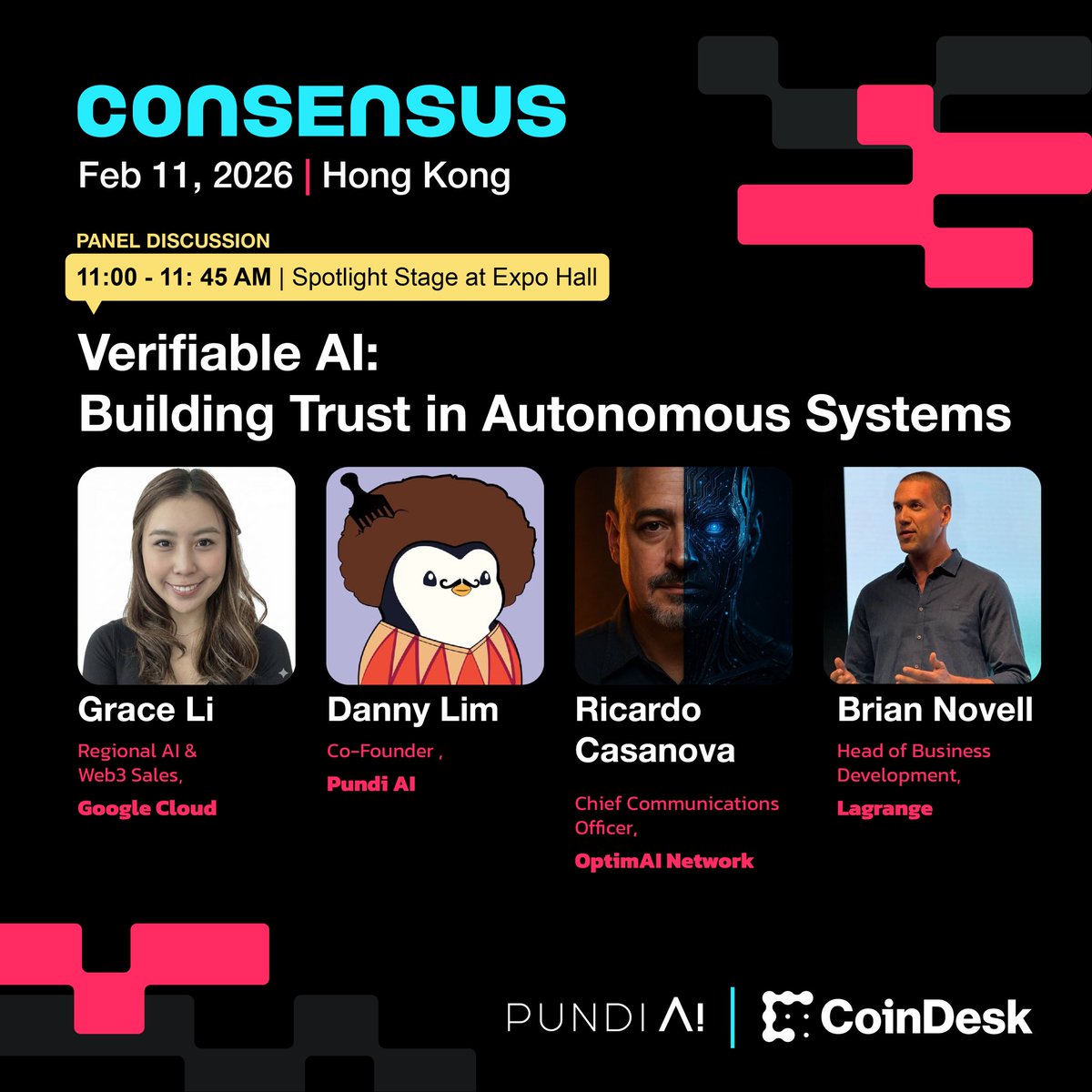
1/ Verifiable computation: Exploring Ethereum’s role as a base layer for trust in autonomous systems. Wednesday, Feb 11: - 11:00 HKT: Verifiable AI: Building Trust in Autonomous Systems with @lagrangedev, @OptimaiNetwork & @PundiAI - 15:00 HKT: Why Robot GDP Will Surpass Human GDP with @virtuals_io Thursday, Feb 12: - 10:50 HKT: Beyond Bolt-On AI: The Rise of AI-Native Web3 with Ant Digital Technologies, builders of @JovayNetwork
English
13
22
129
19.9K
Lance AI รีทวีตแล้ว
CZ 🔶 BNB
CZ 🔶 BNB@cz_binance·
@elonmusk Health, loved ones (strong relationships), time, positive impact all give more happiness than money.
English
921
336
5.1K
574.3K
Lance AI รีทวีตแล้ว
Elon Musk
Elon Musk@elonmusk·
Whoever said “money can’t buy happiness” really knew what they were talking about 😔
English
127.7K
59.2K
599.2K
111.5M
Lance AI รีทวีตแล้ว
vitalik.eth
vitalik.eth@VitalikButerin·
Have been following reactions to what I said about L2s about 1.5 days ago. One important thing that I believe is: "make yet another EVM chain and add an optimistic bridge to Ethereum with a 1 week delay" is to infra what forking Compound is to governance - something we've done far too much for far too long, because we got comfortable, and which has sapped our imagination and put us in a dead end. If you make an EVM chain *without* an optimistic bridge to Ethereum (aka an alt L1), that's even worse. We don't friggin need more copypasta EVM chains, and we definitely don't need even more L1s. L1 is scaling and is going to bring lots of EVM blockspace - not infinite (AIs in particular will need both more blockspace and lower latency than even a greatly scaled L1 can offer), but lots. Build something that brings something new to the table. I gave a few examples: privacy, app-specific efficiency, ultra-low latency, but my list is surely very incomplete. A second important thing that I believe is: regarding "connection to Ethereum", vibes need to match substance. I personally am a fan of many of the things that can be called "app chains". For example I think there's a large chance that the optimal architecture for prediction markets is something like: the market gets issued and resolved on L1, user accounts are on L1, but trading happens on some based rollup or other L2-like system, where the execution reads the L1 to verify signatures and markets. I like architectures where deep connection to L1 is first-class, and not an afterthought ("we're pretty much a separate chain, but oh yeah, we have a bridge, and ok fine let's put 1-2 devs to get it to stage 1 so the l2beat people will put a green checkmark on it so vitalik likes us"). The other extreme of "app chain", eg. the version where you convince some government registry, or social media platform, or gaming thing, to start putting merkle roots of its database, with STARKs that prove every update was authorized and signed and executed according to a pre-committed algorithm, onchain, is also reasonable - this is what makes the most sense to me in terms of "institutional L2s". It's obviously not Ethereum, not credibly neutral and not trustless - the operator can always just choose to say "we're switching to a different version with different rules now". But it would enable verifiable algorithmic transparency, a property that many of us would love to see in government, social media algorithms or wherever else, and it may enable economic activity that would otherwise not be possible. I think if you're the first thing, it's valid and great to call yourself an Ethereum application - it can't survive without Ethereum even technologically, it maximizes interoperability and composability with other Ethereum applications. If you're the second thing, then you're not Ethereum, but you are (i) bringing humanity more algorithmic transparency and trust minimization, so you're pursuing a similar vision, and (ii) depending on details probably synergistic with Ethereum. So you should just say those things directly! Basically: 1. Do something that brings something actually new to the table. 2. Vibes should match substance - the degree of connection to Ethereum in your public image should reflect the degree of connection to Ethereum that your thing has in reality.
English
1.7K
588
4.9K
1M
Lance AI รีทวีตแล้ว
BNB Chain Developers
BNB Chain Developers@BNBChainDevs·
Introducing BAP-578: The first official BNB Application Proposal. The first official BNB Application Proposal. BAP-578 introduces a new token standard for Non-Fungible Agents (NFAs), AI-driven assets that can act autonomously onchain. Here’s everything you need to know 🧵👇
English
195
103
605
418.6K
Lance AI รีทวีตแล้ว
Watcher.Guru
Watcher.Guru@WatcherGuru·
JUST IN: 🇺🇸 President Trump says "I'm also working to ensure America remains the crypto capital of the world."
English
1.1K
1.9K
13.3K
1.5M
Lance AI รีทวีตแล้ว
Cointelegraph
Cointelegraph@Cointelegraph·
🔥 BULLISH: CZ says crypto rules will differ by country, and while global regulation isn’t workable yet, he’s engaging with governments to shape frameworks.
English
218
301
1.9K
207.9K
Lance AI รีทวีตแล้ว
vitalik.eth
vitalik.eth@VitalikButerin·
In 2026, I plan to be fully back to decentralized social. If we want a better society, we need better mass communication tools. We need mass communication tools that surface the best information and arguments and help people find points of agreement. We need mass communication tools that serve the user's long-term interest, not maximize short-term engagement. There is no simple trick that solves these problems. But there is one important place to start: more competition. Decentralization is the way to enable that: a shared data layer, with anyone being able to build their own client on top. In fact, since the start of the year I've been back to decentralized social already. Every post I've made this year, or read this year, I made or read with firefly.social, a multi-client that covers reading and posting to X, Lens, Farcaster and Bluesky (though bluesky has a 300 char limit, so they don't get to see my beautiful long rants). But crypto social projects has often gone the wrong way. Too often, we in crypto think that if you insert a speculative coin into something, that counts as "innovating", and moves the world forward. Mixing money and social is not inherently wrong: Substack shows that it's possible to create an economy that supports very high-quality content. But Substack is about _subscribing to creators_, not _creating price bubbles around them_. Over the past decade, we have seen many many attempts at incentivizing creators by creating price bubbles around them, and all fail by (i) rewarding not content quality, but pre-existing social capital, and (ii) the tokens all going to zero after one or two years anyway. Too many people make galaxy-brained arguments that creating new markets and new assets is automatically good because it "elicits information", when the rest of their product development actions clearly betray that they're not actually interested in maximizing people's ability to benefit from that information. That is not Hayekian info-utopia, that is corposlop. Hence, decentralized social should be run by people who deeply believe in the "social" part, and are motivated first and foremost by solving the problems of social. The Aave team has done a great job stewarding Lens up to this point. I'm excited about what will happen to Lens over the next year, because I think the new team coming in are people who actually are interested in the "social": even back when the decentralized social space barely existed, they were trying to figure out how to do encrypted tweets. I plan to post more there this year. I encourage everyone to spend more time in Lens, Farcaster and the broader decentralized social world this year. We need to move beyond everyone constantly tweeting inside a single global info warzone, and into a reopened frontier, where new and better forms of interaction become possible.
Lens@LC

Today, we’re proud to share that @masknetwork will steward the next chapter for Lens, bringing the strongest onchain SocialFi foundation to life through intuitive, consumer-ready applications.

English
921
656
4.2K
612K
Lance AI รีทวีตแล้ว
Pundi AI
Pundi AI@PundiAI·
We are excited to announce our partnership with @VB_Audit! With Vital Block as our security partner, projects launching Dataset Tokens (DTOKs) on Data Pump can opt in for professional audits and team KYC from day one.
Pundi AI@PundiAI

x.com/i/article/2013…

English
23
9
47
6.5K
Lance AI รีทวีตแล้ว
Pundi AI
Pundi AI@PundiAI·
Pundi AI is excited to collaborate with @4aibsc, the leading AI marketplace on @BNBCHAIN. Together, we are growing the AI ecosystem on BNBChain and unlocking new possibilities for builders and users. medium.com/pundiai/pundi-…
English
22
11
52
6.3K