
Sylvain de Campou

19.7K posts

Sylvain de Campou banner
Sylvain de Campou

Sylvain de Campou

@leGouter

Le Web est LE média des centres d'intérêts partagés || #DIY #Emarketing #SEO #SMO #Content || Formation Pro @EMLyon & (beaucoup de) #Music(s)

Lyon, Fr เข้าร่วม Mart 2009
1.4K กำลังติดตาม1.8K ผู้ติดตาม
Sylvain de Campou รีทวีตแล้ว
Cory Doctorow NO LONGER ON TWIT TER
Not only is agentic AI bullshit, but it's a specific kind of bullshit that AI hucksters have busted out in the past, and will bust out in the future, so it's worth spending a minute to unpack this bullshit and catalog its traits so that we don't fall for it. 1/
Cory Doctorow NO LONGER ON TWIT TER tweet media
English
7
130
397
96.5K
Sylvain de Campou รีทวีตแล้ว
Addy Osmani
Addy Osmani@addyosmani·
Personal Software is moving us from "buy what you need" to "generate what you need" Software development is undergoing a profound shift, but not in the way most predict. While headlines trumpet the "end of programming," the reality is both more interesting and more nuanced. We're witnessing the emergence of "personal software", where the boundary between users and creators becomes increasingly fluid. This is enabled by advances in large language models and AI-assisted development tools. > One of the biggest AI trends I’m excited about is personal apps. Right now, anyone can create an app tailored to their specific needs, all without hiring a developer or designer. As a product design studio founder, should I be worried about this? Not at all. The more people build things, the more they’ll start to appreciate the craft behind great software - @theShaneLevine This transformation isn't about replacing programmers. Instead, it's about expanding the universe of what's possible in software creation, particularly for highly personalized and niche applications that were previously impractical to build. The real story here isn't about AI replacing human developers - it's about how AI tools are enabling a new category of software that simply couldn't exist before. Consider the current software development landscape. Traditional software companies focus on building applications that serve broad market needs, leaving countless niche use cases unaddressed. These gaps aren't just features waiting to be built - they're entire categories of software that couldn't exist in the traditional model because they're too specialized to be commercially viable. The rise of AI-assisted development is changing this equation. When someone can describe their specific needs conversationally and receive working code in response, the economics of personal software development shift dramatically. This isn't about building the next Photoshop or Figma - it's about enabling individuals to create highly specialized tools for their unique workflows, hobbies, and problems. > I'm completely non-technical (never coded). But I just built a Web app from my phone by chatting with an AI agent on Replit. Now I have a tracker for to answer life's most important question: "Has the dog been fed?" - @venturetwins, a16z A crucial distinction emerges here between personal software and traditional application development. Personal software operates in a different domain with different constraints. It doesn't need to scale to millions of users, handle edge cases beyond its creator's needs, or maintain backward compatibility across versions. > Apparently, you don’t need coding experience to build apps anymore. So I made a little workout/yoga app just for me - @LenardFloeren When the time and expertise required to create software drops dramatically, the minimum viable market size for a software project approaches one. This isn't just a quantitative change - it's a qualitative transformation in what constitutes a "marketable" software product. This simplified context is precisely what makes AI-assisted development particularly effective in this space. > The least you know of a specific domain the more impressed by AI outputs you are aka the competency illusion. - @gerardsans The skepticism from experienced developers about AI replacing programmers is well-founded - building and maintaining large-scale software systems does require deep technical knowledge, architectural understanding, and experience that current AI systems simply don't possess. But this skepticism sometimes blinds us to the genuine transformation happening in personal software development. Think of it this way: just as spreadsheets enabled non-programmers to perform complex calculations and data analysis, AI-assisted development tools are enabling non-programmers to create personal software solutions. The key difference is that while spreadsheets provided a constrained environment for specific types of problems, AI-assisted development opens up the possibility of creating full-fledged applications tailored to individual needs. This shift has profound implications for the software industry. We're moving from a world of "buy what you need" to "generate what you need." The total addressable market (TAM) for software expands dramatically when individuals can create solutions for their specific needs rather than waiting for commercial software to address their use cases. We're not just talking about capturing more of the existing software market - we're talking about expanding the very definition of what constitutes a software market. In the traditional model, software development was like industrial manufacturing: high fixed costs required large markets to justify production. The new model is more akin to craft production, where tools can be created for markets of any size, down to individual users. This shift has interesting implications for how we measure the software market itself. Traditional metrics like license sales or subscription revenues may become less relevant as more software is created for personal use rather than commercial distribution. We might need new metrics that capture the value of personal software creation, perhaps measuring the time saved or problems solved rather than direct monetary transactions. However, this transformation comes with important caveats. Personal software created through AI assistance may lack the robustness, security, and maintainability of professionally developed applications. It's crucial to understand these limitations and recognize that personal software isn't a replacement for professional software development - it's an entirely new category with its own strengths and weaknesses. The emergence of personal software also raises interesting questions about the future of software development as a profession. Rather than diminishing the role of professional developers, it's likely to push the field toward higher levels of abstraction and complexity. As basic software creation becomes more accessible, professional developers will likely focus more on areas where deep technical expertise remains crucial: scalability, security, performance optimization, and complex systems integration. The entire history of software engineering can be viewed as a steady march toward higher levels of abstraction. Just as the invention of compilers didn't eliminate the need to think programmatically but rather elevated our work to a higher level of abstraction, AI assistants represent the next step in this continual progression. The key difference is that instead of learning a formal programming language, users are learning how to express computational intent through natural language with sufficient precision to generate working code. AI isn't eliminating programming; it's providing a new, more abstract interface to the same underlying process of instructing computers to perform specific tasks. > More and more apps are being built on @lovable and @boltdotnew by people with zero coding experience. That’s good news for developers. Eventually, they’ll hit the limits of these tools—and turn to devs for real solutions. What was supposed to replace developers might create more opportunities. - @JulienLeg78 The counterintuitive reality of AI-assisted software development is that it's likely to create more opportunities for professional developers, not fewer. As users begin their journey with tools like no-code platforms and AI assistants, they inevitably encounter the boundaries of what these tools can accomplish. Much like how website builders ultimately expanded the market for professional web developers by making web presence accessible to small businesses, AI-assisted development tools may create a new generation of technologically literate clients who understand the value of custom software solutions. Looking ahead, we can expect to see the rise of new platforms and communities centered around personal software development. These might include marketplaces for sharing AI-generated code, tools for customizing and extending personal applications, and new frameworks designed specifically for AI-assisted development. The real revolution in software development isn't about AI replacing programmers - it's about AI enabling a new category of software creation that was previously impossible. This transformation will likely lead to a more diverse and vibrant software ecosystem, where commercial applications coexist with a long tail of highly specialized personal software solutions. As we navigate this transition, it's important to maintain a balanced perspective. The rise of personal software doesn't herald the end of traditional software development any more than spreadsheets marked the end of financial software. Instead, it represents an expansion of what's possible in software creation, opening up new opportunities while preserving the essential role of professional software development. The future of software development isn't either/or - it's both/and. Professional developers will continue to build the complex systems, while AI-assisted tools will enable individuals to create personal software solutions that were previously out of reach. This promises to make software more accessible, more personalized, and more deeply integrated into our lives than ever before.
Addy Osmani tweet media
English
23
52
365
46.5K
Sylvain de Campou รีทวีตแล้ว
affordanceinfo le retour ✊
affordanceinfo le retour ✊@Affordanceinfo2·
Ah tiens, y'a des enfants qui dorment à la rue, le mal-logement n'a jamais été aussi important, y'a plus une thune pour les hôpitaux, l'enseignement et l'université mais ... PUTAIN ON VIENT DE TROUVER 109 MILLIARDS POUR L'IA. bfmtv.com/tech/intellige…
Français
9
59
134
3K
Sylvain de Campou รีทวีตแล้ว
Basta!
Basta!@bastamedia_·
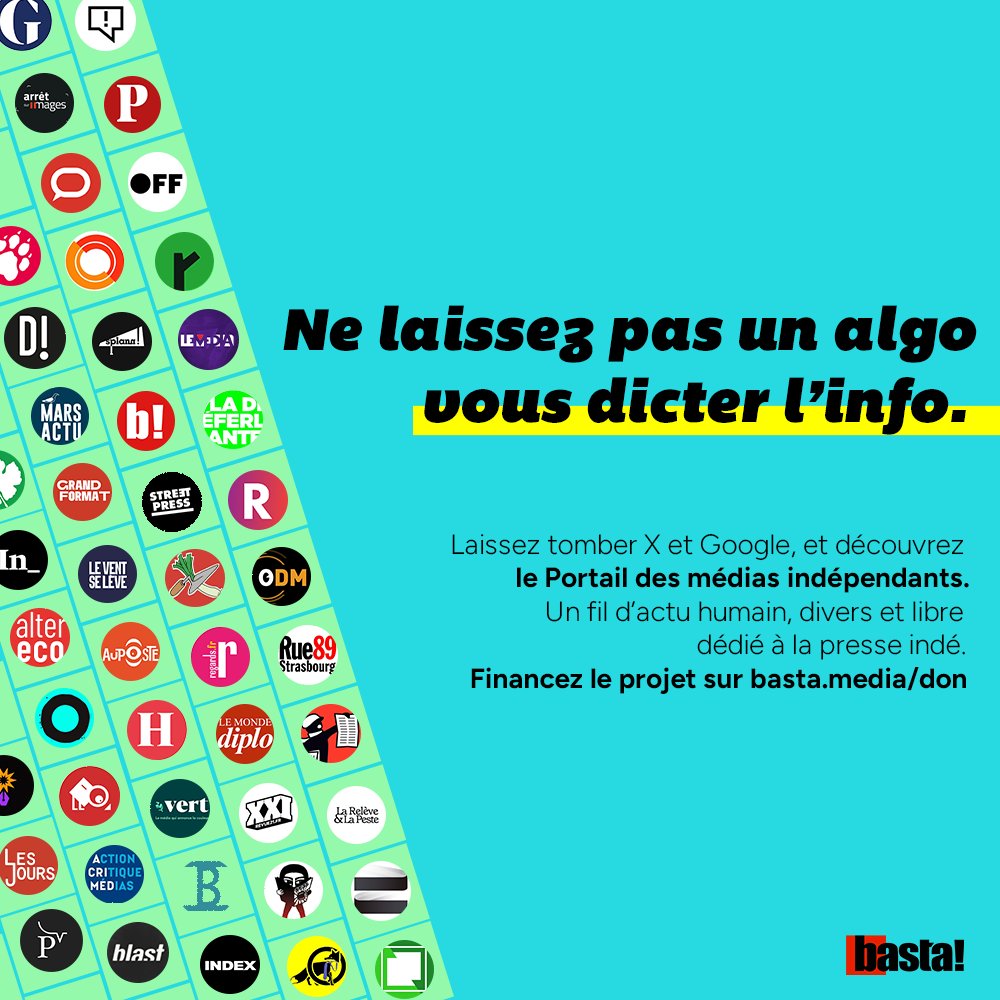
🔴 Il est temps de sortir des bulles de désinformation que deviennent X et Facebook. Avec le Portail des médias indépendants, pas d’algorithmes, mais des journalistes qui vous proposent une sélection d’articles de qualité, divers, fiables et vérifiés 👉 basta.media/don
Basta! tweet media
Français
3
11
16
4.6K
Sylvain de Campou รีทวีตแล้ว
Vat19
Vat19@vat19·
Can Humans Live Off Grass??
English
0
2
2
631
Sylvain de Campou รีทวีตแล้ว
jean marc manach
jean marc manach@manhack·
Cybersécurité : la @Courdescomptes met les hôpitaux en PLS Plus de 20 % des postes de travail et des serveurs ont « plus de 7 ans ou un OS obsolète » et 23 % des équipements réseaux et 22 % des applicatifs métiers ne peuvent plus être mis à jour... next.ink/163968/cyberse…
Français
1
13
6
1.1K
Sylvain de Campou
Sylvain de Campou@leGouter·
@SylvainDeaure Un petit livre synthétique sur le fonctionnement du cerveau, en particulier sur les biais cognitifs :
Sylvain de Campou tweet media
Français
0
0
1
50
Sylvain Deauré
Sylvain Deauré@SylvainDeaure·
Ça fait écho à plusieurs podcasts "Sur les épaules de Darwin" de Jean Claude Ameisen, sur la mémoire et l'oubli.
Rohan Paul@rohanpaul_ai

Your brain doesn't forget - it just loses the keys to unlock memories This paper introduces key-value memory architecture that separates storage and retrieval representations in brain memory systems, optimizing for both fidelity and discriminability. ----- 🧠 Original Problem: → Traditional memory models rely on similarity-based retrieval, limiting their ability to optimize separately for storage and retrieval → Current models can't explain how memories persist for decades despite rare access or how forgotten memories can be recovered ----- 🔑 Solution in this Paper: → The paper proposes a key-value memory system where inputs are transformed into two distinct representations: keys for memory addresses and values for memory content → Keys optimize for discriminability in retrieval while values optimize for storage fidelity → The hippocampus acts as key storage, while neocortex serves as value storage → Memories are accessed by matching queries to keys, then retrieving values weighted by match strength ----- 💡 Key Insights: → Memory failures occur due to retrieval issues, not storage limitations → Information once stored is never permanently lost → The brain implements error correction through attractor dynamics → Hippocampal representations optimize for discrimination while neocortical ones optimize for semantic content ----- 📊 Results: → Model demonstrates recovery of "silent" memories without retraining → Achieves 99% accuracy on initial tasks and 95% on subsequent tasks → Shows graceful degradation instead of catastrophic forgetting → Outperforms flexible encoders trained to minimize reconstruction error

Français
1
0
1
188
Sylvain de Campou รีทวีตแล้ว
WPMarmite
WPMarmite@wpmarmite·
Ne passez pas vos vacances de Noël à choisir vos plugins 🎄❌ Découvrez notre boîte à outils [OFFERTE 🎉] : la liste des 25 PLUGINS INDISPENSABLES pour votre site WordPress. Pour tous les types de sites ! Liste parcourue par + de 18 000 personnes en 2024.
Français
0
2
7
157.7K
Sylvain de Campou รีทวีตแล้ว
Baptiste Guiraud
Baptiste Guiraud@tistou80·
#iA #SEO #formation Jusqu'au 24 décembre au soir, un coaching d'une heure vous est offert pour l'achat de la formation. Profitez-en !
Baptiste Guiraud tweet media
Français
1
4
3
1.1K
Raphael Doucet
Raphael Doucet@RaphSEO·
@VictorLerat Ma réponse à ta dernière phrase : NON. 18 ans que je me bats avec mon entourage pour expliquer l'usage du net et de son image dessus, mais je passe pour un hurluberlu. Après tout c'est vrai, qu'est-ce que j'y connais au web moi ^^
Français
1
0
2
214
Victor Lerat
Victor Lerat@VictorLerat·
Très sympa à regarder ! Belle prod et beaucoup de pédagogique à l'intérieur. Espérons que les parents regardent cela et arrêtent de poster des photos / vidéos de leurs enfants sur le web 🙄 youtube.com/watch?v=jYujNv…
YouTube video
YouTube
Français
1
0
2
366
Sylvain de Campou รีทวีตแล้ว
Basta!
Basta!@bastamedia_·
Des menaces pèsent sur la presse indé ❌Les réseaux sociaux l'invisibilisent ❌Google proposera des réponses d’IA, fini les articles ❌Les discours d’extrême droite polluent la presse des milliardaires Il est temps d'avoir un Google actu des médias indés basta.media/don
Basta! tweet media
Français
4
34
37
3.7K
Sylvain de Campou รีทวีตแล้ว
Maxime Combes
Maxime Combes@MaximCombes·
« Quand allons-nous mettre en place l’inéligibilité à vie pour tous ceux qui ont été condamnés pour des faits commis à l’occasion de leur mandat ? » demandait Marine Le Pen, le 5 avril 2013, sur @publicsenat.
Français
16
389
653
23K