ทวีตที่ปักหมุด

I've seen many people sharing on X that all the Aeons look Unique,
Let me walk you through the tech process behind generating the full collection!
The whole process started when @basil_btc shared the first traits, we needed to find a way to make all of them look good together...
We started by manually generating some different looking Aeons while trying to identify which interactions were problematic or just didn't look good enough.
First Aeons generated:
Noticeable problems:
- Background too chaotic, doesn't allow to clearly identify the main figure.
- Eyes and Head Traits don't fit well together, making the eyes look like they were later glued to the picture.
- Too many colors, makes the image look confusing to people's eyes.
This procedure alone lead us to scrap multiple traits...
Some examples:
Once the majority of the traits were ready the real generation process started.
@LocoMinds started randomly generating some Aeons to identify eventual issues and wrote down a set of rules/restrictions that would avoid any kind of problems...
In the meantime we were working on a custom script that would allow us to generate new images following all the rules that were recorded by Loco.
This part of the process resulted in a set of 51 global rules regarding conflicts between traits, colors not matching and other smaller details that we didn't want to include in the final collection.
We then proceeded to generate 4000+ Aeons that were manually selected to match the final collection size.
Got to this point we also had to think on how we were going to inscribe the full collection on-chain. We couldn't use a standard recursive script since we had some necessities that couldn't be ignored...
Shoutout to @luminexio for providing a solid standard to work on!
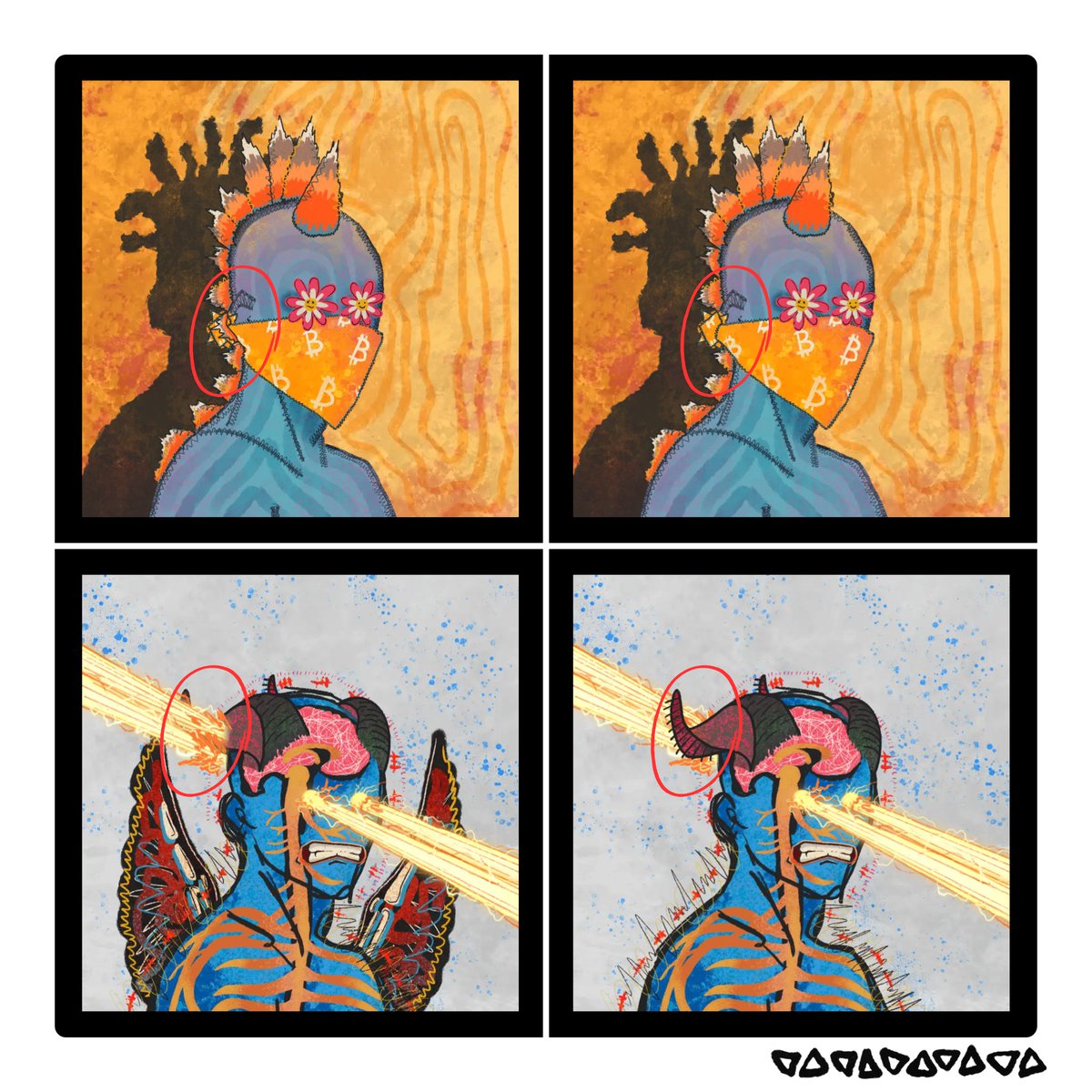
Until that very moment we used a standard layering order, but we needed to be able to switch it for some generations. We also had to find a way to include all the Uniques ("1/1s").
Examples of some generations where we needed to switch the layers:
One last thing was missing, something I like to call "twins hunt". We didn't want any generation to look too similar to the others, every Aeon had to have their own vibe.
We needed to create a program that would easily identify twins both based on common traits but also on aesthetics. How'd we do that?
Every generation was inspected based on the traits coverage, the amount of different non-transparent pixels present among two traits.
The output was a bunch of 3303x3303 graphs where we could easily check the traits distribution, but also the global collection distribution.
Once we had a complete picture of the final collection, we manually checked all the identified twins. We deleted the most obvious duplicates, and the less obvious ones were manually modified to make them look unique.
We were finally ready to inscribe!
In this article, I tried to cover all the key aspects and challenges of generating the Aeons collection. I also aimed to explain all the concepts simply, making it a light read rather than a highly technical post. In hindsight, there are some things we could have done differently. However, art is beautiful because there is no "perfection", everyone has different opinions and tastes.
〜 Ξxplore Art 〜



English