mohrt

17.8K posts

mohrt

mohrt

@mohrt

Handcash $mohrt

Lincoln NE เข้าร่วม Mayıs 2008
281 กำลังติดตาม2.6K ผู้ติดตาม
100% Strategy
100% Strategy@StrategyMaxi·
Retiring in 7 years. Mid-30s. How? 100% MSTR. That’s it. You only need 300 shares held until 2033. Then two paths open: Live a life of leisure forever or go change the world. Wealth. Power. Focus. That’s all you need.
English
47
10
319
23.5K
Juliettee
Juliettee@ravenwood1234·
@Cointelegraph Quantum resistance has finally moved from theory to a playable testing environment
English
1
0
7
1.2K
Cointelegraph
Cointelegraph@Cointelegraph·
⚡️ NEW: Bitcoin Quantum has launched testnet v0.3 with the first live deployment of BIP 360, a quantum-resistant upgrade for Bitcoin.
Cointelegraph tweet mediaCointelegraph tweet media
English
119
345
2K
84.5K
mohrt
mohrt@mohrt·
S Tominaga (Aka Dr Craig Wright)@CsTominaga

Why the Essay Matters as a Governance Argument The importance of the essay lies in the fact that it identifies a governance problem where most commentary sees only a technology problem. That distinction is not decorative. It is decisive. Technology problems invite engineering fixes. Governance problems invite disclosure rules, fiduciary duties, legal accountability, and institutional redesign. A chain can patch software. It cannot patch away the consequences of anonymous power merely by refining code. The essay matters because it forces that recognition. The first major significance of the piece is that it restores beneficial ownership to the centre of analysis. This is what so much crypto commentary systematically evades. It talks about stake distribution, voting participation, validator concentration, and protocol legitimacy while bypassing the one question that determines whether those metrics mean anything at all: who actually controls the positions? The essay makes that omission impossible to ignore. It shows that without beneficial ownership, all the usual metrics are radically incomplete. They may tell you what is visible on-chain, but they do not tell you who governs the institution. And governance is the issue. This is not a semantic point. It goes to the structure of accountability. In every serious system of corporate or financial governance, the reason beneficial ownership matters is obvious. If someone controls an institution, other stakeholders need to know who that person is. Regulators need to know. Courts need to know. Minority participants need to know. Disclosure is not an optional courtesy. It is the precondition for any meaningful regime of fiduciary duty, conflict management, and remedial enforcement. Anonymous governance destroys that architecture at the root. One cannot hold a hidden controller to account in any practical sense. One cannot test for collusion if the identities of the colluders are structurally unavailable. One cannot distinguish a dispersed constituency from a fragmented autocracy if the system recognises only keys and balances. The essay’s treatment of proxy voting is especially important for this reason. It identifies delegation in Proof of Stake not as a harmless convenience but as an unregulated transfer of governance power from beneficial owners to intermediaries. That is a precise and deeply damaging observation. In orthodox finance, proxy voting is regulated because agency risk is real. The person casting the vote may not share the incentives of the person whose capital is exposed. Hence disclosure, solicitation rules, fiduciary obligations, conflicts analysis, and institutional supervision. In Proof of Stake systems, by contrast, delegation is often praised as frictionless participation. The essay punctures that fantasy. Frictionless for whom? Convenient for whom? The delegator may earn yield, yes. But his voting power is effectively warehoused by a validator or exchange actor who owes him little or nothing in governance terms. That means the essay is important because it identifies a domain in which crypto has quietly recreated the very agency problems that traditional finance regulates most heavily, only without the surrounding legal discipline. The rhetoric of innovation has disguised not the elimination of old governance risks, but their return in a more permissive form. Validators inherit votes. Exchanges aggregate power. Retail holders are passive. Conflicts of interest are murky. Participation is selective. Power accrues to those with operational leverage and informational advantage. None of this is unfamiliar. It is textbook governance pathology. The novelty is only that it has been presented as a feature rather than a defect. The essay is also important because it attacks one of the most abused habits of modern crypto discourse: substituting countable surface units for actual institutional analysis. The reason address counts, validator counts, and Nakamoto coefficients are so popular is not only that they are convenient. It is that they create the appearance of scientific rigour while avoiding the hard question of control. Numbers impress. Dashboards reassure. But if the units being counted are pseudonymous and cheaply multiplied, then the resulting metrics may be little more than decorative arithmetic. The essay’s importance lies in exposing that possibility. It does not say every address-level metric is worthless. It says such metrics are incapable, by themselves, of proving the thing they are most often invoked to prove. That is devastating because it means one of the field’s favourite forms of evidence is at best partial and at worst misleading. Another reason the essay matters is that it reframes the threat model. Public discussions of crypto risk often focus on crime, hacks, volatility, and consumer harm. Those are real. But the essay points to something more fundamental: constitutional capture. A system may continue to function, transactions may clear, consensus may hold, and prices may move, while governance has already been colonised by unseen controlling actors. That is a more serious problem than episodic theft because it attacks the terms under which all future decisions will be made. Treasury allocations, protocol changes, reward policies, admission rules, sanctions responses, dispute handling—all of it can be shaped by hidden concentrations of power. A network can therefore be compromised without ever displaying the theatrical symptoms that ordinary users have been trained to watch for. The essay matters, then, because it brings the language of institutional seriousness back into a field addicted to slogan and spectacle. It says that the critical question is not whether a network looks open, noisy, and numerically distributed. The critical question is whether governance power can be traced to accountable beneficial owners and constrained by mechanisms proportionate to its economic significance. If the answer is no, then all the aesthetic language about open participation and community rule begins to look childish. There is also an unmistakable political significance to the essay. It challenges the ideological habit of treating opacity as liberation. That habit has been one of the crypto sector’s great evasions. Hidden control is dressed up as privacy. Unaccountable voting is dressed up as censorship resistance. Regulatory absence is dressed up as neutrality. The essay tears this costume apart. It shows that when real money, real institutional resources, and real governance outcomes are involved, opacity does not emancipate the weak. It shelters the strong. It allows organised actors to hide within the statistical haze produced by systems that refuse to ask who anyone is. That is why the piece matters beyond crypto. It is a warning about what happens when the moral vocabulary of freedom is attached to mechanisms that in practice facilitate concealed domination. The essay’s significance, in the end, is that it restores a hard truth that finance learned slowly and painfully: power that cannot be seen cannot be disciplined, and power that cannot be disciplined will eventually be abused. That is not cynicism. It is history.

QME
0
0
1
123
BSV-Survivor
BSV-Survivor@denariuz_·
@mohrt is this recent? (I already know nobody will reply)
English
2
0
0
123
mohrt
mohrt@mohrt·
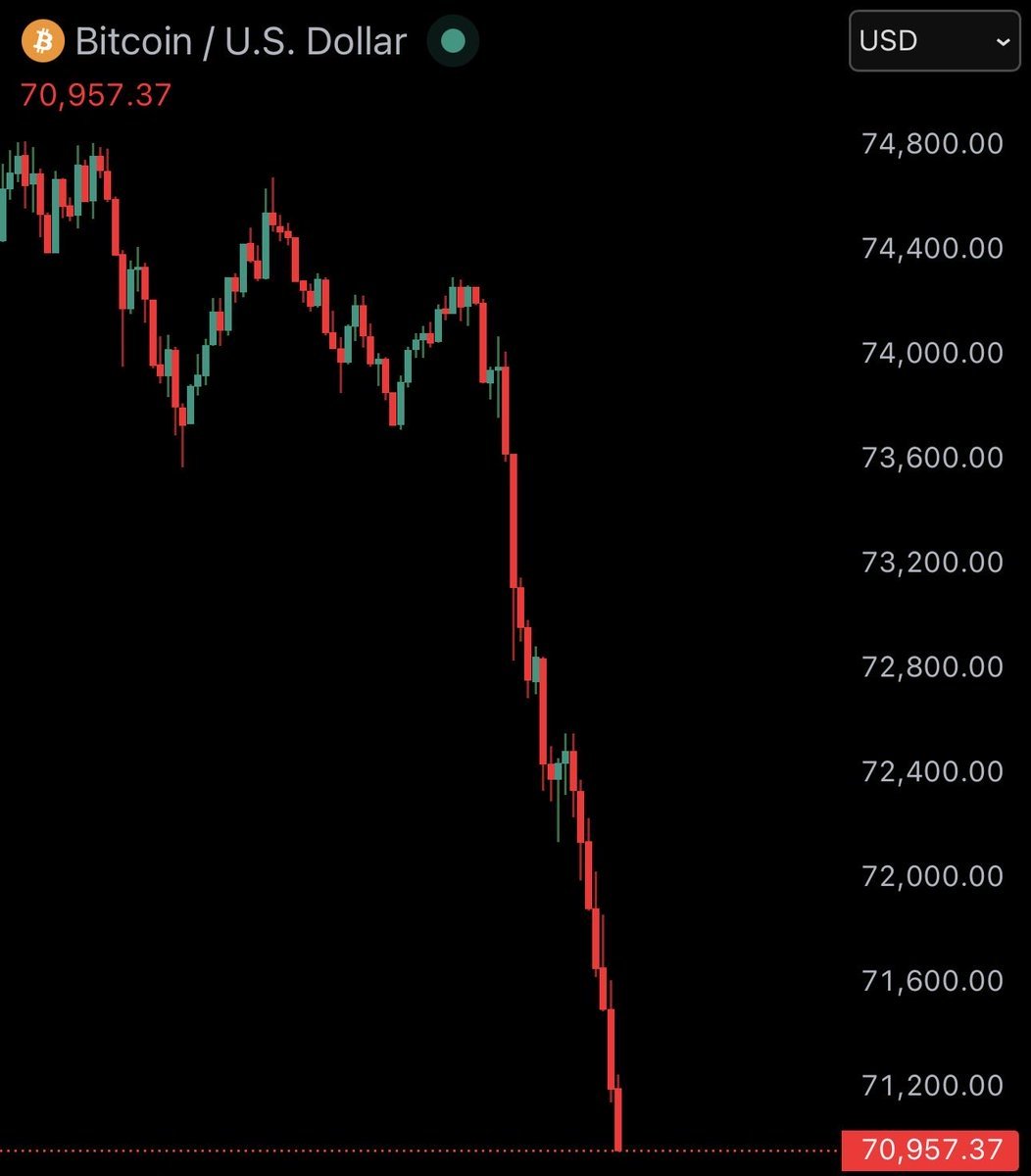
The "Coming Reckoning", when might that be? Next month? Next halving in 2028? How long can the BTC miners play chicken with Satoshi? 😅
mohrt tweet media
English
9
4
51
1.7K
mohrt
mohrt@mohrt·
@Bayalumaya1 No, rolling icebergs are happening constantly. Early coins keep waking up and dumping. Funded by Saylor. 😎
English
1
0
6
205
The enchanted Prince
The enchanted Prince@Bayalumaya1·
@mohrt We gave up on the 2020 and 2024 “rolling icebergs” are we giving up on 2026 too?
English
1
0
2
221
mohrt
mohrt@mohrt·
@_79b_ political views come up often. 😎
English
0
0
0
11
79b
79b@_79b_·
@mohrt then it's not often
English
1
0
0
18
mohrt
mohrt@mohrt·
Often political views cannot be corrected with logic or reason, but only with generational erosion. 😅
English
1
1
3
210
Lil Poker
Lil Poker@lilpokercom·
Fun fact: playing poker trains decision‑making under pressure and emotional regulation. Follow, repost, & drop your handle for a free $0.25 Sit & Go ticket.
Lil Poker tweet media
English
9
12
14
308
mohrt
mohrt@mohrt·
Reckoning 👀
S Tominaga (Aka Dr Craig Wright)@CsTominaga

Why the Essay Is Important for Regulation, Markets, and the Coming Reckoning The deepest importance of the essay is prospective. It is not only explaining a flaw. It is forecasting a collision. Specifically, it is forecasting the moment when regulatory systems that spent decades eliminating anonymous governance in traditional finance finally turn their attention to digital systems that have rebuilt it under a different banner. The essay matters because it suggests that the present calm is not evidence of sound design. It is evidence of regulatory lag. That lag is the condition under which whole industries become reckless. When a structure yields profits, growth, valuation, and ideological glamour before the law has properly classified it, market actors tend to mistake temporary tolerance for principled acceptance. The essay warns against exactly that mistake. It points to the abolition of bearer shares as the precedent that should sober anyone who imagines that pseudonymous stake-based governance will indefinitely be treated as a charming exception. The lesson of bearer shares was not that regulators dislike old paper instruments. The lesson was functional. Where governance power and beneficial ownership are severed, the system becomes a breeding ground for hidden concentration, self-dealing, and evasion. Once that principle is admitted, the technological wrapper ceases to matter very much. This is why the essay is important for regulators, even if they do not yet realise it. Much of current crypto regulation, including the European approach, is built around the market perimeter: issuers, intermediaries, disclosures, service providers, custody, conduct, prudential standards. Those questions matter, but they do not touch the constitutional interior of the protocol. They regulate the market around the instrument while leaving largely untouched the governance machinery that determines how the instrument’s native institutions are run. The essay identifies that blind spot with unusual clarity. It says, in effect, that the most dangerous governance defect may sit precisely where contemporary frameworks are least prepared to look. That is significant because regulatory blind spots do not remain academic for long when large pools of capital are involved. Treasury systems governed by token votes, validator sets shaping protocol parameters, exchanges and intermediaries warehousing effective governance power, pseudonymous actors fragmenting positions across wallets and entities—these are not curiosities. They are mechanisms capable of directing real economic outcomes. If the essay is correct, the likely future is one in which regulators begin to ask questions that the architecture of Proof of Stake is structurally bad at answering. Who controls this validator cluster? Who is the beneficial owner behind these voting blocs? Are these entities independent? Was this treasury allocation effectively self-dealing? Were delegators meaningfully informed? Were exchange-controlled positions used in governance without clear authority or instruction? Once those questions are asked at scale, the industry will discover that “the chain is transparent” is nowhere near an adequate answer. The essay is also important because it exposes a likely source of future market repricing. Markets tolerate opacity until they do not. As long as capital can pretend that governance is healthy, the fiction is serviceable. But once investors, institutions, counterparties, and regulators begin to internalise that address-level plurality may conceal entity-level concentration, the informational premium attached to many Proof of Stake networks becomes unstable. A system thought to be broadly governed may suddenly be viewed as susceptible to hidden control. A treasury previously seen as community-directed may be treated as vulnerable to extraction. Governance tokens may no longer be interpreted as participatory rights in an open polity but as instruments inside a regime whose actual power structure is unknown. That sort of shift is not cosmetic. It affects valuation, risk weighting, listing decisions, compliance posture, and institutional appetite. The essay therefore matters because it is not merely moralistic. It has balance-sheet implications. The moment the market recognises that anonymous governance is not a romantic oddity but a serious institutional defect, one should expect repricing. Some projects may survive that scrutiny by adopting stronger ownership disclosure, governance safeguards, delegation controls, and legally legible accountability mechanisms. Others may not. The essay is important because it points to the criterion by which that sorting could occur. There is also a jurisprudential importance to the piece. It invites the law to reason by function rather than by technical costume. This is one of the oldest and most powerful methods in serious legal analysis. Courts and regulators are often at their best when they ignore surface novelty and ask what a thing does. A device may be called a token, a protocol right, a governance participation mechanism, a staking instrument, or a decentralised coordination layer. Fine. What does it do? If in substance it allows unidentified persons to exercise materially significant governance power over economic institutions, then the law already possesses the conceptual tools to understand the problem. The essay matters because it supplies that bridge. It translates crypto’s self-description into a form legible to the traditions of financial governance. That translation has consequences for the industry’s favourite evasive claim: that regulation designed for old institutions cannot reach distributed digital systems because the ontology is different. The essay’s answer is merciless. If the governance effect is the same, the regulatory concern is the same. That is the sort of sentence that can travel. It can travel into policy papers, enforcement theories, academic literature, judicial reasoning, and institutional due diligence. Its force lies in its economy. It cuts through the fog of technical exceptionalism and returns the matter to first principles. The essay is equally important as a warning to those inside the industry who imagine that opacity can be managed informally. It cannot. Informal norms work poorly where there are large treasuries, divergent incentives, pseudonymous actors, and weak remedies. Communities talk endlessly about culture, legitimacy, and rough consensus. Very well. Those things are fragile even in systems with identifiable actors. In systems where control can be hidden, fragmented, delegated, and masked as dispersion, they are weaker still. The essay’s importance lies partly in refusing to romanticise self-governance under those conditions. It understands that when the capacity for concealment is large and the cost of multiplication is trivial, good intentions are not a governance framework. Ultimately the essay is important because it names the likely arc of events. First comes novelty. Then euphoria. Then the insistence that old legal categories do not apply. Then the slow accumulation of examples showing that the old human vices—concealed control, self-dealing, agency abuse, collusion—have not disappeared but have merely found a more frictionless habitat. Only after sufficient damage does the legal system harden. That pattern is ancient. The essay’s force comes from showing that crypto governance is not exempt from it. What gives the piece its lasting value is that it does not confuse technical sophistication with civilisational progress. The software may be intricate. The governance problem is primitive. Who rules? Can others know it? Can they constrain it? Can they remedy abuse? Those are old questions, and any system that shrugs them off because it has a ledger and a token deserves the reckoning coming toward it. The essay is important because it recognises that reckoning before the crowd does.

English
1
0
10
738
mohrt
mohrt@mohrt·
Why is @CoinGeek talking like BTC is Bitcoin?
English
8
0
19
2.4K
Rajat Soni, CFA
Rajat Soni, CFA@Rajatsoni·
The more you study Bitcoin, the more you will be convinced to own some The more you study a Ponzi scheme, the more you will NOT want to participate Why?
English
28
8
183
6.2K
BitcoinSV
BitcoinSV@PkO59B94XT2iNmC·
@abomac3 @mohrt Plz stop even coingeek also saying now BTC is Bitcoin. Look .
English
1
0
2
45
CoinEx Global
CoinEx Global@coinexcom·
How'd you describe crypto in one word?
English
108
10
98
8.1K
mohrt
mohrt@mohrt·
@EquityDiamonds Explain value when I HODL a 1000g bar of iron. 🤣
English
1
0
2
101