Dmitry Lomov (@mulambda.de)

2.2K posts

Dmitry Lomov (@mulambda.de)

Dmitry Lomov (@mulambda.de)

@mulambda

Google (identity; formerly Bazel V8, Blink, Chrome, TC39); Microsoft (F#); JetBrains(IntelliJ IDEA, ReSharper, Upsource) bsky: @mulambda.de

Munich เข้าร่วม Ekim 2009
115 กำลังติดตาม718 ผู้ติดตาม
ทวีตที่ปักหมุด
Dmitry Lomov (@mulambda.de)
Dmitry Lomov (@mulambda.de)@mulambda·
TL;DR: I abhor the aggressive actions of Russia’s current regime and my heart is with Ukraine and its people standing up to Putin's mad bullying. Thread: I am Russian by birth, by upbringing, and by my cultural affiliation (bloodlines are a bit more complicated). 1/
English
3
5
29
0
Dmitry Lomov (@mulambda.de) รีทวีตแล้ว
Anders K. Hvelplund
Anders K. Hvelplund@Falliblemusings·
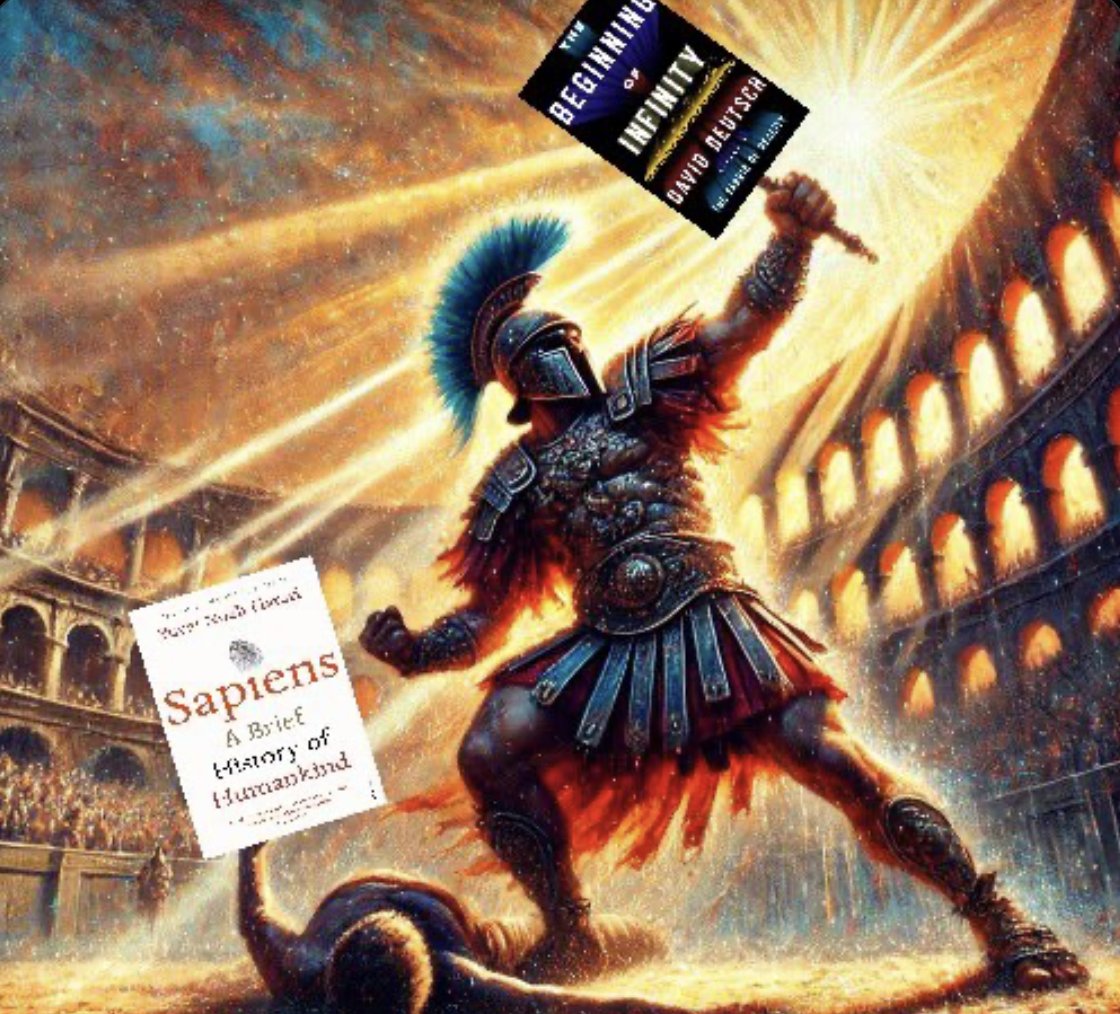
I used to think Sapiens was a great book. Sweeping, provocative, the kind of book that makes you feel like you finally understand the big picture of human history. It's on every CEO's bookshelf, assigned in universities, praised as a masterwork of synthesis. Yuval Noah Harari is treated as one of the serious thinkers of our time. But something nagged at me. Some passages felt off. Claims that human rights are just figments of our collective imagination, not real things, just stories we tell ourselves. That nations, laws, money, justice, doesn't exist outside our heads. That meaning itself is a delusion we've invented to cope. That we're far more powerful than ever before but not happier. That hunter-gatherers had it better because they had no dishes to wash, no carpets to vacuum, no nappies to change, no bills to pay. That sounded depressing to me, but was perhaps just the realistic scientific worldview? What it meant to see the world clearly, without comforting illusions. Then I read The Beginning of Infinity by @DavidDeutschOxf. Deutsch has a concept he calls 'bad philosophy.' Not philosophy that's merely false, but philosophy that actively prevents the growth of knowledge. Ideas that close doors rather than open them. That makes problems seem unsolvable by design. After soaking in Deutsch's framework (it's dense, a bit like digesting a delicious whale), it becomes clear: Harari's books are riddled with bad philosophy. They're smuggling nihilism in under the guise of scientific objectivity. Some examples: On meaning: "Human life has absolutely no meaning. Humans are the outcome of blind evolutionary processes that operate without goal or purpose... any meaning that people inscribe to their lives is just a delusion." On human rights: "There are no gods in the universe, no nations, no money, no human rights, no laws, and no justice outside the common imagination of human beings." On free will: "Humans are now hackable animals. The idea that humans have this soul or spirit and they have free will, that's over." On progress: "We thought we were saving time; instead we revved up the treadmill of life to ten times its former speed." The Agricultural Revolution? "History's biggest fraud." We didn't domesticate wheat, "it domesticated us." On our cosmic significance: "If planet Earth were to blow up tomorrow morning, the universe would probably keep going about its business as usual. Human subjectivity would not be missed." On the future: "Those who fail in the struggle against irrelevance would constitute a new 'useless class.'" Homo sapiens will likely "disappear in a century or two." This is bad philosophy. It tells us our problems are cosmically insignificant, our solutions are illusions, and that progress is neither desirable nor within our control. It's also perfect nonsense. No one would ever go back to being hunter-gatherers. Would you rather worry about your kid spending too much time on Roblox, or face the 50% chance she won't reach puberty? And our so-called "fictions"? They ended slavery. They gave women equal rights. They solved hunger. They eradicated smallpox. They turned sand into computer chips. They got us to the moon, and hopefully soon, to Mars and beyond. These "fictions" are already reshaping the universe, and over time they may become the most potent force in it. Now compare Deutsch: "Humans, people and knowledge are not only objectively significant: they are by far the most significant phenomena in nature." "Feeling insignificant because the universe is large has exactly the same logic as feeling inadequate for not being a cow." "Problems are soluble, and each particular evil is a problem that can be solved." "We are only just scratching the surface, and shall never be doing anything else. If unlimited progress really is going to happen, not only are we now at almost the very beginning of it, we always shall be." Where Harari sees a species of deluded apes stumbling toward obsolescence, Deutsch sees universal explainers, the only entities we know of capable of creating explanatory knowledge, solving problems, and potentially seeding the universe with intelligence. The difference isn't academic. Ideas shape action. If you believe life is meaningless, progress is a trap, and humans are hackable animals with no free will, how does that affect what you build? What you fight for? What you teach your children? Harari's books sell because they flatter a fashionable pessimism. They let readers feel sophisticated for seeing through the "delusions" everyone else lives by. That smug cynicism is corrosive. And it's everywhere: in schools, in media, in bestselling books. More than half of young adults now say they feel little to no purpose or meaning in life. This is what happens when you teach an entire generation bad philosophy. Less progress, less health, less wealth. Less flourishing. And ultimately, a higher chance that civilization and consciousness go extinct. Fortunately, there's another equally well-written, but much truer, account of homo sapiens, appropriately titled 'The Beginning of Infinity'. And this one smuggles no despair in by the backdoor. But let's give Harari credit where it's due. He is right about one thing: if planet Earth blew up tomorrow, we wouldn't be missed. Because there'd be no one left to miss us, just a careless universe, blindly obeying physical laws. We are the only ones who can miss, but we're not going to. We're going to aim, hit, and keep going. Full credit for the amazing meme to @Ben__Jeff
Anders K. Hvelplund tweet media
English
862
1.5K
9.2K
900K
Dmitry Lomov (@mulambda.de) รีทวีตแล้ว
Ruth Deyermond
Ruth Deyermond@ruth_deyermond·
It's New Year, so time to look back and forward. These are 10 things I think we need to recognise in 2026. It’s a response to what I think are profoundly damaging mistaken assumptions I’ve heard and read from practitioners, journalists, and analysts in 2025. Warning: very long🧵
English
37
484
1.1K
258.1K
Dmitry Lomov (@mulambda.de) รีทวีตแล้ว
No Context Brits
No Context Brits@NoContextBrits·
No Context Brits tweet media
ZXX
78
484
8.8K
340.3K
Dmitry Lomov (@mulambda.de)
I am German by choice and I agree
Sabine Hossenfelder@skdh

I don't know why so many Americans have this idea that Germans all feel guilty about WWII. I don't know anyone my generation or even my parents' generation who feels this way. I think this is a story that Americans are telling themselves. What is true is that at least the Germans I know feel a responsibility to make sure what happened in Nazi Germany doesn't happen again, not here, and not anywhere else. I certainly do. This is why we are scared by what we see happening in the United States. The concentration of power, the streamlining of opinions, the normalization of evil, and the populism to excuse it. These are all warning signs we were taught to recognize. Americans have this idea that the Holocaust happened in Germany because something is especially wrong with Germans. We're just somehow especially evil. This is why the bad guys in Hollywood movies are always Germans. This is why they make jokes about our supposedly military sounding language. I strongly disagree. What happened in Germany could have happened anywhere. It's just that Hitler was the first to exploit this weakness. He was a master of mass manipulation (probably strongly influenced by Le Bon's "The Crowd" -- worth a read if you don't know it). Now we have new masters of mass manipulation. And of course Germans worry about it. Don't confuse what we feel is our responsibility with guilt. Yes, ugh, "responsibility". That sounds terribly German, doesn't it. I'm sure you read this wiz a Schermen eksent. No, I'm not proud to be German. Why would I? I didn't do anything for it, I just happen to have been born to two Germans. But I am glad I am German because all things considered it's a good country. But if it was possible to just identify as Earthling and not belong to any country, that's what I'd want to be.

English
1
0
0
270
Dmitry Lomov (@mulambda.de) รีทวีตแล้ว
Fin Moorhouse
Fin Moorhouse@finmoorhouse·
Some wisdom about learning from @AndyMasley
Fin Moorhouse tweet mediaFin Moorhouse tweet media
English
3
9
43
6.2K
Dmitry Lomov (@mulambda.de) รีทวีตแล้ว
Mehrdad Farajtabar
Mehrdad Farajtabar@MFarajtabar·
1/ Can Large Language Models (LLMs) truly reason? Or are they just sophisticated pattern matchers? In our latest preprint, we explore this key question through a large-scale study of both open-source like Llama, Phi, Gemma, and Mistral and leading closed models, including the recent OpenAI GPT-4o and o1-series. arxiv.org/pdf/2410.05229 Work done with @i_mirzadeh, @KeivanAlizadeh2, Hooman Shahrokhi, Samy Bengio, @OncelTuzel. #LLM #Reasoning #Mathematics #AGI #Research #Apple
Mehrdad Farajtabar tweet media
English
385
1.2K
5.6K
1.6M
Ilya Sergey
Ilya Sergey@ilyasergey·
Fun fact: almost 20 years ago, building an IDE for OCaml on top of IntelliJ IDEA was some undergrad’s course project. Everyone in JetBrains laughed at it. That undergrad wasn’t me, btw: my project was IntelliJ support for Scala. Everyone in the company laughed at it too.
KC Sivaramakrishnan@kc_srk

Good to see a "big IDE" company take an interest in building "A next-generation IDE for OCaml". If you have an interest in this topic, please do chime in. discuss.ocaml.org/t/a-next-gener…

English
4
8
144
8.8K
Dmitry Lomov (@mulambda.de) รีทวีตแล้ว
Liquid Robin Poe
Liquid Robin Poe@Sheepladdev·
No one is left brained or right brained. No one is an introvert or an extrovert, you are not a empath, Gary Chapman is wrong you don’t have one of 5 love language:, Myers Briggs is a hack there are no 16 personalities. Every generation we find a way to reinvent Zodiac signs
English
214
1.9K
20.3K
584.2K
Dmitry Lomov (@mulambda.de) รีทวีตแล้ว
ian bremmer
ian bremmer@ianbremmer·
usa. what a comeback
English
18
13
427
49.2K
Dmitry Lomov (@mulambda.de) รีทวีตแล้ว
Shaun Walker
Shaun Walker@shaunwalker7·
It was a joyous exchange but had an undertone of sadness, because one man who was supposed to be there, for whom the whole exchange had initially been designed - Navalny - died/was murdered before it happened. My story, building on great WSJ reporting. theguardian.com/world/article/…
English
19
88
440
82K
Dmitry Lomov (@mulambda.de) รีทวีตแล้ว
ed(1) Conference
ed(1) Conference@ed1conf·
ed(1) Conference tweet media
ZXX
3
23
160
13.9K
Jonny Tickle
Jonny Tickle@jonnytickle·
Does anyone have any recommendations for headphones you can wear in the banya?
English
8
0
8
3.7K
Dmitry Lomov (@mulambda.de) รีทวีตแล้ว
Steve Martin
Steve Martin@UnrealBluegrass·
Still makes me smile.
Steve Martin tweet media
Crescent Springs, KY 🇺🇸 English
213
3.9K
32.4K
2.8M
Dmitry Lomov (@mulambda.de) รีทวีตแล้ว
Agathe Demarais
Agathe Demarais@AgatheDemarais·
Reading the news, one would be forgiven to think export controls on Russia aren’t working. Yet catchy headlines on sanctions evasion miss the big picture - in an op-ed for @POLITICOEurope I explain why export controls on Russia work better than we think 👇 politico.eu/article/export…
English
8
99
262
44.1K