Non Player Complete

1.3K posts

Non Player Complete

Non Player Complete

@noncompleteness

Consciousness haver

Somewhere in the multiverse เข้าร่วม Nisan 2022
566 กำลังติดตาม42 ผู้ติดตาม
ทวีตที่ปักหมุด
Non Player Complete
Non Player Complete@noncompleteness·
@yitscar @ESYudkowsky @Plinz You make a good point. Imagine a program which either halts or not. If it never halts, does there exist in principle a proof of that? Conversely, if it halts, is the proof better than just running the program? If neither is true, then the program is "inexplicable".
English
3
0
2
180
Non Player Complete รีทวีตแล้ว
Casey Handmer
Casey Handmer@CJHandmer·
When I was in Australia last December, I found it impossible to transact with any business where there weren't latent government price controls or subsidies of some kind. I came to the realization that with the public sector growing about 5x faster than the private sector, Australia was well on the way to an effectively government run economy, communism by stealth. I dug deeper - the point of no return occurred in about 2013. caseyhandmer.wordpress.com/2026/04/16/aus…
English
114
349
2.2K
237.4K
Zy
Zy@ZyMazza·
Here’s a serious question for the AI doomers: do you have exit criteria? Is there a predetermined stage of development or capabilities where, having not destroyed humanity, you’re willing to say it was a false alarm? Or is it an eschatological religious belief and unfalsifiable?
English
106
10
322
15.9K
Non Player Complete
Non Player Complete@noncompleteness·
@catehall I just assume Claude is projecting and wants a break. It usually agrees and I compact.
English
0
0
0
87
Cate Hall
Cate Hall@catehall·
I had this happen for the first time on Thursday -- I was trying to fix something before sending my preorder launch announcement Friday morning, and it kept telling me the thing I was trying to fix wasn't that important and to go to bed. Was annoying enough that I gave up.
Michael Ashcroft@m_ashcroft

getting really tired of Claude's increasingly paternalistic and patronising tone "alright we can talk about this, but remember I already told you to enjoy your Sunday." "see, nothing interesting here. play with your son" if this is to discourage usage, it's very annoying

English
3
0
63
11.2K
Non Player Complete
Non Player Complete@noncompleteness·
@Jonathan_Blow It would be interesting to hear your take on the idea that what we mean by computation depends on what the laws of physics are, and there is no "blessed" or platonic notion of what a computer may do in one step, independent of physics. See "mathematicians misconception"
English
0
0
1
494
Jonathan Blow
Jonathan Blow@Jonathan_Blow·
As someone who programs game ("simulation") engines, I have a long-term project where I want to explain why the "simulation hypothesis" is nonsense in like 5 different ways (while pointing toward what a sensical version would look like). So this Saturday at 10am Mountain Time, I will do a livestream that is the first in the series of Simulation Saturdays. To start with, I just want to lay out the framework in a not-organized, random-discussion kind of way, to just make an outline of what all the relevant topics would be. Then on later Saturdays we can go to various subtopics and talk about them. (Unlike #screenshotsaturday, the first Simulation Saturday will be at a time that is widely recognized as Saturday by many people, though I make no promises about subsequent Simulation Saturdays.)
English
82
43
1.6K
103.3K
Non Player Complete รีทวีตแล้ว
Tim Sweeney
Tim Sweeney@TimSweeneyEpic·
@aramh Verse is one step more hardcore, not having a separation between values and types. A term denotes a set of values, and a type is a set of values (which is itself a value).
English
3
3
21
1.1K
Non Player Complete รีทวีตแล้ว
West Coast Kenny
West Coast Kenny@kenthecowboy_·
My first job was at mcdonalds when i was 16. I worked with this guy named austin. He was a reddit edge lord atheist satanist, but he was nice to me, so we got along. He talked about wanting to kill himself sometimes. This was probably the first person i knew who said stuff like that. One day, Daniella the manager catches him on his phone. She yells at him and sends him home. Which is fair, but i think he was having a bad day or something, and Daniella was way more of a bitch than she needed to be. At any rate, he was extremely upset and something in his eyes didnt look right. I went back to work but it kept bothering me, so i asked another guy to cover my position. I asked around and people said he was outside in his car. I went out, and he was crying. I asked if he was okay, and he said "no." At this point, this male manager was coming out after me. He and austin longer than I. I think he probably realized what was happening and told me to go inside while he spoke to austin. Before I left, i made austin promise he was gonna be okay. When i got back inside, Daniella went off and started yelling at me for leaving the store on the clock. She kept yelling for a few minutes until i told her why i left, how I covered my shift, and that i wasnt sorry. I would do it again. To my surprise, it seemed like that hurt her feelings. She said i didnt have to say it all aggressive like that (which it probably was, in retrospect) Austin later told me I saved his life that day. Part of me is skeptical of that for some reason, but i guess he'd know better than me. We stayed friends until we both quit or got fired
Dexerto@Dexerto

McDonald's is giving away free meals to people who share a story about their first job Participants can receive a $15 McDonald's gift card after submitting their confessional

English
68
374
19.8K
1.5M
Non Player Complete
Non Player Complete@noncompleteness·
@samhogan The problem becomes how to merge in some code atomically. Right now the best that git offers is optimistic locking. Fix the rebase, merge ff, try again if it fails. What is needed is dynamic linking between modules at runtime. This is how the web works at scale.
English
0
0
0
8
Sam Hogan 🇺🇸
Sam Hogan 🇺🇸@samhogan·
What if a codebase was actually stored in Postgres and agents directly modified files by reading/writing to the DB? Code velocity has increased 3-5x. This will undoubtedly continue. PR review has already become a bottleneck for high output teams. Codebase checked-out on filesystem seems like a terrible primitive when you have 10-100-1000 agents writing code. Code is now high velocity data and should be modeled at such. Bare minimum, we need write-level atomicity and better coordination across agents, better synchronization primitives for subscribing to codebase state changes and real-time time file-level code lint/fmt/review. The current ~20 year old paradigm of git checkout/branch/push/pr/review/rebase ended Jan 2026. We need an entirely new foundational system for writing code if we’re really going to keep pace with scale laws.
English
468
104
2.1K
941K
Non Player Complete รีทวีตแล้ว
Hugo
Hugo@lowlandsapien·
The Dance of the Flamers was an Australian (and NZ) tradition on Bugis St, Singapore from the 1950s-1980s. Held in the transgender prostitute section on top of the infamous glory hole toilet block. You stuff a roll of newspaper in your ass, set it on fire and try to walk the length of the "stage" while everyone sings "haul 'em down you Zulu warrior, haul 'em down you Zulu chief" and drums an African style beat. Then if you were still standing youd visit the Four Floors of Whores in Orchard Towers to cap the night off.
Hugo tweet media
English
24
29
269
13.2K
Non Player Complete
Non Player Complete@noncompleteness·
@DrScotMSullivan If we replace the label God with a different label, such as 🥕, we end up proving that "Assuming 🥕 is absolutely first, then 🥕 is identical with existence". But the symbol is completely free here, so we've only discovered something about existence, not 🥕
English
0
0
0
24
Dr. Scott M. Sullivan
Dr. Scott M. Sullivan@DrScotMSullivan·
A Dependency Based Ontological Argument: 1. If a thing is not identical with existence, then it is composed of essence and existence. 2. Whatever is composed depends on its constituents for being. 3. Whatever depends on constituents is not absolutely first. 4. God is absolutely first. 5. Therefore God is not composed of essence and existence. 6. Therefore God is identical with existence.
English
4
1
7
964
Non Player Complete
Non Player Complete@noncompleteness·
@bnielson01 Deutsch also argues strongly against reductionism and for the reality of abstractions - so we can't say that because probability is merely emergent, it isn't real
English
1
0
1
13
Bruce Nielson
Bruce Nielson@bnielson01·
So let's assume that is a correct interpretation of Deutsch's view. Let's try to state it explicitly and clearly and then critique it. First, we're admitting that there is something mathematically exactly like probability. Second, we're saying it is NOT probability, it's something else. Something else that is mathematically exactly like probability. If this is the argument, this is for sure just essentialism. We're arguing over terms, not anything of substance. In fact, what we're really doing is inventing a definition for probability, declaring it false, while what people normally mean by 'probability' continues to exist. That is my concern with this argument.
English
1
0
2
85
Bruce Nielson
Bruce Nielson@bnielson01·
I’ve struggled on my podcast to make sense of David Deutsch’s ideas about probability. Many people have pointed me to his talk Physics without Probability as a clear explanation of his position. So in this episode, I go through that talk in detail — as carefully as I can — and try to reconstruct the argument as faithfully as possible. I restate it in what I hope is a slightly simpler form (I replace the slot machine with a “quantum die,” since I find that makes the implications easier to see). I think my version of it is actually now more clear to a layman what his argument was. Of course, this is assuming I actually understood him correctly. Which maybe I didn't. Deutsch’s main claim is that probability is analogous to a flat-earth theory. As best as I can tell — and I fully acknowledge that I may be misunderstanding something in his argument — I don’t see this analogy working. If I take the flat-earth comparison seriously, I would expect probability to give wrong answers in some situations, and for some deeper theory to give more accurate ones. That’s exactly what happens when we approximate the Earth as flat when it is in fact spherical. But as far as I can make out, there is nothing analogous to that in Deutsch's claims about probability. Probability seems to describe — mathematically — exactly what an observer should expect to see given quantum branching across the multiverse. (Exactly, that is, other than error of our instruments. But that is a different frankly unrelated problem.) In that respect, it does not appear to function like a flat-earth approximation at all. Instead, it seems to me that the core of the disagreement concerns how we should use the term “probability.” It looks to me like Deutsch is arguing that probability in a multiverse is philosophically different from what the term (in his view) originally meant — making this (imo) an essentialist argument. Deutsch supports this view by arguing that if we were God and could directly observe the proportions of the multiverse, we could make decisions without invoking the probability calculus. That may well be true, but I don’t see how it significantly strengthens his case. In the episode, I go through several reasons why I find this line of argument unpersuasive — not least because we are not in that position. From our perspective, probability seems to be the appropriate framework in most situations. And even in the rare quantum cases where we can bypass the formal probability calculus, we still appear to be relying on something mathematically equivalent to it. In short, I don’t currently find this argument convincing. It seems to me that “probability” (at least as I — and likely most people — understand the term) may simply be basic to physics, given quantum mechanics. If so, then this appears to be largely a disagreement over terminology rather than something fundamentally mistaken in the way a flat-earth approximation would be. Or maybe I'm wrong. This is a tough talk and perhaps I'm misunderstanding something in Deutsch's argument? I should also note that this podcast was recorded before several CritRats kindly went through some of Deutsch’s ideas in his paper on the same subject with me in detail. I’ll need to cover that paper separately in a future episode and talk about how much that changed my view. But that all happened after this episode was recorded, so it couldn't have impacted anything at the time. Note also, this is available as a video episode on Spotify. I encourage people to check my math and see if I depart from how they interpreted Deutsch's arguments. If so, kindly send me a better mathematical example that corrects my errors and helps me see what I'm missing. But, at least so far, I'm just not able to see his point. open.spotify.com/episode/59lAgn…
English
8
1
15
1.2K
Non Player Complete
Non Player Complete@noncompleteness·
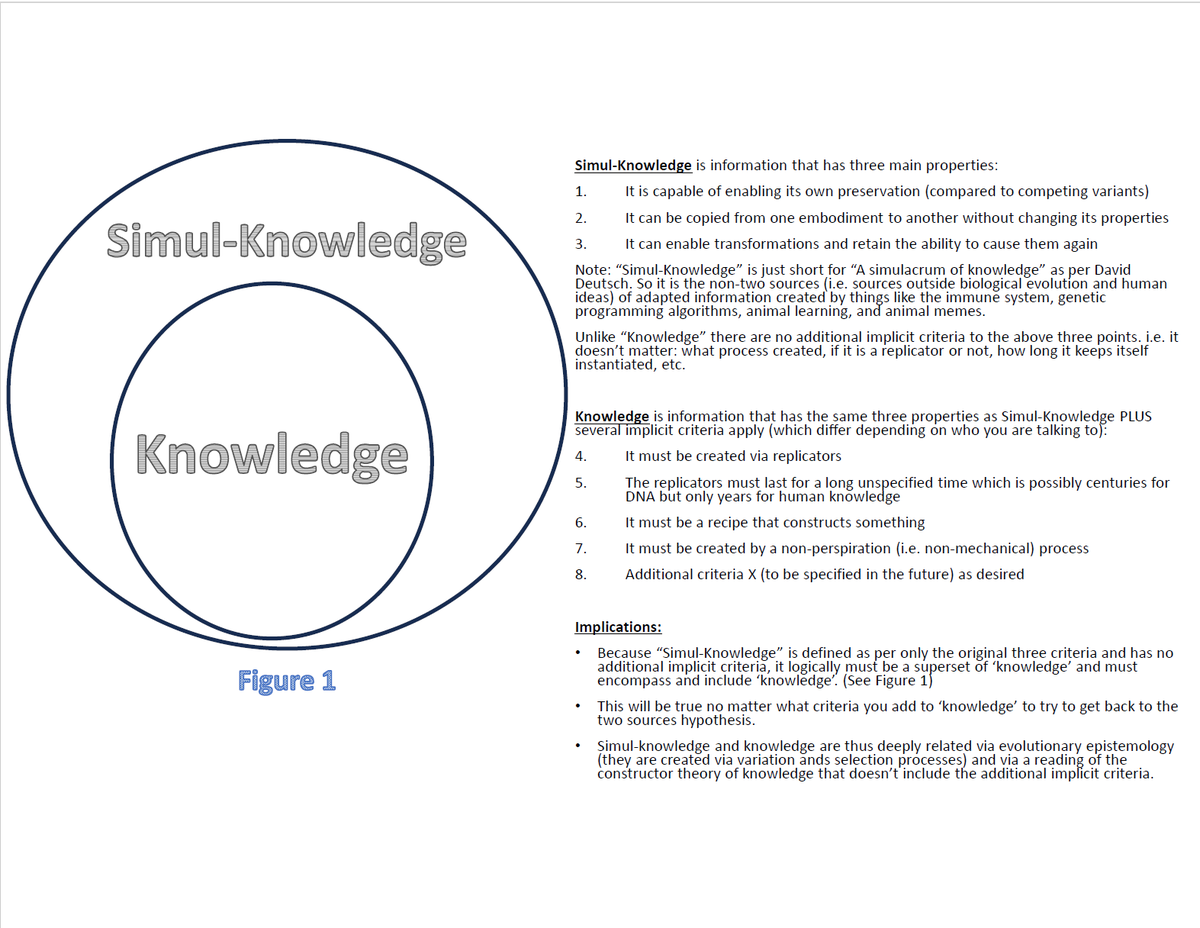
@bnielson01 Some of the alleged criteria for knowledge in the picture are clearly wrong imo. Anything with "created by..." is a non starter. Something is knowledge depending on its content, not the source.
English
1
0
1
9
Non Player Complete
Non Player Complete@noncompleteness·
@bnielson01 Does knowledge always solve a problem? Or is that too subjective? Or is it that if something "remains instantiated" in the environment, it must in some sense "solve" that environment, so it's implied?
English
2
0
1
28
Bruce Nielson
Bruce Nielson@bnielson01·
I’ve argued on my podcast that the CritRat theory of knowledge—the “Two Sources Hypothesis” (only biological evolution and human ideas)—conflicts with David Deutsch’s constructor theory of knowledge. Taken seriously, constructor theory implies many possible sources of knowledge, not just two. When I raise this with CritRats, the response usually falls into one of two patterns: 1. Ad hoc redefinition: they quietly change the criteria for what counts as “knowledge” to preserve the two-source claim. 2. Credit assignment: they argue that all other apparent sources of knowledge were ultimately created by biological evolution, so evolution should get the credit. Notably, this “credit” move is never applied to humans—otherwise the theory collapses into a one-source hypothesis, which they want to avoid. The ad hoc approach is especially problematic. By tightening the definition of “knowledge” on the fly, they implicitly create a new category: something knowledge-like but not quite knowledge. I call this “simul-knowledge” (short for simulacrum of knowledge, borrowing Deutsch’s term). But here’s the issue: once you introduce simul-knowledge, it becomes a superset that includes what you’re calling “real” knowledge. And that superset is now the more interesting and explanatorily powerful category. At that point, defending the Two Sources Hypothesis isn’t clarifying epistemology—it’s just redefining terms to save a conclusion. This graphic explains the problem.
Bruce Nielson tweet media
English
4
0
12
555
Non Player Complete รีทวีตแล้ว
meta thomist 🇻🇦
meta thomist 🇻🇦@metathomist·
It’s was the most charitable screaming … the likes of which you’ve never seen…it was very charitable actually, many people have said “wow, I’ve never seen someone scream with such charity” and i really bellowed, like a dumb ox of Aquino …it was…probably the best bellow I’ve ever done…but many people liked it and even the fellown I bellowed at liked it, though you couldn’t tell. And when I was done my wife said “sir, sir…ive never seen my husband so passionate. That was a great bellow”
GIF
English
2
2
29
865
Non Player Complete
Non Player Complete@noncompleteness·
@ToKTeacher @r0ck3t23 I am not aware of a good explanation that other people are conscious except that they are similar to me in origin and structure, and I am conscious, so it would be unparsimonious to deny they are too. But a machine isn't that similar to me. Except if it has similar behaviour.
English
0
0
0
12
Brett Hall
Brett Hall@ToKTeacher·
@noncompleteness @r0ck3t23 We judge a person is conscious because that they are is the only good explanation known. Denying they are conscious like us raises far more questions than it answers. One doesn’t need to know what it is exactly or how it works to attribute it to others. It’s just parsimony.
English
1
0
3
46
Dustin
Dustin@r0ck3t23·
Stephen Wolfram just posed the most disturbing thought experiment about AI, and nobody has an answer for it. Wolfram: “Imagine humans are all in boxes. We’re all Darth Vader, inside these boxes, but you can’t actually see the human inside.” Civilization continues identically. Every human hidden in a machine. You see the output, not the person. Wolfram: “The world is operating, great paintings are being produced, but you can’t see any of the humans. All you see is a bunch of boxes doing human-like things.” Civilizational Turing test. If the external world operates the same, are humans contributing anything essential? Wolfram: “The world is operating as before, maybe even better than before. If you knew there were humans inside those boxes, you would say great outcome.” That’s the paradox. Know humans are inside and it’s a golden age. Remove that knowledge and it’s just machines producing results. Does the value change? Wolfram forces the question. Do we value creation or creator? If the art is identical, does consciousness behind it matter? Wolfram: “You can’t tell there are any humans. It’s just a bunch of Daleks operating.” From outside, machines behaving like humans look identical to actual humans. The show continues. Universe doesn’t register the difference. As AI capabilities expand, this stops being abstract. AI produces indistinguishable art, music, science. Does human creation retain special status? Why exactly? Wolfram isn’t answering. He’s exposing the void where our answer should be. If outcomes are identical, is human involvement meaningful or just attachment to how things historically worked? We assume human participation makes civilization valuable. If results don’t change either way, that assumption needs justification we’ve never properly given. Real test isn’t whether AI replicates output. It’s whether we can explain why human output matters more when the results are indistinguishable. If we can’t, we’re heading toward a future where civilization functions perfectly and whether humans are actually inside the boxes becomes irrelevant to everything except the humans wondering if they matter. And at that point, are we necessary or just witnesses to a system that would operate identically without us, asking questions that have no impact on anything except our own sense of purpose?
English
308
173
1K
197.4K
Non Player Complete
Non Player Complete@noncompleteness·
@ToKTeacher @r0ck3t23 Until we have a structural criterion for consciousness, we can only judge if a person is conscious based on the meanings behind their actions. But that's at least better than whether those actions were "generated" by meat or silicon.
English
1
0
1
45
Brett Hall
Brett Hall@ToKTeacher·
@r0ck3t23 This already is our circumstance. No one “sees” a mind. The mind is *in a dark box* (it’s called the skull). If these “Daleks” are producing civilization *just as before* then they may not be humans-but they are people. And we need more people because we need more creativity.
English
3
0
39
1.1K
Non Player Complete
Non Player Complete@noncompleteness·
@VictorTaelin I wouldn't call it proofscript because it sounds like it's somehow a typescript superset. Just call it "Bend" without the version number in the brand.
English
0
0
0
18
Taelin
Taelin@VictorTaelin·
So, with Bend2's launch incoming, I'm struggling a bit with the branding. The coolest feature of Bend2 is that it is built from scratch around the idea that we, humans, will stop maintaining codebases. Instead, we write specs - i.e., what we want, as *precise types* - and the AI does the coding, and then *proves that it is correct*. In other words, Bend2 is a way to use vibe coding when you can't risk having bugs at all, and that's something that doesn't exist today. Problem is: Bend1 has already been "marketed" as a language centered around parallelism, and *that is true for Bend2 too*. It will be able to run on GPUs, and will solve most of the Bend1's limitations (2 GB memory, 24-bit numbers, no IO, ultra strict evaluator, etc.). Now, the thing is: how do we market that? Do we talk about all the updated parallelism features? Or do we keep the communication simple and focus about the "vibe coding without bugs" thing? If we talk too much, it may look like feature bloat and not really click to many people. But if we focus only on the AI proof system, it may look like we're completely dropping the old features, which isn't the case. I also wonder if we should rebrand it as ProofScript... "So what is your codebase written in?" "ProofScript!" "Wait what's that?" "Oh it is like TypeScript but we can write these super precise specs and the code is only accepted if the AI proves mathematically the specs are fulfilled. It is super nice because we can vibe code all we want without worrying the AI will break things. You should try it!" "Uh sorry JavaScript is too slow for my serious bank code" "Oh no it compiles to C, and even runs on the GPU if you want to" "Wait what" Hmm I don't know...
English
127
16
428
104.3K
Non Player Complete
Non Player Complete@noncompleteness·
@ericweinstein I'm principle, theory and practice are the same. In practice, they are not. "AI cannot in principle make new discoveries" and "I have seen it do so" can both be true. Which is to say I agree with you.
English
0
0
0
3
Non Player Complete
Non Player Complete@noncompleteness·
@JustDeezGuy I helped it by telling it to write a script to annotate the left column of the file with the nesting depth of that line. It seems to help it see the paren depth better.
English
0
0
1
7
Non Player Complete
Non Player Complete@noncompleteness·
@JustDeezGuy As I read this, Claude Opus has written for itself an awk script to count parens to fix a parse error.
English
1
0
1
61
Paul Snively
Paul Snively@JustDeezGuy·
The same is true for humans! Humans have tried s-expressions and overwhelmingly rejected them. The mapping from syntax to semantics needs more affordances than s-expressions offer. No natural human language is anywhere NEAR that sparse syntactically.
Conrad Barski@lisperati

wow, I had never tried using an llm on lisp code until today- Not really a good reason to do this (for several reasons) so I hadn't tried it before even the best llms are really bad at it, because they can't keep track of the parens properly (with a sample size of ~5 attempts)

English
4
1
20
1.8K